Fifteen Families, Thirty Days
WILMINGTON, NORTH CAROLINA – Easterseals Port Health told 15 client families in late February that its applied behavior analysis program would close on March 31. The 30-day notice gave parents one month to find a new ABA provider in a city where most of the providers already have waitlists.
The closure was first reported by WECT, the Gray-owned Wilmington television station. Shepard Butler, the father of 10-year-old Weston Butler, who has Smith-Kingsmore syndrome and has been an Easterseals Port Health client since age 18 months, told the station the timeline did not match a decade of care. Weston has received ABA services through the program since age 5.
Easterseals Port Health spokesperson Cheryl Tuning said the decision came down to staffing. With several ABA providers already operating in the Wilmington area, Tuning said, retention had become the binding constraint. The organization is providing affected families with lists of alternative ABA providers in the region. According to Easterseals Port Health, all other services offered by the organization will continue.
“30 days is just a slap in the face. It’s really just like, he’s been there 10 years, and 30 days.” – Shepard Butler, parent of an Easterseals Port Health ABA client, to WECT (February 2026)
Why a Nonprofit Pulled Back
Easterseals Port Health is not a small operator. The nonprofit, a 501(c)(3) and an affiliate of the national Easterseals network, says its 2,600 staff deliver more than 10.2 million hours of service annually to 40,200 children, adults, and families across 11,000 home, facility, and community locations in North Carolina and Virginia. ABA is one of several programs at the Wilmington site; the organization’s broader portfolio covers behavioral health, substance use treatment, early intervention, and employment supports.
That scale matters. When a regional nonprofit with thousands of employees and a multi-line service portfolio decides ABA cannot be staffed in a particular market, the move is not a one-off operational decision. It is a read on the labor economics of the service line.
The Wilmington decision lands inside a state context that has been the subject of unusual scrutiny. North Carolina Medicaid ABA spending climbed to about $660 million in 2025, according to data from the State Auditor and DHHS. DHHS implemented a 10% provider rate cut in October 2025, blocked by a Wake County Superior Court preliminary injunction in November and rescinded by Governor Josh Stein in December. The legislature then passed HB 696, which Governor Stein signed on April 30, 2026; the law restructured the ABA benefit with telehealth limits, a ban on out-of-state providers operating more than 40 miles from the North Carolina border, monthly treatment-plan reauthorization, and national RBT certification requirements.
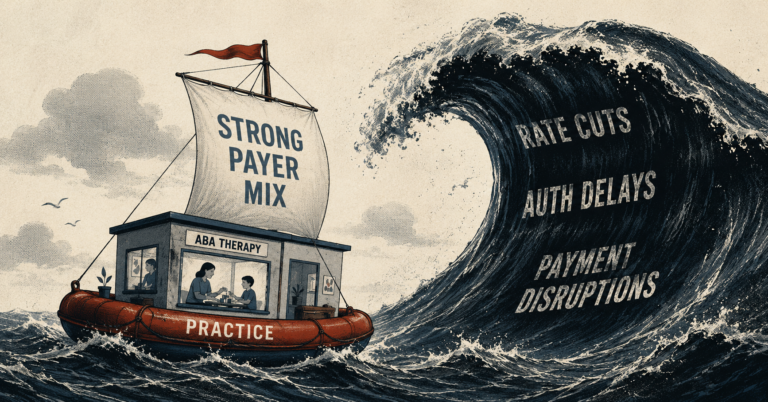
Easterseals Port Health did not cite Medicaid policy in its closure announcement. The reason it gave was staffing. The two pressures, however, are not independent. Tighter authorization regimes increase the administrative load per clinical hour. Rate compression narrows the wage band a provider can pay. Both effects bear hardest on organizations that cannot front-load capital for hiring premiums or absorb a soft quarter without cutting service lines.
The Workforce Math
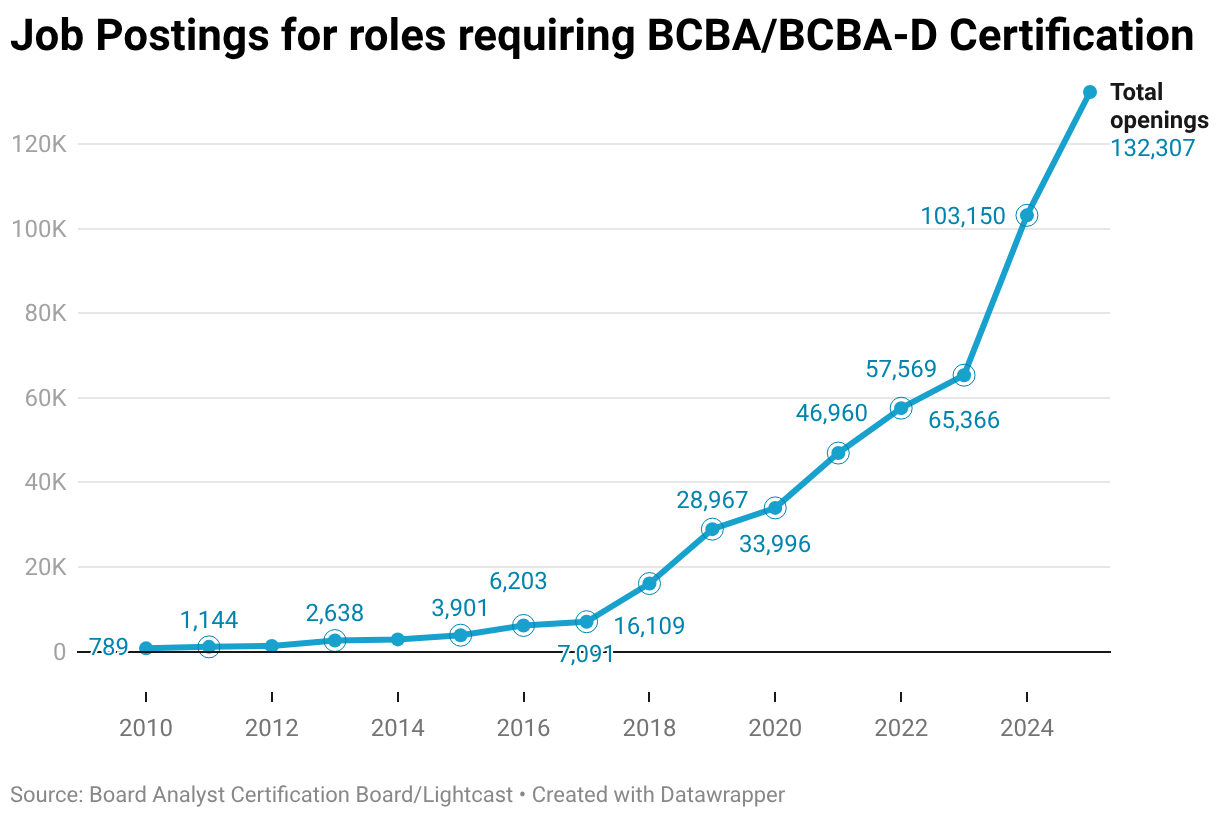
The national workforce picture has not improved. Active board-certified behavior analyst credentials totaled approximately 81,566 by the end of 2025, against an estimated 50,000-clinician shortfall, according to Behavior Analyst Certification Board (BACB) data. BCBA job postings hit 132,307 in 2025, a 28% year-over-year increase. As BreakingNewsABA previously reported, roughly half of US counties have no BCBA at all.
Turnover at the registered behavior technician (RBT) level, the front-line ABA workforce that delivers the bulk of direct service, is more severe. Industry surveys cited by the ABA Workers Union put RBT turnover between 77% and 103% per year, with the upper bound drawn from CentralReach’s 2024 industry data. The drivers are familiar across direct-care behavioral health: low wages, irregular hours, demanding caseloads, and inconsistent supervision. Replacement costs are not trivial. Industry estimates place the cost of recruiting and onboarding a new RBT or BCBA at roughly 30% to 200% of annual salary, with the higher end tracking BCBA replacement.
In a saturated local market, like Wilmington, this math compounds. Multiple providers competing for the same finite pool of certified clinicians push wages up while reimbursement stays fixed. Whichever provider can pay the premium captures the talent. The provider that cannot match the bid either sees its clinical hours fall below break-even or loses the staff entirely. Easterseals Port Health appears to have concluded the latter was the trajectory.
Nonprofits in ABA face the same labor-cost arithmetic as PE-backed providers, without the capital cushion that smooths a bad quarter or finances a hiring premium. The PE consolidation story has a nonprofit-side counterweight: exit, not roll-up.
Nonprofit vs. PE in a Tight Labor Market
The industry conversation about consolidation has run mostly on the PE side. Sponsors have built platforms, added acquisitions, and pushed scale economics through the operator class. The Easterseals Port Health move is the same labor-market signal read from the opposite balance sheet.
Nonprofit ABA providers operate with thinner margins, fewer financing levers, and a mission-driven workforce that does not always price labor at the marginal-cost ceiling. When Medicaid rates compress and competing providers bid up clinician wages, the nonprofit cannot match without cross-subsidizing from other programs. At Easterseals Port Health, the rest of the portfolio (behavioral health, substance use, early intervention, employment) continues. ABA was the line item that did not pencil.
Easterseals as a national organization has signaled the broader pressure. Easterseals President and CEO Kendra Davenport submitted written testimony to the US Senate Special Committee on Aging in December 2025, warning that proposed Medicaid reductions would threaten home and community-based services that millions rely on, including those delivered through Easterseals affiliates. The Wilmington closure is the local operational expression of the warning.
For families, the immediate problem is capacity. Wilmington has alternative ABA providers, but the existing waitlists were the reason Easterseals Port Health’s closure created a 30-day scramble in the first place. The next nonprofit ABA pull-back, in this market or another, is the data point trade analysts will be watching for.
What to watch: The 50,000-clinician national BCBA shortfall is set to widen, not close, before the next BACB rule cycle in 2027. HB 696’s monthly reauthorization regime adds documentation burden to the same understaffed organizations. Whether the next nonprofit ABA closure in North Carolina lands in a small market with no replacement capacity is the test ahead.
AT A GLANCE
| Program closure date: |
March 31, 2026 |
| Families affected: |
15 |
| Notice given: |
Approximately 30 days, announced late February 2026 (WECT) |
| Reason cited: |
Staffing/retention difficulty in saturated Wilmington ABA market (Easterseals Port Health spokesperson Cheryl Tuning) |
| Easterseals Port Health scope: |
2,600 staff; 40,200 individuals served annually; 11,000 service locations across NC and VA |
| Status: |
501(c)(3) nonprofit; affiliate of Easterseals national network |
| Other Easterseals Port Health programs: |
All other Easterseals Port Health services continuing per Cheryl Tuning’s statement to WECT (specific Wilmington-site offerings not itemized by the organization) |
| BCBA workforce 2025: |
~81,566 active credentials; 132,307 BCBA job postings (BACB / Acuity News) |
| National BCBA shortfall: |
~50,000 clinicians (BACB projections) |
| RBT turnover: |
77% to 103% annually (CentralReach 2024 industry data, cited by the ABA Workers Union) |
| NC Medicaid ABA spending, 2025: |
~$660 million (NC State Auditor; 11,000% growth over four years) |
| HB 696 signed: |
April 30, 2026 (Gov. Josh Stein); monthly treatment-plan reauthorization, telehealth limits, RBT national certification |
SOURCES & REFERENCES
| 1. |
Bruns, Mackenzie. Easterseals PORT Health ending ABA program, leaving 15 families scrambling for care. WECT. February 26, 2026. https://www.wect.com/2026/02/26/easterseals-port-health-ending-aba-program-leaving-15-families-scrambling-care/ |
| 2. |
Fox Wilmington WSFX-TV (republished from WECT). Easterseals PORT Health ending ABA program, leaving 15 families scrambling for care. February 27, 2026. https://foxwilmington.com/easterseals-port-health-ending-aba-program-leaving-15-families-scrambling-for-care/ |
| 3. |
Easterseals Disability and Community Services. Affiliate page: Easterseals PORT Health (North Carolina and Virginia). https://www.easterseals.com/connect-locally/affiliate-locations/easterseals-port-health-north-carolina-and-virginia.html |
| 4. |
Easterseals PORT Health corporate site. https://eastersealsport.com/ |
| 5. |
Pomeranz, Andrew. NC lawmakers probe surge in autism therapy costs. Carolina Journal. March 23, 2026. https://www.carolinajournal.com/nc-lawmakers-probe-surge-in-autism-therapy-costs/ |
| 6. |
North Carolina Health News. Parents win pause on NC Medicaid cuts. November 14, 2025. https://www.northcarolinahealthnews.org/2025/11/14/parents-win-medicaid-cuts-pause/ |
| 7. |
Sable-Smith, Bram and Andrew Jones. It’s the Gold Standard in Autism Care. Why Are States Reining It In? KFF Health News. December 23, 2025. https://kffhealthnews.org/news/article/aba-therapy-applied-behavior-analysis-autism-medicaid-rate-cuts-north-carolina/ |
| 8. |
Acuity News. BCBA Job Demand 2026: 50,000 Clinician Shortfall and New BACB Rules. 2026. https://acuity.news/regulation/bacb-data-2026-workforce-gap-new-certification-rules/ |
| 9. |
BreakingNewsABA. Half of U.S. Counties Have No BCBA. Demand Hit 132,307 Job Postings in 2025. https://breakingnewsaba.com/industry-analysis/half-of-u-s-counties-have-no-bcba-demand-hit-132307-job-postings-in-2025-can-telehealth-close-the-gap |
| 10. |
ABA Workers Union. The Data Are Clear: The ABA Workforce Is in Crisis. https://www.abaworkersunion.org/post/the-data-are-clear-the-ABA-workforce-is-in-crisis/ |
| 11. |
Easterseals national newsroom. Easterseals CEO Advises Senate That Medicaid Cuts Threaten Home and Community-Based Services Millions Rely On. https://www.easterseals.com/about-us/newsroom/press-releases/easterseals-ceo-advises-senate-medicaid-cuts-threaten-home-and |
| 12. |
Behavioral Health Business. North Carolina Limits Telehealth In Autism Therapy, Bans Out-of-State Providers. May 5, 2026. https://bhbusiness.com/2026/05/05/north-carolina-limits-telehealth-in-autism-therapy-bans-out-of-state-providers/ |