What ALP Announced
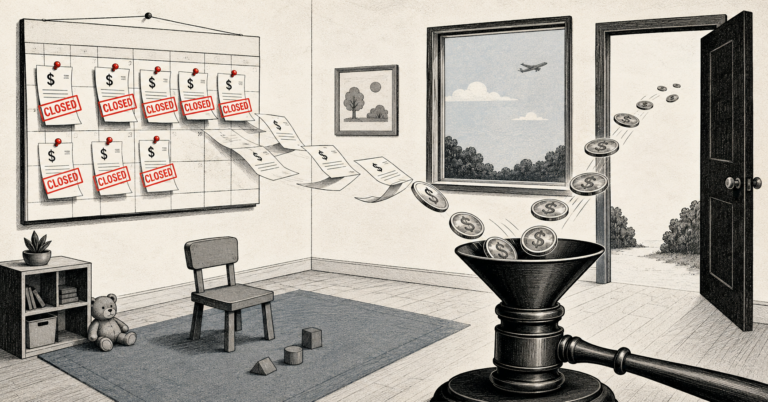
BUFFALO, NEW YORK — Autism Learning Partners, one of the largest and longest-standing providers of applied behavior analysis therapy in the United States, announced on April 17, 2026 that it has closed all New York Medicaid panels for new Medicaid and Child Health Plus patients, effective immediately. The closure applies to ABA intake only. ALP will continue serving existing patients but will not accept new Medicaid or CHP referrals in the state.
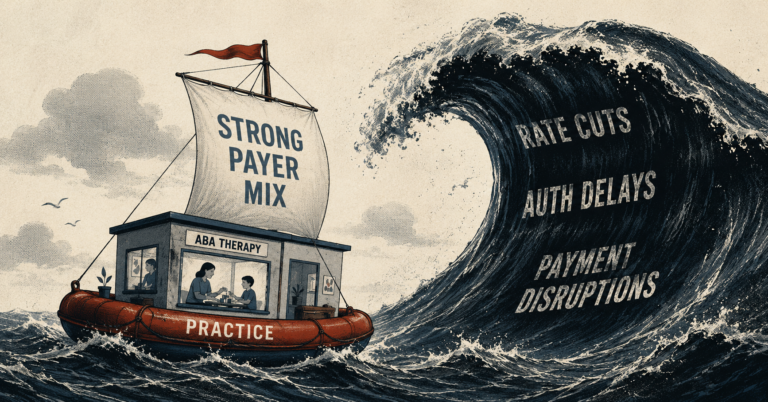
The decision follows two consecutive state-directed rate reductions to ABA services in New York: a 12.5 percent cut implemented on October 1, 2025, and a second 12.5 percent reduction effective April 1, 2026. The cumulative effect is a 25 percent reduction off the original fee schedule. ALP stated in its press release that the reductions “have materially reduced reimbursement and rendered continued Medicaid services financially unsustainable.”
“These reductions come at the exact moment when New York families are finally gaining access to autism services through Medicaid,” said Dr. Gina Chang, PhD, BCBA-D, ALP’s President and CEO. “Unfortunately, the current reimbursement structure no longer supports the ability to ensure access to care for incoming Medicaid members in a sustainable way.” Dr. Rachael Schneider, PhD, BCBA-LBA, ALP’s Executive Director for New York, who was part of the team that helped open ABA access to Medicaid families in the Buffalo community, added: “It is devastating what these reimbursement reductions are doing to access and quality care.”
ALP currently serves 523 children across New York, including 480 who are Medicaid or Child Health Plus members. An additional 118 children are on the waitlist. The panel closure eliminates capacity to treat approximately 425 additional children in 2026 who would have accessed care through ALP’s planned waitlist reductions. Those families will now face extended delays measured in months or years for access to medically necessary ABA services.
“It is devastating what these reimbursement reductions are doing to access and quality care.” — Dr. Rachael Schneider, PhD, BCBA-LBA, Executive Director for NY, Autism Learning Partners
New York Reimburses Below Texas
The rate comparison that ALP highlighted in its announcement is striking. Following the April 1, 2026 reduction, New York’s Medicaid ABA reimbursement rates are now lower than those in Texas, despite New York having one of the highest costs of living in the country. For CPT code 97153, the primary billing code for adaptive behavior treatment by protocol delivered by a behavior technician, the New York Medicaid rate was reduced to $14.45 per 15-minute unit effective April 1, 2026, according to the New York State Medicaid Update.
Dr. Mirella Petersen, DHA, MISM, ALP’s Vice President of Payor Relations and Government Affairs, put the disparity into operational terms: “These rates do not align with the economic realities of providing care in New York. When reimbursement falls below sustainable levels—even compared to lower-cost states—it directly impacts access for families.”
The comparison to Texas is particularly pointed because ALP exited the entire Texas market earlier in 2026, ending services at locations in El Paso, the Dallas-Fort Worth metro, and Greater Houston on March 21, 2026. ALP cited rates “too low to sustain operations” combined with authorization process issues in Texas. The fact that New York’s rates have now fallen below the Texas rates that ALP already found unsustainable underscores the severity of the New York cuts. ALP once operated in 19 states. The Texas and New York withdrawals represent a deliberate contraction by a PE-backed platform away from markets where Medicaid reimbursement does not cover the cost of service delivery.

The PE Angle: FFL Partners and Platform Contraction
Autism Learning Partners is owned by FFL Partners, a San Francisco-based private equity firm with over $4.5 billion under management. FFL acquired ALP in December 2017 from prior investors Great Point Partners, Jefferson River Capital, and Scopia Capital Management. Founded in 1988 and headquartered in Monrovia, California, ALP is one of the oldest ABA providers in the country and grew under FFL’s ownership to operate in as many as 19 states, offering center-based and home-based ABA, speech therapy, occupational therapy, and physical therapy.
The New York panel closure, combined with the Texas market exit, represents a pattern that is unusual for PE-backed ABA platforms. The standard PE playbook in ABA over the past decade has been geographic expansion: acquire a regional platform, add locations in new states, grow Medicaid and commercial volume, and build toward a recapitalization or sale at a higher multiple. ALP’s trajectory is running in the opposite direction. The company is contracting its footprint, pulling out of states where Medicaid rates cannot support the cost structure, and concentrating in markets where reimbursement is sustainable.
For PE-backed platforms, Medicaid contraction creates a structural tension. The growth narrative that justifies entry valuations depends on expanding access and volume. When state rate cuts make Medicaid volume unprofitable, the platform must choose between operating at a loss to maintain market share or exiting markets and shrinking the revenue base that underpins the investment thesis. ALP’s decisions in Texas and New York suggest that FFL Partners has concluded that subsidizing below-cost Medicaid operations is not a viable strategy, even at the expense of geographic scale.
“These rates do not align with the economic realities of providing care in New York. When reimbursement falls below sustainable levels—even compared to lower-cost states—it directly impacts access for families.” — Dr. Mirella Petersen, VP of Payor Relations, Autism Learning Partners
The Survey: 74% of New York Providers Would Exit
ALP’s panel closure is not an isolated decision. According to testimony submitted to the New York State Senate by the New York State Association for Behavior Analysis in February 2026, a joint survey conducted with the Council of Autism Service Providers found that 74 percent of providers indicated they would leave the Medicaid program if New York implemented the second rate cut. That second cut took effect on April 1, 2026. The survey results suggest that ALP may be the first large national provider to formally close panels, but it is unlikely to be the last.
NYSABA’s testimony placed the rate cuts in historical context. New York was the 49th state to implement Medicaid coverage for ABA services, launching the benefit in 2021. Due to multiple implementation barriers, including delays in provider credentialing and low initial enrollment, the benefit was not widely used until 2023. The cuts amount to a reduction in a benefit that most families have had meaningful access to for fewer than three years. NYSABA described the cuts as “a reaction to this population finally being allowed to access the medical care they have been prescribed to receive.”
The Governor’s FY 2026 executive budget proposed cutting Medicaid ABA spending by $9.6 million in the 2025-26 fiscal year and $19 million in 2026-27. The budget also proposed a “Centers of Excellence” designation to “ensure that ABA treatments are clear and appropriate,” which NYSABA noted was described in a single paragraph in the executive budget briefing book without implementation details. The rate reductions were implemented through the state Medicaid fee schedule rather than through legislation, meaning providers had no formal public comment period or legislative hearing before the cuts took effect.
Access in a State That Already Has Too Few Providers
New York’s ABA provider supply was already below national benchmarks before the rate cuts. According to a 2022 study cited in a New York State Health Department evidence review, the state had 3.2 licensed behavior analysts per 100 students with autism spectrum disorder, less than half the benchmark of 6.67 established by the Council of Autism Service Providers. No region in the state met the CASP supply benchmark. New York had the lowest per capita supply of licensed behavior analysts in the northeast as of 2020.
The panel closure removes ALP’s intake capacity in Buffalo, Rochester, Albany, Yonkers, and other locations across the state. ALP’s 480 existing Medicaid patients will continue to receive services, but the 118 children on the waitlist and the 425 who would have been served through planned capacity expansion will not. In regions where ALP was one of a handful of Medicaid-accepting ABA providers, the closure concentrates demand on remaining providers who are facing the same rate pressure and may be approaching the same decision.
The dynamic is self-reinforcing. Rate cuts reduce the number of providers willing to accept Medicaid. Fewer providers mean longer waitlists. Longer waitlists mean children miss the early intervention window where ABA therapy has the strongest evidence base. Families who cannot access Medicaid ABA may turn to emergency services, school-based behavioral interventions, or no treatment at all. The cost of untreated or undertreated autism over a lifetime far exceeds the cost of early ABA intervention, a point that advocates have made repeatedly in testimony but that has not altered the budget trajectory.
What It Means for the Market
ALP’s New York panel closure, coming weeks after its Texas exit, is the clearest signal yet that PE-backed ABA platforms are willing to abandon Medicaid markets where rates do not cover costs. The implication for other states considering ABA rate reductions is direct: when reimbursement drops below the operating threshold, providers will leave, and the largest providers with multi-state optionality will leave first because they have markets to retreat to. Small, single-state providers do not have that option and face the binary of absorbing losses or closing entirely.
The national pattern is accelerating. Georgia’s CareSource cut Medicaid ABA reimbursement by 20 percent effective May 11, 2026. Nebraska cut rates by 28 to 79 percent depending on service code. Indiana imposed tiered weekly caps and a 4,000 lifetime-hour limit. In each case, the state or payer action reduced the financial viability of Medicaid ABA operations, and in each case, provider advocacy organizations warned that access would deteriorate. ALP’s formal panel closure in New York puts a corporate name and a specific patient count on what those warnings look like when they materialize: 425 children who will not receive care this year from a provider that was actively planning to serve them.
For FFL Partners and other PE sponsors of ABA platforms, the strategic question is whether the current wave of Medicaid rate cuts represents a cyclical correction that will reverse as access deteriorates and political pressure builds, or a structural repricing that permanently reduces the addressable Medicaid market. If the former, the right strategy is to hold capacity and wait. If the latter, the right strategy is what ALP appears to be doing: consolidate in commercially viable markets, exit Medicaid-dependent geographies, and reorient the growth thesis around commercial insurance and private-pay volume where reimbursement covers costs.
The timing of the New York cuts adds a layer of political tension that distinguishes this situation from other states. New York’s Medicaid ABA benefit launched in 2021, whereas commercial insurers in New York have covered ABA since 2012 under a legislative mandate. The Medicaid population waited an additional nine years. Even after launch, delays meant the benefit was not meaningfully accessible until 2023. The rate cuts arrived less than three years after most families finally gained practical access.
The federal context makes the state-level cuts harder to absorb. The One Big Beautiful Bill Act, signed in 2025, is projected to reduce federal Medicaid funding to New York by billions over the next decade. Governor Hochul has publicly stated that the state cannot fully backfill federal cuts. Provider rate increases that were expected to flow from the state’s managed care organization tax may not materialize now that the MCO tax is being canceled under the federal legislation. ABA providers, who were already absorbing state-directed rate cuts, now face the prospect of additional reductions as the state confronts a widening Medicaid budget gap. The dual compression from federal funding reductions and state rate cuts leaves ABA providers in New York with diminishing margins and no clear path to rate restoration.
The impact extends beyond ALP. New York’s ABA provider community includes both national PE-backed platforms and small, independently owned BCBA practices. For the PE-backed platforms, exiting an unprofitable Medicaid market is a portfolio optimization decision. For independent practitioners whose entire practice is built on serving Medicaid families in a single New York community, there is no market to retreat to. A BCBA operating a solo practice in Syracuse or Utica who accepts Medicaid at the reduced rate is absorbing a 25 percent revenue cut on a cost base that includes rent, supervision hours, technician wages, and insurance overhead. The CASP/NYSABA survey finding that 74 percent of providers would exit suggests that many of these smaller practices are at or past the break-even point.
For the 480 Medicaid children currently served by ALP in New York, services will continue for now. But the panel closure means that as those children age out of treatment, complete their treatment plans, or move, ALP will not replace them with new Medicaid intake. The practical result is a slow attrition of ALP’s New York Medicaid caseload toward zero. Other providers who remain in the Medicaid network will absorb some of the displaced demand, but the CASP/NYSABA survey data suggest that many of those providers are themselves considering exit. The question for New York policymakers is whether the $28.6 million in projected Medicaid ABA savings from the rate cuts will be offset by the downstream costs of untreated autism, increased emergency utilization, and school-based behavioral crisis interventions that fall on other state budgets.
AT A GLANCE
| Provider: | Autism Learning Partners (ALP), one of the largest national ABA providers; founded 1988, headquartered in Monrovia, CA |
| PE ownership: | FFL Partners (San Francisco); acquired ALP December 2017 from Great Point Partners, Jefferson River Capital, and Scopia Capital |
| Panel closure: | All NY Medicaid and Child Health Plus panels closed to new intake effective April 17, 2026; existing patients continue services |
| Rate cuts: | Two consecutive 12.5% reductions (Oct 1, 2025 + April 1, 2026) totaling 25% off original fee schedule; CPT 97153 reduced to $14.45/unit |
| NY patient impact: | 523 children served (480 Medicaid/CHP); 118 on waitlist; ~425 additional children lose planned access in 2026 |
| Texas exit: | ALP closed all TX locations March 21, 2026 (El Paso, DFW, Houston) citing rates too low to sustain operations |
| Rate comparison: | NY now reimburses lower than TX for ABA despite substantially higher cost of living |
| Provider survey: | Joint CASP/NYSABA survey found 74% of NY providers would exit Medicaid if second rate cut was implemented (NYSABA Senate testimony, Feb 2026) |
| NY ABA history: | 49th state to implement Medicaid ABA coverage (2021); benefit not widely used until 2023 due to implementation delays |
| Provider supply: | NY had 3.2 LBAs per 100 ASD students vs. CASP benchmark of 6.67; lowest per capita in northeast as of 2020 |
| Budget context: | Governor’s FY 2026 budget cut ABA Medicaid by $9.6M (FY 2025-26) and $19M (FY 2026-27) |
SOURCES & REFERENCES
| 1. | Autism Learning Partners. “Autism Learning Partners Closes New York Medicaid Panels as Reimbursement Falls Below National Benchmarks.” PR Newswire. April 17, 2026. https://www.prnewswire.com/news-releases/autism-learning-partners-closes-new-york-medicaid-panels-as-reimbursement-falls-below-national-benchmarks-302746300.html |
| 2. | Becker’s Behavioral Health. “Autism Care Provider Closes New York Medicaid Panels After Rate Cuts.” April 2026. https://www.beckersbehavioralhealth.com/finance/autism-care-provider-closes-new-york-medicaid-panels-after-rate-cuts/ |
| 3. | OPEN MINDS. “Autism Learning Partners Closes New York Medicaid Panels As Reimbursement Falls Below National Benchmarks.” May 2026. https://openminds.com/market-intelligence/bulletins/autism-learning-partners-closes-new-york-medicaid-panels-as-reimbursement-falls-below-national-benchmarks/ |
| 4. | New York State Association for Behavior Analysis (NYSABA). Testimony to the New York State Senate. February 2026. https://www.nysenate.gov/sites/default/files/admin/structure/media/manage/filefile/a/2026-02/new-york-state-association-for-behavior-analysis-nysaba_0.pdf |
| 5. | New York State Department of Health. “New York State Medicaid Update, August 2025, Volume 41, Number 8.” CPT 97153 rate reduction to $14.45/unit effective April 1, 2026. https://health.ny.gov/health_care/medicaid/program/update/2025/no08_2025-08.htm |
| 6. | FFL Partners. “FFL Partners Completes Investment in Autism Learning Partners.” December 2017. https://fflpartners.com/ffl-partners-completes-investment-in-autism-learning-partners/ |
| 7. | Private Equity Wire. “FFL Partners Completes Investment in Autism Learning Partners.” December 21, 2017. https://www.privateequitywire.co.uk/ffl-partners-completes-investment-autism-learning-partners/ |
| 8. | Action Network / NYSABA. “Reject Governor Hochul’s Proposed Cuts to Medicaid ABA.” 2025. https://actionnetwork.org/letters/reject-governor-hochuls-proposed-cuts-to-medicaid-aba |
| 9. | New York State Division of the Budget. “Health Care: FY 2026 Executive Budget Briefing Book.” January 2026. https://www.budget.ny.gov/pubs/archive/fy26/ex/book/healthcare.pdf |
| 10. | New York State Department of Health. “Applied Behavior Analysis Provided Via Telehealth Evidence Review.” July 2025. https://www.health.ny.gov/health_care/medicaid/ebbrac/2025/docs/2025-07_evidence_review.pdf |