The scheme involved kickback payments of $300 to $1,500 per month made to parents of autistic children in exchange for their participation in fraudulent billing. Fifteen Minnesota autism centers have been identified as under investigation. The case documents the specific mechanics of how Medicaid autism program fraud is structured and executed — and why it is difficult to detect before it reaches $14 million.
The EIDBI Program and Why It Was a Target
MINNEAPOLIS, MINNESOTA — Minnesota’s Early Intensive Developmental and Behavioral Intervention program was designed to fund intensive applied behavior analysis and related services for autistic individuals who qualify under the state’s Medicaid program. EIDBI is one of the most comprehensive state-level ABA funding structures in the country, providing coverage for services that many other state Medicaid programs do not cover at equivalent intensity. The program’s relative generosity in terms of covered services and reimbursement rates made it a target: the fraud scheme described in federal charging documents exploited a program with high per-beneficiary spending, limited pre-payment audit infrastructure, and a funding model that created opportunities for fraudulent claims to generate large returns before detection.
The specific vulnerability the fraud scheme exploited was the combination of Medicaid’s reliance on provider attestation to support claims payment and the difficulty of verifying, in real time, whether the services billed were actually delivered to the children named on the claims. The scheme involved providers who were billing EIDBI for services that were not delivered, or not delivered as billed, using the participation of the beneficiaries’ parents as a mechanism for sustaining the fraud: parents who received kickbacks were less likely to report that the services their children were receiving did not match the services being billed on their children’s behalf.
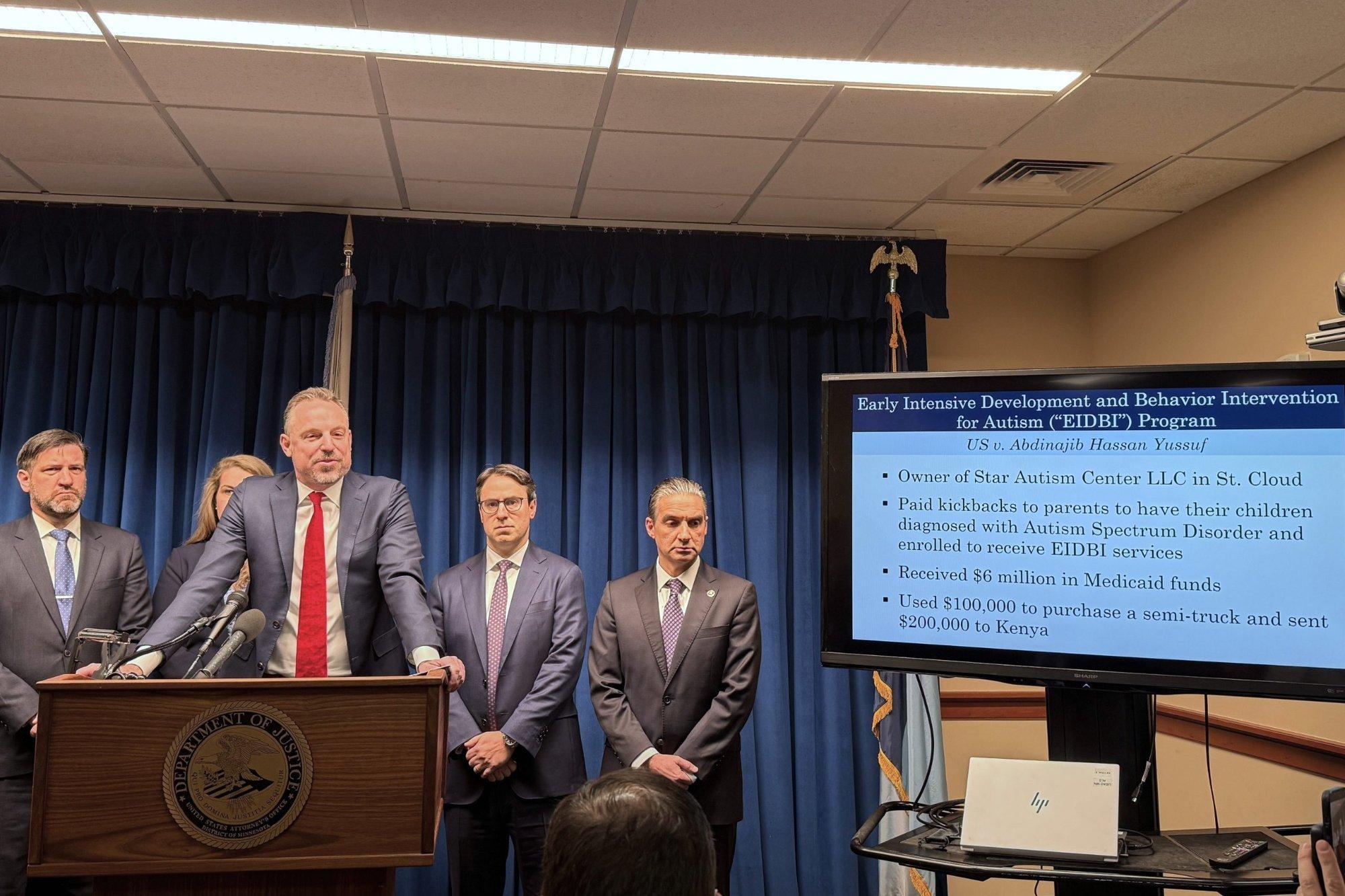
The DOJ press conference photograph above illustrates the specific charges against one defendant: Abdinajib Hassan Yussuf, identified as owner of Star Autism Center LLC in St. Cloud, who according to the charging documents paid kickbacks to parents to have their children diagnosed with Autism Spectrum Disorder and enrolled to receive EIDBI services, received $6 million in Medicaid funds, used $100,000 to purchase a semi-truck, and sent $200,000 to Kenya. These are allegations against a charged defendant; Yussuf is presumed innocent of the charges pending the resolution of those proceedings.
The mechanics of the EIDBI fraud are instructive. Kickbacks to parents created a cohort of beneficiaries unlikely to report that services billed in their names were not actually delivered. The scheme was not sophisticated — it was patient. It ran long enough to reach $14 million before charges were filed.
Asha Farah Hassan, the Guilty Plea, and What Was Admitted
Asha Farah Hassan pleaded guilty to charges arising from the EIDBI fraud investigation, as reported by the Minnesota Reformer in September 2025 and confirmed in subsequent DOJ documentation. A guilty plea in a federal fraud case constitutes an admission of the factual basis of the charge, which means that the conduct described in the charging document — as admitted by the defendant — is established as a matter of legal record rather than allegation.
The charging documents describe the specific conduct admitted: participation in a scheme to defraud the EIDBI program through the submission of false or fraudulent claims for services that were not delivered as billed, using kickback payments to parents as a mechanism for sustaining the scheme. The kickback payments ranged from $300 to $1,500 per month per participating family, according to the charging documentation. These payments were structured as inducements for parents to allow their children’s Medicaid beneficiary information to be used in connection with fraudulent billing.
The DOJ’s announcement of six additional defendants charged in the ongoing investigation indicates that the investigation identified a network of participants across multiple organizations rather than a single-provider scheme. Six additional defendants being charged in a single investigation reflects the organizational complexity of a fraud ring that operated across fifteen autism centers rather than within a single practice.
Important legal distinction: Asha Farah Hassan has pleaded guilty to specific charges documented in federal court filings. The six additional defendants charged in the subsequent round of the investigation are charged, not convicted; they are presumed innocent of those charges until and unless conviction is established through guilty plea or trial. This reporting describes the charges and the guilty plea as documented by the DOJ and the Minnesota Reformer; it does not characterize the additional defendants as having engaged in the conduct alleged against them.
The Kickback Structure: $300 to $1,500 Per Month to Parents
The kickback payment structure documented in the EIDBI fraud case — monthly payments of $300 to $1,500 to parents of autistic children — is a specific fraud mechanic that is worth understanding in its operational detail, because it represents a different threat model than the documentation and billing deficiency patterns documented in the Colorado OIG audit.
In the Colorado audit, the improper payments identified were primarily the result of documentation failures and supervision ratio billing errors — deficiencies that reflect poor compliance practices but do not necessarily involve intentional criminal conduct. The Minnesota scheme is different in character: it involves the intentional payment of money to third parties for the purpose of inducing their participation in a fraud scheme. That is not a documentation failure. It is a kickback, which is a federal crime under the Anti-Kickback Statute (42 U.S.C. § 1320a-7b(b)) that carries independent criminal liability separate from the fraud charges.
At the midpoint of the kickback range ($900 per month per family), a scheme involving 30 participating families generates $27,000 in kickback costs per month, or approximately $324,000 per year. For that expenditure to be financially rational, the fraudulent EIDBI billing generated through those families’ participation had to exceed the kickback costs substantially. At $14 million in total identified fraudulent billing, the scheme was generating a substantial return on its kickback expenditure — indicating that the EIDBI billing rates, multiplied across a sufficient number of fabricated or inflated service records, produced large enough per-family fraud yields to make the kickback payments economically worthwhile.
The use of parent kickbacks also reflects a specific operational intelligence about Medicaid fraud detection. Medicaid program integrity units detect fraud most commonly through anomaly detection in claims data and through beneficiary complaints that services billed in their names were not received. A parent who is receiving $900 per month in kickback payments has a direct financial incentive not to report to the Medicaid program that the services billed in their child’s name were not delivered. The kickback functions as a silence payment as much as a participation inducement.
Fifteen Centers Under Investigation and the National Compliance Implications
The identification of fifteen Minnesota autism centers as under investigation reflects the organizational breadth of the case. A fraud ring that operates across fifteen separate provider organizations is not a small-scale billing irregularity. It is a coordinated network with organizational infrastructure — shared knowledge of the fraud mechanics, a referral network for recruiting participating families, and either centralized coordination or a model that allowed individual centers to replicate the fraud structure independently.
The Minnesota EIDBI fraud case, read alongside the Colorado OIG audit, represents two different faces of the same regulatory risk that the ABA industry is navigating. The Colorado audit found systematic billing deficiencies across a state’s entire Medicaid ABA claims ecosystem — a compliance infrastructure failure. The Minnesota investigation found intentional criminal fraud by specific actors within a network of provider organizations — a different category of conduct with a different legal response.
Both cases are generating enforcement attention that will affect providers who were not involved in either the Colorado deficiencies or the Minnesota fraud. The federal government’s response to identified fraud and billing irregularities in Medicaid ABA is to increase scrutiny of the sector broadly. Providers who bill Medicaid for ABA services in any state should assume that their claims are being reviewed with greater attention than they were before the combination of the Colorado OIG audit and the Minnesota prosecution raised the profile of ABA billing integrity as a federal enforcement priority.
The specific mechanics of the Minnesota scheme — the kickback payments to parents, the fabricated or inflated service records, the network of centers operating in coordination — provide a specific checklist of fraud indicators that Medicaid program integrity units, managed care organization audit teams, and the OIG are now explicitly looking for in EIDBI and ABA claims data across all states. Providers who have processes that could be misread as matching those indicators should review those practices immediately with healthcare compliance counsel.
AT A GLANCE
| Program targeted: | Minnesota EIDBI (Early Intensive Developmental and Behavioral Intervention) — Medicaid ABA funding |
| Total alleged fraud: | $14 million (Minnesota Reformer, September 2025; DOJ press releases) |
| Asha Farah Hassan: | Pleaded guilty — first defendant to plead in the investigation (Minnesota Reformer, September 2025) |
| Additional defendants: | Six additional defendants charged — presumed innocent (DOJ, U.S. Attorney’s Office for D. Minn.) |
| Star Autism Center charge: | Abdinajib Hassan Yussuf charged with paying kickbacks to parents; $6M in Medicaid funds; $100K semi-truck; $200K sent to Kenya — charges, not conviction |
| Kickback amounts: | $300 to $1,500 per month per participating family (federal charging documents) |
| Centers under investigation: | 15 Minnesota autism centers identified as under investigation |
| Federal statute: | Anti-Kickback Statute, 42 U.S.C. § 1320a-7b(b) — kickbacks to beneficiary families are independent federal crime |
| Critical legal distinction: | Charged defendants are presumed innocent; only Hassan’s guilty plea constitutes admission of conduct |
| National implication: | All EIDBI and ABA Medicaid billing subject to heightened scrutiny; financial arrangements with beneficiaries require immediate compliance review |
| Reporting sources: | Minnesota Reformer (September 24, 2025); DOJ/USAO-MN press releases |
SOURCES & REFERENCES
| 1. | Minnesota Reformer. “Federal prosecutors charge first person in Minnesota autism fraud investigation.” September 24, 2025. minnesotareformer.com/2025/09/24/federal-prosecutors-charge-first-person-in-minnesota-autism-fraud-investigation/ (Asha Farah Hassan guilty plea; first defendant) |
| 2. | U.S. Department of Justice, U.S. Attorney’s Office for the District of Minnesota. “Six Additional Defendants Charged, One Defendant Pleads Guilty in Ongoing Fraud Schemes.” justice.gov/usao-mn/pr/six-additional-defendants-charged-one-defendant-pleads-guilty-ongoing-fraud-schemes ($14M fraud; six additional defendants; 15 centers; Star Autism Center / Yussuf charge details) |
| 3. | Anti-Kickback Statute, 42 U.S.C. § 1320a-7b(b). Federal prohibition on kickbacks in federal healthcare programs. |
| 4. | Minnesota Department of Human Services. EIDBI program overview. mn.gov/dhs |
| 5. | Centers for Medicare & Medicaid Services. Medicaid Fraud Control Units and program integrity. cms.gov |