
What Happened
ATLANTA, GEORGIA — In March 27, 2026, CareSource Georgia sent a Notice of Material Amendment by certified mail to ABA providers across the state. The notice reduced reimbursement for all covered services to 80 percent of the then-current Georgia Medicaid fee schedule, effective May 11, 2026. No public announcement accompanied the mailing. No actuarial or programmatic justification was included. No negotiation window or appeals process was offered. Providers who did not submit a written objection to CareSource within 45 calendar days of receiving the letter were deemed to have accepted the new rate. Providers who formally objected were told their CareSource provider agreement could be terminated 90 days after receipt of the objection.
The rate reduction applies to all covered services under the provider agreement, not exclusively to ABA therapy codes. It supersedes any prior compensation schedules. For ABA providers, the math translates directly: a session previously reimbursed at 100 percent of the Georgia Medicaid fee schedule now pays 80 percent. For BCBA-owned practices operating on margins that were already compressed by rising wages, credentialing costs, and administrative overhead, a 20 percent across-the-board cut is not a trim. It is a question of whether the practice model remains viable on Medicaid volume.
In a public statement, CareSource framed the reduction as “part of our broader effort to support sustainable program operations that ensure continued access to medically necessary services for our members.” A CareSource spokesperson said in a statement that the adjustments “align with actions being taken by Medicaid programs nationwide to responsibly manage public resources as demand for these services grows.” CareSource made no changes to prior authorization requirements or billing guidelines.
Providers who did not submit a written objection within 45 calendar days were deemed to have accepted the new rate. Providers who objected were told their agreement could be terminated 90 days later. There was no third option.
The Market Structure That Makes This Different
What makes the CareSource rate cut structurally distinct from ABA rate reductions in other states is the managed care landscape in which it landed. Georgia’s Medicaid program covers approximately 2.2 million people at a cost of roughly $16 billion annually. Three care management organizations have administered the Georgia Families program: Peach State Health Plan, a Centene subsidiary managing roughly 45 percent of Medicaid volume; Amerigroup, an Elevance Health subsidiary managing approximately 30 percent; and CareSource managing roughly 25 percent.
In December 2024, the Georgia Department of Community Health awarded new CMO contracts to four companies: CareSource, the sole returning incumbent, along with three newcomers, Humana Employers Health Plan of Georgia, Molina Health Care of Georgia, and UnitedHealthcare of Georgia. Amerigroup and Peach State both lost their bids. Both filed formal protests, which were denied in November 2025. Both subsequently filed lawsuits in Fulton County Superior Court alleging mismanagement of the bid process. Those cases remain active and have not been scheduled for a hearing.
The result is a market in disintegration. Peach State initially planned its own 20 percent rate cut mirroring CareSource’s, but paused the reduction after pushback from providers and families. However, Peach State has begun terminating provider agreements outright. Amerigroup’s claims processing has deteriorated since 2025, with providers reporting delays and denials at rates that make the network functionally unreliable. The three incoming CMOs, Humana, Molina, and UnitedHealthcare, were originally targeting a July 1, 2026 operational launch. According to Autism Providers of Georgia, citing State Affairs reporting, that transition has been delayed by one year, with current incumbent contracts now extended through June 30, 2027.
If the delay holds, it transforms the CareSource rate cut from a short-term squeeze into the operating reality for Georgia Medicaid ABA providers through at least mid-2027. Providers cannot redirect patient volume to the incoming plans because those plans are not yet credentialing or paying claims. CareSource is the only fully functioning network in the market, and it is gaining members from the exiting plans at the same moment it is cutting rates.

CareSource is the only fully functioning network in the market, and it is gaining members from the exiting plans at the same moment it is cutting rates. For BCBA-owned practices, the choice is binary: accept 80 percent or trigger the 90-day termination clock.
The Provider Calculus
Brett Blevins, founder of Commonwealth ABA who served as Chief Development Officer at Already Autism Health, described the situation to industry media: “There’s really no way to be prepared for a 20% rate cut, because the wage market in the environment of ABA in Georgia is pretty well established.” The observation captures the core problem. ABA providers cannot cut RBT wages by 20 percent in a labor market where turnover already exceeds 65 percent nationally. They cannot reduce BCBA hours by 20 percent without dropping below payer supervision minimums. The cost structure of delivering ABA therapy is largely fixed in the short term. A 20 percent revenue reduction on the same cost base produces losses, not margin compression.
Ben Braxley, president of the Georgia chapter of the American Physical Therapy Association, told Capitol Beat that the cuts would reduce rates to what therapists were being paid a decade ago. “I don’t know any business who could roll the clock back that far and feel that they will be in a sustainable situation,” he said. The cuts affect not only ABA but also speech therapy, occupational therapy, and physical therapy services for Medicaid-enrolled children. Only children with severe chronic conditions managed directly by the state, such as cerebral palsy, Down syndrome, and spina bifida, are exempted.
In rural Georgia, the impact may be immediate. Montserrat Graves, founder of the South Georgia Autism Center in Thomasville and a clinical child psychologist, told WTXL that she was informed of the rate changes only a couple of weeks before they took effect, with little time to prepare. About a third of children across South Georgia rely on CareSource or Peach State plans. In rural markets where that share is even higher, providers say the cut could force clinic closures, leaving families with no ABA access within driving distance.
State Response and the Network Adequacy Question
The Georgia Department of Community Health, the state agency responsible for Medicaid oversight, distanced itself from the rate decision. A DCH spokesperson told Capitol Beat by email that the state “was not involved with the decision by CareSource and Peach State to negotiate down rates with their providers.” The spokesperson added that DCH “is responsible for oversight of our managed care contracts and ensuring the adequacy of the provider networks each CMO develops” and would increase the frequency of monitoring provider networks. “Should any CMO fail to meet network adequacy standards established in its contract, appropriate actions will be taken,” the statement read.
The network adequacy language is the key regulatory lever. If CareSource’s rate cut drives enough providers out of the network that access standards are breached, DCH has contractual authority to intervene. But the enforcement depends on providers actually exiting rather than silently absorbing the cut, and on DCH measuring access in a way that captures the reduction in capacity rather than counting the number of providers still technically enrolled. Autism Providers of Georgia launched an anonymous provider survey to quantify the scope of the rate amendment and its expected operational impact. APG described the notice as having arrived “with no public announcement and a very narrow response window” and said it is actively investigating how widespread the amendment is.
State Representative Matthew Gambill told Capitol Beat that CareSource told him the cuts were a response to increasing demand for pediatric therapy. “I think it’s just kind of overwhelmed the system,” Gambill said. “So they’re looking at ways to try to manage that and unfortunately it’s manifested in the way that it has.” Multiple Georgia legislators are receiving calls from constituents about the cuts, and Gambill indicated this is not the last the legislature has heard of the issue.
The National Pattern
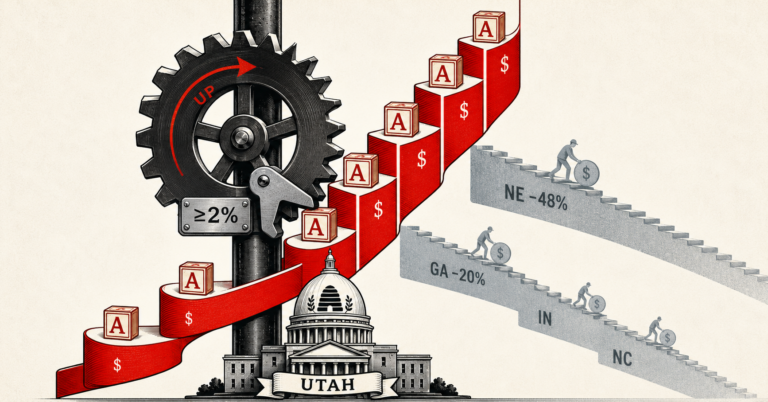
Georgia’s rate cut is part of a documented national trend of ABA reimbursement reductions, but it is structurally unusual in one respect: it originated from a managed care organization, not from a state Medicaid agency. In most other states where ABA rates have been cut, including Nebraska, Indiana, and North Carolina, the reductions were implemented by the state through fee schedule changes or legislative action. Georgia’s situation is a CMO-level decision that the state says it did not direct. The distinction matters because it shifts the accountability framework. Providers have no state rulemaking process to participate in, no legislative hearing to testify at, and no formal public comment period. The only recourse is the objection mechanism in the provider agreement, which by its own terms triggers termination.
New York cut Medicaid ABA rates by 12.5 percent on October 1, 2025, with a second 12.5 percent cut in April 2026, for a cumulative 25 percent reduction off the original fee schedule. Nebraska cut rates by 28 to 79 percent depending on service code, according to the Council of Autism Service Providers, effective August 1, 2025. Indiana imposed tiered weekly caps and a 4,000 lifetime-hour limit on comprehensive ABA, effective April 2026. In each of those states, the reductions moved through formal state processes with at least some period of public comment. In Georgia, the rate cut arrived by certified mail with a 45-day acceptance clock and no hearing.
The 45-day window closed for most providers in mid-May. Providers who did not respond are now operating under the new rate. Providers who objected are on the 90-day termination clock. The next inflection point is the CMO transition timeline: if the July 2027 date holds, CareSource’s rate structure will be the dominant fact in Georgia Medicaid ABA reimbursement for the next 13 months. If DCH accelerates the transition, the incoming plans may offer different rate structures, but no guidance on those rates has been issued. For now, Georgia ABA providers are billing at 80 percent of a fee schedule that was not generous to begin with, in a state where 75 percent of the Medicaid managed care market is in transition and the only stable payer just cut their pay.
The operational timeline compounds the financial pressure. Providers who accepted the rate cut by silence are now billing at 80 percent with no defined endpoint. Providers who objected face termination by approximately August 2026, at which point they lose access to the only functioning Medicaid network in Georgia. Rebuilding a commercial-only or private-pay caseload in a state where Medicaid covers a substantial share of the pediatric population served by ABA is not a realistic short-term alternative for most practices. The providers most vulnerable are the small, BCBA-owned practices that serve rural and underserved markets, where Medicaid penetration is highest and commercial insurance options are thinnest.
Kimberly Oviedo, who operates Beyond Limits Pediatric Therapy Center in Acworth with a staff of 25 serving about 500 children per week, told Capitol Beat that more than half of her patients are on Medicaid. If she opts out of CareSource, many of those families would need to find another provider, but in her market, alternative providers accepting Medicaid at the reduced rate may not exist. The dynamic is self-reinforcing: as providers exit the network, the remaining providers absorb more Medicaid volume at the lower rate, intensifying the financial strain that caused others to leave.
For PE-backed platforms with multi-state operations and diversified payer mixes, a 20 percent Medicaid rate cut in one state is manageable through cross-subsidization from commercial contracts and geographic rebalancing. For independent BCBAs and small practice groups whose revenue depends heavily on a single state Medicaid program, the cut is existential. The Georgia situation illustrates a pattern visible in Nebraska, Indiana, and North Carolina as well: rate reductions imposed at the payer or state level fall hardest on the smallest providers who have the least capacity to absorb them, accelerating the consolidation trend that policymakers in other contexts have expressed concern about.
Georgia legislators are watching. Multiple members of the General Assembly have received constituent calls about the rate cuts, and Representative Gambill indicated publicly that the issue is far from resolved. The Autism Providers of Georgia survey, designed to produce aggregate data on how many providers received the notice and what operational impact the cut is expected to have, will inform APG’s advocacy strategy. If the data show that network adequacy is deteriorating, DCH will face mounting pressure to exercise its contractual authority over CareSource’s provider network standards. The next formal milestone is the CMO transition timeline: whether the July 2027 date holds or whether DCH accelerates the launch of Humana, Molina, and UnitedHealthcare will determine whether Georgia Medicaid ABA providers spend 13 more months under the current rate structure or gain access to competing networks sooner.
What happened in Georgia also raises a question that payers and regulators in other states have not yet been forced to answer: what are the network adequacy obligations of a managed care organization that is simultaneously the sole operational payer in a market and a participant in a competitive reprocurement? CareSource is not just any CMO cutting rates. It is the only CMO with a functioning claims operation in Georgia, and it is the only incumbent with a guaranteed seat at the table when the new contracts launch. The leverage that position confers is substantial, and the rate cut is a use of that leverage at a moment when providers have no alternative network to join.
AT A GLANCE
| Rate reduction: | 20% cut to 80% of Georgia Medicaid fee schedule, all covered services, effective May 11, 2026 |
| Notice date: | March 27, 2026, delivered by certified mail; no public announcement |
| Provider options: | Accept within 45 days (silence = acceptance) or object and trigger 90-day termination of CareSource agreement |
| CareSource market share: | ~25% of Georgia Families Medicaid volume; sole returning incumbent CMO with a renewed contract |
| Exiting CMOs: | Peach State Health Plan (~45% of volume, Centene) and Amerigroup (~30%, Elevance Health) lost bids; contracts extended while lawsuits pending |
| Incoming CMOs: | Humana, Molina, UnitedHealthcare awarded new contracts (Dec 2024); originally targeting July 1, 2026 launch, now reportedly delayed to July 2027 |
| Peach State status: | Initially planned matching 20% cut; paused after provider/family pushback; has begun terminating provider agreements |
| Georgia Medicaid: | ~2.2 million enrollees, ~$16 billion annual cost (KFF data) |
| State response: | DCH says it was “not involved” in the rate decision; will increase monitoring of network adequacy |
| APG action: | Autism Providers of Georgia launched anonymous provider survey to quantify rate amendment scope and inform advocacy strategy |
| National context: | NY cut ABA 25% cumulative (Oct 2025 + Apr 2026); NE cut 28–79% (Aug 2025); IN imposed lifetime caps (Apr 2026) |
SOURCES & REFERENCES
| 1. | Acuity.news. “Georgia ABA Alert: CareSource Slashing Medicaid Rates by 20%.” April 2026. acuity.news/regulation/georgia-medicaid-aba-caresource-rate-cut-2026/. |
| 2. | Moultrie Observer / Capitol Beat. “Pending Cuts to Georgia Medicaid Payments Could Affect Children Who Need Therapy.” April 25, 2026. moultrieobserver.com/2026/04/25/pending-cuts-to-georgia-medicaid-payments-could-affect-children-who-need-therapy/. |
| 3. | Capitol Beat / Georgia Press Educational Foundation. “Pending Cuts to Georgia Medicaid Payments Could Affect Children Who Need Therapy.” April 2026. capitol-beat.org/2026/04/pending-cuts-to-georgia-medicaid-payments-could-affect-children-who-need-therapy/. |
| 4. | WTXL Tallahassee. “Medicaid Cuts Threaten to Close South Georgia Autism Therapy Clinics.” May 5, 2026. wtxl.com/news/local-news/in-your-neighborhood/thomas-county/medicaid-cuts-threaten-to-close-south-georgia-autism-therapy-clinics. |
| 5. | OPEN MINDS. “CareSource Georgia Cuts Medicaid ABA Rates 20%.” May 2026. openminds.com/market-intelligence/news/caresource-georgia-cuts-medicaid-aba-rates-20/. |
| 6. | The Current GA / Capitol Beat. “Contract Disputes Create Uncertainty Over Georgia’s Medicaid Oversight.” May 3, 2025. thecurrentga.org/2025/05/03/contract-disputes-create-uncertainty-over-georgias-medicaid-oversight/. |
| 7. | Atlanta Journal-Constitution. “Inside the ‘Big Deal’ Battle for Georgia’s Multibillion-Dollar Medicaid Contract.” December 24, 2024. ajc.com/politics/inside-the-big-deal-battle-for-georgias-multibillion-dollar-medicaid-contract/ZWBDMVJBTJH63PTDE6NPS2JBAY/. |
| 8. | Becker’s Payer Issues. “Georgia to Award 4 Medicaid Contracts.” December 5, 2024. beckerspayer.com/contracting/georgia-to-award-4-medicaid-contracts/. |
| 9. | WABE. “Fight Over Georgia’s Medicaid Contracts Nears the End, as Foster Parents Plead for Reversal.” December 15, 2025. wabe.org/fight-over-georgias-medicaid-contracts-nears-the-end-as-foster-parents-plead-for-reversal/. |
| 10. | PR.com. “Already Autism Health Acquires Commonwealth ABA.” Press release. January 28, 2025. pr.com/press-release/930120. |
| 11. | Georgia Department of Community Health. “Medicaid Managed Care.” Accessed May 2026. dch.georgia.gov/medicaid-managed-care. |