The Texas Decision
AUSTIN, TEXAS — on December 6, 2024, the Texas Commission of Licensing and Regulation voted to approve the Qualified Applied Behavior Analysis Credentialing Board (QABA) as a certifying entity for behavior analyst licensure under Texas Occupations Code 506.002(2). Texas now accepts both the BCBA, from the Behavior Analyst Certification Board (BACB), and the QBA, from QABA, for full Licensed Behavior Analyst status. At the assistant level, the BCaBA and the QASP-S are both accepted.
The decision matters because Texas is one of the largest ABA markets in the country. State labor projections put behavior analyst employment growth at 27.2 percent through 2032, with roughly 2,220 average annual openings, well above the national projection of 17 percent. A second pathway in a market that size produces, in short order, a population of QBA-licensed practitioners who will seek insurance credentialing, Medicaid enrollment, and employment at organizations that previously hired only BCBAs.
It also creates a precedent. Other states reviewing similar petitions can point to the Texas TDLR review and approval as evidence that dual-pathway licensing is workable. Virginia is the next major state with an active proceeding.
The BACB’s Long Hold
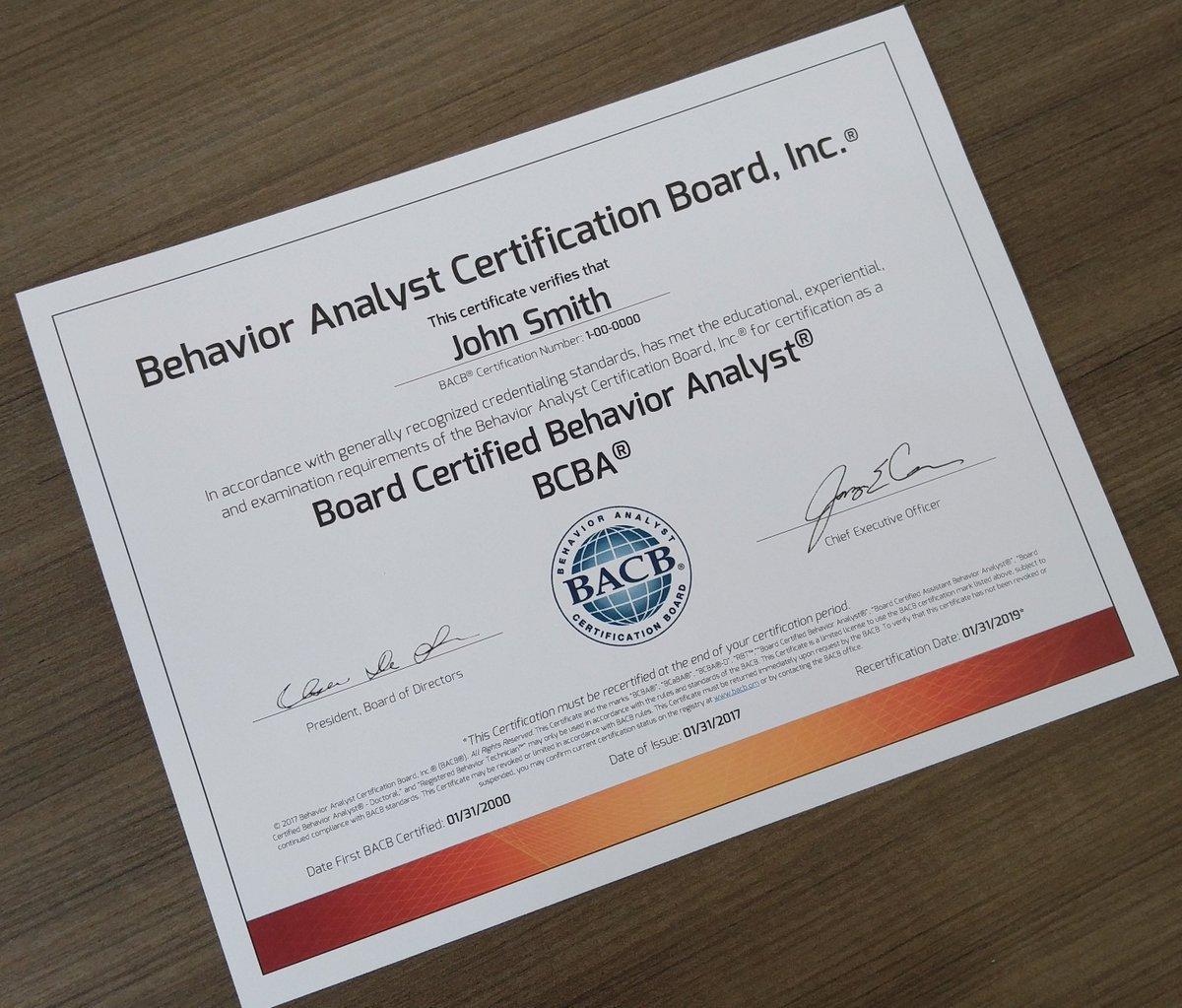
The Behavior Analyst Certification Board, headquartered in Littleton, Colorado, was incorporated by Dr. Jerry Shook on May 5, 1998. For most of the next two decades it operated without meaningful competition. The BCBA, BCaBA, and RBT credentials became the references in state licensure statutes, insurer credentialing requirements, and employer job descriptions. Master’s programs designed their curricula around BACB content standards. As of late 2024, the BACB reported approximately 74,000 BCBAs, 5,400 BCaBAs, and 196,000 RBTs.
Two structural changes have unsettled that position. First, the BACB announced in December 2019 that it would stop accepting initial certification applications from individuals residing outside an authorized list of countries, effective January 1, 2023. The current list is the United States, Canada, and Australia. Australia is set to phase out as of January 1, 2027. Thousands of behavior analysts working in the United Kingdom, Europe, the Middle East, Latin America, and Asia were cut off from new BCBA certification. Second, ABAI’s Verified Course Sequence (VCS) system, the long-standing front door for BCBA Pathway 2 candidates, was discontinued December 31, 2025. The BACB’s replacement Pathway 2 Coursework Attestation System took effect January 1, 2026; existing VCS attestations remain valid through December 31, 2026. Pathway 2 itself remains an option through 2031, after which only Pathway 1, an ABAI- or APBA-accredited program, will qualify.
What QABA Offers
The Qualified Applied Behavior Analysis Credentialing Board, established in 2012, runs a three-tier structure that mirrors the BACB hierarchy. The QBA is the master’s-level independent practitioner credential, positioned against the BCBA. The QASP-S sits at the assistant tier alongside the BCaBA. The ABAT covers the technician role parallel to the RBT.
To earn the QBA, a candidate must hold a master’s degree from an accredited university in ABA, psychology, special education, or a related field. The credential requires 270 hours of QABA-approved coursework, including 20 hours each in ethics and autism core knowledge, plus 20 hours of supervision coursework. Supervised fieldwork is 2,000 hours for candidates beginning fieldwork after January 1, 2026, up from 1,500 hours under the prior standard. Supervisors must hold an active QBA, BCBA, Licensed Behavior Analyst, or Licensed Psychologist credential. Candidates then sit for the QBA examination.
The competitive claim rests on accreditation. QABA holds international accreditation from the ANSI National Accreditation Board (ANAB) under ISO/IEC 17024 for all three programs. The BACB is accredited by the National Commission for Certifying Agencies (NCCA), part of the Institute for Credentialing Excellence. Both ANSI-ANAB and NCCA are referenced in state licensing statutes; both are recognized accreditation pathways for personnel certification programs. The QABA argument is direct: if a state’s statute requires a credential from a nationally accredited certifying body, and QABA holds that accreditation, then the QBA qualifies.
The QABA coursework network includes the University of California, Santa Barbara Professional and Continuing Education program, which offers QABA-approved QBA coursework in an asynchronous online format. The presence of a UC system institution in the approved-provider network is a legitimacy signal that distinguishes QABA from smaller credentialing organizations.

Virginia: The Next Battleground
Virginia’s Department of Health Professions is reviewing a petition (#359) to amend the state’s licensure framework so that QABA credentials qualify alongside BACB credentials. Public comments on the petition show the shape of the fight. Supporters argue that the current framework references BACB certification specifically, rather than credential-neutral language such as nationally accredited certifying body, and that the BACB therefore enjoys an effective state-conferred monopoly. They point to QABA’s ANAB accreditation, comparable task lists, equivalent fieldwork hours, and a psychometrically validated examination.
“The non-profit called the Autism Business Association represents ABA providers nationally and we strongly support providers using accredited certifications with the BACB and QABA Board. National accreditation is a fair and equally rigorous criterion.” — Autism Business Association, Virginia Town Hall public comment (2025)
Opponents, primarily BACB-aligned practitioners, argue that the BACB’s longer track record, larger certification base, and deeper integration into the profession’s infrastructure make it the more reliable standard. They raise questions about the equivalence of QABA examinations and the comparability of coursework standards, and warn that credential proliferation could confuse consumers and dilute professional standards.
A Virginia approval would create a multi-state footprint, Texas plus Virginia, that strengthens QABA’s case with payers and Medicaid programs in adjacent states. Several other commenters identify themselves as QBAs practicing in New Jersey, Florida, and other states with statutes that already use accreditation-neutral language, and argue that the same logic should apply in Virginia.
The International Vacuum
The BACB’s 2019 announcement, effective in 2023, created the single largest opening for alternative credentialing bodies. Before the change, behavior analysts in dozens of countries held or pursued BCBA certification. After it, those practitioners and the programs that trained them needed somewhere to go.
QABA moved into that space. The QABA approved-provider network now includes institutions in Saudi Arabia (Dar Al-Hekma University), India (Behavior Momentum India), the Philippines, and elsewhere, with coursework offered in Arabic, English, and other languages. The International Behavior Analysis Organization (IBAO) and the Behavioral Intervention Certification Council (BICC), which administers the BCAT and BCAP credentials, have also entered the international market. Federal recognition is following: the QBA is listed in the Department of Defense Civilian COOL (Credentialing Opportunities On-Line) program and the Army and Navy COOL programs, providing federal recognition for military and civilian employees pursuing the credential.
The fragmentation of behavior analysis credentialing outside the United States is accelerating. Practitioners trained under these alternative systems are also beginning to seek US recognition as they relocate or take employment with US-based organizations.
The Insurance Threshold
The decisive test for any alternative credential is whether insurers will accept it for reimbursement. Today, virtually every commercial insurer and Medicaid program that covers ABA services requires the treating behavior analyst to hold BCBA certification. Without insurer credentialing, state licensure has limited practical value: the practitioner may be licensed, but unable to bill.
The path from state licensure to insurer credentialing is not automatic. It took years for the BCBA to achieve broad payer recognition, and that process was easier because there was no competing credential. QBA holders will need to push through credentialing one payer at a time. The pace of recognition will depend on the number of QBA holders practicing in each state, advocacy by QABA and supportive trade groups, and the willingness of state insurance regulators to require network-adequacy parity.
Medicaid is the more likely first-mover. If Texas Medicaid begins enrolling QBA practitioners under its dual-pathway licensure framework, and Virginia follows, commercial insurers in those markets face pressure to credential QBAs to maintain network adequacy. Self-funded employer plans, governed by federal ERISA rather than state insurance law, are likely to be slower.
For practice owners, the practical implication is straightforward. A multi-credential workforce is no longer hypothetical in Texas, and is becoming more likely elsewhere. Hiring policies, supervision structures, and payer contracts written for a BCBA-only world will need updating. The Virginia decision is the next milestone to watch.
AT A GLANCE
| Texas decision (Dec 6, 2024): | TDLR approved QABA as a certifying entity for behavior analyst licensure under TOC 506.002(2) |
| Texas dual pathway: | BCBA (BACB) and QBA (QABA) both qualify for Licensed Behavior Analyst; BCaBA and QASP-S both qualify at assistant level |
| Texas employment outlook: | 27.2% growth through 2032; ~2,220 annual openings (national projection: 17%) |
| BACB scale (late 2024): | ~74,000 BCBAs, 5,400 BCaBAs, 196,000 RBTs; HQ Littleton, Colorado; founded May 5, 1998 |
| BACB international policy: | New initial certifications restricted to US, Canada, Australia (Australia phasing out Jan 1, 2027); change announced Dec 2019, effective Jan 1, 2023 |
| BACB Pathway 2 transition: | ABAI VCS sunset Dec 31, 2025; BACB Pathway 2 Coursework Attestation in effect Jan 1, 2026; existing attestations valid through Dec 31, 2026 |
| QBA requirements: | Master’s degree, 270 hours coursework (incl. 20 ethics, 20 autism, 20 supervision), 2,000 fieldwork hours (post-Jan 1, 2026), QBA exam |
| QABA accreditation: | ANSI National Accreditation Board (ANAB) under ISO/IEC 17024 for ABAT, QASP-S, QBA |
| BACB accreditation: | National Commission for Certifying Agencies (NCCA), Institute for Credentialing Excellence |
| Federal recognition: | QBA listed in DOD Civilian COOL, Army COOL, and Navy COOL programs |
| Virginia status: | Active petition (#359) before Department of Health Professions; outcome pending |
| Insurance status: | Commercial insurers and Medicaid still require BCBA in nearly all markets; QBA payer credentialing will be the decisive threshold |
| State licensure baseline: | Approximately 39 states plus DC have behavior analyst licensure or registration laws; most reference BACB specifically |
SOURCES & REFERENCES
| 1. | Texas Department of Licensing and Regulation. “Commission Approves Qualified Applied Behavior Analysis Credentialing Board (QABA) as a Certifying Entity for Behavior Analysis Licensure.” News release. December 9, 2024. https://www.tdlr.texas.gov/news/2024/12/09/commission-approves-qualified-applied-behavior-analysis-credentialing-board-qaba-as-a-certifying-entity-for-behavior-analysis-licensure/ |
| 2. | Texas Department of Licensing and Regulation. “Behavior Analysts Program: How to Apply for a License as a Behavior Analyst in Texas.” https://www.tdlr.texas.gov/bhv/bhvapply-analyst.htm |
| 3. | QABA Credentialing Board. QBA Credential page. https://qababoard.com/pages/qualified-behavior-analyst-credential/ |
| 4. | QABA Credentialing Board. About page. https://qababoard.com/about/ |
| 5. | Virginia Regulatory Town Hall. Public comments on Petition #359 (proposed amendment to ABA licensure regulations). https://www.townhall.virginia.gov/l/viewcomments.cfm?petitionid=359 |
| 6. | Behavior Analyst Certification Board. “About the BACB.” https://www.bacb.com/about/ |
| 7. | Behavior Analyst Certification Board. “International Development & Support.” https://www.bacb.com/international-development/ |
| 8. | Behavior Analyst Certification Board. “FAQs About the 2023 International Changes.” https://www.bacb.com/faqs-about-the-2023-international-changes/ |
| 9. | Behavior Analyst Certification Board. “University Training for Those Pursuing BCBA Certification (Pathway 2 Attestation System).” https://www.bacb.com/university-faculty-resources/university-training-for-those-pursuing-bcba-certification/ |
| 10. | Behavior Analyst Certification Board. “US Licensure of Behavior Analysts.” https://www.bacb.com/u-s-licensure-of-behavior-analysts/ |
| 11. | ABAI. “Verified Course Sequence (VCS) sunset notice.” https://www.abainternational.org/vcs.aspx |
| 12. | Carr, J.E., et al. “A History of the Professional Credentialing of Applied Behavior Analysts.” Behavior Analysis in Practice. 2019. https://pmc.ncbi.nlm.nih.gov/articles/PMC6701231/ |
| 13. | DOD Civilian COOL. Qualified Behavior Analyst (QBA) credential page. https://www.cool.osd.mil/dciv/credential/index.html?cert=qba10508 |
| 14. | Army COOL. Qualified Behavior Analyst (QBA) credential page. https://www.cool.osd.mil/army/credential/index.html?cert=qba10508 |
| 15. | Navy COOL. Qualified Behavior Analyst (QBA) credential page. https://www.cool.osd.mil/usn/credential/index.html?cert=qba10508 |
| 16. | University of California Santa Barbara Professional and Continuing Education. “Qualified Behavior Analyst (QBA)” certificate program. https://www.professional.ucsb.edu/certificate-qualified-behavior-analyst |
| 17. | Quinn, N.R. “Texas ABA Licensure Requirements.” Applied Behavior Analysis Edu. Updated March 2026. https://www.appliedbehavioranalysisedu.org/texas/ |
| 18. | Quinn, N.R. “ABAI VCS Sunset: BCBA Pathways After the VCS Ended.” Applied Behavior Analysis Edu. March 2026. https://www.appliedbehavioranalysisedu.org/2026/03/abai-vcs-sunset-bcba-pathways/ |
| 19. | Autism Business Association. https://autismbusinessassociation.com/ |
| 20. | ANSI National Accreditation Board (ANAB). QABA Credentialing Board accreditation listing. https://anabpd.ansi.org/accreditation/credentialing/personnel-certification/AllDirectoryDetails?prgID=201&OrgId=2168&statusID=4 |
| 21. | 3 Pie Squared. “Texas Recognizes QABA for Behavior Analyst Licensure.” Industry analysis. December 2024. https://3piesquared.com/blog/texas-recognizes-qaba-for-behavior-analyst-licensure_263 |