

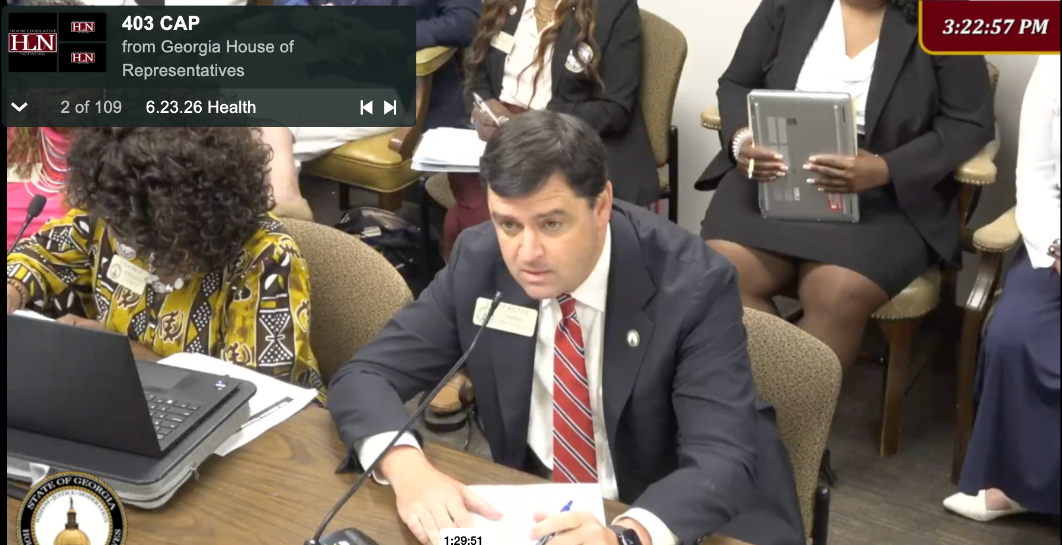
An Exchange Over Who Pays
ATLANTA – The sharpest exchange of the June 23 hearing came when state Rep. Jesse Petrea reminded a CareSource defender how the company is paid. “This is a capitated program, you alluded to that,” Petrea said. “That’s your job, to anticipate the demand and the need for services.”
Petrea was pointing at the financial machinery beneath Georgia’s Medicaid fight. CareSource, one of the private insurers the state pays to administer its Medicaid program, had cut reimbursement for children’s therapy by 20 percent. The question the hearing kept circling was not whether the cut was fair, but whether, under the way these contracts are built, rising demand was the insurer’s cost to begin with.
The answer runs through capitation, the payment model at the center of Medicaid managed care. Understanding it could explain both why CareSource acted and why lawmakers think it had the burden backwards.
How Capitation Works
Georgia does not pay its Medicaid plans by the claim. It pays each Care Management Organization (CMO), the plans that run Medicaid managed care, a fixed amount per member per month. That payment, the capitation rate, arrives whether a member uses no care that month or thousands of dollars of it.
The fixed payment does the work here. It transfers financial risk from the state to the plan. If members use more care than the rate assumed, the plan absorbs the loss. If they use less, the plan keeps the difference. A plan that takes capitation is, by design, accepting the risk that demand will rise. That is what the state is buying: a predictable budget, with the insurer holding the variable.

So when use of a service climbs, the cost lands on the plan first. That is the model working as intended, not failing. Petrea’s “that’s your job” was a restatement of the deal Georgia struck when it chose managed care.
“Every effort we make should be focused on taking care and improving services, not decreasing them.” – Rep. Jesse Petrea, Georgia General Assembly (June 2026)
What the Rules Require
Federal law sets boundaries on how a plan handles that risk. Under the Medicaid managed care regulations at 42 CFR Part 438, capitation rates must be “actuarially sound,” meaning an actuary sets them in advance to “provide for all reasonable, appropriate, and attainable costs that are required under the terms of the contract” for the covered population and the contract year.
Rising use is supposed to be priced in before the year starts. The rules require the rate to include a “trend factor” for changes in the utilization and price of services. In other words, the increase CareSource cites as its reason for cutting pay is exactly the kind of growth the rate is designed to anticipate. The federal fix for a rate that proves too low is a revised, state-certified rate reviewed by CMS, not a unilateral cut to providers.
A second rule limits what a plan can keep. The medical loss ratio (MLR) measures the share of the capitation a plan spends on care, and provider claims are the core of it. Federal rules say that if a state sets a minimum MLR, it must be at least 85 percent, and a plan that comes in below the state’s minimum can owe money back. Cutting therapy reimbursement lowers the amount spent on care. If Georgia has set a minimum, that pulls CareSource toward the floor and a possible repayment; if it has not, or if CareSource sits well above the line, the saved money widens the plan’s own margin. Which case applies depends on Georgia’s contract terms and CareSource’s reported MLR.
Why Georgia Stands Out
What makes Georgia unusual is that the cut came from a plan, not the state. Most Medicaid rate reductions for these services are set at the state level. Here, a single CMO lowered pay on its own. CareSource mailed providers a Notice of Material Amendment on March 27 dropping reimbursement to 80 percent of the Georgia Medicaid fee schedule, effective May 11, giving providers 45 days to accept the cuts or exit the network.
The timing adds to the strain. In December 2024, the Department of Community Health rebuilt the program, keeping CareSource as the only returning incumbent and adding Humana, Molina, and UnitedHealthcare. The two plans that lost their bids, Amerigroup and Peach State, will leave when the new plans take over, a transition now expected in 2027 after the original timeline slipped, according to the Georgia Association for Behavior Analysis. CareSource is the lone incumbent, and it moved to reset rates ahead of the new competitors. It is not the only plan trimming pay, though. Peach State issued its own 20 percent cut this spring, and CareSource’s Georgia market operations chief, Dwayne Flowers, told a DCH provider meeting, “we’re not the only one doing it.”
Cuts Not Positive for Access for Network Adequacy
At the hearing, the CareSource representative defended the cut as a response to surging use. “You’ve seen, I think, utilizations increasing to about 62% over the period from 2018 to 2025,” he said, and “especially in the Autism services community subset, that has been more like 300%.” He argued patients would not be stranded, because a member whose provider declines the new rate “can be seen potentially by another provider that does elect to stay in the network.”
Federal network rules complicate that answer. The state, not the plan, must “develop and enforce” standards ensuring members can actually reach care, and when a state allows exceptions to those standards, the rules require it to weigh the payment rates a plan offers providers. A rate low enough to drive providers out is, under the regulation, a factor the state must account for, not a detail outside the adequacy test. An Atlanta News First analysis found 40 of Georgia’s 159 counties have no in-network speech, physical, or occupational therapist.
Georgia also has a tool it has not used here. Through a state-directed payment, a state can require its plans to pay providers at a defined floor. The Department of Community Health said it was not involved in CareSource’s rate decision but oversees the contracts. It told Atlanta News First it is “closely monitoring the provider network,” adding that CMOs “have flexibility with respect to contract negotiations but must ensure that members have access to services whether in person or via telehealth.”
The unresolved question is the one Petrea pressed: whether a plan paid to carry the risk of rising demand can hand that risk to providers and the families who depend on them. When the new plans eventually take over, expected in 2027, their rate certifications will show whether the utilization CareSource cites was already funded. Whether those plans decide to honor the Medicaid fee schedule or match CareSource’s 20 percent cut will show whether Georgia’s version of capitation works as designed.
AT A GLANCE
| Capitation, defined: | A fixed per-member, per-month payment that shifts financial risk for utilization from the state to the plan |
| Rate standard: | Capitation must be “actuarially sound,” set in advance to cover projected costs (42 CFR 438.4) |
| Utilization trend: | Rate-setting must include a trend factor for rising use of services (42 CFR 438.7) |
| Medical loss ratio: | State-set minimum must be at least 85% of the capitation spent on care; shortfalls can owe a remittance (42 CFR 438.8) |
| Network adequacy: | State must enforce access standards; provider pay rates are an explicit factor (42 CFR 438.68) |
| The cut: | 20% reduction to 80% of the Georgia Medicaid fee schedule, effective May 11, 2026 (Acuity News; Atlanta News First) |
| CareSource rationale: | Utilization up ~62% from 2018 to 2025, ~300% within autism services (hearing testimony, June 2026) |
| CMO transition: | CareSource the lone returning incumbent; Amerigroup and Peach State to exit when new plans launch, now expected 2027 (GABA, June 2026) |
| Network gaps: | 40 of 159 Georgia counties have no in-network speech, PT, or OT provider (Atlanta News First, May 2026) |
| Unused state tool: | State-directed payment can set a provider rate floor (42 CFR 438.6(c)) |
SOURCES & REFERENCES
| 1. | Georgia General Assembly. House committee hearing on Medicaid therapy reimbursement. June 23, 2026. Video: https://www.legis.ga.gov/schedule/house |
| 2. | 42 CFR 438.4, Actuarial soundness. eCFR, up to date as of 5/18/2026 (retrieved June 24, 2026). https://www.ecfr.gov/current/title-42/section-438.4 |
| 3. | 42 CFR 438.7, Rate certification submission. eCFR, up to date as of 6/02/2026 (retrieved June 24, 2026). https://www.ecfr.gov/current/title-42/section-438.7 |
| 4. | 42 CFR 438.8, Medical loss ratio (MLR) standards. eCFR, up to date as of 3/26/2026 (retrieved June 24, 2026). https://www.ecfr.gov/current/title-42/section-438.8 |
| 5. | 42 CFR 438.68, Network adequacy standards. eCFR, up to date as of 6/17/2026 (retrieved June 24, 2026). https://www.ecfr.gov/current/title-42/section-438.68 |
| 6. | Webb, Ethan. “Georgia Medicaid ABA Providers Face a 20% Rate Cut from CareSource.” Acuity News. April 7, 2026. https://acuity.news/regulation/georgia-medicaid-aba-caresource-rate-cut-2026/ |
| 7. | Tagami, Ty. “Pending cuts to Georgia Medicaid payments could affect children who need therapy.” Capitol Beat News Service. April 24, 2026. https://capitol-beat.org/2026/04/pending-cuts-to-georgia-medicaid-payments-could-affect-children-who-need-therapy/ |
| 8. | “For Georgia Medicaid Managed Care Contracts, One Incumbent & Three New Plans.” OPEN MINDS. January 13, 2025. https://openminds.com/market-intelligence/news/for-georgia-medicaid-managed-care-contracts-one-incumbent-three-new-plans/ |
| 9. | Georgia House of Representatives. Representative Jesse Petrea, District 166, Chairman, Human Relations & Aging Committee. https://www.house.ga.gov/Representatives/en-US/member.aspx?Member=862 |
| 10. | Cummings, Ciara. “Georgia therapy clinic closing as Medicaid company cuts reimbursement rates by 20%.” Atlanta News First. May 28, 2026. https://www.atlantanewsfirst.com/2026/05/28/georgia-therapy-clinic-closing-medicaid-company-cuts-reimbursement-rates-by-20/ |
| 11. | Georgia Association for Behavior Analysis. “Georgia Medicaid Managed Care Changes: What ABA Providers Need to Know.” June 5, 2026. https://www.georgia-aba.org/post/georgia-medicaid-managed-care-changes-what-aba-providers-need-to-know |
| 12. | Georgia Health Initiative. “Insights on Medicaid in Georgia.” January 2026. https://georgiahealthinitiative.org/wp-content/uploads/2026/01/2026_Insights_on_Medicaid_in_Georgia.pdf |