A Guarantee That Ends at 21
The most reliable payer in autism care has a hard age limit.
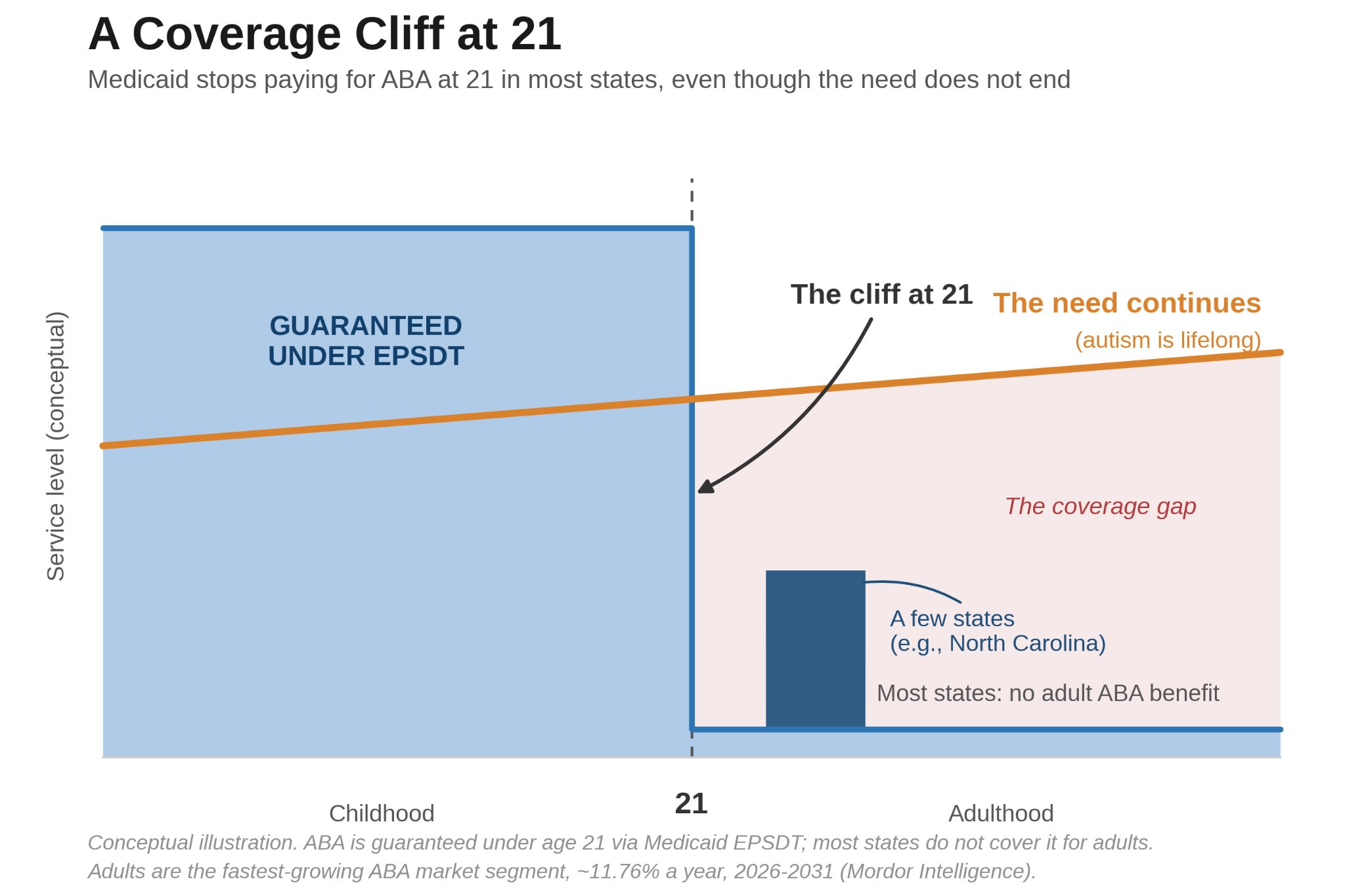
Medicaid covers intensive behavioral therapy for children with autism through a federal guarantee that pays for any service a clinician deems medically necessary. In most states, that guarantee ends on the client’s 21st birthday.
Behind that cutoff is a demographic wave that shapes the realities of coverage. About 50,000 autistic Americans turn 18 each year, according to the A.J. Drexel Autism Institute, and a large group that entered ABA as young children is now reaching the upper edge of pediatric coverage. They arrive there just as the adult market becomes the fastest-growing part of the ABA industry, and just as most state Medicaid programs offer them almost nothing.
The cutoff is built into how Medicaid works. Under the benefit known as Early and Periodic Screening, Diagnostic, and Treatment, or EPSDT, states must cover any medically necessary service for enrollees under 21, including ABA. A 2014 guidance bulletin from the Centers for Medicare and Medicaid Services made clear that autism treatment falls under that obligation, and it pushed most states to add ABA as a children’s Medicaid benefit. EPSDT stops at 21. After that, covering ABA for adults is optional, and every state decides for itself.
The drop-off has a name in advocacy circles. Once someone with autism turns 21, “they fall off a cliff,” Lorri Unumb, then vice president of state government affairs at Autism Speaks, told PBS NewsHour in 2014. More than a decade later, the cliff is largely still there.
The population on the far side of that line is large. The CDC estimated in 2020 that about 5.4 million American adults, or 2.2%, have autism spectrum disorder, a figure derived from childhood prevalence data. Most of them have never had access to adult ABA, because in most of the country, it is not a covered benefit.
The Demand Curve Bends Toward Adults
The timing is awkward for an industry built almost entirely around children. Children accounted for 86% of the ABA market in 2025, according to Mordor Intelligence, which valued the global market at $8.33 billion in 2026 and projected it would reach $10.39 billion by 2031. The market overall is growing at about 4.5% a year.
The adult segment is growing at 11.76%, making it the fastest of any age group the firm tracks, and more than double the market’s overall pace. This rapid growth in adult ABA services signals a significant shift, with rising demand likely to influence how providers set priorities and allocate resources across the industry.
Several forces are lifting adult demand at once, intensifying the impact on the overall market. Diagnosis is improving among adults who went unidentified as children. Employers running neurodiversity hiring programs are creating demand for workplace-readiness and social-skills support. The children behind two decades of growth in pediatric ABA are aging up. As demand from adults accelerates, providers may face new operational challenges and decision points, as adult services require distinct protocols and funding sources. The billing problem comes first: the fastest-expanding segment is the one that, in most states, no one will pay for.
The fastest-growing segment of the ABA market is aging into a benefit that, in most states, ends the year a client becomes an adult. This disconnect between rapid growth in the adult market and limited coverage affects how providers plan and deliver services and could shape the future structure of autism care.
What North Carolina Did Differently
North Carolina is one of the few states to write adult autism treatment into its Medicaid plan. In 2021, it won federal approval to cover Research-Based Behavioral Health Treatment, the state’s term for ABA and related interventions, for beneficiaries over the age of 21, effective July 1 that year. The change was folded into Clinical Coverage Policy 8F.
The benefit is not automatic. Treatment must be supported by credible scientific or clinical evidence appropriate to the person’s age, delivered under a prior-authorized plan with measurable goals, and reviewed every six months by a licensed, qualified autism service provider. Adults access the benefit through managed care and tailored plans that run the state’s Medicaid behavioral health system. The design keeps adult autism treatment inside the medical benefit, instead of pushing it into the social-services system, where most states leave it.
Where the Coverage Stops
Most states stop at the EPSDT line. In Tennessee, TennCare covers ABA for children with no annual dollar cap, a relatively generous benefit, but it ends at 21. Georgia added ABA only in 2018 and only for children, covering up to 25 hours a week for those aged 6 and older and up to 40 hours for younger children, all of it limited to beneficiaries under 21. Neither state offers an adult equivalent to North Carolina’s benefit.
The pattern repeats across most of the country. Where adults with autism receive publicly funded help at all, it usually arrives not as clinical therapy but through Medicaid waivers designed for intellectual and developmental disabilities.
The Adult Safety Net Is a Waiting List
That waiver system is rationed. Home- and community-based services, the Medicaid programs that fund supported employment, day programs, and residential care for adults with disabilities, are optional for states, and states are allowed to cap how many people enroll. The result is waiting lists. In 2025, more than 600,000 people were on those waiting lists, according to KFF, a firm that conducts health policy research. People with intellectual and developmental disabilities, the category that includes autism, made up about three-quarters of that total.
The wait is longest for the group at the center of this story. Among waivers that specifically serve people with autism, the average time from waiting list to services was 63 months in 2025, KFF found, longer than for any other population. A young adult who ages out of ABA at 21 can, in much of the country, expect to spend years on a list before an adult program opens.
The two systems are not the same kind of benefit. Pediatric ABA is medical care, guaranteed and delivered by clinicians. The adult system is social services, optional, and budget-rationed. Moving from one to the other is what families experience as the cliff.
What Providers and States Are Watching
Looking ahead, the adult opportunity now faces a tightening Medicaid budget. The reconciliation law signed in July 2025 is projected by the Congressional Budget Office to cut federal Medicaid spending by about $911 billion over a decade. Because home- and community-based services are optional, they are among the first programs states can trim when federal funding shrinks, adding pressure on the same waivers adults with autism already wait years to reach.
Providers weighing an adult service line are doing the math on a benefit that, in most states, does not exist, set against a real, growing demographic wave. North Carolina shows that a state can fund adult treatment as medical care. Whether others follow or budget pressure prevails remains to be seen, but the answer will determine if the fastest-growing part of the ABA market can finally secure sustainable funding for adult clients.
Beginning in 2027, a 2024 CMS access rule will require every state to report how many people are waiting for waiver services and how long they wait. For the first time, there will be a national measure of a gap the market already faces—a necessary step toward ensuring adults with autism are not left behind.
AT A GLANCE
| Adult ABA segment growth: | 11.76% projected CAGR, 2026–2031, fastest of any age group (Mordor Intelligence, 2026) |
| Overall ABA market: | $8.33 billion in 2026 to $10.39 billion by 2031, 4.51% CAGR (Mordor Intelligence) |
| Children’s share of market, 2025: | 86.02% (Mordor Intelligence) |
| Autistic Americans turning 18 each year: | ~50,000 (A.J. Drexel Autism Institute, 2015) |
| U.S. adults with autism: | ~5.4 million, 2.2% (CDC; Dietz et al., 2020, estimate for 2017) |
| Pediatric Medicaid ABA mechanism: | EPSDT benefit, guaranteed under age 21 (CMS autism guidance, 2014) |
| North Carolina over-21 benefit: | Research-Based Behavioral Health Treatment, effective July 1, 2021 (Clinical Coverage Policy 8F) |
| Tennessee (TennCare) ABA: | Covered for children, no annual dollar cap; coverage ends at 21 |
| Georgia Medicaid ABA: | Children under 21 only since Jan. 1, 2018; up to 25 hrs/week age 6 and older |
| HCBS waiver waiting lists, 2025: | 41 states; more than 600,000 people; ~74% have I/DD (KFF, Nov. 2025) |
| Autism-specific waiver wait, 2025: | 63 months average, longest of any population (KFF, Nov. 2025) |
| 2025 reconciliation law: | ~$911 billion federal Medicaid cut over 10 years (CBO), pressuring optional HCBS |
SOURCES & REFERENCES
| 1. | Mordor Intelligence. Applied Behavior Analysis Market Size & Share Analysis (2026–2031). Updated January 29, 2026. https://www.mordorintelligence.com/industry-reports/applied-behavior-analysis-market |
| 2. | NC Medicaid, Division of Health Benefits. “Research Based – Behavioral Health Treatment for Autism Spectrum Disorder: Approved for beneficiaries over the age of 21, effective July 1, 2021.” April 19, 2022. https://medicaid.ncdhhs.gov/blog/2022/04/19/research-based-behavioral-health-treatment-autism-spectrum-disorder |
| 3. | NC Medicaid. Clinical Coverage Policy No. 8F: Research-Based Behavioral Health Treatment (RB-BHT) for Autism Spectrum Disorder. https://medicaid.ncdhhs.gov/8f-research-based-behavioral-health-treatment-rb-bht-autism-spectrum-disorder-asd/download |
| 4. | Centers for Medicare & Medicaid Services. FAQ: Services to Address Autism (EPSDT obligations for beneficiaries under 21). September 24, 2014. https://www.medicaid.gov/federal-policy-guidance/downloads/faq-09-24-2014.pdf |
| 5. | Andrews, Michelle (Kaiser Health News). “Adults with autism locked out of health coverage due to age limits.” PBS NewsHour. September 19, 2014. https://www.pbs.org/newshour/health/adults-autism-locked-health-coverage-due-age-limits |
| 6. | Dietz PM, Rose CE, McArthur D, Maenner M. “National and State Estimates of Adults with Autism Spectrum Disorder.” Journal of Autism and Developmental Disorders. 2020;50(12):4258–4266 (CDC). https://pubmed.ncbi.nlm.nih.gov/32390121/ |
| 7. | A.J. Drexel Autism Institute. National Autism Indicators Report: Transition into Young Adulthood. 2015. https://drexel.edu/autisminstitute |
| 8. | TennCare ABA coverage summary (Tennessee Medicaid). Accessed June 2026. https://www.tn.gov/tenncare |
| 9. | Georgia Department of Community Health, Georgia Medicaid. “Autism Spectrum Disorder.” https://medicaid.georgia.gov/programs/all-programs/autism-spectrum-disorder |
| 10. | Burns A, Wolk A, O’Malley Watts M. “A Look at Waiting Lists for Medicaid Home- and Community-Based Services from 2016 to 2025.” KFF. November 20, 2025. https://www.kff.org/medicaid/a-look-at-waiting-lists-for-medicaid-home-and-community-based-services-from-2016-to-2025/ |
| 11. | KFF. “Allocating CBO’s Estimates of Federal Medicaid Spending Reductions Across the States: Enacted Reconciliation Package.” 2025. https://www.kff.org/medicaid/issue-brief/allocating-cbos-estimates-of-federal-medicaid-spending-reductions-across-the-states-enacted-reconciliation-package/ |
| 12. | Centers for Medicare & Medicaid Services. “Medicaid Program: Ensuring Access to Medicaid Services” (final rule; waiver waiting-list reporting beginning 2027). Federal Register, May 10, 2024. https://www.federalregister.gov/documents/2024/05/10/2024-08363/medicaid-program-ensuring-access-to-medicaid-services |