What the Dashboard Shows
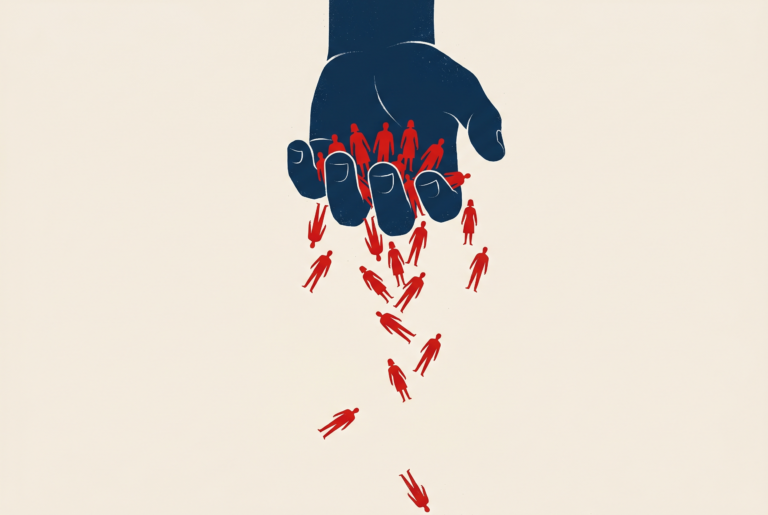
The federal government’s largest autism research funder spends most of its money studying the biology of autism, and comparatively little on the adults who live with it.
That is the picture from a dashboard Autism Speaks published April 29, which maps National Institutes of Health autism grants against the 12 research priorities Congress wrote into the Autism CARES Act of 2024. Of 160 NIH autism grants logged so far in fiscal 2026, 142, roughly $68.1 million, went to foundational biology and genetics, according to the group. Twenty-five, about $12.7 million, addressed adult autism, one of the smallest shares in the portfolio. Safety, services, and caregiver support sat near the bottom as well.
The fiscal-2026 numbers are partial. Autism Speaks and the dashboard’s authors flag them as very preliminary, drawn from a March 2026 extract of NIH RePORTER that captures only the grants posted in the first half of the year. The firmer read comes from fiscal 2024, the last complete year before the CARES Act took effect. Under the Act’s framework, foundational research absorbed 80% of NIH autism funding that year, the authors found, while services, workforce, safety, caregiver support, and lifespan research each drew far less.
The pattern is not new. The analysis, credited to researchers Wittenburg and Vasudevan, traces the same concentration in basic science from 2019 through 2024, across multiple Congresses and administrations. NIH itself notes that its emphasis on foundational work reflects its core mandate as a biomedical research agency.
A Research Gap, Not a Services Count
The dashboard measures research dollars, not the services autistic adults actually receive, and Autism Speaks is careful about the difference. NIH is the single largest funder of autism research, but the dashboard counts NIH grants alone. Several of the priorities where adults lose out, including adult services, safety, and workforce training, are funded mainly by other federal agencies: the Administration for Community Living, the Health Resources and Services Administration, and the Centers for Disease Control and Prevention.
Low NIH spending in a category does not prove low federal spending overall, the authors caution, and the dashboard stops short of calling for research money to be redirected. The point is alignment, not a verdict on where every dollar should go.
The through-line is still hard to miss. Whether the lens is research or service delivery, the adult end of the spectrum draws the least attention and the least money. The autism investment community has reached that conclusion from the opposite direction.
Why Investors Are Watching
For years, almost every dollar of autism investment has gone to early intervention and pediatric care. The Autism Investor Summit, the sector’s main dealmaking event, now frames adults as the clearest opening in the market, describing the needs of the aging autism population as “grossly under-serviced” and a service line not presently covered by any segment of behavioral health.
The observation is not fresh. At the inaugural summit in 2019, Intrepid Investment Bankers reported that nearly all investing activity was aimed at children, and that attendees expected “a new wave of M&A activity involving service providers who cater to adults with alternative care models.” Six years on, that wave has yet to arrive at any scale.
What has arrived is consolidation in the pediatric base. At the 2025 summit, a Piper Sandler managing director and the chief executive of 360 Behavioral Health described private-equity buyers chasing scale, geographic diversification, and seasoned management teams across children’s ABA platforms, even as state Medicaid programs move to cap service hours and audit billing. The capital is pooling where the reimbursement is, and the reimbursement is pediatric.
The Adults Aging Into the Gap
Demand on the adult side is not in dispute. The CDC has estimated that about 2.2% of U.S. adults, roughly 5.4 million people, are on the autism spectrum, though that figure was extrapolated from data on children rather than measured directly. The cohort diagnosed during the pediatric ABA boom of the past two decades is now aging into adulthood in large numbers.
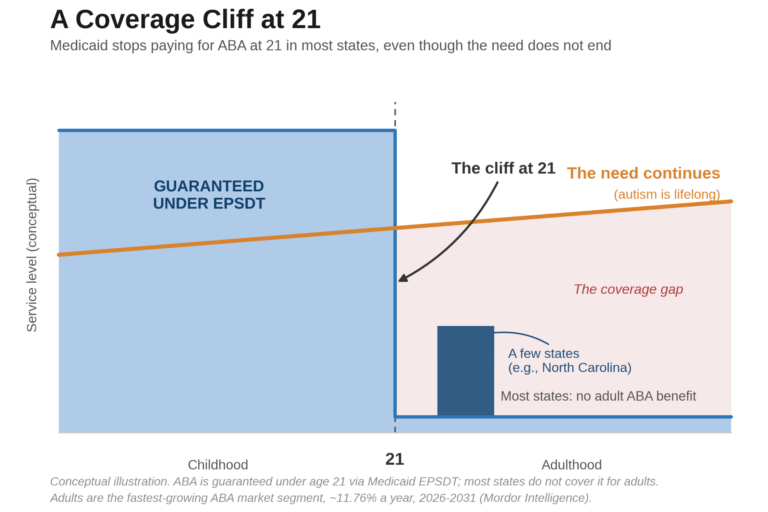
Many hit what the summit calls the “benefits cliff.” School-based entitlements that guarantee therapy and support through the early 20s end at graduation, and the adult system offers no equivalent. For families, the supports often simply stop. For providers and investors, that is the unserved market the data keeps pointing back to.
AT A GLANCE
| Source: | Autism Speaks CARES Act Alignment Dashboard, published April 29, 2026 (data: NIH RePORTER, extracted March 2026) |
| Adult autism, FY2026: | 25 of 160 NIH autism grants, about $12.7 million (partial-year, preliminary) |
| Foundational research, FY2026: | 142 of 160 NIH autism grants, about $68.1 million (partial-year, preliminary) |
| Foundational share, FY2024: | 80% of NIH autism funding under the CARES Act framework (last complete year) |
| NIH role: | Single largest funder of U.S. autism research |
| U.S. autistic adults: | ~5.4 million, about 2.2% of adults (CDC estimate, extrapolated from child data) |
| Investor framing: | Aging autism needs “grossly under-serviced” (Autism Investor Summit) |
| Key distinction: | Research funding is not service funding; adult services fall largely to ACL, HRSA, and states |
SOURCES & REFERENCES
| 1. | Autism Speaks. “A new Autism Speaks dashboard tracks how NIH autism research funding aligns with the priorities in the Autism CARES Act.” News release. April 29, 2026. autismspeaks.org |
| 2. | Autism Speaks. CARES Act Alignment Dashboard. Classification by Wittenburg, D. & Vasudevan, V. (2026); data from NIH RePORTER, extracted March 2026. abncares.autismspeaks.org |
| 3. | Autism CARES Act of 2024 (P.L. 118-180). 118th Congress. congress.gov |
| 4. | Autism Investor Summit. Conference overview and adult-services framing. autisminvestorsummit.com (accessed June 2026) |
| 5. | Abramowitz, A. “Observations from the Autism Investor Summit.” Intrepid Investment Bankers. February 2019. intrepidib.com |
| 6. | Knoelke, S. “Autism Investor Summit – Which Way Are the Autism Investment Winds Blowing.” Behavioral Health Business. May 20, 2025. bhbusiness.com |
| 7. | Dietz PM, Rose CE, McArthur D, Maenner M. “National and State Estimates of Adults with Autism Spectrum Disorder.” Journal of Autism and Developmental Disorders / CDC. 2020. (~2.2%, ~5.4 million U.S. adults) |