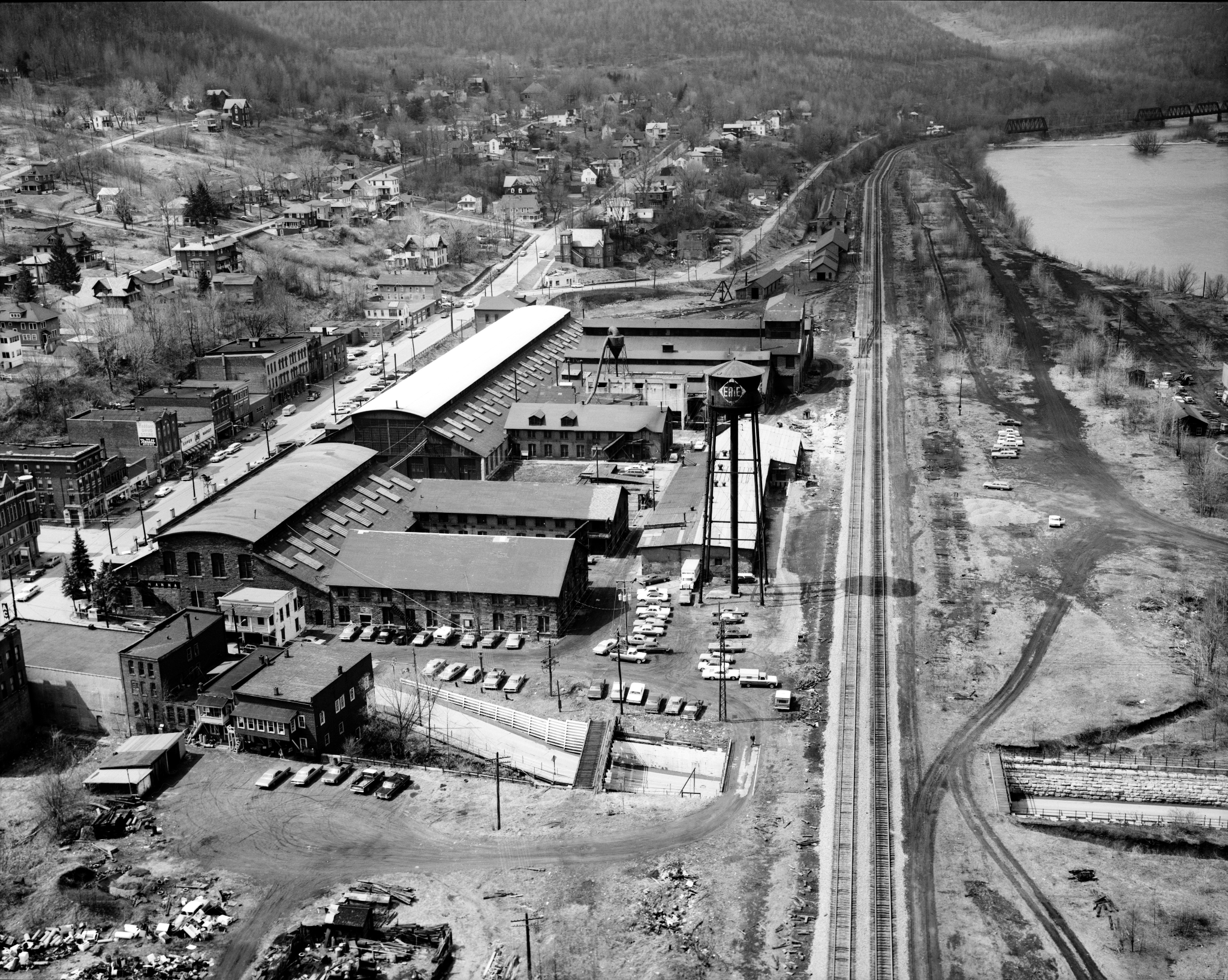
As a boy in Susquehanna, Pennsylvania, B.F. Skinner ran a door-to-door elderberry business with a problem he could not solve by hand. He could not sort the ripe berries from the green ones fast enough to make the route pay. So he built a machine, a flotation device that separated the berries by whether they sank or floated, and let the apparatus do what his eyes could not. He was a child, and he had already found the move that would organize his life. When something is not working, do not try harder. Redesign the conditions.
Burrhus Frederic Skinner was born on March 20, 1904, in Susquehanna, an Erie Railroad town of about 2,000 people in the hills of northeastern Pennsylvania, just below Binghamton, New York. His father, William, was a rising young lawyer. His mother, Grace, ran the house. A younger brother, Edward, known as Ebbe, arrived in 1906. Skinner later called the home warm and stable, and he filled his share of it with projects.
A Boyhood of Contraptions
The elderberry rig was one of many. Skinner and his brother built a cabin in the woods and a cart whose steering, through a miscalculation, worked backwards. He attempted a perpetual motion machine, which never moved, and a system to pull oxygen out of sea water, which never worked. The failures taught as much as the wins, each one a lesson in how a mechanism behaves when you actually run it, not how you pictured it in your head.
Other builds were useful. Clerking in a shoe store as a teenager, he rigged a device to spread the green dust that helped a push broom pick up dirt. He assembled model sailing ships with enough precision that, decades later, the same hands would build the levers, feeders, and recording drums of his laboratory. The boy was running a workshop, and the workshop was training an experimentalist.
Words and Doubt
He was not only a builder. Skinner wrote constantly as a boy, turning out short stories, the starts of novels, and a morality play whose characters were named Greed and Youth. His high school English teacher, Mary Graves, pushed him toward intellectual independence, and he credited her for it for the rest of his life. He was also losing his religion. After a Christian teacher tried to talk him out of the fear of hell his grandmother had described, Skinner reasoned his way out of belief and stayed an atheist.
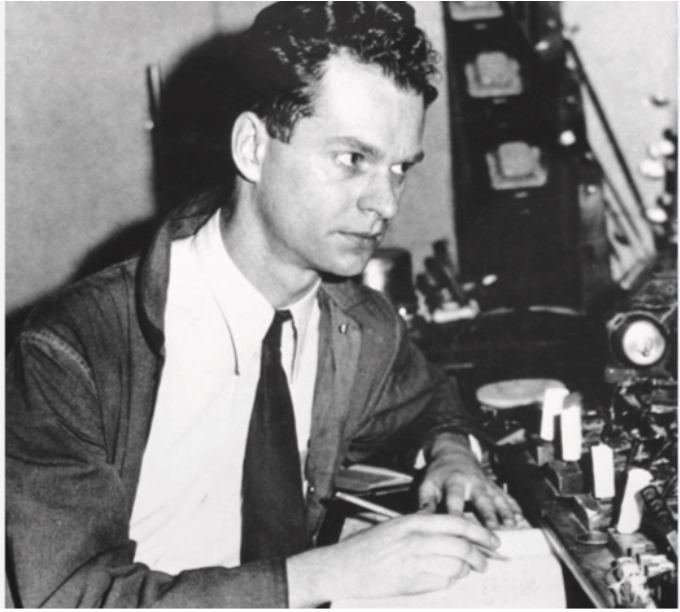
The Workshop Became a Laboratory
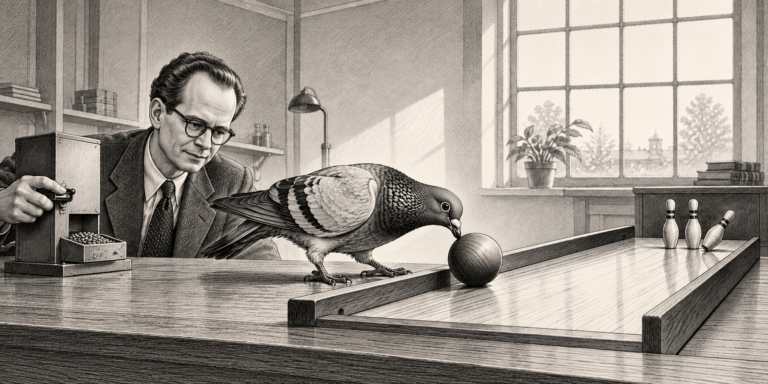
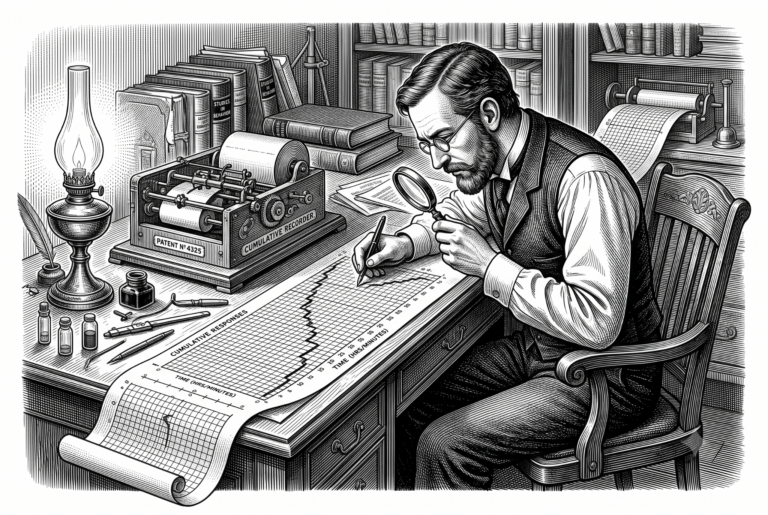
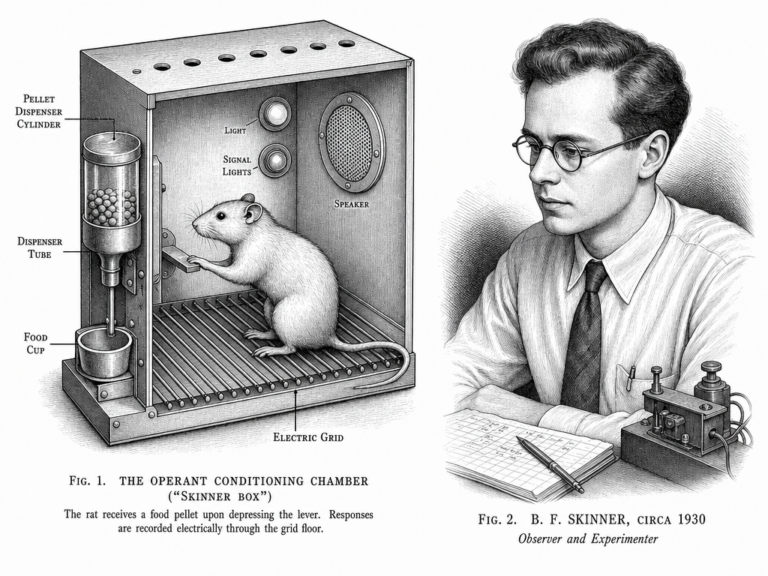
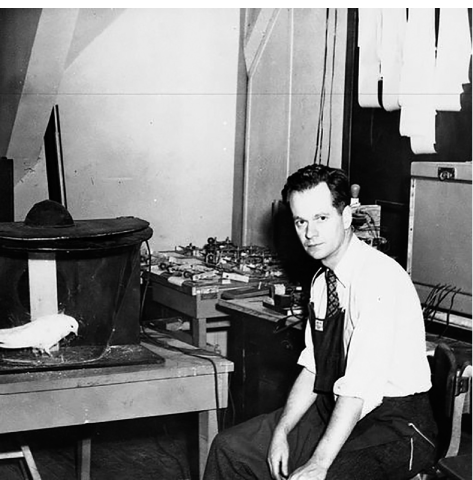
Skinner would not find psychology for another six years, but the workshop had already taught him how he would practice it. Faced with a problem, he did not look inward or theorize about hidden causes. He built a device, arranged the conditions, and watched what happened. That is, in miniature, the method he would later turn on behavior itself: the operant chamber that presented a lever and delivered food, the cumulative recorder that drew the result as a line on a moving drum.
It is also, in miniature, what a behavior analyst does now. The field Skinner founded does not argue a child into new behavior or try to repair what is presumed broken inside. It changes the environment, the antecedents and the consequences, and measures what the change produces. A BCBA writing a behavior plan is running the Susquehanna workshop on a clinical problem. The instinct to engineer conditions rather than lecture the mind started with a boy and a pile of improvised parts.
Long before he rejected the study of the mind, Skinner was a child who fixed problems by changing the world around him, not the thoughts inside his head.
In 1922 Skinner left Susquehanna for Hamilton College, certain that his future was in writing, not in building things. He was wrong about that, though it would take a painful few years to find out. The following spring brought the harder loss. While the family was home in Scranton, his sixteen-year-old brother Edward collapsed from a cerebral hemorrhage and died within hours. The Susquehanna boyhood, the workshop, and the two-boy household were over.
The next article in this series follows Skinner into the years that came after, the failed attempt to become a novelist that he later called the Dark Year, and the books that finally pulled him toward a new science.
AT A GLANCE
| Born: | March 20, 1904, Susquehanna, Pennsylvania |
| Hometown: | Susquehanna, an Erie Railroad town of about 2,000, below Binghamton, New York |
| Parents: | William Skinner, attorney; Grace Skinner |
| Brother: | Edward (Ebbe) Skinner, born 1906; died 1923 at sixteen, of a cerebral hemorrhage |
| Boyhood inventions: | Backwards-steering cart, a perpetual motion attempt, an elderberry flotation separator, a shoe-store green-dust spreader |
| High school mentor: | Mary Graves, English teacher, whom he credited with his intellectual independence |
| Early ambition: | Writer; produced stories, novels, and a morality play with characters named Greed and Youth |
| Religion: | Became an atheist as a teenager |
| Left for college: | Hamilton College, 1922, to study English |
| Through-line to ABA: | The boyhood habit of building apparatus became the method behind the operant chamber and the field he founded |
| Source memoir: | Particulars of My Life (1976), the first volume of his autobiography |
SOURCES & REFERENCES
| 1. | B.F. Skinner Foundation. “Biographical Information.” bfskinner.org. https://www.bfskinner.org/archives/biographical-information/ |
| 2. | Pennsylvania Center for the Book, Penn State University Libraries. “B.F. Skinner.” pabook.libraries.psu.edu. https://pabook.libraries.psu.edu/literary-cultural-heritage-map-pa/bios/skinner__bf |
| 3. | Encyclopaedia Britannica. “B.F. Skinner.” britannica.com. https://www.britannica.com/biography/B-F-Skinner |
| 4. | Wikipedia. “B.F. Skinner.” https://en.wikipedia.org/wiki/B._F._Skinner |
| 5. | Skinner BF. Particulars of My Life. New York: Alfred A. Knopf; 1976. |
| 6. | Smithsonian Magazine. “B.F. Skinner: The Man Who Taught Pigeons to Play Ping-Pong and Rats to Pull Levers.” smithsonianmag.com. https://www.smithsonianmag.com/science-nature/bf-skinner-the-man-who-taught-pigeons-to-play-ping-pong-and-rats-to-pull-levers-5363946/ |