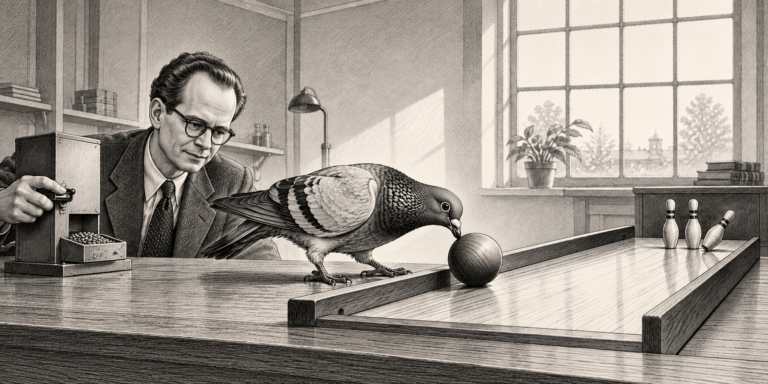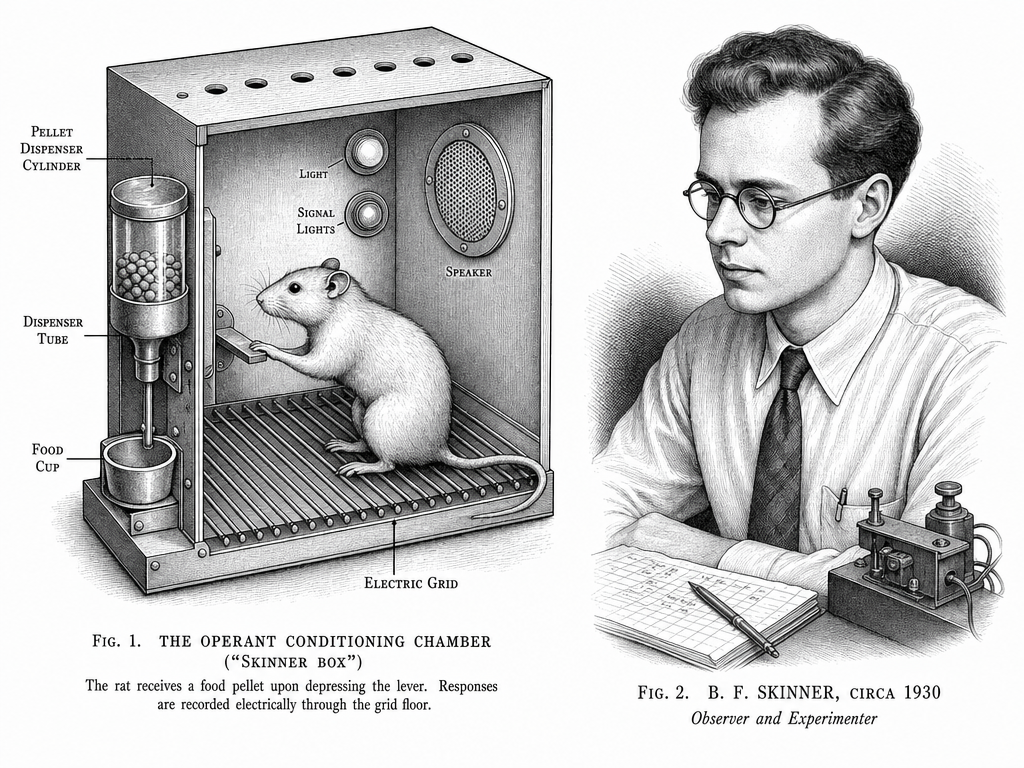
In a Harvard laboratory around 1930, a graduate student named B.F. Skinner put a rat in a box he had built, wired a lever to a food dispenser, and started counting. He had built it to settle a question psychology was still arguing over. Could behavior be studied without guessing at what an animal was thinking, by recording only what it did and what happened next?
Skinner’s answer was operant conditioning, and the box he built to find it would eventually carry his name. It also became the central tool of a field that did not yet exist. Applied behavior analysis would not be named for nearly four decades, but its method was already taking shape in that box.
A New Unit of Behavior
Skinner had earned his Harvard PhD in psychology in 1931 and stayed on through 1936 on a run of research fellowships, including a junior fellowship in the university’s Society of Fellows.
He spent those years building equipment and watching rats, and what he saw did not fit the model he had arrived with.
Pavlov had described behavior as a response pulled out of an organism by a preceding stimulus: ring a bell, get a reflex. Skinner found something the bell could not explain. A rat’s lever pressing was governed less by what came before it than by what came after: the food that followed. He split behavior into two kinds. Respondent behavior is elicited by a prior stimulus, the Pavlovian reflex. Operant behavior is emitted by the organism and controlled by its consequences. He set the distinction out in 1938, in his first major book, The Behavior of Organisms: An Experimental Analysis, and gave the second kind the name that stuck: operant conditioning.
The Box and the Recorder
The box gave him a clean place to look: a single response, the lever press, in a controlled space, with a consequence he could schedule and a count he could trust. The world later called it the Skinner box, a label believed to be given in a 1943 book by the psychologist Clark Hull. Skinner never used it. He called the device an operant chamber and or lever box.
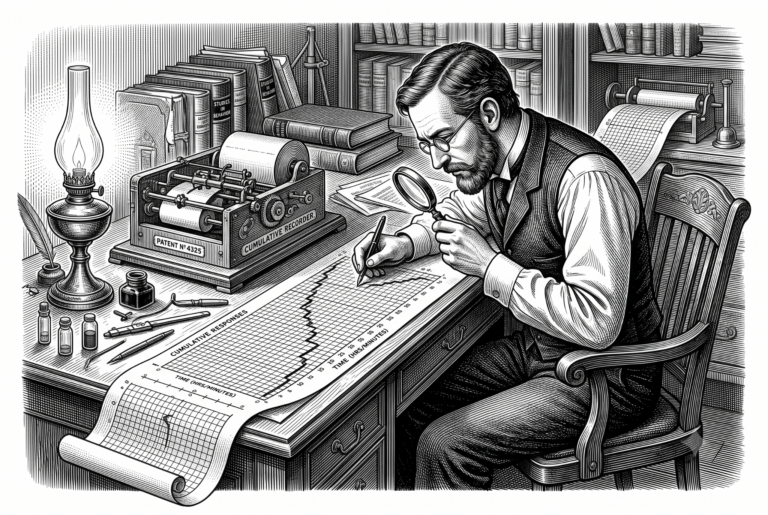
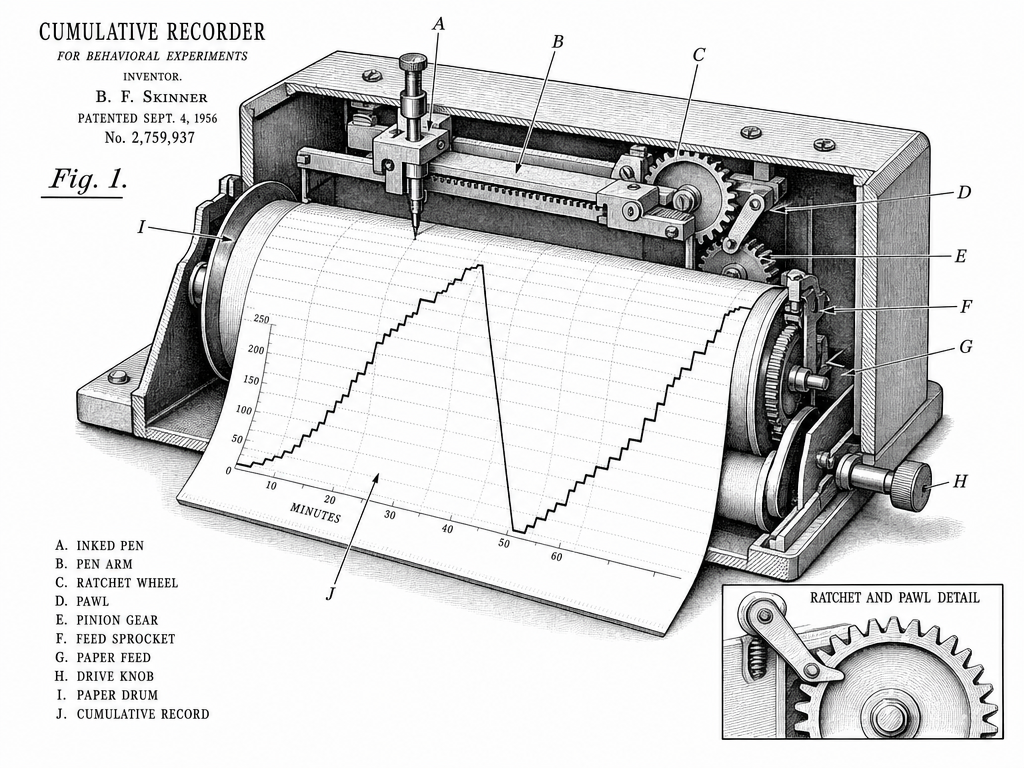
The second invention mattered as much as the first. Skinner built the cumulative recorder, a device that drew each response as a small step upward on a roll of paper, so a fast rate climbed steeply and a pause went flat. Rate of response, how often the behavior happened over time, became his fundamental measure, the figure he treated as the real index of a behavior’s strength. For the first time, the strength of a behavior was a line on a chart, not an inference about a hidden state.
Discovery by Accident
Much of what he found, he found by accident. When the supply of food pellets for his rats ran low, he began reinforcing only some lever presses instead of every one, to make the pellets last. The makeshift economy turned into a discovery. In a 1956 essay, A Case History in Scientific Method, Skinner set out the unofficial rule he had actually followed in the lab.
“When you run onto something interesting, drop everything else and study it.” – B.F. Skinner, “A Case History in Scientific Method,” 1956
That accident opened a line of work. Reinforcing a response only part of the time, rather than every time, produced steady and durable patterns of behavior, and Skinner would spend the next two decades mapping them. The same essay carried a quieter argument that outlasted much of the rest. He trusted the single case, one organism studied closely over time, over averages drawn from a crowd.
What the BCBA Inherited
Take the rat and the box away and the logic is the one a behavior analyst uses now. Skinner’s operant is behavior selected by what follows it, which is why ABA reads behavior as a three-part sequence: the antecedent that sets the occasion, the behavior itself, and the consequence that makes it more or less likely next time. The A-B-C contingency on a behavior plan is the operant, written for a clinic.
The measurement came with it. A BCBA still counts behavior as a rate or frequency and graphs it over time, then judges the program by reading that line for a single client rather than averaging a group. That is Skinner’s cumulative record and his trust in the single case, carried into practice. The field itself would not be named or organized into a profession until the late 1960s. The science it would apply was already running, one rat and one lever at a time, in the 1930s.
The next article in the series stays with that line on the paper, and how Skinner’s way of measuring behavior became the data discipline that decides whether a modern ABA program is working.
AT A GLANCE
| Harvard PhD: | Psychology, 1931 |
| Harvard years: | About five years of research fellowships through 1936, including a junior fellowship in the Society of Fellows |
| Operant chamber: | Built by Skinner as a Harvard graduate student in the 1930s; a lever, a food dispenser, a controlled space |
| “Skinner box”: | Term tied to Clark Hull (1943); Skinner never used it, preferring operant chamber or lever box |
| Cumulative recorder: | Skinner’s invention; drew responses as a rising line, with rate of responding as the key measure |
| Operant vs. respondent: | Respondent behavior is elicited by a prior stimulus; operant behavior is emitted and controlled by its consequences |
| Operant conditioning: | Term coined by Skinner; behavior is selected by its consequences |
| Foundational book: | The Behavior of Organisms: An Experimental Analysis (1938) |
| Method: | Serendipity and the single case over group statistics (A Case History in Scientific Method, 1956) |
| Through-line to ABA: | The operant, the A-B-C contingency, and rate-based measurement are the experimental core of applied behavior analysis |
SOURCES & REFERENCES
| 1. | Wikipedia. “Operant conditioning chamber.” https://en.wikipedia.org/wiki/Operant_conditioning_chamber |
| 2. | Wikipedia. “B.F. Skinner.” https://en.wikipedia.org/wiki/B._F._Skinner |
| 3. | Harvard University, Department of Psychology. “B.F. Skinner.” https://psychology.fas.harvard.edu/people/b-f-skinner |
| 4. | Encyclopedia.com. “Skinner, Burrhus Frederic.” https://www.encyclopedia.com/psychology/arts-construction-medicine-science-and-technology-magazines/skinner-burrhus-frederic |
| 5. | Skinner BF. The Behavior of Organisms: An Experimental Analysis. New York: Appleton-Century-Crofts; 1938. |
| 6. | Skinner BF. “A Case History in Scientific Method.” American Psychologist. 1956;11:221–233. |
| 7. | McLeod S. “Operant Conditioning: B.F. Skinner.” Simply Psychology. https://www.simplypsychology.org/operant-conditioning.html |
| 8. | Applied Behavior Analysis Edu. “Who Was B.F. Skinner? The Father of Operant Conditioning.” https://www.appliedbehavioranalysisedu.org/who-was-bf-skinner/ |