The Common Thread Across Four State Audits
WASHINGTON, D.C. — The HHS Office of Inspector General has now completed audits of Medicaid ABA payments in Indiana, Wisconsin, Maine, and Colorado. In every state, 100 percent of sampled enrollee-months contained at least one improper or potentially improper payment. The error categories vary in their specifics, but one theme dominates: documentation deficiencies. Missing session notes, incomplete session notes, session notes that do not match billed codes, session notes that describe non-therapeutic activities, and session notes signed by staff who were not present during the session appear in the findings of every audit.
The Colorado audit, released March 2, 2026, found 7.8 million in confirmed improper payments and 07.4 million in potentially improper payments. Auditors specifically cited documentation failures including sessions billed without adequate notes, notes that did not support the billed CPT codes, and notes that described activities inconsistent with ABA therapy. The Wall Street Journal investigation found that therapy was billed while children engaged in non-therapeutic activities such as watching movies or napping. These are not edge cases; they represent a systemic failure in how session documentation is created, reviewed, and submitted for payment.
Benesch, which published two detailed analyses of the OIG audit findings, identified documentation as the first and most critical compliance area for ABA providers. The firm recommended that providers conduct internal audits of treatment notes, time logs, and authorization alignment, and implement standardized, defensible clinical documentation that clearly links services to individualized need. The firm noted that regulators have identified common issues including missing documentation, billing during non-therapeutic activities, and discrepancies between treatment plans and billed hours.
The Massachusetts Inspector General found up to 7.3 million in ABA overpayments in a separate March 2024 report, driven by many of the same documentation issues: inadequate supervision ratios, documentation failures, impossible billing patterns, and holiday claims. The consistency of findings across federal and state audits, across multiple years, and across geographically diverse states confirms that the documentation crisis is an industry-wide structural problem rather than a collection of isolated provider failures.
Regulators have described the ABA landscape as immature and vulnerable to abuse. Documentation deficiencies are the common thread that connects overbilling, credential gaps, and supervision fraud into a single audit trail. — Benesch analysis, March 2026
What Adequate Documentation Actually Means
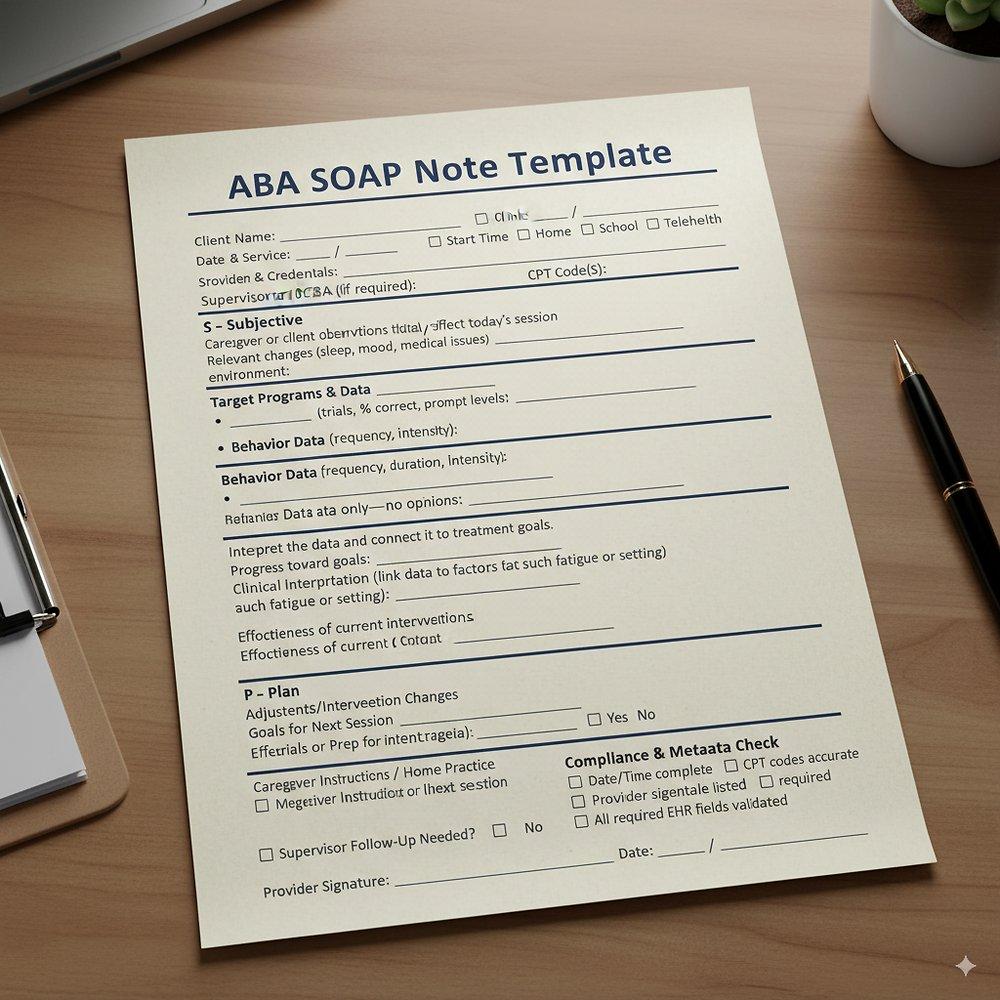
The definition of adequate ABA session documentation varies by state, by payer, and by CPT code. At a minimum, session notes for CPT code 97153 (adaptive behavior treatment by protocol) must identify the client, the date and time of service, the rendering provider and their credentials, the specific interventions used, the client’s responses, progress toward treatment plan goals, and the supervising BCBA. For CPT 97155 (adaptive behavior treatment with protocol modification), notes must additionally document what clinical issues were identified and what changes were made to the treatment protocol or plan of care.
The Wisconsin OIG audit specifically recommended that the state update guidance for CPT code 97155 to require documentation on how issues were resolved or what changes were made to the treatment protocol. This recommendation highlights a gap that exists in many states: the CPT code requires a specific clinical action (protocol modification), but the documentation standards do not always specify what must be recorded to substantiate that the action occurred. Providers can bill the higher-reimbursement code without demonstrating the clinical rationale that justifies it.
State-level variation compounds the problem. Some states require specific signature formats; others accept electronic signatures. Some states require session notes to be completed within 24 hours; others allow longer windows. Some states require the supervising BCBA to co-sign technician notes; others do not. This patchwork of requirements creates compliance risk for multi-state providers and confusion for RBTs who may work across state lines or for organizations operating in multiple jurisdictions.
Payers are responding to the documentation crisis by tightening pre-payment and post-payment review processes. Colorado launched post-payment auditing and pre-payment claims review in July 2025 and is updating its billing system to automatically flag or block claims that lack required information or appear improperly billed. Indiana imposed a moratorium on new providers and new accreditation requirements. The shift from a pay-and-trust model to a verify-then-pay model represents a fundamental change in how ABA claims will be processed going forward.
Why RBTs Are Set Up to Fail
The entry-level ABA workforce — Registered Behavior Technicians — delivers the majority of direct therapy hours and creates the majority of session documentation. Yet RBTs receive minimal training on documentation standards as part of their 40-hour certification curriculum. The BACB’s RBT training covers behavioral principles, measurement, and intervention techniques, but does not include extensive instruction on payer-specific documentation requirements, CPT code distinctions, or the legal implications of inadequate session notes.
Praxis Notes, an ABA documentation platform, identified nine common RBT session note errors that BCBAs should address: lacking medical necessity documentation, writing in passive voice, lacking intervention specificity, omitting client response data, using subjective rather than objective language, failing to link activities to treatment plan goals, incomplete time documentation, missing signatures, and using informal or unprofessional language. These errors are not the result of negligent technicians; they are the predictable outcome of inadequate training combined with production pressure.
Benesch observed that some providers billed 30 to 40 therapy hours per week for nearly every child, despite expert guidance that such intensive schedules are rarely needed. When providers operate at maximum billable capacity, the time available for documentation review, correction, and training is compressed. RBTs working back-to-back sessions have limited time to write detailed notes. BCBAs supervising maximum caseloads have limited time to review those notes. The documentation crisis is, at its core, a capacity crisis: the industry is billing more hours than its workforce can adequately document.
AI-driven documentation tools like Brellium are emerging to address the gap, offering automated session note auditing that can flag missing elements, inconsistent language, and billing code mismatches before claims are submitted. These tools represent a technological response to a structural problem, but they cannot substitute for adequate training, reasonable caseloads, and organizational cultures that prioritize documentation accuracy alongside billable hour production.
For compliance officers and clinical directors, the documentation crisis demands a multi-layered response: standardized note templates tied to specific CPT codes, regular internal audits of a representative sample of notes, real-time feedback loops between BCBAs and RBTs on documentation quality, and protected time for documentation that is not counted against productivity metrics. Providers that treat documentation as a cost center rather than a compliance imperative are the providers that the next round of audits will flag.
AT A GLANCE
| Documentation errors: | Most common finding across all 4 OIG state audits |
|---|---|
| States audited: | Indiana, Wisconsin, Maine, Colorado (100% error rate in all) |
| Key CPT codes: | 97153 (treatment by protocol); 97155 (protocol modification) |
| MA Inspector General: | 7.3M ABA overpayments (March 2024); same documentation issues |
| CO response: | Post-payment auditing; pre-payment review; automated claim flagging |
| WSJ finding: | Therapy billed during non-therapeutic activities (movies, napping) |
| Benesch guidance: | Internal audits, standardized documentation, staff training, utilization review |
| Common note errors: | Missing signatures, vague language, no medical necessity, no intervention specifics |
| AI tools emerging: | Brellium automated session note auditing; pre-submission compliance checks |
SOURCES & REFERENCES
| 1. | Benesch. “Heightened Scrutiny of Medicaid-Funded ABA Services — Key Takeaways for Providers.” March 2026. |
|---|---|
| 2. | Benesch. “OIG Finds Significant Improper Medicaid Payments for ABA in WI and IN.” January 2026. |
| 3. | HHS-OIG. Colorado, Indiana, Wisconsin, Maine ABA audit reports. 2024–2026. |
| 4. | Praxis Notes. “9 RBT Session Note Errors BCBAs Can Fix Fast.” praxisnotes.com. |
| 5. | CrossRiverTherapy. “Why Session Notes Matter in ABA Therapy.” crossrivertherapy.com. |
| 6. | Brellium. “Prevent ABA Insurance Clawbacks with AI Session Audits.” brellium.com. |
| 7. | Wall Street Journal. “The Boom in Autism Therapy Is Medicaid’s Fastest-Growing Jackpot.” March 10, 2026. |