
Five Centers, One Decision
MONROVIA, CALIFORNIA — On December 2, 2025, Autism Learning Partners announced it would shut down all ABA services in Texas effective March 21, 2026. The closures affected five locations: center-based and in-home programs in El Paso, Plano, Sugarland, Southlake, and The Woodlands. The company cited two compounding problems; Medicaid reimbursement rates it described as “significantly lower” than most other states, and “process issues with authorizations” that had made delivering care in the state unsustainable.
ALP is not a small operator making a quiet exit. The Monrovia, California-based company employs roughly 4,000 people nationwide, including more than 300 Board Certified Behavior Analysts, and delivers ABA therapy across 15 states. It was founded in 1988 and has been backed since December 2017 by FFL Partners, a San Francisco-based private equity firm with over $6 billion in cumulative capital commitments. FFL acquired the company from Great Point Partners, Jefferson River Capital, and Scopia Capital Management.
“ALP has prided itself and is deeply committed to providing excellent care in communities to all families, this has been a very hard decision because unfortunately given the state of Medicaid in Texas, there are not very many providers that are able to provide care for these patients,” said Gina T. Chang, PhD, BCBA-D, ALP’s CEO, in the company’s December press release. “Our hope is that lawmakers and state-level administrators will see that the current policies are not adequate to serve these families appropriately or equitably.”
Chang, who holds a doctorate in Applied Developmental Psychology from Claremont Graduate University and started her career as a behavior technician, was appointed CEO by ALP’s board of directors. She brings over 20 years of clinical and leadership experience in autism services, a credential that gives clinical weight to a decision that is ultimately financial.
“Our hope is that lawmakers and state-level administrators will see that the current policies are not adequate to serve these families appropriately or equitably.” Gina T. Chang, PhD, BCBA-D, CEO, Autism Learning Partners (December 2025)
The Texas Rate Problem
The numbers behind ALP’s decision are specific. According to data Chang provided to Behavioral Health Business, Texas Medicaid reimburses $14.50 per 15-minute unit for adaptive behavioral treatment by a technician (CPT 97153). The national average for this rate is $15.57 and the median is $15.00, according to research by MediRate, placing Texas at the 17th-lowest reimbursement among all state Medicaid programs.
But the rate alone does not tell the full story. Chang also noted that protocol modification by a BCBA is reimbursed at a lower rate even though a technician is simultaneously required to be engaged with the client. The technician’s service code cannot be concurrently billed during protocol modification, effectively reducing compensation by an additional 5% to 10%. For a large multi-state platform managing center leases, clinical supervision requirements, and workforce retention, that margin erosion compounds.
Texas also imposes weekly unit caps on authorized services, requiring providers to bill strictly within approved weekly limits. Starting in 2026, if a child is approved for 20 hours per week, the provider must stay within that cap each week, reducing the flexibility that allows clinical teams to adjust treatment intensity in response to client needs.
The broader context matters: Texas is the second-most populous state in the country, with an autism prevalence now estimated at 1 in 31 children nationally (CDC, April 2025). It should be one of the most important ABA markets in the country. Instead, ALP’s departure signals that the state’s Medicaid infrastructure is pushing major providers away from the families who depend on them most.
The California Pivot
Eight days after announcing the Texas exit, ALP released a second press statement, this one about expansion. On December 10, 2025, the company announced plans to open three new ABA therapy centers in California in 2026: in Compton (South Los Angeles), Torrance (South Bay), and San Leandro (East Bay/Northern California). The day before, it had opened a new center in Murrieta, in Riverside County.
The new California centers will focus on Early Intensive Behavior Intervention (EIBI) for children from birth to age five, featuring what the company described as a “comprehensive, play-based ABA program” with a proprietary curriculum targeting communication, social skills, play skills, and executive function development.
California is ALP’s home market. The company is headquartered in Monrovia and has long maintained its densest network of centers and home-based services in the state, where it also offers speech, occupational, and physical therapy in addition to ABA, a breadth of services not available in all of its other states. The California expansion is not merely geographic growth; it is a strategic concentration of resources in a state where reimbursement rates, payer mix, and regulatory conditions are more favorable to the company’s operating model.
The juxtaposition is stark: five closures in Texas, four openings in California, announced within nine days of each other. For a PE-backed platform managing a national footprint, the message to investors and clinicians alike is clear — capital follows reimbursement.

The PE Calculus
FFL Partners is not a generalist investor. The firm describes itself as a “hyperspecialized, thematic investor” focused on healthcare and tech-enabled services. Chris Harris, a partner at FFL, said at the time of the 2017 acquisition that the firm had evaluated “more than a dozen companies focused on helping autistic children and their families” before selecting ALP for its “combination of clinical rigor, business discipline and growth aspirations.”
That investment thesis is now being tested by a Medicaid landscape that has shifted significantly since 2017. When FFL acquired ALP, the company operated in 19 states, according to a 2021 Behavioral Health Business profile. It now operates in 15. The contraction reflects not a failure of clinical operations but a rational response to rate environments that cannot sustain the labor costs, supervision ratios, and facility overhead that large-platform ABA delivery requires.
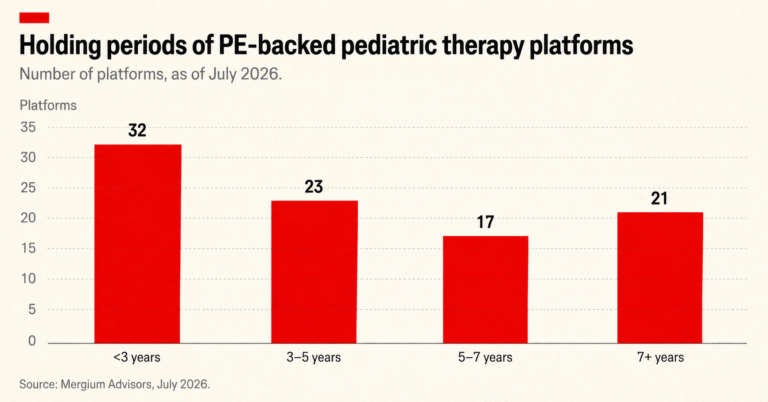
ALP’s Texas exit fits a pattern now visible across the PE-backed ABA sector. Hopebridge, an Indianapolis-based platform, shuttered its three Arkansas locations in October 2025 after the state reclassified ABA centers as childcare facilities, imposing regulations the company said conflicted with its clinical model. Across rural Alabama, 11 ABA clinics closed in early 2026, leaving more than 200 families without services. In each case, the exits followed changes in the regulatory or reimbursement environment that made continued operations financially unviable.
A National Reckoning Over ABA Rates
ALP’s Texas exit is one data point in a national pattern that accelerated sharply through 2025 and into 2026. Medicaid spending on ABA therapy has surged across the country: North Carolina’s ABA spending rose from $122 million in fiscal 2022 to a projected $639 million in fiscal 2026, a 423% increase. Nebraska saw a 1,700% jump. Indiana reported a 2,800% rise. Nationally, ABA therapy volume increased 267% from 2019 to 2024, with Medicaid-covered services growing even faster at 341% relative to 2019.
States have responded with cuts. North Carolina attempted a 10% provider payment reduction before Governor Josh Stein reversed the cuts in December 2025 amid lawsuits from families of children with autism. Nebraska cut rates by 28% to 79% depending on the service. Indiana is implementing a 6% rate cut for individual ABA services effective April 1, 2026, with an additional 4% reduction scheduled for April 2027. Colorado is requiring prior authorization and reducing reimbursement rates, triggering a lawsuit from providers and parents.
In Georgia, ABA providers face an unusual threat: a 20% rate cut imposed not by the state Medicaid agency itself but by CareSource, a managed care organization, which notified providers in early 2026 that it would reimburse at 80% of the state fee schedule. The move is particularly jarring because Georgia had just increased its ABA rate in 2025.
Federal audits have added fuel to the rate-cut argument. A federal audit of Indiana’s Medicaid program estimated at least $56 million in improper ABA payments in 2019 and 2020, noting some providers billed for excessive hours, including during nap time. Wisconsin saw an estimated $18.5 million in improper payments in 2021–2022. In Minnesota, 85 investigations into ABA providers were open as of mid-2025, and the FBI raided two providers in late 2024 as part of a Medicaid fraud probe.
The collision of rising utilization, state fiscal pressure, fraud concerns, and the nearly $1 trillion in looming Medicaid reductions from President Trump’s One Big Beautiful Bill Act has created an environment where even well-run platforms are being forced to make market-by-market calculations about where they can operate sustainably.

What Gets Left Behind
When a 4,000-employee platform exits a state, the disruption extends beyond a press release. ALP acknowledged in its December statement that transitioning families to other providers in Texas would be difficult, precisely because the same rate environment that drove ALP out has limited the pool of remaining Medicaid-accepting ABA providers in the state.
Chang’s language was pointed: “Given the state of Medicaid in Texas, there are not very many providers that are able to provide care for these patients.” The implication is that ALP’s exit does not simply redistribute patients to other providers, it reduces the total available supply of care.
The pattern is consistent with what KFF Health News documented in a December 2025 investigation across multiple states. In Nebraska, families feared that rate cuts would drive providers away and “yank the rug out from under” children who had made progress. In North Carolina, families of 21 children with autism filed a lawsuit challenging provider payment cuts. In Colorado, providers and parents sued the state over changes to reimbursement and authorization requirements.
For families in El Paso, Plano, Sugarland, Southlake, and The Woodlands, the math is simpler and more personal: the provider is gone, and there may not be another one to take its place.
AT A GLANCE
| Company: |
Autism Learning Partners (ALP), Monrovia, CA. Founded 1988. |
| PE Sponsor: |
FFL Partners, San Francisco. Acquired ALP December 2017 from Great Point Partners, Jefferson River Capital, and Scopia Capital. |
| CEO: |
Gina T. Chang, PhD, BCBA-D. Over 20 years in autism services; started as a behavior technician. |
| Workforce: |
~4,000 employees, 300+ BCBAs, 15 states (down from 19 in 2021). |
| TX Locations Closed: |
El Paso, Plano, Sugarland, Southlake, The Woodlands. Effective March 21, 2026. |
| TX Medicaid Rate: |
$14.50 per 15-min unit (CPT 97153). National average $15.57, median $15.00 (MediRate). 17th lowest in U.S. |
| Concurrent Billing Issue: |
BCBA protocol modification reimbursed at lower rate; technician code cannot be concurrently billed, reducing compensation 5–10%. |
| CA Expansion: |
New centers in Compton, Torrance, San Leandro (2026). Murrieta opened December 9, 2025. |
| National ABA Volume Growth: |
267% increase from 2019 to 2024; Medicaid-covered services up 341% (Trilliant Health, 2025). |
| NC Spending Surge: |
$122M in FY 2022 to projected $639M in FY 2026 (423% increase). |
| Other Market Exits: |
Hopebridge left Arkansas (October 2025); 11 rural Alabama clinics closed early 2026. |
| Federal Fiscal Pressure: |
Trump’s One Big Beautiful Bill Act targets nearly $1 trillion in Medicaid reductions. |
SOURCES & REFERENCES
| 1. |
Autism Learning Partners. “ALP to End ABA Services in Texas in March 2026.” PR Newswire. December 2, 2025. https://www.prnewswire.com/news-releases/alp-to-end-aba-services-in-texas-in-march-2026-302631041.html |
| 2. |
Chris Larson. “Autism Learning Partners to Leave Texas Market.” Behavioral Health Business. December 3, 2025. https://bhbusiness.com/2025/12/03/autism-learning-partners-to-leave-texas-market/ |
| 3. |
Autism Learning Partners. “ALP to Open New ABA Therapy Centers in CA in 2026.” PR Newswire. December 10, 2025. https://www.prnewswire.com/news-releases/alp-to-open-new-aba-therapy-centers-in-ca-in-2026-302637755.html |
| 4. |
FFL Partners. “FFL Partners Completes Investment in Autism Learning Partners.” FFL Partners. December 2017. https://fflpartners.com/ffl-partners-completes-investment-in-autism-learning-partners/ |
| 5. |
Autism Learning Partners. “Autism Learning Partners Appoints Gina T. Chang, Ph.D., BCBA-D as New CEO.” Autism Learning Partners. https://autismlearningpartners.com/news/autism-learning-partners-appoints-gina-t-chang-ph-d-bcba-d-as-new-ceo/ |
| 6. |
Bram Sable-Smith and Andrew Jones. “It’s the ‘Gold Standard’ in Autism Care. Why Are States Reining It In?” KFF Health News / NPR. December 23, 2025. https://kffhealthnews.org/news/article/aba-therapy-applied-behavior-analysis-autism-medicaid-rate-cuts-north-carolina/ |
| 7. |
MediRate. State Medicaid ABA reimbursement rate data cited in Behavioral Health Business reporting, 2025. |
| 8. |
Trilliant Health. “ABA Therapy Utilization Grew Nearly 300%, Driven by Increases in Medicaid.” 2025. https://www.trillianthealth.com/market-research/studies/aba-therapy-utilization-grew-nearly-300-driven-by-increases-in-medicaid |
| 9. |
Behavioral Health Business. “ABA Volume Skyrocketed by 267% from 2019 to 2024.” December 22, 2025. https://bhbusiness.com/2025/12/22/aba-volume-skyrocketed-by-267-from-2019-to-2024/ |
| 10. |
Behavioral Health Business. “Hopebridge Shutters Arkansas Operations, Cites Child Care Facility Regs.” November 12, 2025. https://bhbusiness.com/2025/11/12/hopebridge-shutters-arkansas-operations-cites-child-care-facility-regs/ |
| 11. |
Behavioral Health Business. “Georgia ABA Providers Brace for 20% Rate Cut from CareSource.” April 8, 2026. https://bhbusiness.com/2026/04/08/georgia-aba-providers-brace-for-20-rate-cut-from-caresource/ |
| 12. |
Behavioral Health Business. “States Refine ABA Coverage: New Hour Caps, Age Limits, Rate Cuts.” January 22, 2026. https://bhbusiness.com/2026/01/22/states-refine-aba-coverage-new-hour-caps-age-limits-rate-cuts/ |
| 13. |
HHS OIG. “Indiana Medicaid ABA Audit.” Federal audit estimating $56M in improper payments (2019–2020). https://oig.hhs.gov/documents/audit/10124/A-09-22-02002-highlights.pdf |
| 14. |
CDC. Autism prevalence data: 1 in 31 children by age 8. April 2025. |
| 15. |
Behavioral Health Business. “Behavioral Health Predictions for 2026: Autism Rate Cuts, TMS on the Rise.” January 7, 2026. https://bhbusiness.com/2026/01/07/behavioral-health-predictions-for-2026-autism-rate-cuts-tms-on-the-rise/ |