What the Documents Show
LAFAYETTE, LOUISIANA – When Sharelle Menard opened a letter from Optum in May 2024 about her 10-year-old son Benji, it read like one reviewer’s call. “Your child has been in ABA for six years,” the insurer wrote. “After six years, more progress would be expected.” It was a denial that, ProPublica reported, fit a documented corporate strategy to limit the therapy.
Optum, the behavioral health arm of UnitedHealth Group, developed a strategy to reduce its spending on applied behavior analysis therapy for autistic children across the Medicaid plans it manages. ProPublica reporter Annie Waldman obtained the internal reports and published them on December 13, 2024.
The response to those facts was not to expand access. The report describes Optum “pursuing market-specific action plans,” meaning it keeps new providers out of the network, and “terminates” existing ones, including “cost outliers.” In some states, the documents projected that the reduction could cut more than two-fifths of in-network ABA provider groups and affect up to 19% of patients in therapy.
Optum disputed ProPublica’s account saying the article “grossly misrepresents our efforts to ensure the people we serve are getting the most effective, evidence-based care for their needs,” and it told Fox Business it had expanded its ABA network by more than 110% over the prior three years, to more than 46,000 providers across all lines of business.
The documents matter to every ABA provider in a state where UnitedHealthcare holds a Medicaid managed care contract. They describe a payer working to shrink a covered benefit. The consequences are plain.
The Financial Logic
The strategy follows the economics of Medicaid managed care. States do not pay insurers per service. They pay a fixed amount per enrolled member each month, regardless of the care that member uses, a structure known as capitation.
ABA is expensive relative to most behavioral health services. Intensive treatment for a child with significant needs can run 30 or more hours a week, delivered by a supervising BCBA and one or more behavior technicians. One child can represent a high annual cost, and enrollment has been climbing fast.
With the number of Medicaid patients in ABA up about 20% over the prior year and costs rising roughly $75 million year over year, according to ProPublica, the company expected to spend about $290 million on ABA in its Medicaid plans the year the documents were prepared
The growth is not a billing anomaly. It tracks rising autism prevalence. The CDC now estimates that 1 in 31 eight-year-olds had autism in 2022, its most recent surveillance year, up from about 1 in 150 for children monitored in 2000 and 2002. A 2024 study in JAMA Network Open found diagnoses across all ages reached 6.3 per 1,000 people, a 175% increase since 2011. Children on Medicaid are diagnosed at more than twice the rate of those with private insurance, which concentrates the cost on Medicaid plans.
When costs rise faster than the fixed payment, cutting the services that drive them widens the margin. Optum’s documents lay out exactly that cost problem and a plan to address it. That logic helps explain why the impact turned real in practice. The company earned about $22 billion in net profit in 2023, against UnitedHealth Group’s bottom line, the ABA spend was small.
Its results have weakened since. Net income fell to $14.4 billion in 2024 after being hit by a cyberattack and the sale of its South American operations. Income then decreased to $12.1 billion in 2025. Optum Health, the division that houses its behavioral arm, posted a full-year operating loss in 2025. The company then set aside a $623 million reserve for 2026 on contracts it could not exit and deemed structurally unprofitable. UnitedHealthcare has told investors that its Medicaid payment rates still lag the health needs of the members it covers.
Optum’s own clinical criteria cite the Council of Autism Service Providers’ guidelines, stating that there is no fixed limit on how long ABA should last. Benji’s denial cited his six years in therapy as the reason to reduce it. His team at Aspire Behavioral Health Center in Lafayette ran a brief reversal-to-baseline test, withdrawing therapy to document the effect. He threw chairs and flipped tables. He pushed behavior analyst Whitney Newton into a bookshelf, causing it to collapse. Newton drafted a report with line charts and photographs of the injuries and faxed it to Optum. The insurer did not change its decision.
The Seven-State Target List
The documents name seven states where Optum’s Medicaid ABA costs run highest and where it focused the reductions: Arizona, Nebraska, Tennessee, Virginia, New Jersey, Indiana, and Louisiana. They do not treat the seven alike. Louisiana is the most detailed case, and the projections aimed to exclude about 40% of the state’s ABA provider groups from the network. This puts roughly one in five children covered under Optum’s Medicaid plan there at risk of losing access.
The reports describe how Optum flags providers for termination, citing patterns such as billing on weekends or holidays, serving multiple family members in one practice, long clinician or patient days, above-average service volume, or abrupt changes in patient or claims counts. Providers told ProPublica these could be ordinary features of ABA delivery, not signs of fraud or overuse.
Optum deployed more than 90 “care advocates” to review ABA authorizations. The documents address this, under “quality initiatives to decrease overutilization and cost,” and developed an “approach to authorizing fewer units than requested.” The effect is fewer approved hours than a child’s clinical team has judged necessary.
Aspire, the Lafayette clinic treating Benji, underwent an Optum payment-integrity audit that required thousands of pages of records and was followed by an in-person quality review. The reviewer told founder Joslyn McCoy she admired the center’s work and thought it should expand across Louisiana. Authorizations for Aspire’s patients kept getting challenged anyway.
Arizona: The Consequences
Nowhere is the squeeze more visible than in Arizona. Three Medicaid plans dropped the state’s two largest ABA providers within months of each other. Roughly 1,000 children lost access to their established clinics.
The terminations stacked up across the state’s major Medicaid contractors. Mercy Care moved first, ending contracts with Action Behavior Centers and Centria Autism in late 2025. Arizona Complete Health also dropped Action Behavior Centers. On January 26, 2026, AZFamily reported that UnitedHealthcare Community Plan would also drop Action Behavior Centers from its Arizona Medicaid network. Together, the two providers ran about 50 ABA centers statewide.
Families received termination letters in December 2025, with coverage ending in March 2026. Parents told Arizona outlets that in-network alternatives already carried waitlists of six months to a year before the terminations. At the March rally, advocate Jonna Lang said one mother canceled her own health insurance to afford the $600 a month it would cost to keep her son in therapy.
Action Behavior Centers’ chief marketing officer, Matt Stringer, said the company was “disappointed that Mercy Care unilaterally chose to terminate agreements with ABA therapy providers after proposing crippling cuts that would make it untenable to continue delivering services,” and noted Arizona already had one of the largest ABA provider shortages in the country. Mercy Care said it kept a network of more than 75 ABA providers and was helping members transition. UnitedHealthcare said it regularly reviews and improves its networks to comply with state and federal requirements.
AHCCCS, the state Medicaid agency, said it was monitoring access but that the contracting decisions belonged to the managed care plans, not the agency. It told ProPublica in 2024 that all its plans, including UnitedHealthcare, were required to provide timely in-network services and that it was carefully monitoring ABA networks.
Two suits followed in Maricopa County Superior Court. The first, filed December 15, 2025, by Centria and two parents, named AHCCCS, Mercy Care, and the Arizona Department of Economic Security. They sought an emergency order to halt the terminations. The second, a putative class action filed February 6, 2026, on behalf of 11 children, names AHCCCS and alleges five counts: violations of the federal Medicaid Act, the Americans with Disabilities Act, the Developmental Disabilities Assistance and Bill of Rights Act, the Arizonans with Disabilities Act, and the Arizona Constitution. Its lawyers argue the plans maintained “ghost networks,” listing providers who had no openings, did not take Medicaid, or had closed.
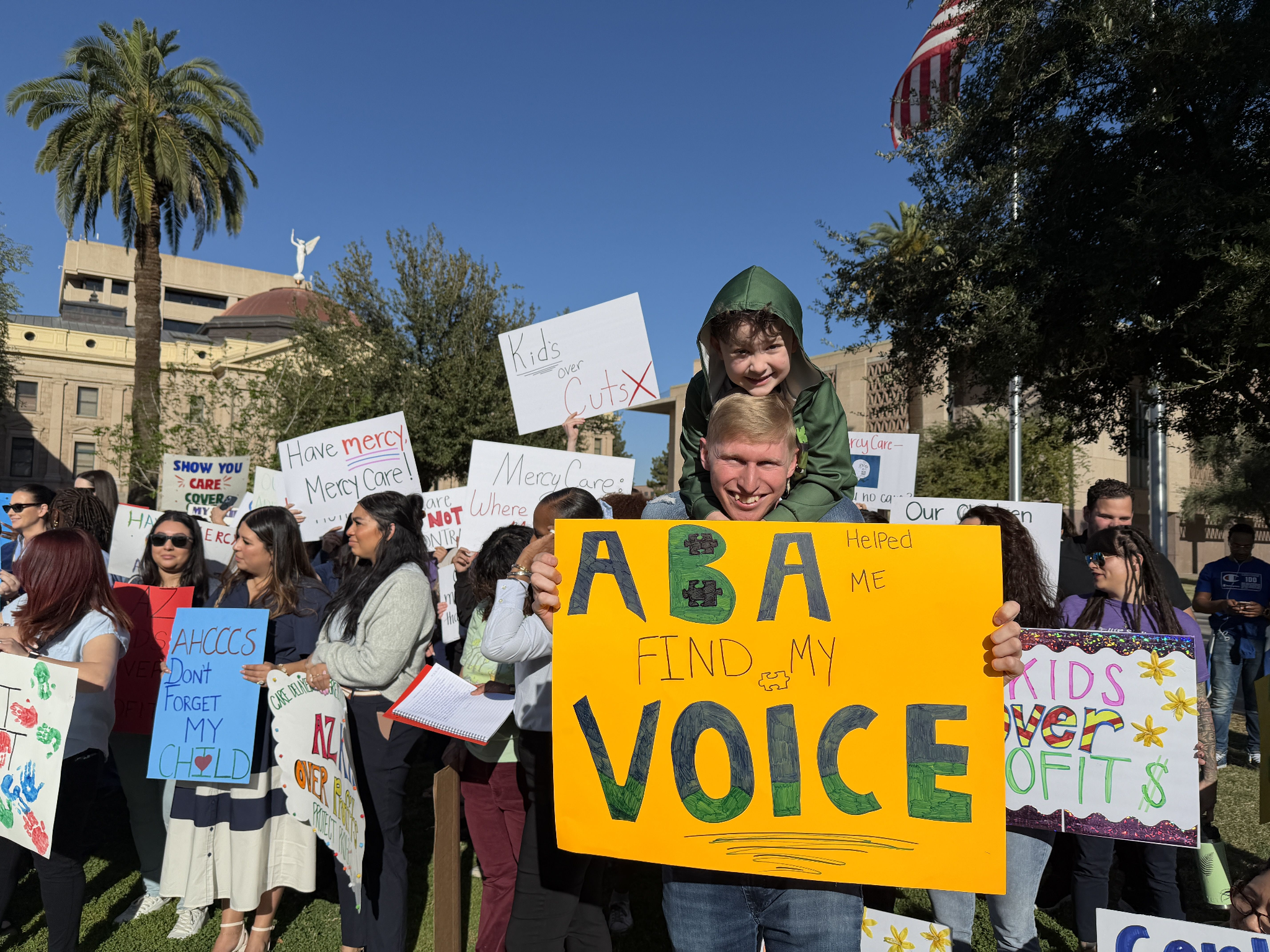
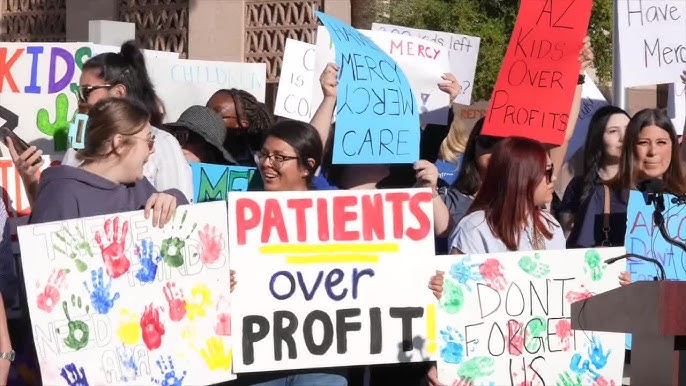
About 100 parents, providers, and advocates gathered at the state Capitol in Phoenix on March 5, 2026. Kim Powell introduced her four-year-old son, Teddy, who was nonverbal before ABA, and he spelled his name at the microphone.
As of late June 2026, neither suit has yielded an injunction, settlement, or final ruling, and no dropped provider has been reinstated. The class action is before Maricopa County Superior Court Judge Michael Herrod. A February court declaration by AHCCCS, cited by AZ Law Now, showed that of about 300 Action Behavior Centers patients on Mercy Care, only 37 had moved to a new provider before coverage ended. AHCCCS held webinars in April 2026 to preview proposed rules that would tighten oversight of ABA providers.
A Wider Retrenchment
Optum’s playbook now looks less like an outlier than an early move in a wider squeeze on Medicaid ABA. Across 2025 and 2026, states cut rates, capped hours, and tightened reviews. Meanwhile federal auditors pressed to recover what they called improper payments.
The HHS Office of Inspector General has made Medicaid ABA spending a priority, auditing state programs one by one. It reported that Indiana made at least $56 million in improper fee-for-service ABA payments, Wisconsin at least $18.5 million, and Colorado at least $77.8 million, with more state audits on its work plan. Those findings centered on record-keeping gaps, missing credentials, and billing errors, not proven fraud, a distinction providers and their trade groups have pressed hard as the audits spread.
States moved on rates simultaneously. Nebraska cut some ABA payments by up to 79% and imposed a 30-hour weekly cap in 2025, its largest provider announced a Medicaid exit. They then reversed within a week after public outcry. North Carolina went the other way. Governor Josh Stein canceled planned Medicaid rate cuts, including a 10% ABA reduction, in December 2025. This happened after families of autistic children sued and a court paused the cuts. The pattern is uneven, but in most states, the direction is toward containment.
The result is a benefit caught between two pressures. Insurers like Optum move to trim networks and hours to protect margins, while state and federal auditors press to recover payments they flag as improper. Honest providers can be squeezed by both at once, even as prevalence and demand continue to rise.
UnitedHealth Under Pressure
The company behind the playbook sits in a very different place than it did in December 2024. In May 2025, CEO Andrew Witty stepped down, and Stephen Hemsley, who led UnitedHealth from 2006 to 2017, returned as chief executive. Patrick Conway became CEO of Optum that same month.
In July 2025, UnitedHealth confirmed it was complying with “formal criminal and civil requests” from the Department of Justice tied to its Medicare Advantage billing, a matter separate from its Medicaid ABA practices. That investigation remained open as of mid-2026, with no charges or settlement reported. The company’s share price fell sharply in 2025, its worst year on the market since 2008.
For 2026, UnitedHealth guided revenue down by roughly 2%, its first annual decline in more than a decade. A company shedding Medicaid members and repricing contracts it calls unprofitable has little room for rising spend on a high-cost benefit.
The Legal Exposure
Advocates who reviewed the documents told ProPublica the strategy raised questions under the federal mental health parity law and Medicaid network-adequacy rules. The Mental Health Parity and Addiction Equity Act requires health plans, including Medicaid managed care organizations, to cover mental health care no more restrictively than comparable medical care.
The enforcement picture has shifted since the documents surfaced. A 2024 federal rule that tightened up the requirements for how plans must prove parity prompted a lawsuit from employer groups. In May 2025, the Departments of Labor, Health and Human Services, and the Treasury said they would not enforce the new rule while they reconsider it. The parity statute itself, and the 2013 rule under it, remain in force.
Deborah Steinberg, a senior health policy attorney at the Legal Action Center, told ProPublica that Optum may also be running afoul of Medicaid managed care rules under 42 CFR 438.206, which require plans to maintain adequate networks to deliver covered services. A 2024 CMS rule added appointment wait-time standards and secret-shopper surveys to those requirements.
It would not be UnitedHealth’s first parity reckoning. In 2021, the New York Attorney General and the U.S. Labor Department reached a settlement that returned about $14 million to consumers from the company’s behavioral health unit over claims it wrongly denied mental health coverage. The company did not admit the underlying allegations. Every state now requires some autism coverage in state-regulated plans, though self-funded employer plans, which cover most workers, fall outside those mandates. For children under 21 on Medicaid, federal EPSDT rules require coverage of medically necessary services, including ABA.
What Operators Should Watch
For practice owners, the documents and the events carry practical weight. If Optum applies the approach across its seven target states, providers in Arizona, Nebraska, Tennessee, Virginia, New Jersey, Indiana, and Louisiana are working in states where a major Medicaid payer is trying to reduce both its network participation and its authorized hours.
Optum’s own provider pages show Medicaid network entry for ABA is no longer open in every market. In Arizona, it says it is limiting additions and accepting new ABA participation requests only where it sees a network need. For operators planning new locations in these states, a routine credentialing application may no longer mean Medicaid participation.
The “outlier” behaviors the documents flag describe standard ABA delivery. Weekend and holiday sessions are routine in intensive programs. Treating siblings from the same family is common in autism practice. Long treatment days reflect the intensity required by severe cases. Each can now trigger scrutiny, an audit, or termination under a documented payer methodology and, increasingly, government audits that draw on the same billing data.
The risk to operators is a downward spiral: as routine denials make insurance work unsustainable, clinicians stop accepting insurance, families who cannot pay out of pocket lose access to care, and clinics operating on Medicaid rates close. Aspire’s waitlist was about 260 children at the time of ProPublica’s report. The need continues to stay.
AT A GLANCE
| Source documents: | Optum internal reports obtained by ProPublica; reported December 13, 2024 (Annie Waldman) |
| Projected network impact: | More than two-fifths of ABA provider groups in some states; up to 19% of patients (ProPublica, 2024) |
| Optum Medicaid ABA spend: | ~$290M projected; up ~$75M year over year; patients up ~20% (ProPublica, 2024) |
| UnitedHealth Group net income: | $22B (2023), $14.4B (2024), $12.1B (2025) (UHG SEC filings) |
| Targeted states: | Arizona, Nebraska, Tennessee, Virginia, New Jersey, Indiana, Louisiana (ProPublica, 2024) |
| Louisiana projection: | ~40% of ABA provider groups cut; ~1 in 5 covered children at risk (ProPublica, 2024) |
| Arizona terminations: | Mercy Care, AZ Complete Health, and UnitedHealthcare dropped Action Behavior Centers and/or Centria; ~1,000 children; effective March 2026 |
| Arizona litigation: | 2 suits, Maricopa County; class action (Feb 6, 2026) names AHCCCS; no injunction or settlement as of late June 2026 |
| Transition gap: | 37 of ~300 ABC patients on Mercy Care moved to a new provider before cutoff (AHCCCS declaration via AZ Law Now, 2026) |
| HHS-OIG ABA audits: | Indiana ≥$56M, Wisconsin ≥$18.5M, Colorado ≥$77.8M improper payments; more pending (2024–2026) |
| Autism prevalence: | 1 in 31 eight-year-olds (CDC, surveillance year 2022; published April 2025) |
| Parity rule status: | 2024 MHPAEA final rule in non-enforcement since May 2025; statute and 2013 rule still apply |
| DOJ investigation: | UnitedHealth confirmed criminal and civil Medicare probes, July 2025 (separate from ABA); open |
SOURCES & REFERENCES
| 1. | ProPublica. “UnitedHealth Is Strategically Limiting Access to Critical Treatment for Kids With Autism.” Annie Waldman. December 13, 2024. https://www.propublica.org/article/unitedhealthcare-insurance-autism-denials-applied-behavior-analysis-medicaid |
| 2. | Behavioral Health Business. “Optum Reportedly Whittling Away at Medicaid Coverage for Autism Therapy.” December 13, 2024. https://bhbusiness.com/2024/12/13/optum-reportedly-whittling-away-at-medicaid-coverage-for-autism-therapy/ |
| 3. | Fox Business. “News Outlet Says UnitedHealthcare Limited ‘Critical’ Care for Kids With Autism.” Breck Dumas. December 16, 2024. https://www.foxbusiness.com/lifestyle/news-outlet-says-unitedhealthcare-limited-critical-care-kids-autism |
| 4. | CDC. “Prevalence and Early Identification of Autism Spectrum Disorder Among Children Aged 4 and 8 Years, ADDM Network, 16 Sites, United States, 2022.” MMWR Surveillance Summaries 2025;74(2). April 17, 2025. https://www.cdc.gov/mmwr/volumes/74/ss/ss7402a1.htm |
| 5. | Grosvenor LP, et al. “Autism Diagnosis Among US Children and Adults, 2011–2022.” JAMA Network Open. 2024. https://jamanetwork.com/journals/jamanetworkopen/fullarticle/2825472 |
| 6. | Behavioral Health Business. “Rates of Autism Higher Among Children With Public Insurance.” July 15, 2024. https://bhbusiness.com/2024/07/15/rates-of-autism-higher-among-children-with-public-insurance/ |
| 7. | UnitedHealth Group. “UnitedHealth Group Announces Leadership Transition.” May 13, 2025. https://www.unitedhealthgroup.com/newsroom/2025/2025-05-13-uhg-announces-leadership-transition.html |
| 8. | UnitedHealth Group. “UnitedHealth Group Responds to Department of Justice Investigation.” July 24, 2025. https://www.unitedhealthgroup.com/newsroom/2025/2025-07-24-uhg-responds-to-doj-investigation.html |
| 9. | UnitedHealth Group. “UnitedHealth Group Reports 2025 Results and Issues 2026 Outlook.” SEC Form 8-K, Exhibit 99.1. January 27, 2026. |
| 10. | UnitedHealth Group. First Quarter 2026 Earnings Release. SEC Form 8-K. April 21, 2026. |
| 11. | Healthcare Dive. “UnitedHealth Names New CEO of Optum.” 2025. https://www.healthcaredive.com/news/unitedhealth-new-optum-ceo-patrick-conway/746797/ |
| 12. | AZFamily (KTVK). “Arizona Autism Families Forced to Change Providers After Medicaid Contract Dispute.” Derek Staahl. November 25, 2025. https://www.azfamily.com/2025/11/26/arizona-autism-families-forced-change-providers-after-medicaid-contract-dispute/ |
| 13. | Arizona Capitol Times. “Autism Therapy Center, Parents Sue AHCCCS, DES and Insurer Over Contract Dispute.” Reagan Priest. December 22, 2025. https://azcapitoltimes.com/news/2025/12/22/autism-therapy-center-parents-sue-ahcccs-des-and-insurer-over-contract-dispute/ |
| 14. | AZFamily (KTVK). “UnitedHealthcare Cuts Autism Therapy Provider, Impacting Arizona Families.” Mickaela Castillo. January 26, 2026. https://www.azfamily.com/2026/01/26/unitedhealthcare-cuts-autism-therapy-providers-impacting-arizona-families/ |
| 15. | KJZZ / Capitol Media Services. “Lawsuit: 1,000 Kids With Autism Lost Access to Critical Therapy Due to AHCCCS.” Howard Fischer. February 9, 2026. https://www.kjzz.org/politics/2026-02-09/lawsuit-1-000-kids-with-autism-lost-access-to-critical-therapy-due-to-ahcccs |
| 16. | Arizona Mirror. “Arizona Families Say AHCCCS Left Autistic Children Stranded Without Therapy Options.” March 5, 2026. https://azmirror.com/2026/03/05/arizona-families-say-ahcccs-left-autistic-children-stranded-without-therapy-options/ |
| 17. | KTAR News. “AZ Families Scrambling After Medicaid Drops Autism Therapy Providers.” Heidi Hommel. March 5, 2026. https://ktar.com/arizona-health-news/medicaid-drops-autism-therapy/5831579/ |
| 18. | Axios Phoenix. “Nearly 1,000 Arizona Children Lose Access to Medicaid Autism Therapy Providers.” Jessica Boehm. March 6, 2026. https://www.axios.com/local/phoenix/2026/03/06/arizona-children-lose-access-autism-therapy-providers |
| 19. | AZ Law Now. “AHCCCS ABA Contract Crisis: 1,000 Children.” May 19, 2026 (updated June 14, 2026). https://azlawnow.com/investigations/ahcccs-aba-contract-crisis-1000-children/ |
| 20. | HHS Office of Inspector General. “Indiana Made at Least $56 Million in Improper Fee-for-Service Medicaid Payments for ABA.” Report A-09-22-02002. December 2024. https://oig.hhs.gov/reports/all/2024/ |
| 21. | HHS Office of Inspector General. “Wisconsin Made at Least $18.5 Million in Improper Fee-for-Service Medicaid Payments for ABA.” Report A-06-23-01002. July 2025. https://oig.hhs.gov/reports/all/2025/ |
| 22. | HHS Office of Inspector General. “Colorado Made at Least $77.8 Million in Improper Fee-for-Service Medicaid Payments for ABA.” Report A-09-24-02004. February 2026. https://oig.hhs.gov/reports/all/2026/ |
| 23. | Behavioral Health Business. “Nebraska Medicaid Rolls Out Steep Cuts to ABA Services.” July 14, 2025. https://bhbusiness.com/2025/07/14/nebraska-medicaid-rolls-out-steep-cuts-to-aba-services/ |
| 24. | KFF Health News / NPR. “It’s the ‘Gold Standard’ in Autism Care. Why Are States Reining It In?” Bram Sable-Smith and Andrew Jones. December 23, 2025. https://kffhealthnews.org/news/article/aba-therapy-applied-behavior-analysis-autism-medicaid-rate-cuts-north-carolina/ |
| 25. | Office of North Carolina Governor Josh Stein. “Governor Stein Directs NCDHHS to Restore Medicaid Rates.” December 10, 2025. https://governor.nc.gov/news/press-releases/2025/12/10/ |
| 26. | U.S. Departments of Labor, Health and Human Services, and the Treasury (EBSA). “Statement Regarding Enforcement of the 2024 MHPAEA Final Rule.” May 15, 2025. https://www.dol.gov/agencies/ebsa/laws-and-regulations/laws/mental-health-parity/statement-regarding-enforcement-of-the-final-rule-on-requirements-related-to-mhpaea |
| 27. | Federal Register. “Medicaid and CHIP Managed Care Access, Finance, and Quality.” 89 FR 41002 (CMS-2439-F). May 10, 2024. https://www.federalregister.gov/documents/2024/05/10/2024-08085/ |
| 28. | New York Attorney General. “Attorney General James and US Department of Labor Deliver $14 Million to Consumers Who Were Wrongly Denied Mental Health Coverage.” 2021. https://ag.ny.gov/press-release/2021/attorney-general-james-and-us-department-labor-deliver-14-million-consumers-who |
| 29. | Optum Provider Express (Arizona). “Welcome Arizona Behavioral Health Providers.” https://public.providerexpress.com/content/ope-provexpr/us/en/our-network/welcomeNtwk/wAZ.html |
| 30. | National Conference of State Legislatures. “Autism and Insurance Coverage State Laws”; CMS EPSDT Informational Bulletin (2014). https://www.ncsl.org/health/autism-and-insurance-coverage-state-laws |
| 31. | The Motley Fool. “UnitedHealth Stock Is Having Its Worst Year Since 2008.” July 28, 2025. https://www.fool.com/investing/2025/07/28/unitedhealth-stock-is-having-its-worst-year-since/ |
| 32. | AZFamily (KTVK). “Class-Action Lawsuit Targets AHCCCS Over Autism Coverage Cuts in Arizona.” Brian Petersheim Jr. February 6, 2026. https://www.azfamily.com/2026/02/06/class-action-lawsuit-targets-ahcccs-over-autism-coverage-cuts-arizona/ |