A Hearing Over the Last Plan Standing
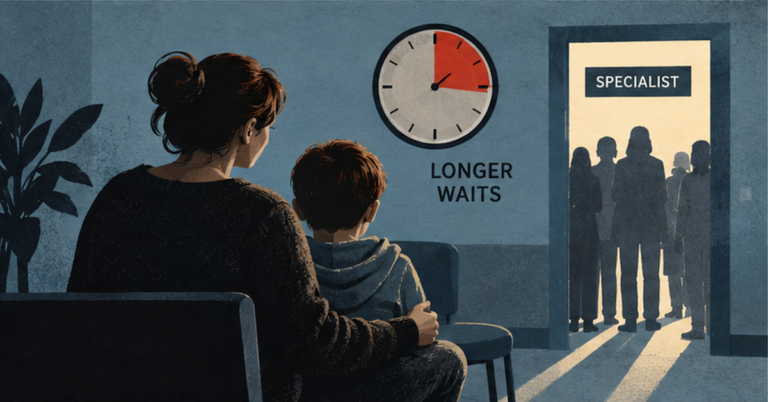
ATLANTA – CareSource is the last Medicaid plan continuing to operate in Georgia. It recently cut what it pays for children’s therapy by 20 percent. On June 23, state lawmakers brought the insurer before a General Assembly hearing to explain why.
The reduction took effect May 11. CareSource mailed providers a Notice of Material Amendment on March 27 cut reimbursement by 20 percent for every covered service. Providers had 45 days to object. Silence counted as acceptance, and a formal objection would result in a termination of the contract.
The timing is what gives the cut its force. In December 2024, the Georgia Department of Community Health rebuilt the state’s Medicaid managed care program, awarding new contracts to CareSource, Humana, Molina, and UnitedHealthcare. Two incumbents that lost their bids, Amerigroup and Peach State Health Plan, are on their way out. The three new plans do not go live until July 1, 2026. That leaves CareSource as the only fully functioning network in the market, taking on members from the exiting plans at the same moment it is cutting their providers’ pay.
The Case Against the Cut
Therapists who testified framed the reduction as a threat to access for the children least able to absorb it. Cynthia Burroway, a physical therapist who employs 30 people at Atlanta Children’s Therapy Associates to deliver care in homes, schools, and daycares, described in-home therapy as the only option many of her families have.
“It is a vital lifeline for these low income families who simply lack transportation or resources to drive to a clinic, not once, but every single week.” – Cynthia Burroway, physical therapist, before the Georgia General Assembly (June 2026)
The economics leave little cushion. Most BCBA-owned practices run on operating lean operating margins, an amount far thinner than the 20 percent CareSource is taking off the top. For owner-operated clinics that cannot spread the loss across a multi-state platform, the choice CareSource set out is binary: accept 20 percent less from the market’s dominant active payer, or leave the network while no replacement network is yet open.
That last point drew the opposition’s sharpest argument. CareSource can impose the cut, providers and lawmakers said, only because it holds a temporary monopoly. Amerigroup and Peach State are exiting after losing their contracts, and the incoming plans are not yet credentialing providers or paying claims. CareSource is the only incumbent that kept its contract, and it is using that position to reset rates before competition returns July 1.
Lawmakers on the panel were blunt. State Rep. Scott Hilton, who chaired the hearing, said the state should be expanding access for disabled children, not contracting it.
“Frankly I’ve got no tolerance. No tolerance for anyone who is hurting some of our state’s most vulnerable kids.” – Rep. Scott Hilton, before the Georgia General Assembly (June 2026)
“Every effort we make should be focused on taking care and improving services, not decreasing them,” Hilton added.
CareSource Defends the Cut. Executive Conspicuously Absent
Jesse Wethington, CEO of the Georgia Association of Health Plans speaking on behalf of CareSource, told lawmakers the cut responds to fast-rising use of therapy services and is meant to keep the program sustainable. He pointed to utilization climbing across the benefit and far faster within autism services.
“You’ve seen, I think, utilizations increasing to about 62% over the period from 2018 to 2025,” Wethington said. “A lot of these areas, especially in the autism services community subset, that has been more like 300%.”
Wethington also argued the change would not strand patients, because providers who decline the new rate are not the only option for a member. “If there are instances where a provider does not want to take the new rates that are on offer,” he said, “that Medicaid member can be seen potentially by another provider that does elect to stay the network.”
Rep. Jesse Petrea, chairman of the House Human Relations and Aging Committee, pressed on that logic. Georgia’s arrangement pays the plan a fixed amount per member regardless of how much care is delivered, he noted, which makes managing demand the insurer’s responsibility rather than the provider’s.
“This is a capitated program, you alluded to that,” Petrea told Wethington. “That’s your job, to anticipate the demand and the need for services.”
The Consequences Each Side Foresees
On the provider side, the feared consequence is collapse of access. A cut of a fifth pushes reimbursement back to roughly where it sat a decade ago, a level owner-operated clinics say they cannot run on. If those practices close or drop CareSource, the cost falls on families. It also means that there will be less providers and practices. Low-income households that rely on in-home therapy, including the children Burroway said cannot reach a clinic every week, could be left with no provider once their current one exits and no replacement network open until July.
For CareSource, the feared consequence is runaway cost. Under a capitated contract, the plan absorbs demand it cannot directly control, and Wethington pointed to use of therapy services rising about 62 percent since 2018 and roughly 300 percent within autism services. Left unchecked, the insurer argues, that growth threatens the program’s sustainability for everyone it covers. The cut carries a second risk if enough providers walk, CareSource still must serve those members and could end up paying more at out-of-network rates.
The two outcomes hang on one question the hearing did not resolve: whether cutting pay by a fifth protects the program or hollows out the network meant to deliver it. Three new plans join July 1. Whether they hold the line on rates, or follow CareSource lead on the 20 percent cut, is what Georgia providers will be watching first.
AT A GLANCE
| Rate change: | Reimbursement cut to 80% of the Georgia Medicaid fee schedule, a 20% reduction (CareSource Notice of Material Amendment, March 27, 2026) |
| Effective date: | May 11, 2026 (Acuity News, April 2026) |
| Provider window: | 45 days to object; silence is acceptance; objection triggers termination 90 days later (Acuity News, April 2026) |
| Hearing: | Georgia General Assembly, June 23, 2026 |
| CMO transition: | Amerigroup and Peach State exiting; Humana, Molina, UnitedHealthcare launch July 1, 2026 (Georgia DCH; OPEN MINDS, January 2025) |
| Incumbent renewed: | CareSource, the only returning plan and only fully operating network during the transition (Acuity News, April 2026) |
| Beneficiaries affected: | About 1.5 million in Georgia Families, the largest Medicaid restructuring since 2006 (OPEN MINDS, January 2025) |
| Practice margins cited: | Most BCBA-owned practices run on 8% to 15% operating margins (provider testimony, June 2026) |
| CareSource rationale: | Utilization up about 62% from 2018 to 2025, roughly 300% within autism services (Jesse Wethington, June 2026) |
SOURCES & REFERENCES
| 1. | Georgia General Assembly. House committee hearing on Medicaid therapy reimbursement. June 23, 2026. Video: https://www.legis.ga.gov/schedule/house |
| 2. | Webb, Ethan. “Georgia Medicaid ABA Providers Face a 20% Rate Cut from CareSource.” Acuity News. April 7, 2026 (updated April 20, 2026). https://acuity.news/regulation/georgia-medicaid-aba-caresource-rate-cut-2026/ |
| 3. | Tagami, Ty. “Pending cuts to Georgia Medicaid payments could affect children who need therapy.” Capitol Beat News Service. April 24, 2026. https://capitol-beat.org/2026/04/pending-cuts-to-georgia-medicaid-payments-could-affect-children-who-need-therapy/ |
| 4. | “For Georgia Medicaid Managed Care Contracts, One Incumbent & Three New Plans.” OPEN MINDS. January 13, 2025. https://openminds.com/market-intelligence/news/for-georgia-medicaid-managed-care-contracts-one-incumbent-three-new-plans/ |
| 5. | “Georgia ABA Providers Brace for 20% Rate Cut from CareSource.” Behavioral Health Business. April 8, 2026. https://bhbusiness.com/2026/04/08/georgia-aba-providers-brace-for-20-rate-cut-from-caresource/ |
| 6. | Georgia House of Representatives. Representative Jesse Petrea, District 166, Chairman, Human Relations & Aging Committee. https://www.house.ga.gov/Representatives/en-US/member.aspx?Member=862 |
| 7. | “Fight over Georgia’s Medicaid contracts nears the end, as foster parents plead for reversal.” Georgia Recorder. December 13, 2025. https://georgiarecorder.com/2025/12/13/ |