


It is July 4th, 2026 and I am incredibly fortunate. I get to live in the city where it all started 250 years ago, I learned this behavioral perspective that serves me so well, and I get an opportunity to write about behavior analysis and freedom. My day starts as any July 4th usually would. My wife is taking advantage of holiday pay, and I’m spending the day with my daughters, ages teen and tween. We attend the parade in Rockledge, PA, just outside of Fox Chase, Philadelphia, where we live. I see a little girl wearing a dress with stars and stripes, crying to her mother to pick her up. Her mother may be doing an intervention as the little girl will not stop crying and the mother will not pick her up. Her father eventually comes over and takes her by the hand to the front row. The crowd cheers on the parade. I cheer the removal of an aversive. I ask myself, is this freedom? Skinner (1971) saw freedom as the removal or escape from aversives while Goldiamond (1975; 1976) saw freedom as the possibility to seek alternative reinforcement. In this situation, who became more free? The crying little girl? The mother? The father? Me?
A behavior analytic view of freedom first starts with determinism, a core perspective of radical behaviorism, the philosophy of our science. Determinism is a necessary approach if you want to conduct a science of behavior. If we cannot determine behavior from measurable environmental variables, our science would not be possible as an unknown number of variables unrelated to the environment would need to be considered. Our ABC data sheets, functional behavior assessments, and functional analyses would be useless. Determinism assumes that our behaviors are the product of the consequences experienced when our biology interacts with the environment, which suggests determinism is more than our learned behavior. Many of us were taught that determinism is a necessary outcome of antecedent events and that only the antecedent events that occurred could have produced this behavior. In this sense, behavior is like destiny: an inevitable fate that arises from our past. However, what many of us were not told (except for my students, of course) is that there are more than one ‘flavor’ of determinism. For more in-depth coverage, please read the review by Slife et al. (1999).
Metaphysical determinism is the ‘flavor’ of determinism we are all most familiar with: the fate-like, destiny-seeking, strict control over behavior. However, some question whether the order derived from our analysis of behavior is not a feature of behavior and controlling variables, but rather our scientific methods. Scientific (methodological) determinists believe that our measurement and analysis, in and of itself, alters the thing to be measured. In a way, this makes sense. We are applying order to a system either in categorizing or quantifying events. Since categorization and quantification are necessarily orderly, we get orderly results. Scientific determinism believes the scientific method will lead to discoveries in order and prediction, but it is also the thing that makes it orderly and predicts.
Seeking functional relations between an independent variable and a dependent variable is a fundamental operation in our science. We laud the superiority of our experimental methods over correlation, screaming “correlation does not mean causation”. However, some determinists believe we can never really prove causation. As with all behavior analytic discussions on causation, we invoke the analogy of the pool table: a well-placed speaker and magnets below the surface of the table could ‘trick’ us into assuming one ball hits another, which results in the second ball rolling into a pocket. Causal relations are evoked when the only possible thing we can do objectively and scientifically is to show correlations and covariations. Functional interdependence is a flavor of determinism that suggests correlation and covariation should be our focus as they are the only things we can really prove, not functional relations.
Lastly, and my favorite, is metaphysical probabilism, a flavor of determinism that suggests all events occur in a stochastic fashion (randomly, but on a normal curve). This is consistent with a behavior analytic view of evolution as selectionism is a core philosophy of radical behaviorism. It infers that the random variation suggested by Darwin’s theory occurs on the levels of phylogeny, ontogeny, and culture. A discussion of this ‘randomness’ is applicable but beyond the scope of this writing. However, metaphysical probabilism with its ‘stochaotic’ variation stands in stark contrast to metaphysical determinism especially in what to do next: where metaphysical determinists would insist specific antecedent events are necessary for a specified outcome, metaphysical probabilists would insist the outcomes could only fall on a probability distribution that is ever changing depending on selection by the environment.
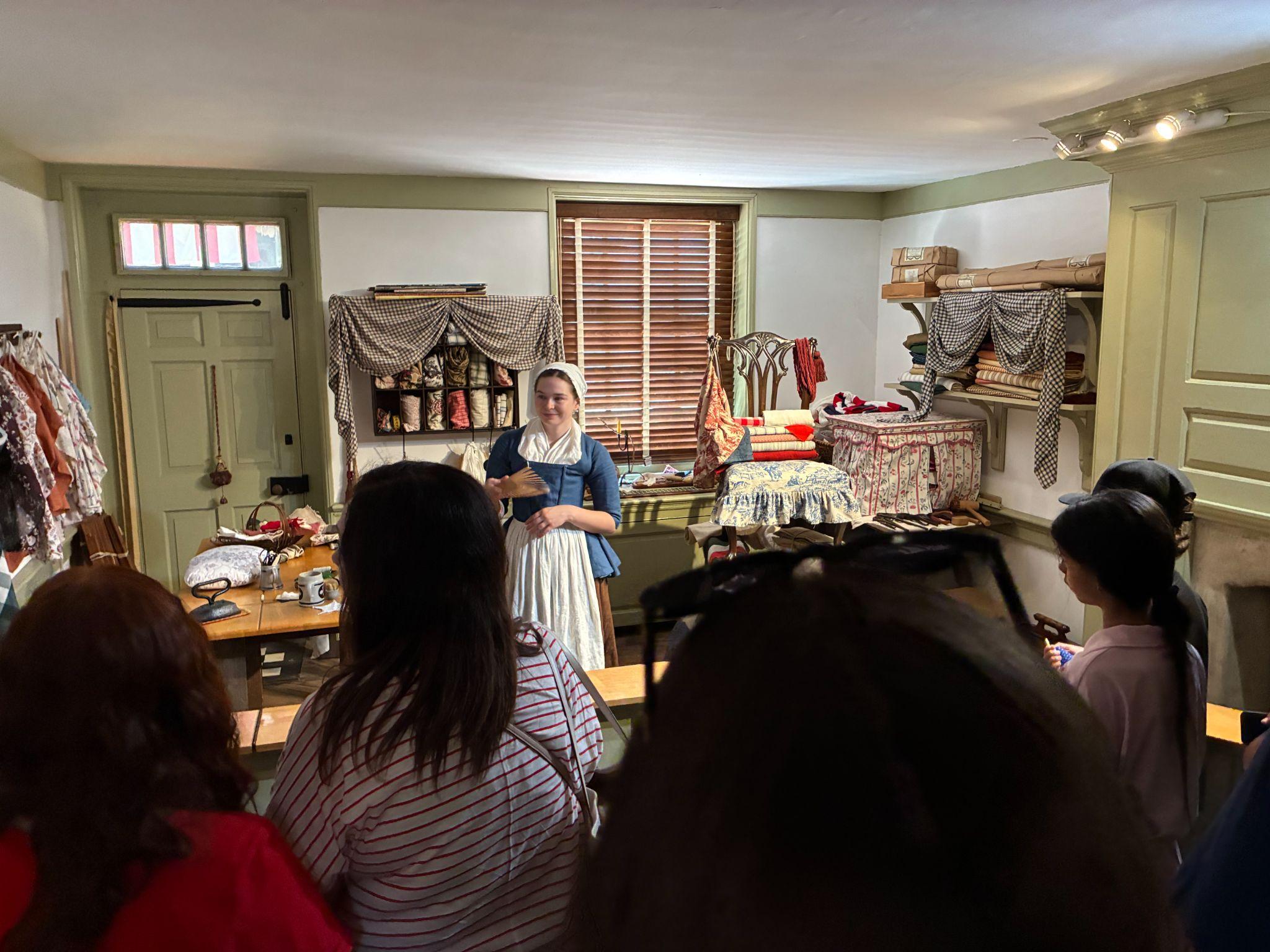
As savvy Philadelphians, we drove downtown instead of taking the train despite the instructions on the news to avoid driving. Ironically, we avoided the tourist traffic on public transportation and found a great spot around the corner from our first spot. The Betsy Ross House is a Philadelphia landmark where the first stars and stripes were sewn. My daughters and I place bets on which Betsy we will see: young Betsy or old Betsy. It was young Betsy. As I watch my girls interact with “the ghost of Betsy Ross” and the re-enactor gracefully bobs and weaves questions without breaking character, I think of the tangible function of behavior and the flag: something that has become a symbol for our patriotism and our nation. Of course, we apply arbitrary meaning to this arbitrary piece of cloth with pieces of cloth sewn on it, but just because it is arbitrary does not mean there is not strong stimulus control.
The tangible function of behavior is ever so pertinent as we continue towards Independence Mall and come across the President’s House: a predecessor to the White House presided by Washington that was recently “re-messaged” at the order of President Trump to remove all stories relating to the 2007 discovery of slave quarters during excavation. The excavation captivated us. We often watched the archeologists do their tedious work. What they found confused us, horrified us, embarrassed us, but also taught us something very important. We were not going to hide what happened there. News stories were affixed to the wall regarding the actions of the President and a recent court reversal. I asked myself again, is this freedom? His freedom or my freedom? I think of Goltz (2020) on freedom: when resources are diverted from an individual, they are not considered free.
Interestingly, the voting booth is very much like an operant chamber: the subject is isolated and required to press levers. Previous research (Herrnstein, 1961) has shown that at least for animals, behavior is not allocated “freely” across response options. Rather, it is allocated according to rate of reinforcement. Using a six-key operant chamber, Catania (1976, 1980) showed that even when rates of reinforcement are equal, the birds prefer having a choice over forced choices. Although this is attributed to a survival function (as having alternative reinforcement is more adaptive), Catania also showed that having options may be reinforcing in and of itself. Even when responding shifted to forced choice because reinforcement shifted there, this shift could not be maintained. I think back to President Trump…his behavior is the result of his phylogeny and history of reinforcement. His behavior is controlled by consequences too and is sensitive to them.
I pass by the Liberty Bell with a long line to go inside. I see it through a window in the garden behind it, closer than if I went inside (savvy Philadelphian). Behind me is Independence Hall. If I were transported back 250 years, I’d be watching the signing through the window. A stage with national broadcasters was on the lawn in front of Independence Hall and next to the Liberty Bell. A cheer emerges from the crowd that separates the locals from the tourists. E-A-G-L-E-S Eagles! We yell for our football team as the broadcasters talk about the upcoming World Cup match and shrug their shoulders on how to handle the off-topic cheering. Just east of Independence Hall is Signer’s Garden where storytellers were enlisting the young tourists to march like they were part of the revolutionary army. The crowd cheers and smiles underneath a statue: the signer (Frudakis, 1980). I examine the face of the Bronze as he holds up a rolled parchment, gazing at it with a look that exemplifies not only hope, but amazement that a parchment could be his salvation. I pause again, being mindful and in the moment, I ask myself, “is that…freedom?” Skinner (1971) said freedom was a matter of contingencies of reinforcement. If we appropriately arrange these contingencies, we will feel free. Were those contingencies arranged for ‘the signer’ to feel free? The sculptor? Me?
Determinism, as a philosophy of our science, is a point of view, very much like a lens. If one ‘flips the lens’ the other way, you might see something different. The opposing viewpoint to determinism is libertarianism which proposes that since another response option exists, we could have done the other thing. Libertarianism believes that not every event has a causal antecedent and since those options have different outcomes, the selection of those options are self-forming. It is hard to argue we are making choices when the matching law has so clearly shown us our choices are allocated according to reinforcement (Cox et al., 2017; Reed et al., 2006). If there is free will, as in choice behavior not controlled by another source, how could this equation account for so much behavior? Either free will doesn’t exist or it has a very small effect on behavior. And if there is free will…behaviorists might be out of business. Not only that, but how could we ever hold someone accountable in court if their environment were responsible for their actions?
Perhaps a compatibilist perspective might rectify determinism and the judicial system. Compatibilists believe moral responsibility and freedom are compatible with determinism since more than one response option generally exists and thus perpetrators did have a choice’. In this way, freedom is not thought of as the ability to do the other thing (which matching law shows is predictably controlled) but that another response option was available. Another determinism rectifying point of view is revisionism where free will is thought to serve social and cognitive functions: a practice that evolved due to its usefulness. Freedom and free will allows us to problem solve, seek answers, and make a choice. Skinner (1971) noted the importance of the literature of freedom, suggesting control for such a thing can come from our culture. Behavior analysts adopt pragmatism, another core philosophy of radical behaviorism, over realism: instead of arguing whether freedom is ‘real’ or not, we ask about the usefulness of such a thing.
Freedom as a cultural practice to behavior analysts looks like selection at the level of culture. In this way, freedom is a behavior practiced by groups, with an aggregate product that could either be harmful for the group or increase the group’s adaptiveness and survivability (Glenn, 1988). Considering freedom as a cultural practice makes it verbal behavior maintained by generalized conditioned reinforcement in the form of approval or acceptance from the group. Freedom as a verbal behavior can be conceptualized with relational frame theory, which emphasizes our learning to respond in arbitrary ways, such as in sameness with being free, in opposition to being free, more free, less free, or in other arbitrary ways. I have been known to ask a student in my class to behave as if they ‘have more freedom’. Students might put their feet up on the desk, lean back, close their books, or leave, as if there was a lack of instructional control (Galizio, 1979). Regardless of whether the accuracy of the performance captured freedom, the simple possibility that someone could behave more or less free gives credence to the existence or at least to the usefulness of freedom. It also suggests that whatever freedom is considered to be, it is learned through our culture and that definition may differ with other cultures.
When delivering Acceptance and Commitment Therapy, we train a skill called mindfulness which includes two components: paying attention to present moment sensory input and doing so ‘non-judgmentally’. It is the non-judgmental part that gives me pause. If our behavior is a result of our reinforcement history, can we behave as if it weren’t? And if that is possible, is there still determinism? In the face of determinism, it is important to consider mindfulness a skill we us to respond as if we were not influenced by our previous history. Two ways in which we deviate from behavior matching precisely to consequences are bias and sensitivity. Bias is explained preference which could be inherited or learned. Phylogenetically speaking, preference for or against a thing is apparent and adaptive. Animals are biased towards (reinforcers) and against (aversives) certain stimuli through the history of their species because it was adaptive. A preference could also be learned as stimuli can be associated with a higher proportion of reinforcement. Or maybe we just use our right hands because we are right-handed.
Either way, learned or unlearned, generalized matching law (Rachlin & Green, 1972) accounts for the discrepancy. If this is true, even with bias, how do we know if an organism is choosing freely? Baum (2017) suggested freedom requires unpredictability, but not randomness. This is an important distinction because Page and Neuringer (1985) and Neuringer (1986) taught pigeons and then humans (respectively) to respond more randomly. Does this mean they also responded ‘more freely’? This would be hard to argue since their random responding was under environmental control. On the concept of control, Skinner (1971) realized people don’t like the idea of their behavior being controlled, even though they are controlled everywhere they go: at church by the commandments or religious rules, parented when they are raised, in the classroom by the teacher for instructional control and learning, and parents are controlled by their children’s needs. Video games, loved by most, represent the strongest control. The control is so precise that the slightest wrong movement by the thumb will result in a loss. Perhaps control is the wrong word for it? If I asked you to choose between $100 and $500, all things being equal you would choose the larger amount. Is this “control” over your behavior, or common sense? If I offered you $1 million dollars to mow my lawn, am I controlling you or are you controlling me? If I hold a gun to your head and made you mow my lawn, we might agree that this is control and you are not free. Skinner argued that people want to be controlled, just in very specific ways. He was referring to reinforcement.
For Skinner, freedom meant no contingencies of aversive control, which would include freedom from immediate reinforcers that could be long-term aversives. For Goldiamond, freedom meant choices or a means to seek alternative reinforcement. For Goltz, freedom is extended to no diversions of reinforcement and appropriate choice architectures. As the day closes and I set off fireworks that I could not set off 10 years ago, I pause mindfully and ask, “is this freedom? Am I free?” Or maybe it is just fun, and I like it (reinforcement).
AT A GLANCE
| Author: | Scott A. O’Donnell, Temple University; Society for the Expansion of Behavior Analysis |
| Occasion: | July 4, 2026, the U.S. semiquincentennial, written from Philadelphia |
| Recurring question: | “Is this freedom?” asked across scenes from a July 4th in Philadelphia |
| Core premise: | Determinism is the philosophy underlying a science of behavior |
| Flavors of determinism: | Metaphysical, scientific (methodological), functional interdependence, and metaphysical probabilism |
| Skinner (1971): | Freedom as removal of or escape from aversive control |
| Goldiamond (1975; 1976): | Freedom as the possibility to seek alternative reinforcement |
| Goltz (2020): | Freedom lost when resources or reinforcement are diverted from a person |
| Matching law: | Choice allocated by rate of reinforcement (Herrnstein, 1961; Cox et al., 2017; Reed et al., 2006) |
| Reconciling free will: | Compatibilism, revisionism, and pragmatism over realism |
| Freedom as culture: | A cultural practice and verbal behavior maintained by group approval (Glenn, 1988) |
References
Baum, W. M. (2017). Understanding behaviorism: Behavior, culture, and evolution. Wiley Blackwell
Catania, A. C. (1975). Freedom and knowledge: An experimental analysis of preference in pigeons. Journal of the Experimental Analysis of Behavior, 24(1), 89-106
Catania, A. C., & Sagvolden, T. (1980). Preference for free choice over forced choice in pigeons. Journal of the Experimental Analysis of Behavior, 34(1), 77-86.
Cox, D. J., Sosine, J., & Dallery, J. (2017). Application of the matching law to pitch selection in professional baseball. Journal of Applied Behavior Analysis, 50(2), 393-406.
Galizio, M. (1979). Contingency-shaped and rule-governed behavior: Instructional control of human loss avoidance. Journal of the Experimental Analysis of Behavior, 31(1), 55-70.
Glenn, S. S. (1988). Contingencies and metacontingencies: Towards a synthesis of behavior analysis and cultural materialism. The Behavior Analyst, 11(2), 161-179.
Goldiamond, I. (1975). Alternative sets as a framework for behavioral formulations and research. Behaviorism, 3(1), 49-86.
Goldiamond, I. (1976). Protection of human subjects and patients. Behaviorism, 4(1), 1-41.
Goltz, S. M. (2020). On power and freedom: Extending the definition of coercion. Perspectives on Behavior Science, 43(1), 137-156. https://doi.org/10.1007/s40614-019-00240-z
Herrnstein, R. J. (1961). Relative and absolute strength of response as a function of frequency of reinforcement. Journal of the Experimental Analysis of Behavior, 4(3), 267-272. https://doi.org/10.1901/jeab.1961.4-267
Neuringer, A. (1986). Can people behave “randomly”? The role of feedback. Journal of Experimental Psychology: General, 115, 62-75. https://doi.org/10.1037/0096-3445.115.1.62
Page, S., & Neuringer, A. (1985). Variability is an operant. Journal of Experimental Psychology: Animal Behavior Processes, 11, 429-452. https://doi.org/10.1037/0097-7403.11.3.429
Rachlin, H. & Green, L. (1972). Commitment, choice, and self-control. Journal of the Experimental Analysis of Behavior, 17(1), 15-22.
Reed, D. D., Critchfield, T. S., & Martens, B. K. (2006). The generalized matching law in elite sport competition: Football play calling as operant choice. Journal of Applied Behavior Analysis, 39(3), 281-297.
Skinner, B. F. (1971). Beyond freedom and dignity. Hackett.
Slife, B. D., Yanchar, S. C., & Williams, B. (1999). Conceptions of determinism in radical behaviorism: A taxonomy. Behavior and Philosophy, 27, 75-96.








Join the discussion ▾