

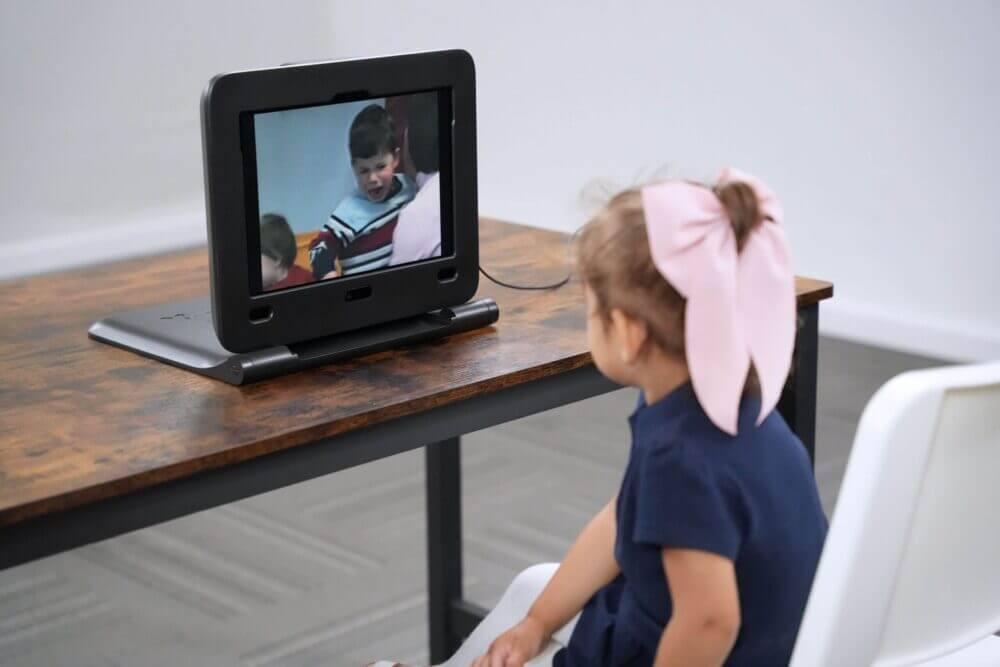
For decades, diagnosing autism has meant hours of observation, questionnaires, and specialist appointments that families often wait months or years to get. A cluster of research now points somewhere unexpected for a faster answer: the eye. And in one case, that research has already left the lab and entered the clinic.
The device that’s actually here
The clearest sign that eye-based autism assessment is no longer hypothetical is EarliPoint. Built on eye-tracking science developed at the Marcus Autism Center, the EarliPoint System measures how a young child’s gaze engages with social scenes, where they look, what they look at, and what they skip. It turns that into standardized, objective data for clinicians.
It is the first FDA-authorized tool to assess autism in children as young as 16 months objectively. In March 2026, EarliPoint Health announced that the FDA had cleared an expanded age indication, extending the device’s use through 95 months, age seven. That matters because, as the company’s scientific co-founder Dr. Ami Klin points out, four of every five children with autism are diagnosed at later ages, well past the toddler window where early intervention does the most good. The expansion, EarliPoint says, brings an objective assessment to “the vast majority of families who have waited, sometimes for years.”
“This expanded clearance allows us to now extend objective and cost-effective diagnosis and assessment to the vast majority of families who have waited, sometimes for years, to gain access to these services.” – Dr. Ami Klin, Scientific Co-Founder, EarliPoint Health (2026)
The pitch is not that a machine replaces the clinician. It’s that a roughly 20-minute test can add quantifiable evidence to a process that has long leaned almost entirely on expert observation, and can be repeated over time to track whether an intervention is actually working.
The science still in the lab
EarliPoint tracks where the eyes go. A separate and more experimental line of research asks a stranger question: can the eye itself, its structure and its electrical behavior, reveal autism, even when it isn’t looking at anything social?
The most striking result came in late 2023, when researchers at Yonsei University in South Korea published a study in JAMA Network Open using ordinary retinal photographs. They trained deep-learning models on 1,890 images from 958 children, half with autism and half matched controls. They reported an area under the curve of 1.00 for screening, effectively perfect separation of the two groups, along with a weaker but real signal for symptom severity. The interpretation is that structural changes in the retina, which is developmentally an extension of the brain, may quietly mirror changes happening in the brain itself.
That paper became the seed for one of this year’s more charming science stories. A 17-year-old New Jersey student, Edward Kang, read the retinal research and built his own version, called RetinaMind, extending it to flag both autism and ADHD from retinal images at about 89% accuracy. He went further than a classifier, building a retinal cell model and identifying roughly a dozen candidate genes that might explain why the retina looks different in the first place. The project won second place at the 2026 Regeneron Science Talent Search.
A third approach skips the photograph entirely and measures the retina’s electrical response to light. Using an electroretinogram, a single bright flash to the eye, researchers from the University of South Australia and Flinders University found that the retinas of autistic children responded differently than those of neurotypical children, with the strongest signal coming from a flash to the right eye. The test runs in about ten minutes, is non-invasive, and children tolerate it well.
Even the pupil may hold clues. A Washington State University team measured the pupillary light reflex, how quickly the pupil constricts to light and recovers afterward, in a small group of children using a handheld device, and found consistent differences in autistic children. Like the others, it points toward a fast, portable screen aimed squarely at that critical early developmental window.
The caveat every researcher keeps repeating
The enthusiasm comes with an asterisk, and the researchers themselves are the first to raise it. Autism is a behavioral and developmental condition rooted in the brain, and the differences these tools detect in the eye may not be specific to autism at all. As neurodevelopmental pediatrician Dr. Paul Lipkin cautioned in coverage of RetinaMind, any retinal difference “may not be specific for these conditions, but instead of some brain-based neurologic condition generally.” Kang agrees. A tool that can tell an autistic child from a typically developing one, the task behind that headline-grabbing 100% figure, faces a much harder job in the real world, where it has to distinguish autism from ADHD and everything else.
That is the line dividing the two halves of this story. The retinal photograph, the flash of light, the pupil test, these remain proofs of concept, promising and unproven. EarliPoint’s eye-tracking, by contrast, has cleared the FDA twice now and is being used on real children in real clinics. The gap between them is exactly the gap between an interesting finding and a validated medical tool: large studies, careful attention to specificity, and regulatory scrutiny.
What’s changed is that the destination no longer looks far-fetched. The eyes, it turns out, may be worth watching, in more ways than one.
AT A GLANCE
| FDA-cleared device: | EarliPoint System, an eye-tracking autism assessment aid built on Marcus Autism Center science |
| Original indication: | Children as young as 16 months |
| 2026 expansion: | FDA-cleared use through 95 months (age 7), announced March 12, 2026 |
| Test time: | Roughly 20 minutes; complements clinician judgment |
| Retinal-photo study: | JAMA Network Open (2023): 1,890 images, 958 children; AUC 1.00 for screening |
| RetinaMind: | Student-built AI, ~89% accuracy; 2nd place and $175,000 at 2026 Regeneron STS |
| Electroretinogram: | Single bright flash, ~10 minutes, non-invasive; autistic retinas respond differently |
| Pupillary light reflex: | Handheld test of pupil constriction and recovery shows differences in autistic children |
| Key caveat: | Eye signals may reflect brain-based neurologic conditions broadly, not autism specifically |
SOURCES & REFERENCES
| 1. | Development of Deep Ensembles to Screen for Autism and Symptom Severity Using Retinal Photographs. JAMA Network Open. 2023. jamanetwork.com/journals/jamanetworkopen/fullarticle/2812964 |
| 2. | Waseem R. This High Schooler Developed an A.I. Tool to Diagnose Autism and ADHD Using the Retina. Smithsonian Magazine. May 11, 2026. smithsonianmag.com |
| 3. | Hutton D. AI identifies autism via ERG in the blink of an eye. Optometry Times. Jan 11, 2024. optometrytimes.com |
| 4. | Accuracy of a 2-minute eye-tracking assessment to differentiate young children with and without autism. Molecular Autism. 2025. link.springer.com/article/10.1186/s13229-025-00670-4 |
| 5. | Eye test could help screen children for autism. Washington State University College of Nursing. Aug 30, 2022. nursing.wsu.edu |
| 6. | EarliPoint Receives FDA Clearance to Expand Autism Diagnosis and Assessment Up to Age 8. EarliPoint Health. March 12, 2026. earlipointhealth.com |



Join the discussion ▾