

A Gap Almost No County Clears
Getting a child into autism therapy depends on whether a qualified provider is close enough to reach. By one estimate for 2025, almost no county in the country clears that bar. It is estimated that only 12 of 3,143 counties met the distance standards CMS now uses to judge network adequacy for autism providers.
That figure, roughly 0.38 percent, comes from a study published in October 2025 in Behavior Analysis in Practice by researchers affiliated with the Council of Autism Service Providers (CASP). Applying new CMS distance standards to Affordable Care Act plan markets, they found every state had at least one county out of compliance. In 43 states and Washington, D.C., the median county’s adequacy estimate fell below 50 percent. In 29 of those states, it came in under 20 percent.
Closing a gap that wide comes down to three things: putting more care within reach, enforcing the access rules already on the books, and holding plans accountable for the networks they advertise.
Telehealth as the Near-Term Lever
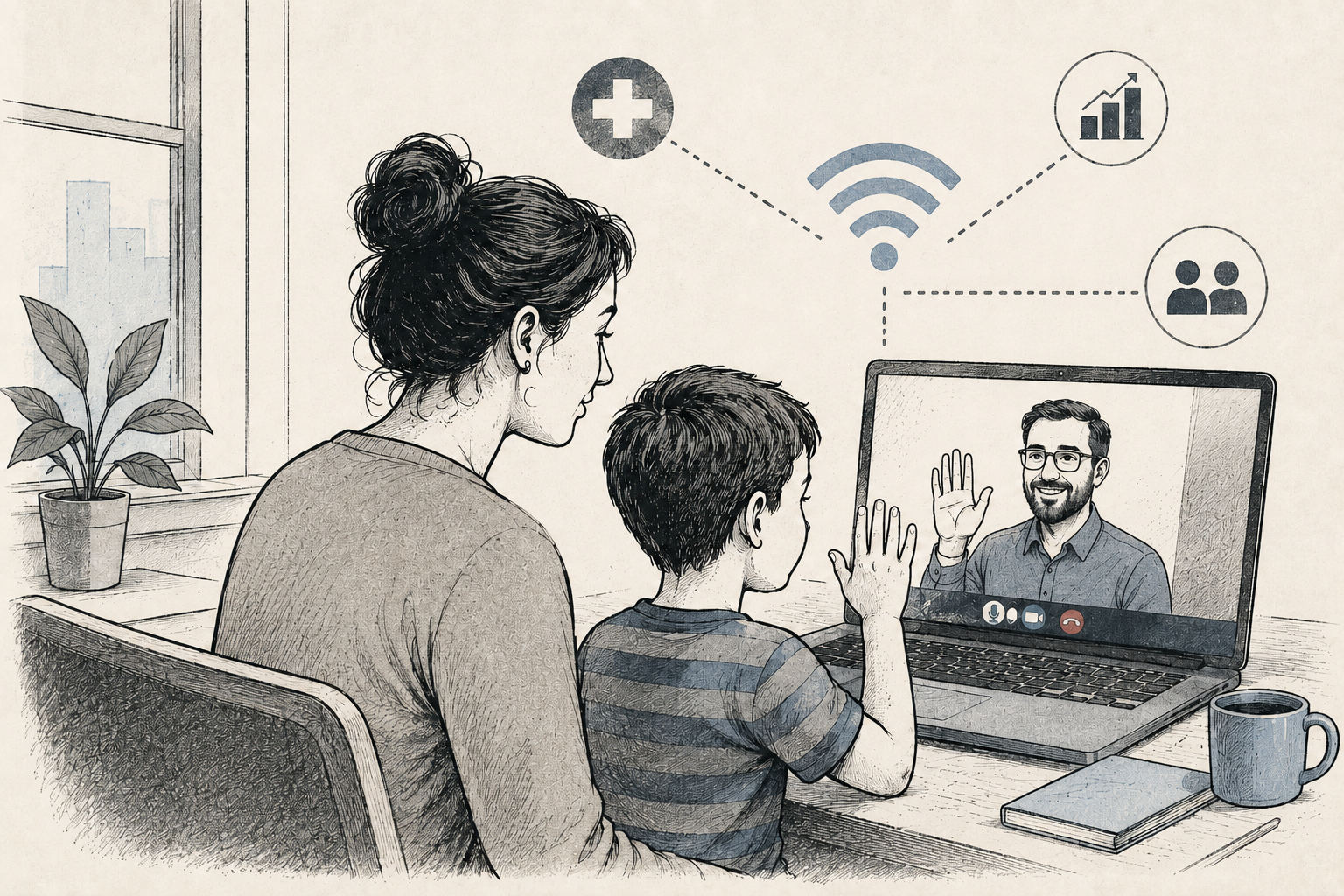
Telehealth is the fastest of the three possible solutions to move, because it does not require building a clinic where none exists. The evidence so far is limited but favorable. In July 2025, New York’s Medicaid Evidence-Based Benefit Review Advisory Committee reviewed five trials of ABA delivered by telehealth, all focused on coaching parents to run procedures at home. The one study that compared telehealth head-to-head with in-person care found no difference in behavior severity or parenting stress. Two studies demonstrated that challenging behavior can be reduced through an experiment measuring telehealth parent coaching compared with no treatment.
The evidence is not airtight. Only one of the five trials reported on safety, and the review covered parent-mediated coaching rather than the broader in-person model. All nine states the committee examined already allow some ABA by telehealth. CASP has published telehealth practice parameters to guide providers on delivering ABA safely in the home and community.
Telehealth is not a universal fix. It needs a reliable internet connection and a workable space at home, and the families hardest to reach are often the ones least equipped for it.
Enforcement Rules With a Long Fuse
The rules meant to force wider access are written but do not necessarily have real consequences. The CMS 2024 Medicaid managed care access rule sets a maximum wait of 10 business days for routine outpatient mental health and substance use appointments, for adults and children alike. It also requires states to hire an independent firm to run annual “secret shopper” surveys that test whether plans meet the standard and whether their directories are accurate. The timeline for complying with these rules has been lenient, with the last one due in July 2028.
This rule did not become definite. On May 15, 2025, the Departments of Labor, Health and Human Services, and the Treasury said they would not enforce the parts of the 2024 Mental Health Parity and Addiction Equity Act (MHPAEA) rule that went beyond the 2013 standard, pending the outcome of an industry lawsuit and for 18 months after a final decision. Parity rules are a key lever regulators use to push plans toward adequate behavioral health networks, and lighter enforcement loosens that pressure.
Accountability for Ghost Networks
Access rules mean little if the network on paper is not the network in practice. A data brief the HHS Office of Inspector General (OIG) released in October 2025 covered behavioral health broadly across four Medicare Advantage and two Medicaid plans in selected counties, found limited networks whose rosters included providers who were not seeing patients. Almost half of the Medicaid plans reviewed had less than 25 percent of their county’s behavioral health workforce under contract, the threshold OIG uses to define a network as limited.
On average, 28 percent of the behavioral health providers listed by those Medicaid plans were inactive, meaning they delivered no services to enrollees during 2023. In Medicare Advantage, the average was 55 percent. Investigators call these “ghost” providers. Providers told OIG that administrative burden and low payment rates affected their willingness to work with the plans.
OIG recommended that CMS use claims data to monitor networks, work with states to clean up Medicaid directories, and keep exploring a single nationwide provider directory. The CASP-affiliated researchers pressed on measurement, offering their county-level method as a prototype that regulators and payers can run in insurance markets beyond the ACA plans they studied.
For now, the tools to measure the gap are sharper than the tools to close it. The federal secret-shopper surveys that could expose ghost networks do not begin until 2028. Whether telehealth and tighter directory oversight narrow the distance before then will come down to the coverage and enforcement decisions state Medicaid programs are writing right now.
AT A GLANCE
| Counties meeting CMS distance standard: | 12 of 3,143, roughly 0.38% (Behavior Analysis in Practice, October 2025) |
| States with median county adequacy under 20%: | 29 (Behavior Analysis in Practice, October 2025) |
| Medicaid plans with limited networks: | Almost half had under 25% of the county behavioral health workforce (HHS-OIG, October 2025) |
| Inactive “ghost” providers, Medicaid plans: | 28% of listed behavioral health providers, on average (HHS-OIG, October 2025) |
| New Medicaid wait-time standard: | Routine outpatient behavioral health within 10 business days (CMS final rule, 2024) |
| Secret-shopper surveys required: | First rating period on or after July 10, 2028 (CMS) |
| Parity enforcement: | Departments will not enforce new provisions of the 2024 MHPAEA rule (May 15, 2025) |
| Telehealth ABA evidence: | No difference vs. in-person in one head-to-head parent-coaching trial (NY Medicaid review, July 2025) |
SOURCES & REFERENCES
| 1. | Dubuque, E.M., Yingling, M.E., et al. “Estimating Network Adequacy of Autism Service Providers in Affordable Care Act Markets.” Behavior Analysis in Practice. Published online October 27, 2025. doi:10.1007/s40617-025-01103-7 |
| 2. | HHS Office of Inspector General. “Many Medicare Advantage and Medicaid Managed Care Plans Have Limited Behavioral Health Provider Networks and Inactive Providers.” OEI-02-23-00540. Issued October 2, 2025. oig.hhs.gov |
| 3. | Centers for Medicare & Medicaid Services. “Medicaid and CHIP Managed Care Access, Finance, and Quality Final Rule (CMS-2439-F).” Fact sheet, 2024. cms.gov |
| 4. | Georgetown University Center for Children and Families. “An Explanation of Final Medicaid Managed Care and Access Rules.” 2024. ccf.georgetown.edu |
| 5. | U.S. Departments of Labor, Health and Human Services, and the Treasury. “Statement Regarding Enforcement of the Final Rule on Requirements Related to MHPAEA.” May 15, 2025. dol.gov |
| 6. | New York State Medicaid Evidence-Based Benefit Review Advisory Committee. “Applied Behavior Analysis Provided Via Telehealth: Evidence Review.” July 2025. health.ny.gov |
| 7. | Council of Autism Service Providers. “Applied Behavior Analysis Telehealth Parameters Best Practices Document.” casproviders.org |










Join the discussion ▾