

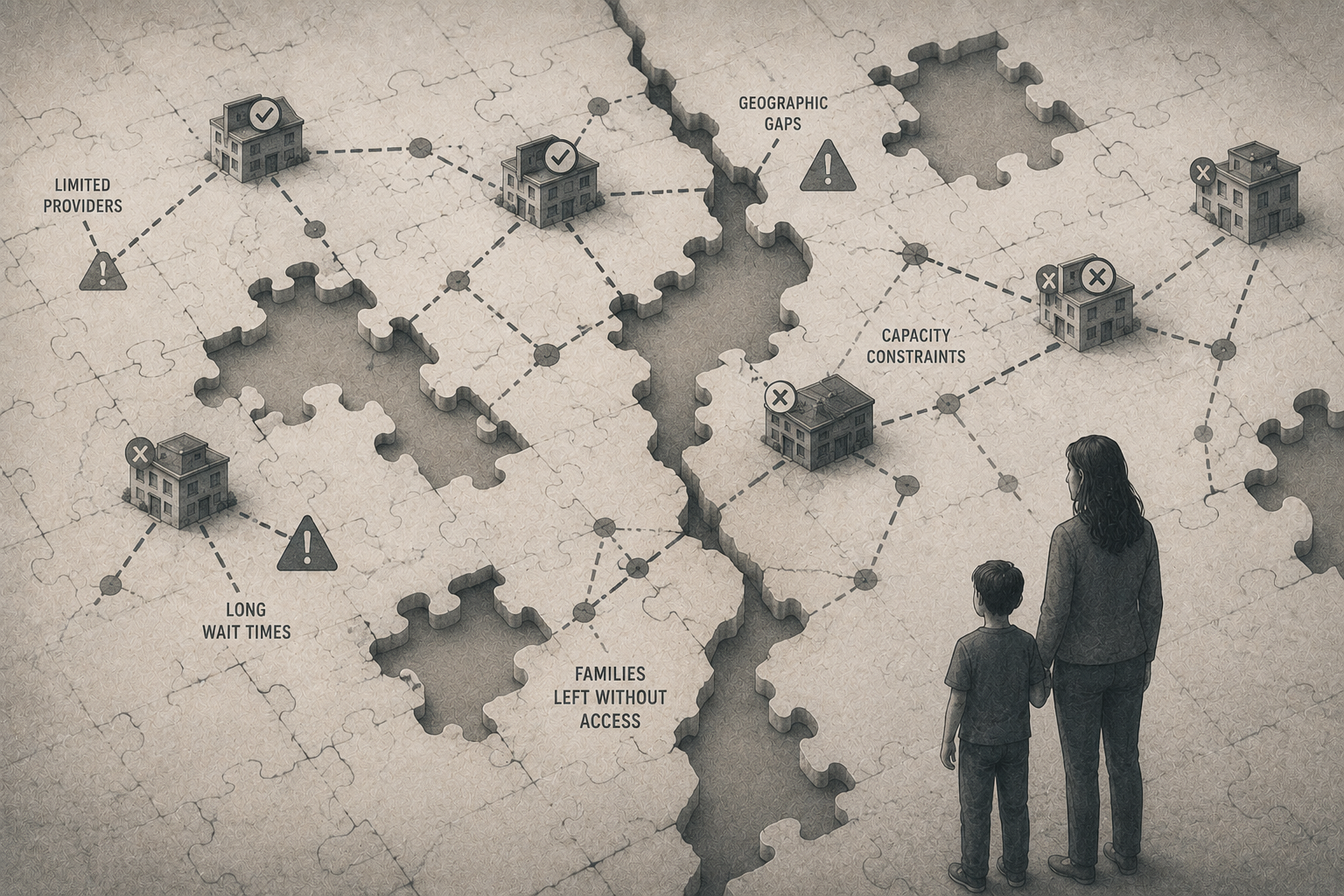
Network adequacy is the standard that determines whether an insurance plan has enough providers, close enough and available enough, for members to use the benefits they hold. Across applied behavior analysis, a set of documented problems shows the standard often fails in practice even when a plan satisfies it on paper.
The core issue is that adequacy is measured in filings and experienced at the point of care. A network can meet its state standard in a report, while families work through provider lists that return no available clinician. The distance between the two is where access breaks down for children who need ABA.
Inaccurate Provider Directories
Provider directories are a primary source of overstated adequacy. At a Senate Finance Committee hearing on May 3, 2023, focused on the prevalence of “ghost networks,” psychiatrist Robert Trestman testified that directories contain inaccuracies across commercial, Medicare Advantage, and Medicaid plans, according to the AAMC: clinicians listed as accepting patients who are not, along with outdated phone numbers and addresses. Trestman described the experience of working through an inaccurate directory as “at best demoralizing and at worst set up to precipitate clinical deterioration.”
The inaccurate data sits atop a supply shortage. When a directory lists a BCBA who has a long waitlist, has left the plan, or never joined it, the plan still counts that clinician toward its network, and the network is considered adequate while the listed provider is unavailable.
A Contracting Provider Pool
Reimbursement policy is reducing the number of participating providers. In New York, the state cut the technician-delivered rate by 25 percent, to $14.45 per 15-minute unit, effective April 1, 2026. A joint survey by the New York State Association for Behavior Analysis and the Council of Autism Service Providers found that 74 percent of Medicaid ABA providers said they would leave the program. New York already pays among the lowest Medicaid ABA rates in the country.
Commercial networks are narrowing through payer decisions. In June 2026, ABA Centers of America laid off staff after Optum would no longer engage with the company. The company, which operates an out-of-network model and is in litigation with other plans, said it continues to “operate business as usual.” For members assigned to affected clinicians, the practical result is a smaller set of in-network options.
Federal Coverage Gaps at TRICARE
TRICARE, the military health program, tightened its ABA coverage in 2021, and families have reported being denied care that comparable private coverage would provide. On June 26, 2026, Sens. Kirsten Gillibrand and Eric Schmitt sent a letter urging the Pentagon to make ABA a basic TRICARE benefit. “It is unacceptable that military families are being denied essential care for their autistic children,” Gillibrand said, adding that the current rules force “overwhelmed families to navigate a frustrating bureaucratic maze just to secure limited life-changing care.” A National Academies analysis recommended that TRICARE cover ABA as a basic benefit. State coverage does not bind federal program mandates that apply to many other plans, leaving the adequacy of coverage for military families dependent on federal policy.
Efforts to Measure the Gap
Standardized measurement of ABA network adequacy remains limited. In 2024, CASP partnered with the software firm CentralReach to use anonymized industry data to inform payors of provider network adequacy nationally and to refine CASP’s own network adequacy model, according to CentralReach. CASP CEO Lorri Unumb said the effort was intended to identify and address pain points in access. The initiative reflects a broader point: the trade association for providers is building its own evidence base because existing adequacy measures do not fully capture the access problems families report.
Proposed federal remedies target these failures directly. CMS has proposed maximum appointment wait time standards, including routine outpatient behavioral health appointments within 10 business days, and independent secret-shopper surveys to verify that providers in a directory are reachable and accepting patients, with a proposed minimum compliance rate of 90 percent. Whether states adopt and enforce those measures remains unresolved, and it will determine whether network adequacy standards begin to reflect the access members actually receive.
AT A GLANCE
| What adequacy requires: | States must set Medicaid managed care network standards, including pediatric behavioral health; the 2020 CMS rule dropped mandatory time-and-distance measures (KFF, 2023) |
| Managed care reach: | 72% of Medicaid enrollees are in comprehensive MCOs (KFF, 2023) |
| Enforcement: | Only 9 of 38 responding states issued any network-adequacy penalty in three years (KFF survey, 2022) |
| Ghost networks: | Senate Finance Committee hearing on inaccurate provider directories, May 3, 2023 (AAMC) |
| New York exodus: | 74% of Medicaid ABA providers said they would leave after the 25% cut to $14.45 per unit (CPT 97153), effective April 1, 2026 (Acuity News) |
| Commercial exit: | ABA Centers of America laid off staff after Optum would no longer engage the company, June 2026 (Behavioral Health Business) |
| TRICARE: | Sens. Gillibrand and Schmitt urged the Pentagon to make ABA a basic benefit, June 26, 2026 (NBC News) |
| Measuring the gap: | CASP and CentralReach partnered to inform payor network-adequacy filings, 2024 (CentralReach) |
| Proposed fix: | CMS proposals for appointment wait-time standards and secret-shopper directory audits (KFF, 2023) |
SOURCES & REFERENCES
| 1. | AAMC. “Senate Examines Behavioral Health Provider Network Accuracy, Adequacy.” May 5, 2023. https://www.aamc.org/advocacy-policy/washington-highlights/senate-examines-behavioral-health-provider-network-accuracy-adequacy |
| 2. | Hinton E, Raphael J. “Medicaid Managed Care Network Adequacy & Access: Current Standards and Proposed Changes.” KFF. June 15, 2023. https://www.kff.org/medicaid/medicaid-managed-care-network-adequacy-access-current-standards-and-proposed-changes/ |
| 3. | Webb E. “New York Medicaid ABA Reimbursement Rates: A Late-Arriving Benefit Facing a 25% Rate Reduction and a Proposed Centers of Excellence Framework.” Acuity News. April 23, 2026. https://acuity.news/regulation/new-york-medicaid-aba-reimbursement-rate-reduction-2026/ |
| 4. | Larson C. “ABA Centers of America Lays Off Staff.” Behavioral Health Business. June 12, 2026. https://bhbusiness.com/2026/06/12/aba-centers-of-america-lays-off-staff/ |
| 5. | Kane J (NBC News). “Senators call for military healthcare to cover autism therapy as a basic benefit.” June 26, 2026 (via AOL). https://www.aol.com/news/senators-call-military-healthcare-program-212602305.html |
| 6. | CentralReach. “CentralReach’s Anonymized Autism and IDD Care Industry Data Will Be Leveraged by the Council of Autism Service Providers (CASP) to Inform Provider Network Adequacy.” Press release. December 2024. https://centralreach.com/blog/centralreachs-anonymized-autism-and-idd-care-industry-data-will-be-leveraged-by-the-council-of-autism-service-providers-casp-to-inform-provider-network-adequacy/ |








Join the discussion ▾