
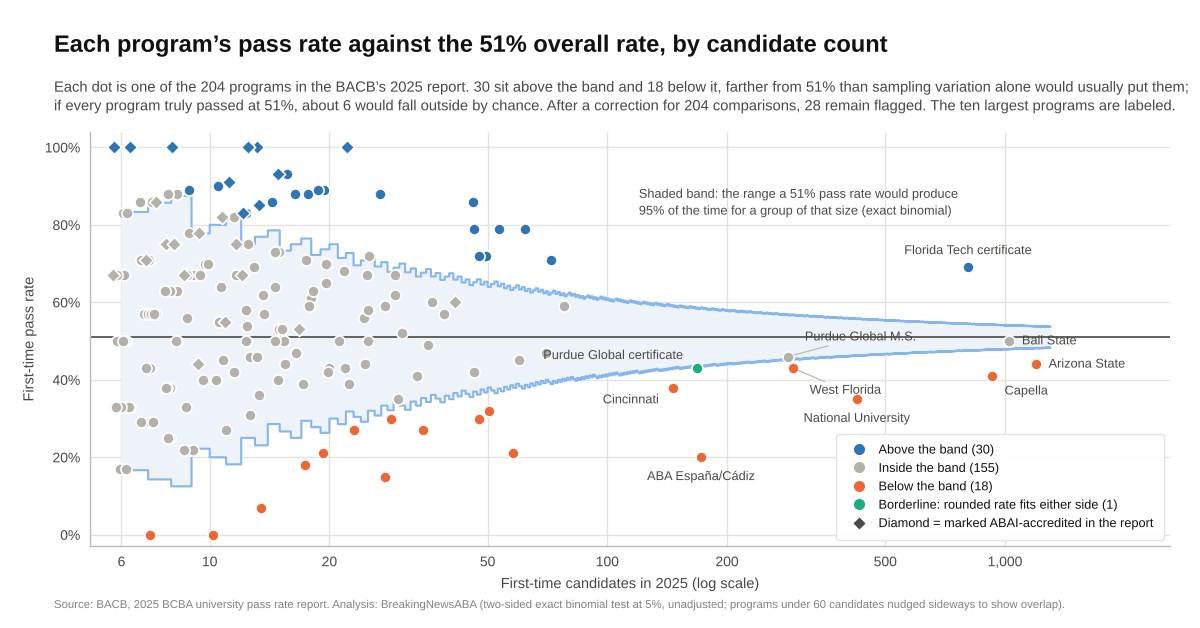
LITTLETON, COLORADO – The Behavior Analyst Certification Board published its 2025 university pass rate reports on October 8, and for the first time it published its own comparisons alongside the tables. Twenty-five programs accredited by the Association for Behavior Analysis International (ABAI) posted a mean first-time pass rate of 79.3% on the BCBA exam. The 179 other programs in the report averaged 53.2%.
The accredited programs produced 295 of the 8,558 candidates in the report (3.4%) and about 3% of all 9,955 people who took the exam for the first time in 2025. The ten largest programs, none of them marked accredited in the report and nine of them online, produced 5,446, more than half of all first-time candidates, and their mean pass rate was 42.9%. Beginning January 1, 2032, new BCBA applicants must hold a master’s degree or higher from a program accredited by ABAI or the Association of Professional Behavior Analysts (APBA); the other certification requirements still apply.
That is how heavily 2025’s first-time testing ran through programs not marked accredited that year: the coursework route the board will close in 2032 produced 96% of the candidates in this report. The rule applies to new applicants, and programs can gain accreditation before it takes effect. The overall first-time pass rate fell to 51% in 2025, from 54% in 2024 and 60% in 2021, on the first exam built to the board’s sixth-edition test content outline; the report states both facts in the same bullet and draws no line between them.
What the Report Covers
The BACB’s program-level archive runs back to 2014. The 2014 to 2018 edition carried a table of yearly totals, and the editions covering 2016 through 2024 were sorted program tables with a paragraph of definitions; none compared accredited programs with the rest or singled out the largest programs. The 2025 report adds a summary, three key findings, a table of accredited programs, and a table of the ten programs with more than 100 candidates. The announcement calls them “new analyses to help prospective students evaluate their options.”
The report covers 204 programs with at least six first-time candidates (its text says “more than six,” but its tables include 28 programs at exactly six, and the board’s pass-rate page sets the cutoff at six) and 8,558 of the 9,955 people who took the exam for the first time in 2025, or 86% by the board’s count. Twenty-five small-program rows combine 2024 and 2025 candidates to reach a reportable number, so the table is not a strictly single-year cohort; the program-level figures in this article use the published rows as they stand. A candidate counts toward a program with a degree from an ABAI-accredited or ABAI-recognized program, or by completing all of the required BCBA coursework at a single program.
The report includes the board’s standard caution. “Pass rates are historical outcomes; they are not rankings, endorsements, or guarantees of future or individual performance,” it says, and it tells readers to weigh them with cost, format, faculty, fieldwork, and prior-year results. On its pass-rate page, the board tells readers not to compare a program with the overall rate, because “the overall pass rate is impacted by several large programs.”
Testing Each Program Against 51%
Small candidate counts make a program’s pass rate sensitive to a few outcomes, so BreakingNewsABA tested each of the 204 programs against the overall rate. The question for each one: if its candidates passed at the overall 51%, how often would a group this size land where this program did? For a program with 10 candidates, anything from 20% to 80% is within the range chance would produce; for a program with 1,000, the range narrows to 48% to 54%.
By that test, 30 programs sit farther above the 51% rate than sampling variation alone would usually put them, 18 sit farther below it, and 155 are inside the range their candidate counts allow. One, Purdue Global’s graduate certificate, is borderline: its rounded 43% is consistent with two different passer counts, and the test flips between them. The 30 programs above the line trained 1,473 candidates, 17% of the report. The 18 below it trained 3,500, or 41%, because six of the ten largest programs are among them: Arizona State, Capella, National University, West Florida, ABA España, and Cincinnati. Ten of the 30 above the line are marked ABAI-accredited in the report; the other 20 are not.
Two cautions apply. If every program truly passed at 51%, about 6 of the 204 would land outside the limits by chance alone; 49 did. After a standard correction for making 204 comparisons, 28 programs remain flagged, 18 above and 10 below, and five of the six large programs stay on the list; West Florida drops off. The test is also observational: it says where a program’s candidates landed, not why, and it does not separate teaching from who enrolls. The board itself advises against comparing a program with the overall rate, and this test uses that rate only as a fixed reference point.
Ten Programs, Half the Candidates
Arizona State University’s online special-education program sent 1,197 first-time candidates to the exam in 2025, and 44% passed. Ball State University sent 1,026 and 50% passed. Capella University sent 928 and passed 41%. Those three programs alone accounted for nearly a third of all first-time candidates.
Florida Institute of Technology’s online certificate was the fourth-largest program, with 807 candidates, and the only one of the ten to pass more than half, at 69%. On the board’s numbers, Florida Tech produced roughly 560 first-time passers, more than Arizona State’s roughly 530 from a program half again as large. The other six programs in the group range from National University, 424 candidates at 35%, to the University of Cincinnati, 146 at 38%.
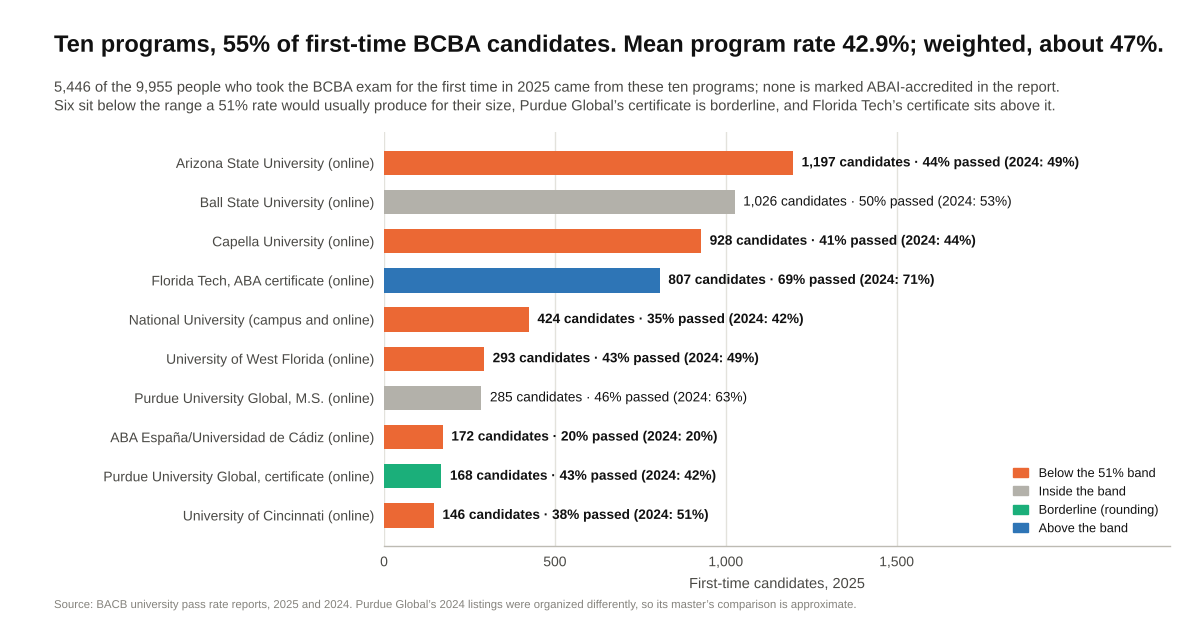
The simple average pass rate across the ten programs is 42.9%. Weighted by how many candidates each sent, about 47% passed, roughly 2,500 of the roughly 5,100 people who passed the exam on their first try in 2025. The other 194 programs in the report passed about 57% of theirs. As an arithmetic illustration, had the ten largest matched that 57% with every other row held fixed, the report’s overall rate would have been about 57% instead of about 50%.
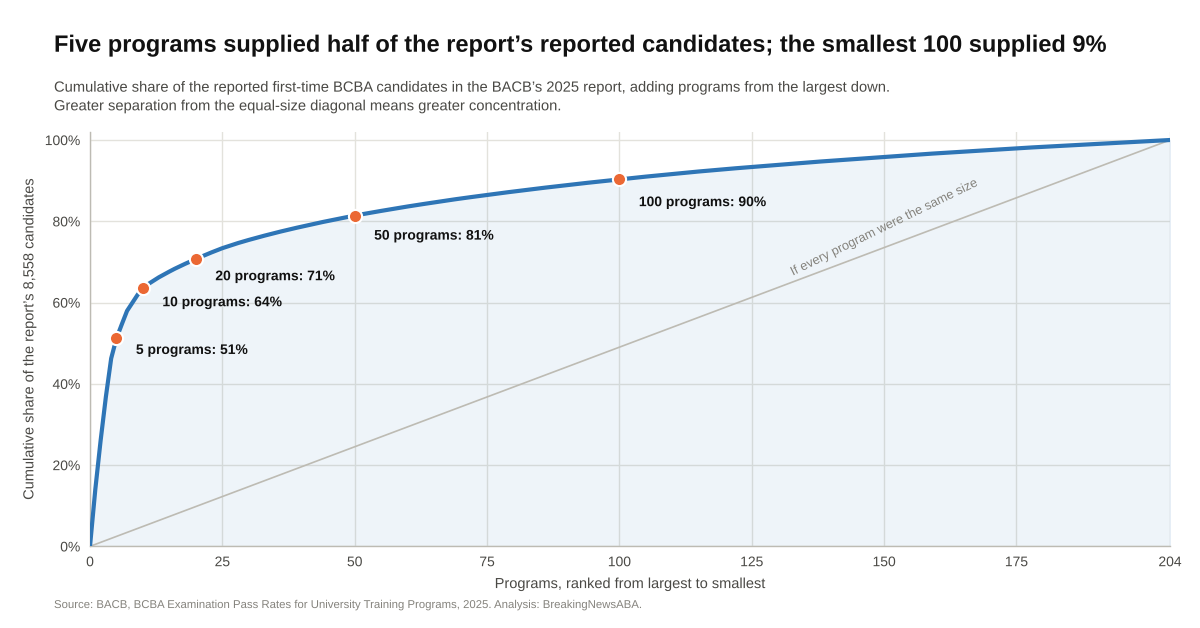
The concentration runs deeper than ten programs. The five largest supplied 51% of the candidates in the report, the 20 largest 71%, the 50 largest 81%, and the 100 largest 90%. The smallest 100 programs, half the table, supplied 9%.
The concentration grew between the two reports. In the 2024 report, the ten largest programs accounted for 51.1% of first-time candidates and averaged 45.7%; in 2025, the ten largest accounted for 54.7% and averaged 42.9%. Ball State grew from 832 candidates to 1,026 while its pass rate slipped from 53% to 50%. Purdue University Global’s two programs together went from 277 candidates to 453, a 64% increase, while their combined pass rate held near 45%. ABA España’s master’s program with the Universidad de Cádiz nearly tripled, from 61 candidates to 172, and held at 20%.
Where Most Candidates Actually Train
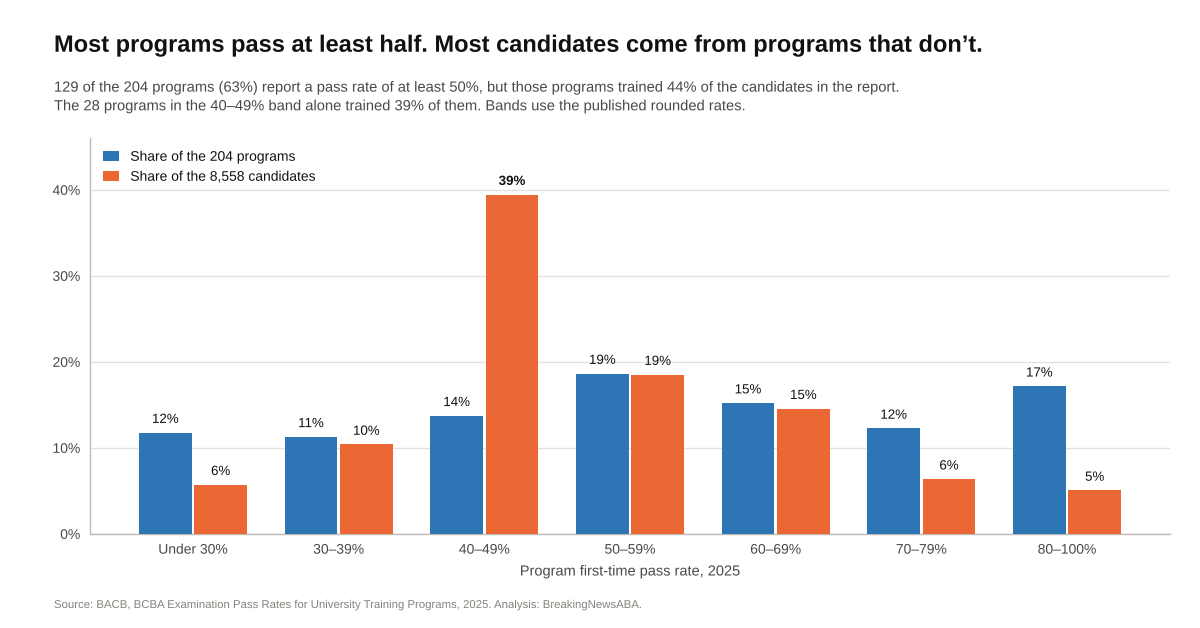
Read program by program, the report looks healthier than its headline number. Of the 204 programs, 129 passed at least half of their candidates, 91 passed at least 60%, and 35 passed at least 80%. Read candidate by candidate, it inverts. The 129 programs at 50% or better trained 44% of the candidates in the report; the 91 at 60% or better trained 26%; the 35 at 80% or better trained 5%.
The 28 programs with pass rates in the 40s trained 3,375 candidates, 39% of the report, because that band holds Arizona State, Capella, West Florida, and both Purdue Global programs. A prospective student picking a program at random would most likely land in one that passes at least half its candidates. A candidate picked at random from the exam line most likely came from one that does not.
The Accreditation Gap
Six of the 25 accredited programs passed every candidate: St. Cloud State University (22 candidates), the University of Houston-Clear Lake (13), the University of North Texas (12), the University of North Carolina Wilmington (6), and the pooled programs at Auburn University (8) and the University of Kansas (6). The weakest accredited results were Ohio State’s pooled online program at 44%, The Chicago School’s Chicago campus at 53%, and Regis College’s on-campus program at 55%.
“Pass rates are historical outcomes; they are not rankings, endorsements, or guarantees of future or individual performance.” – Behavior Analyst Certification Board, BCBA Examination Pass Rates for University Training Programs (2025)
Accreditation is not the only route to a strong number. Western New England University passed 88% of 26 candidates, the University of South Florida’s online master’s passed 86% of 44, the University of Washington’s two programs passed 93% and 89%, and Utah Valley University passed 89% of 18. None is marked ABAI-accredited in the report, though one of the Washington programs holds ABAI’s Tier 2a recognition, a designation short of accreditation. The accredited group is small and mostly campus-based: 20 of the 25 programs are on campus, 3 are online, and 2 are hybrid or mixed; together, they sent 295 candidates to the exam, roughly what Purdue Global’s master’s program alone sent.
Splitting the programs by format narrows the question. Among campus-based programs, the 20 accredited ones passed 80.6% of their 201 candidates, and the 26 non-accredited ones passed 69.5% of their 309, an 11-point gap. A simple test on the candidate counts puts that difference beyond the usual threshold for sampling noise (p of about 0.007), but it is an observational comparison: it does not isolate accreditation from who enrolls, how programs admit, or where students do fieldwork. Among non-accredited programs, the campus-based ones passed 69.5%, and the 87 online ones passed 48.2% of their 6,453 candidates, a 21-point gap. In these two comparisons, the campus-versus-online difference among non-accredited programs was about twice the accreditation difference among campus programs. Neither contrast isolates the effect of format or accreditation.
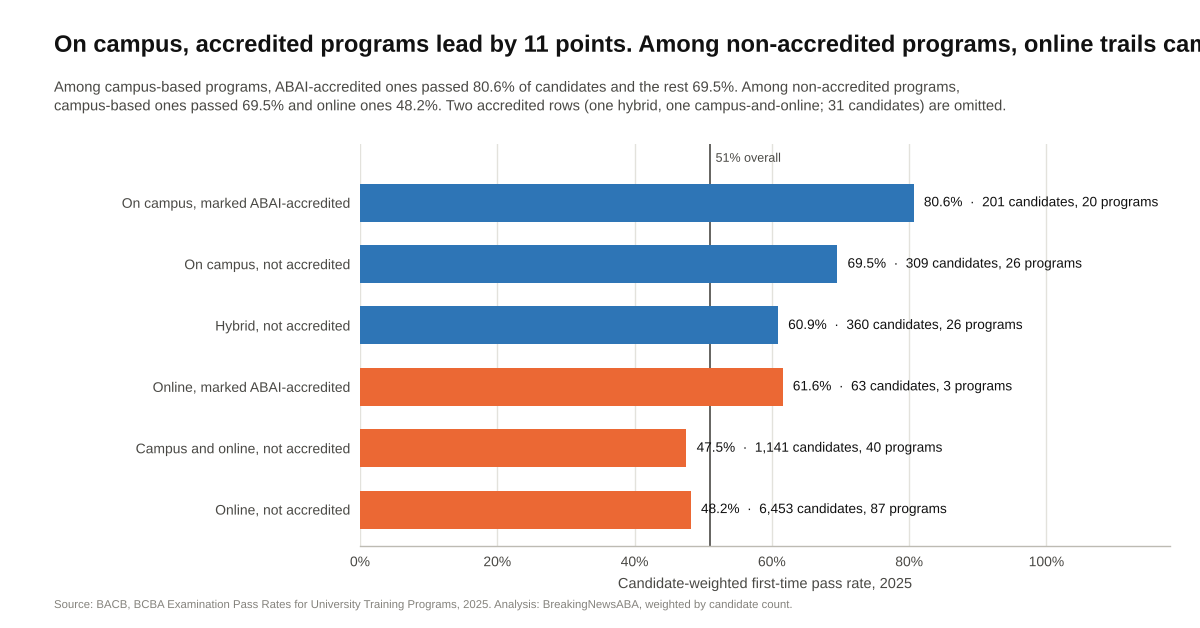
The report does not claim that accreditation causes the gap, and the numbers cannot settle it. Accredited programs are smaller and mostly campus-based, and they must meet ABAI standards for curriculum, faculty, outcomes assessment, and student services. The report does establish where the two groups stood on the exam in 2025, with two-year pooling for a handful of small programs. The board’s 2032 rule, announced in 2022 and widened to include APBA accreditation in 2023, requires the accredited side of that comparison.
Online Programs Carry the Volume
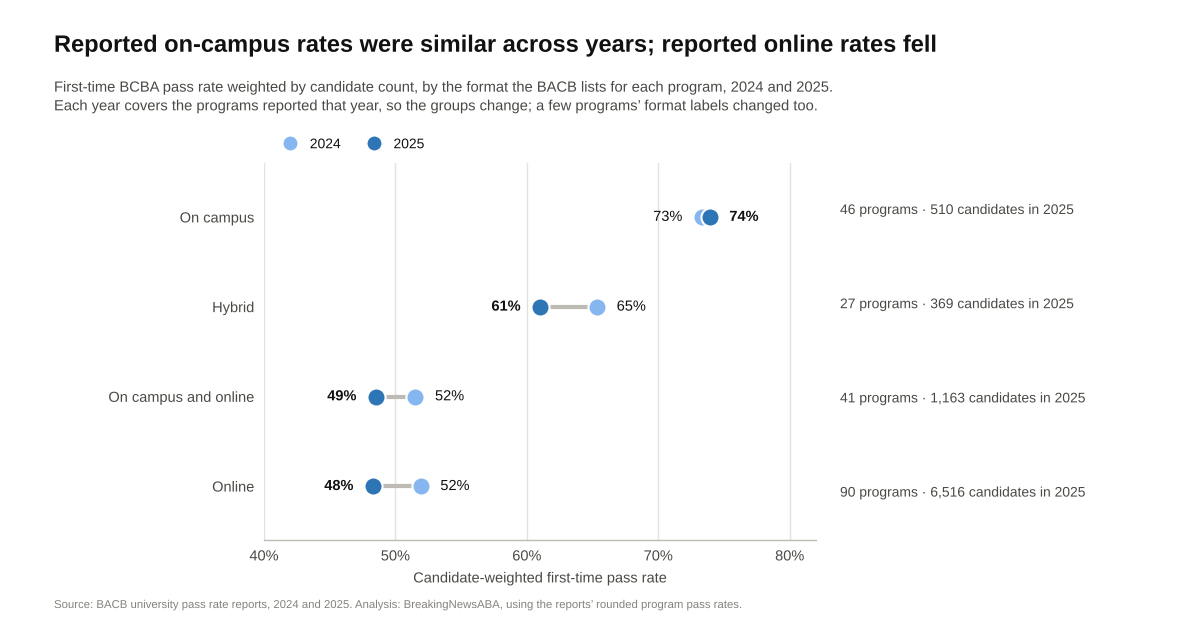
Ninety of the 204 programs are listed as online, and they trained 6,516 candidates, 76% of everyone in the report. Weighted by headcount, 48% of their candidates passed. The 46 on-campus programs trained 510 candidates, and 74% passed. Hybrid programs passed 61%, and the 41 programs listed as both on-campus and online passed about 49%.
The ten largest programs do not account for the whole online gap. Remove them, and the remaining 81 online programs passed 50% of 1,494 candidates.
Across the programs reported in each year, the candidate-weighted on-campus rate was 73% in 2024 and 74% in 2025, while the online rate fell from 52% to 48%, hybrid programs from 65% to 61%, and mixed-format programs from 52% to 49%. These program groups are changing, and a few format labels changed, so the comparison does not isolate the effect of the exam revision. Mid-sized online programs can post strong numbers: South Florida’s online master’s, Simmons University (79% of 53), Western Connecticut State University (72% of 50), Western University (72% of 46), and North Texas’s online master’s (71% of 72) all cleared 70%. Together, those five sent 265 candidates to the exam, against 5,446 from the ten largest programs.
Who Moved Most Since 2024
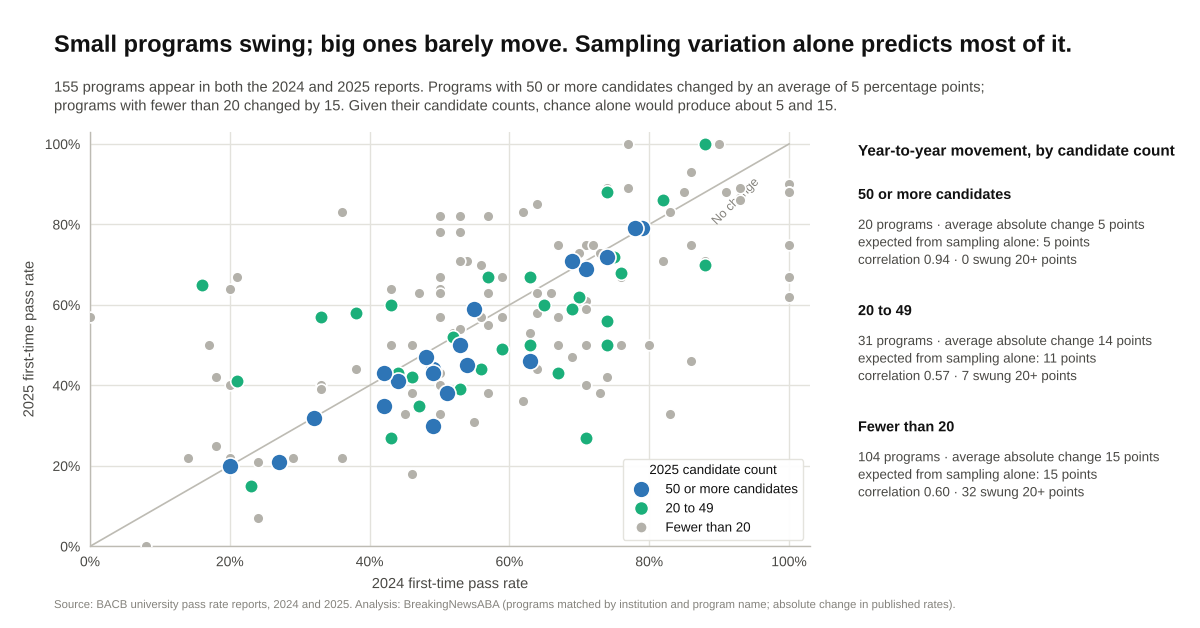
BreakingNewsABA matched 155 programs across the two reports by institution and program name; the pairing is available on request. Of those, 84 lost ground, 64 gained, and 7 held even; the median change was a 2-point decline, and the matched programs’ weighted pass rate fell from about 54% to about 50%.
Among the large programs, Arizona State fell from 49% to 44%, Capella from 44% to 41%, Florida Tech from 71% to 69%, National University from 42% to 35%, West Florida from 49% to 43%, and the University of Cincinnati from 51% to 38% on a nearly unchanged 146 candidates. The steepest fall among programs with at least 20 candidates was Niagara University, from 71% to 27% as its candidate count rose from 7 to 33. Among programs with at least 20 candidates in 2025, the biggest gain was Mississippi State University, from 16% to 65% on 20 candidates; Mary Baldwin University rose from 33% to 57%, SUNY Empire State University from 38% to 58%, and UMass Global from 21% to 41%, and The Chicago School’s accredited online master’s rose from 43% to 60%.
The swings track candidate counts, and sampling variation alone accounts for most of them. The 20 matched programs with 50 or more candidates in 2025 showed an average absolute change of 5 percentage points between the two reports, none of them 20 points or more; given their candidate counts, chance alone would produce an average change of about 5. The 104 matched programs with fewer than 20 candidates showed an average absolute change of 15 points, and 32 of them swung 20 points or more; chance alone would produce about 15. The 31 mid-sized programs moved 14 points on average against an expected 11. Of the 39 programs whose rate swung 20 points or more, 32 had fewer than 20 candidates. A different but defensible pairing of the handful of ambiguous rows moves the smaller-tier counts by a program or two and the count of 20-point swings from 39 to 36; the pattern does not change. The board’s advice to read prior-year results alongside the current one is not boilerplate; for a small program, one year’s number says little on its own.
At the bottom of the 2025 table sit two programs at 0%: ABA España’s second Cádiz program, with 10 candidates, and Cleveland State University’s certificate, with 7. Kean University passed 7% of 14 candidates, down from 24% a year earlier, and Walden University passed 15% of 27, down from 23%. Small programs come and go from the report: 49 programs in the 2025 table have no clear counterpart in 2024, and 40 programs from the 2024 table do not appear in 2025.
Five Years of Exam Results
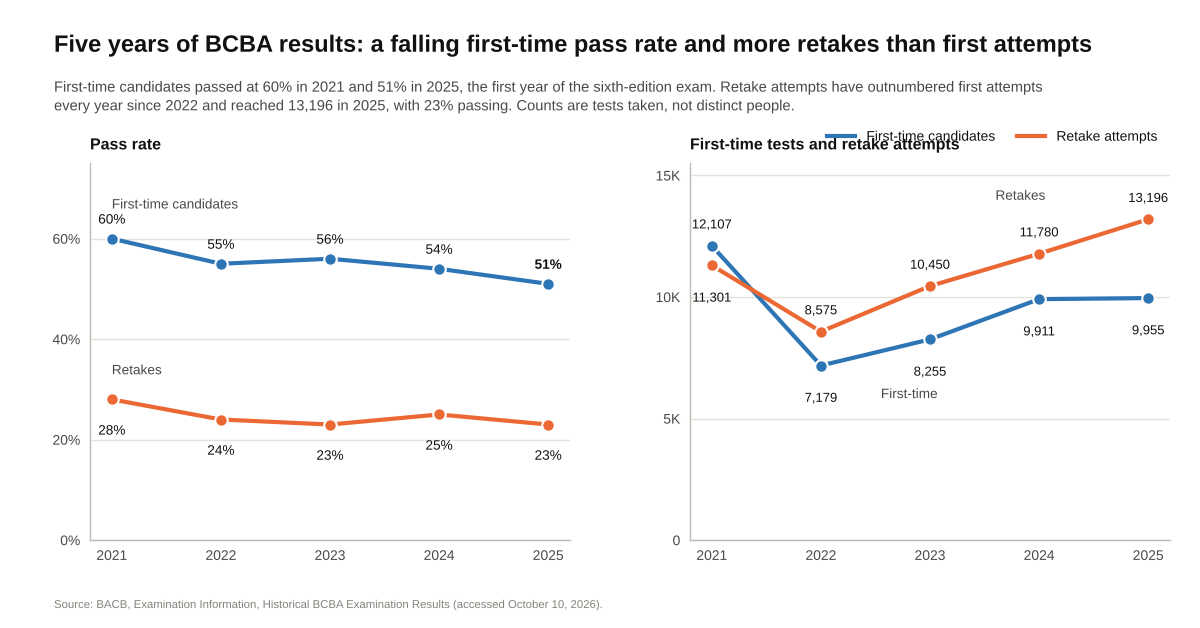
The program tables sit inside a five-year trend the board publishes separately. First-time candidates passed at 60% in 2021, 55% in 2022, 56% in 2023, 54% in 2024, and 51% in 2025. First-time volume fell from 12,107 in 2021 to 7,179 in 2022 and climbed back to 9,955 in 2025. The board recorded 13,196 retake attempts in 2025 against 9,955 first attempts, and 23% of the retakes passed. Retakes have outnumbered first attempts every year since 2022, and the figures count attempts, not people. The university reports cover only first attempts, so none of that volume appears in them.
The BCaBA Report
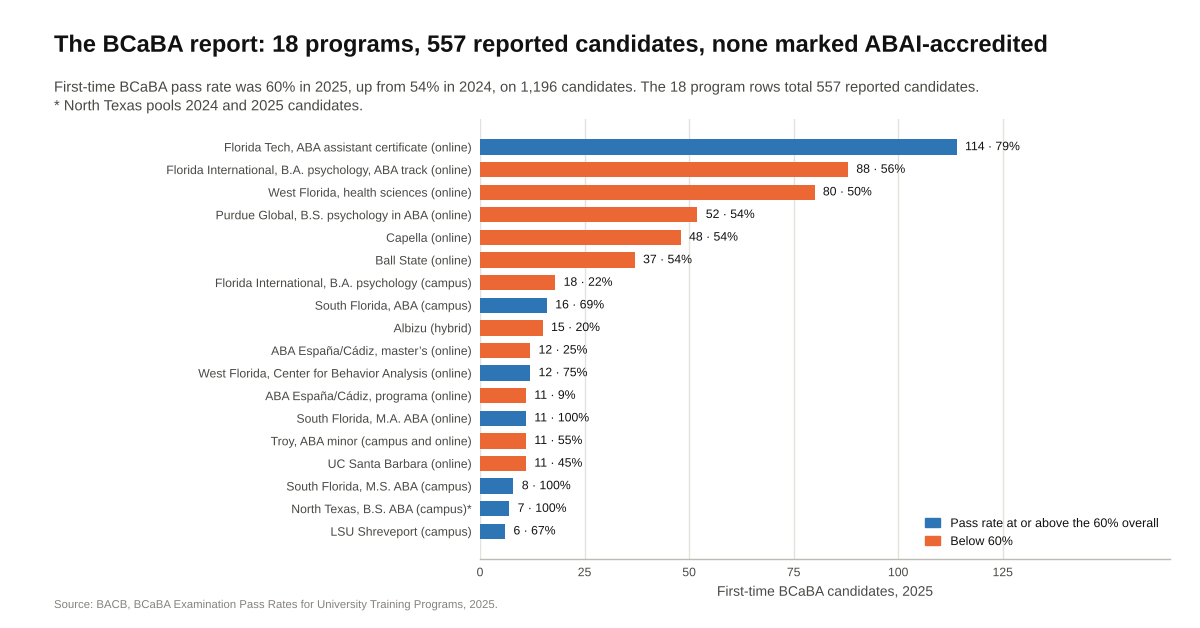
The report for the assistant-level credential (BCaBA, board-certified assistant behavior analyst) moved the other way. First-time candidates passed at 60% in 2025, up from 54% in 2024, on 1,196 attempts. The 18 program rows total 557 reported candidates, fewer than half of that (North Texas’s row pools 2024 and 2025), and none is marked ABAI-accredited in the report. Florida Tech’s online assistant certificate was again the largest program, with 114 candidates at 79%, up from 66% on 89 candidates in 2024, and the University of South Florida posted 100% in two small programs. At the bottom were ABA España’s two Cádiz programs, at 9% and 25%, Albizu University at 20%, and Florida International University’s on-campus psychology degree at 22%.
The 2032 Arithmetic
In the 2025 report, 25 program rows were marked ABAI-accredited and one, the University of Washington’s master’s, was marked Tier 2a-recognized; both designations count under the board’s Pathway 1, the accredited-degree route, and the recognized tier stops counting in 2032. The other 178 rows, with 8,244 candidates, 96% of the report, carried neither designation, which under the report’s inclusion rules means their candidates qualified by completing coursework under Pathway 2, the route the board will close on January 1, 2032. The board first announced the change in 2022 and widened it to include APBA accreditation in 2023.
The coursework route is already changing. ABAI shut down its Verified Course Sequence system, the registry of approved coursework that Pathway 2 ran on, on January 1, 2026, and the BACB replaced it with its own coursework attestation system; the 2025 report, prepared after the switch, lists no course-sequence numbers where the 2024 edition had 173. New coursework requirements take effect January 1, 2027.
The accredited side is still small, and the 2025 rows are not a forecast of 2032 capacity. ABAI’s directory listed 47 accredited master’s programs across 39 institutions on October 10, two of them outside the United States; the 2025 report, which groups some formats together, carries 25 rows marked accredited. Programs can gain accreditation before 2032; for example, ABAI has since listed Simmons University’s online master’s as accredited for 2026 through 2030, and four initial-accreditation applications were under review. APBA, the second accreditor the rule names, says in its FAQ that it began accepting applications on January 20, 2026, charges $7,000 to $8,500 per review, and offers accreditation only to master’s programs in the United States and Canada; another page on the same site still says applications have not begun, and no list of accredited programs appeared on its pages as of October 10. In a public note accompanying its November 14, 2023 letter to APBA, ABAI’s executive council wrote that “important principles that make accreditation valuable are being threatened.”
The board’s advice to students is in the report: anyone who expects to apply for BCBA certification in 2032 or later “should verify degree accreditation status before enrolling.” Its advice to employers appears on the pass-rate page, where it asks leaders of service organizations to read the reports and share them with staff considering a degree. ABAI’s board has four initial-accreditation applications under review, filed between April and June 2026, and APBA had yet to post an accredited program on its site. The next deadline on the board’s calendar is January 1, 2027, when new BCBA coursework requirements take effect.
AT A GLANCE
| 2025 first-time BCBA pass rate: | 51% of 9,955 candidates; 54% in 2024, 60% in 2021 (BACB, 2026) |
| Programs in the 2025 report: | 204, covering 8,558 candidates (86.0% of first-time test takers) |
| ABAI-accredited programs: | 25; mean pass rate 79.3%; 295 candidates (3.4% of the report) |
| All other programs: | 179; mean pass rate 53.2%; 8,263 candidates |
| Ten largest programs: | 5,446 candidates (54.7% of all first-time candidates); mean program pass rate 42.9%, candidate-weighted about 47%; none marked accredited; nine online |
| Concentration: | The 5 largest programs supplied 51% of the report’s candidates, the 20 largest 71%, the 100 largest 90%; the smallest 100 supplied 9% (BreakingNewsABA analysis) |
| Against the 51% rate: | 30 programs above and 18 below by more than sampling variation would usually produce; 1 borderline; 155 within range (two-sided exact binomial test, 5%, unadjusted; 28 remain after a correction for 204 comparisons; BreakingNewsABA analysis) |
| Programs vs. candidates: | 129 programs (63%) report a pass rate of at least 50%; those programs trained 44% of the candidates in the report |
| Format and accreditation, 2025: | Campus, marked accredited 80.6% (201 candidates); campus, not accredited 69.5% (309); all hybrid 61% (369); all campus and online 49% (1,163); all online 48% (6,516) (BreakingNewsABA analysis, candidate-weighted) |
| Year-to-year stability: | Among 155 programs in both reports, average absolute change of 5 percentage points for programs with 50+ candidates and 15 for those under 20, about what sampling variation alone would produce (BreakingNewsABA analysis) |
| Largest program: | Arizona State University online, 1,197 candidates, 44%; most first-time passers: Florida Tech’s certificate, 807 candidates, 69% |
| Retakes, 2025: | 13,196 retake attempts against 9,955 first attempts; 23% passed; retakes have outnumbered first attempts every year since 2022 (BACB) |
| BCaBA, 2025: | 60% first-time pass rate (54% in 2024); 18 program rows totaling 557 reported candidates against 1,196 first-time candidates (one row pools 2024 and 2025) |
| 2032 rule: | From January 1, 2032, new BCBA applicants must hold a degree from an ABAI- or APBA-accredited program; Pathway 2 coursework and Tier 2a/2b recognition no longer satisfy the degree requirement (BACB; announced 2022, APBA added 2023) |
| Accreditor capacity, October 10, 2026: | ABAI lists 47 accredited master’s programs across 39 institutions (the report carries 25 accredited rows), 4 under initial review; APBA’s site showed no accredited programs |
| Data note: | Weighted figures use the reports’ rounded program pass rates; the report’s text sets the inclusion threshold at “more than six” candidates, but its tables list 28 programs at six |
SOURCES & REFERENCES
| 1. | Behavior Analyst Certification Board. “Now Available: 2025 BCBA and BCaBA University Pass Rate Reports.” News post. October 8, 2026. https://www.bacb.com/now-available-2025-bcba-and-bcaba-university-pass-rate-reports/ |
| 2. | Behavior Analyst Certification Board. BCBA Examination Pass Rates for University Training Programs (2025). Updated October 2026. https://www.bacb.com/wp-content/bcba-pass-rates-2025/ |
| 3. | Behavior Analyst Certification Board. BCaBA Examination Pass Rates for University Training Programs (2025). Updated October 2026. https://www.bacb.com/wp-content/bcaba-pass-rates-2025/ |
| 4. | Behavior Analyst Certification Board. BCBA Examination Pass Rates for University Training Programs (2024). Updated December 2025. https://www.bacb.com/wp-content/bcba-pass-rates-2024/ |
| 5. | Behavior Analyst Certification Board. BCaBA Examination Pass Rates for University Training Programs (2024). Updated May 2025. https://www.bacb.com/wp-content/bcaba-pass-rates-2024/ |
| 6. | Behavior Analyst Certification Board. “Examination Information,” Historical BCBA and BCaBA Examination Results, 2021–2025. Accessed October 10, 2026. https://www.bacb.com/examination-information/ |
| 7. | Behavior Analyst Certification Board. “University Examination Pass Rates.” Accessed October 10, 2026. https://www.bacb.com/university-examination-pass-rates/ |
| 8. | Behavior Analyst Certification Board. “University Training for Those Pursuing BCBA Certification.” Accessed October 10, 2026. https://www.bacb.com/university-faculty-resources/university-training-for-those-pursuing-bcba-certification/ |
| 9. | Behavior Analyst Certification Board. “Upcoming Changes.” Accessed October 10, 2026. https://www.bacb.com/upcoming-changes/ |
| 10. | Association of Professional Behavior Analysts. “About Accreditation” and “Accreditation FAQs.” Accessed October 10, 2026. https://www.apbahome.net/about-accreditation; https://www.apbahome.net/accreditation-faqs |
| 11. | ABAI Accreditation Board. “Accredited Programs.” Accessed October 10, 2026. https://accreditation.abainternational.org/accredited-programs.aspx |
| 12. | ABAI Executive Council. Public note accompanying its Letter of Concern to the Association of Professional Behavior Analysts, November 14, 2023. https://accreditation.abainternational.org/news-and-events/letter-of-concern.aspx (letter: https://accreditation.abainternational.org/media/117707/abai_letter_of_concern_to_apba-11-14-2023.pdf) |
| 13. | Chen C. “BCBA Pass Rate Hits Record Low as Demand Doubles.” BreakingNewsABA. August 7, 2026. https://breakingnewsaba.com/industry-analysis/bcba-pass-rate-hits-record-low |
| 14. | BreakingNewsABA analysis of the program tables in sources 2, 3, 4, and 5, October 2026. Candidate-weighted figures use the reports’ rounded program pass rates and are estimates. The chance test for each program is a two-sided equal-tail exact binomial test against a fixed 51% rate (2.5% in each tail, no adjustment for multiple comparisons), evaluated for every whole-number passer count consistent with nearest-percent rounding of the published rate; a program is classified only when every such count gives the same result. The multiple-comparison correction is the Benjamini-Hochberg procedure at a 5% false discovery rate. Programs were matched across years by institution and program name, with format checked by hand; the 155-pair crosswalk is available from BreakingNewsABA on request. Year-to-year movement is the unweighted mean absolute change in published pass rates, in percentage points; the sampling-only comparison uses each program’s candidate counts in both years. |
| 15. | ABAI Accreditation Board. “Simmons University,” accredited programs listing. Accessed October 13, 2026. https://accreditation.abainternational.org/apply/accredited-programs/simmons-university.aspx |





Join the discussion ▾