

A Profession Nearly Fully Regulated
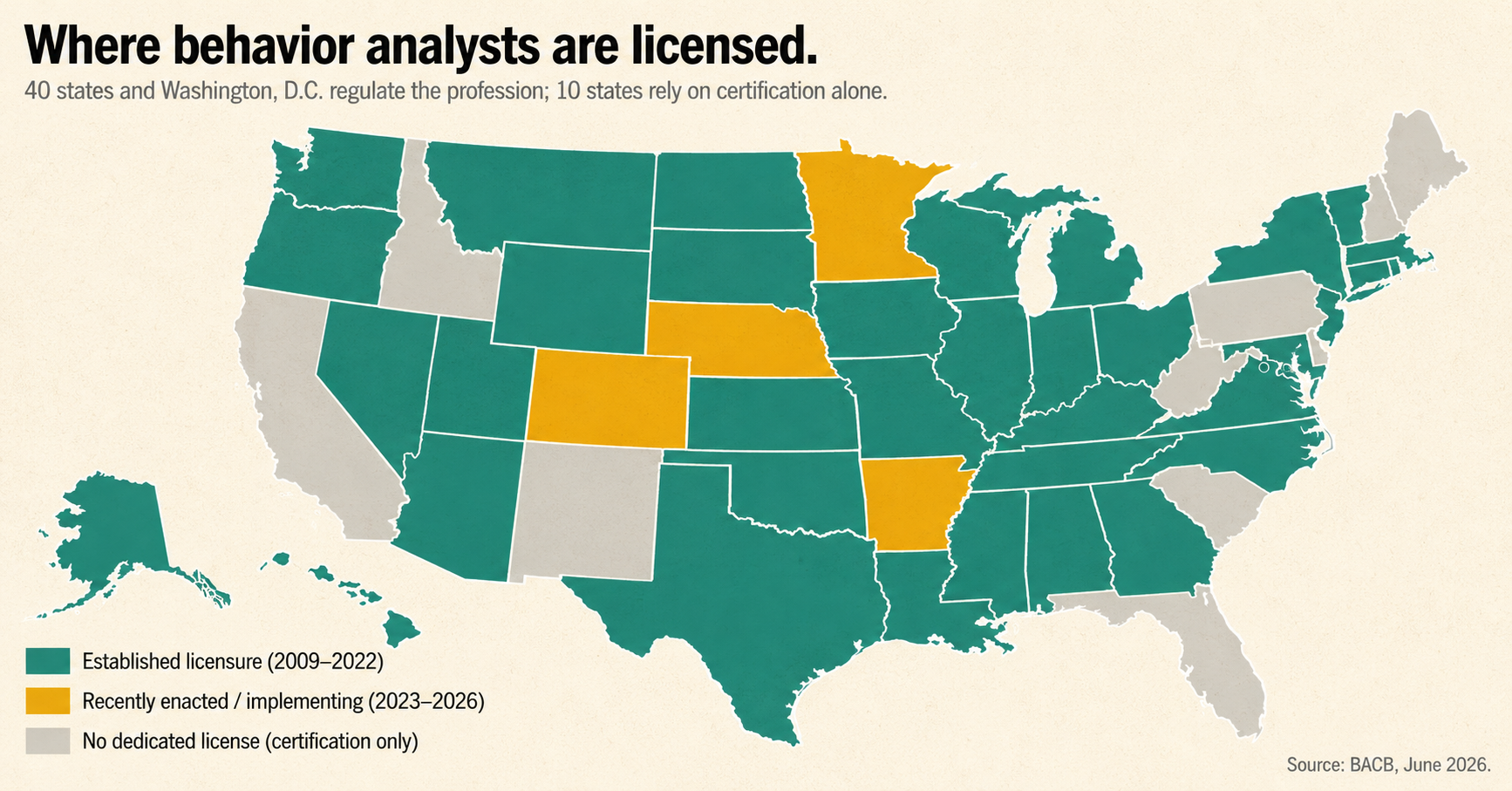
Fifteen years ago, no state licensed behavior analysts. Today, according to the Behavior Analyst Certification Board’s national tracker, 40 states and Washington, D.C. have passed laws to license or otherwise regulate the profession. Nevada and Oklahoma moved first in 2009. The wave built steadily through the 2010s and has not stopped: five jurisdictions have enacted laws since 2023, including the District of Columbia and Minnesota in 2024, Arkansas in 2025, and Colorado in 2026.
The shift matters because a state license is not the same thing as national certification. The BCBA credential proves a practitioner met standardized education, fieldwork, and exam requirements. A state license is a separate legal credential that defines who may practice, use protected titles, and bill within that state’s borders. Most licensure laws use BCBA certification as a prerequisite, but in a licensing state the certification alone does not authorize practice.
The Ten Holdouts
Ten states still have no dedicated behavior-analyst license: California, Delaware, Florida, Idaho, Maine, New Hampshire, New Mexico, Pennsylvania, South Carolina, and West Virginia. In these states a BCBA can practice on certification alone, though Medicaid programs and commercial insurers usually impose their own credentialing requirements as a condition of payment.
Two of the ten are special cases. Pennsylvania regulates practitioners under a separate “Behavior Specialist” license through its Board of Medicine rather than a behavior-analyst-specific statute, so practice there is governed, just under a different category. Florida restricts use of the professional title but has no active licensure board, leaving insurance credentialing to do most of the regulating. That California, the single largest ABA market in the country, still lacks a dedicated license is the most consequential gap on the map.
License, Registration, or Nothing
The map hides a second distinction that matters to operators: not every regulated state regulates the same way. Most have full licensure, which defines scope of practice and protects the title. A few use lighter-touch registration; Arkansas’s 2025 law is a registration program rather than full licensure. The newest laws also come with a lag between enactment and operation, so a state can appear regulated on paper while its board is still standing up an application system, as several of the 2023-to-2026 entrants are now doing.
A caution for anyone consulting a quick online guide: the popular aggregator sites disagree with the official record. Several list Maine, Delaware, Idaho, New Hampshire, New Mexico, or West Virginia as licensed, when the BACB’s own map does not. Where a state regulates behavior analysts under another profession’s statute, the trackers diverge. The board-by-board record is the one to trust, and even it changes often enough to warrant a direct check.
National certification tells a payer what a clinician knows. A state license tells a payer whether that clinician may legally deliver the service and bill for it. In 40 states, the field now needs both.
Why the Map Matters
For providers, the license line is an operational line, not a bureaucratic one. In most licensing states, the supervising analyst must hold that state’s license to legally oversee services delivered there; a national credential is not enough. Telehealth sharpens the point. When services reach a client located in a licensing state, the supervising analyst generally must hold that state’s license even if the clinician sits in another state. A multi-state platform therefore needs clinicians licensed in every state where its clients live, not merely where its staff work.
The practical takeaway is that the map is now a compliance map. Expansion planning, telehealth design, payer credentialing, and hiring all run through it. As the last holdouts weigh legislation and the newest boards finish standing up, the safest assumption for any provider crossing a state line is that certification opens the door only where the state has not yet built one of its own.
AT A GLANCE
| Regulated jurisdictions: | 40 states plus Washington, D.C. license or register behavior analysts (BACB, June 2026) |
| First laws: | Nevada and Oklahoma, 2009 |
| Most recent: | District of Columbia and Minnesota (2024), Arkansas (2025), Colorado (2026) |
| No dedicated license (10 states): | California, Delaware, Florida, Idaho, Maine, New Hampshire, New Mexico, Pennsylvania, South Carolina, West Virginia |
| Special cases: | Pennsylvania regulates via a “Behavior Specialist” license; Florida has title restriction only, no active board |
| License vs. registration: | Most regulated states use full licensure; Arkansas (2025) uses a lighter registration program |
| Certification vs. license: | BCBA certification is a national credential; a state license is a separate legal authorization to practice and bill |
| Supervision rule: | In most licensing states, the supervising analyst must hold that state’s license, not certification alone |
| Telehealth rule: | Services to a client in a licensing state generally require the analyst to hold that state’s license |
| Authoritative source: | BACB U.S. Licensure of Behavior Analysts map; verify with each state board, as laws change frequently |
SOURCES & REFERENCES
| 1. | Behavior Analyst Certification Board. “U.S. Licensure of Behavior Analysts” (state table and map). Updated June 2026. bacb.com/u-s-licensure-of-behavior-analysts/ |
| 2. | My ABA Jobs. “ABA Licensing & Certification by State (2026)” (supervision, telehealth, and title-restriction detail; aggregator, cross-checked against the BACB record). April 2026. myabajobs.com/resources/licensing |
| 3. | Association of Professional Behavior Analysts (APBA). Licensure resources and state tracking. apbahome.net |
| 4. | State regulatory boards, including the Illinois Department of Financial and Professional Regulation and the Minnesota Board of Psychology, for state-specific implementation status. |






Join the discussion ▾