A Grant That Reads Like a Thesis
A National Institutes of Health project summary posted to the agency’s RePORTER database states the problem in two sentences. Early intervention benefits autistic children, the summary says, but rising autism prevalence is overwhelming the public health system’s capacity, leaving many children unable to access timely diagnostic and intervention services. The funded answer is an adaptive, parent-mediated intervention built around self-directed telehealth, online programs that parents complete on their own, with professional support layered in as needed.
The framing matters because it is not unique to one grant. It is the working hypothesis behind a decade of telehealth parent-training research, and the access math behind it has only gotten harder. The Centers for Disease Control and Prevention reported in April 2025 that about 1 in 31 8-year-olds were identified with autism in its 2022 surveillance, up from 1 in 36 two years earlier. The median age of diagnosis, per the Autism Society of America, still sits at 47 months, nearly two years past the window when early intervention does the most good.
Parent-mediated intervention is the field’s most direct response to that supply problem. Instead of a clinician delivering all treatment, a trained caregiver implements the techniques during everyday routines, extending a child’s exposure to intervention well beyond billable clinical hours. Telehealth removes the geographic constraint. The open question, the one the NIH grant is built to answer, is how much professional coaching parents actually need to do it well.
The unglamorous variable in parent-mediated care is not whether telehealth works. It is how much therapist time each family needs, and whether a program can tell which families need more.
What the Evidence Already Shows
The self-directed model is attractive because it is cheap to scale. A program that parents complete online does not require a trained professional for every family and can be delivered at a fraction of the cost, which makes it potentially more widely disseminated among underserved and rural families. The evidence that it works on its own, though, is mixed, and that is the tension the adaptive design is meant to resolve.
In a 2016 pilot randomized controlled trial, Brooke Ingersoll and colleagues at Michigan State University compared self-directed and therapist-assisted versions of ImPACT Online, a telehealth parent-mediated program. Parents in both groups improved their intervention fidelity, self-efficacy, and stress, but the therapist-assisted group showed greater gains in parent fidelity and in positive perceptions of their child. Children in both groups improved on language measures; only the children in the therapist-assisted group improved in social skills. The authors concluded that both models showed promise, but that therapist assistance carried an added benefit for some outcomes.
A larger comparative-efficacy study from the same group, published in 2024, sharpened the picture. There was a significant treatment effect for parent learning in the therapist-assisted program but not in the self-directed one, the researchers reported, yet when the analysis was limited to parents who actually completed the program, both groups showed effects. Completion, in other words, did much of the work. Earlier engagement data pointed in the same direction: 85 percent of participants completed the program, overall, with the therapist-assisted group completing at a significantly higher rate than the self-directed group, and completion – not therapist contact alone- predicted gains in parents’ knowledge and fidelity.
The throughline across these studies is that self-directed telehealth helps the parents who stick with it, and that therapist support increases the odds that they do so. That is precisely the kind of finding an adaptive design is built to exploit.
The Adaptive Logic
An adaptive intervention does not assign the same dose to every family. It starts most families on the lower-cost option, then steps up the intensity for those who are not responding, using preset decision rules rather than clinician guesswork. In the telehealth parent-training context, that means starting with the self-directed program and adding therapist coaching for the families who stall, a stepped-care structure that follows logically from the comparative-efficacy work the ImPACT investigators called for in their earlier trials.
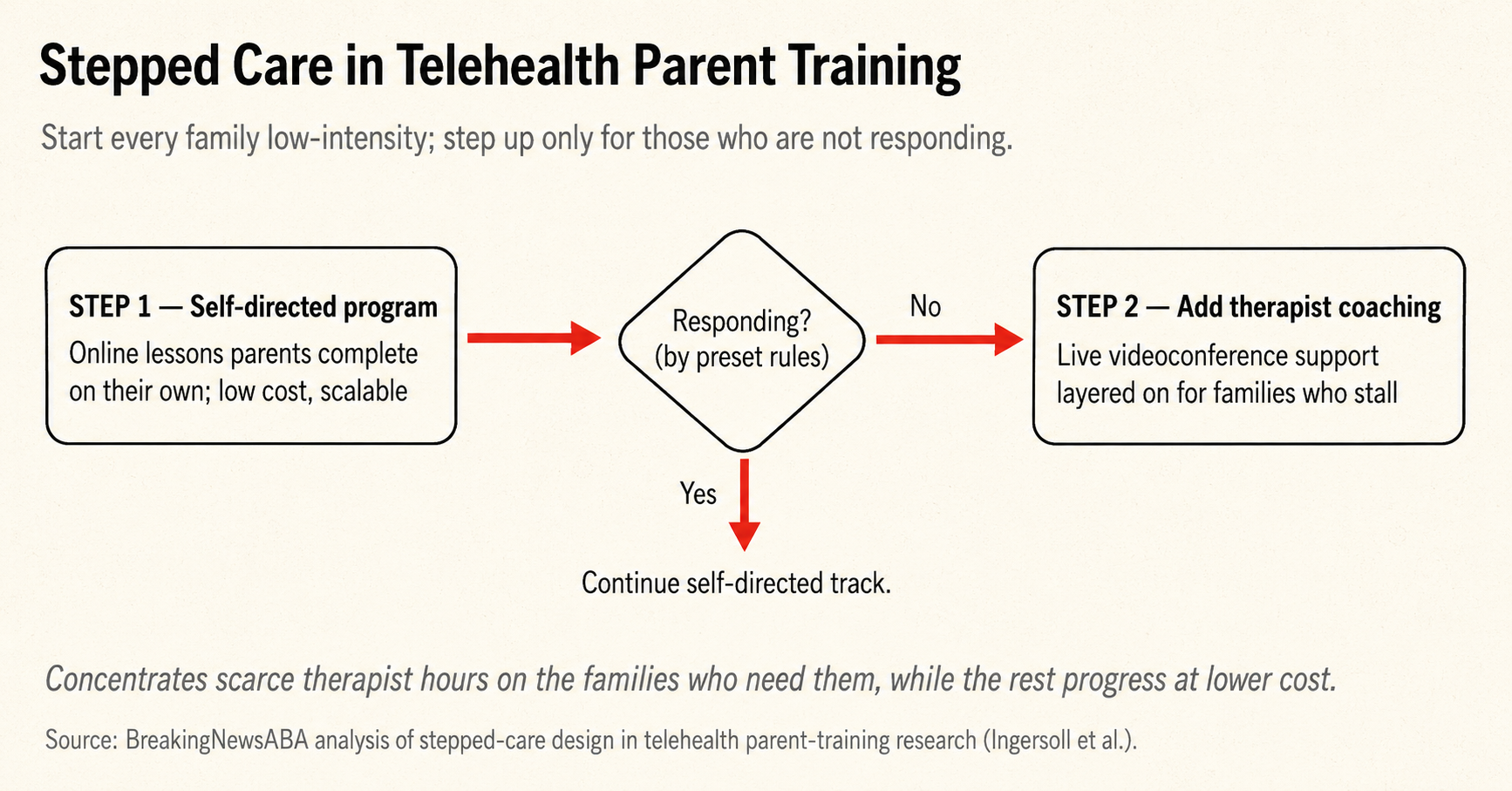
For providers and payers, the appeal is operational, not just clinical. A stepped model concentrates scarce therapist hours on the families who need them and lets the rest progress on a self-directed track, which is the only version of parent-mediated telehealth that scales to a 1-in-31 prevalence rate. It also produces exactly the data that value-based contracts increasingly ask for: who responded to the low-intensity option, who needed more, and what each step cost. Whether the model delivers on that promise is now an empirical question, and the answer will come from trials, not pilots.
AT A GLANCE
| Funder: | National Institutes of Health (project summary, NIH RePORTER, posted June 2026) |
| Intervention type: | Adaptive, parent-mediated, built on self-directed telehealth with professional support added as needed |
| Stated problem: | Rising autism prevalence is overwhelming system capacity; many children lack timely access (per project summary) |
| Autism prevalence: | 1 in 31 8-year-olds, 2022 surveillance, up from 1 in 36 in 2020 (CDC ADDM, April 2025) |
| Median diagnosis age: | 47 months, well past the optimal early-intervention window (Autism Society of America, 2025) |
| 2016 pilot RCT finding: | Both self-directed and therapist-assisted ImPACT Online improved parent fidelity; therapist-assisted gained more on fidelity and child social skills (Ingersoll et al., 2016) |
| 2024 efficacy finding: | Parent-learning effect for therapist-assisted overall; both groups showed effects among program completers (Ingersoll et al., 2024) |
| Self-directed completion: | ~69% of self-directed parents completed; completion predicted gains independent of therapist contact (Ingersoll & Berger, 2015) |
| Adaptive logic: | Start low-intensity (self-directed), step up to therapist coaching for non-responders by preset rules |
| Why it matters: | Concentrates scarce therapist hours, scales to prevalence, and generates step-level cost and response data for payers |
SOURCES & REFERENCES
| 1. | National Institutes of Health. “An adaptive parent-mediated intervention to improve outcomes for autistic children” (project summary). NIH RePORTER. https://reporter.nih.gov/project-details/11356391 |
| 2. | Shaw KA, Williams S, Patrick ME, et al. Prevalence and Early Identification of Autism Spectrum Disorder Among Children Aged 4 and 8 Years. CDC ADDM Network, April 2025. https://www.cdc.gov/autism/articles/prevalence-varies-across-us-communities.html |
| 3. | Autism Society of America. “Autism Society of America Responds to New CDC Report on Updated Autism Prevalence Rates.” April 2025. https://autismsociety.org/autism-society-of-america-responds-to-new-cdc-report-on-updated-autism-prevalence-rates/ |
| 4. | Ingersoll B, Wainer AL, Berger NI, Pickard KE, Bonter N. Comparison of a Self-Directed and Therapist-Assisted Telehealth Parent-Mediated Intervention for Children with ASD: A Pilot RCT. J Autism Dev Disord. 2016;46(7):2275-2284. https://doi.org/10.1007/s10803-016-2755-z |
| 5. | Ingersoll B, Frost KM, Straiton D, Pomales Ramos A, Howard M. Relative Efficacy of Self-directed and Therapist-assisted Telehealth Models of a Parent-mediated Intervention for Autism. J Autism Dev Disord. 2024;54(10):3605-3619. https://doi.org/10.1007/s10803-023-06092-6 |
| 6. | Ingersoll B, Berger NI. Parent Engagement With a Telehealth-Based Parent-Mediated Intervention Program for Children With ASD: Predictors of Program Use and Parent Outcomes. J Med Internet Res. 2015;17(10):e227. https://www.jmir.org/2015/10/e227/ |
| 7. | Ingersoll B, Shannon K, Berger N, Pickard K, Holtz B. Self-Directed Telehealth Parent-Mediated Intervention for Children With ASD: Examination of the Potential Reach and Utilization in Community Settings. J Med Internet Res. 2017;19(7):e248. https://www.jmir.org/2017/7/e248/ |