


A New Kind of Reviewer
INDIANAPOLIS – The Indiana Family and Social Services Administration (FSSA) has joined a federal pilot that puts artificial intelligence to work hunting Medicaid fraud, and the timing matters for the applied behavior analysis (ABA) sector. The 90-day program, launched by the federal Centers for Medicare and Medicaid Services (CMS), gives the state free access to Oracle software that analyzes claims for suspect billing patterns such as upcoding and so-called ghost services, care billed but not delivered. The stated goal is to catch questionable claims before they are paid, rather than chasing the money afterward.
The agency also intends to test whether the software can suggest claims edits, trigger prior-authorization requirements, and flag policy changes, and to build a shared platform for joint fraud investigations and faster enforcement against high-risk providers. In return, Indiana will evaluate whether other states could use Oracle’s models and will report the technical, legal, and privacy issues that would need to be fixed before any broader rollout. “Indiana is proud to partner with CMS and Oracle on this state-of-the-art pilot program to help states eliminate fraud,” Governor Mike Braun said in a statement, casting the state as a national test case.
On its face, the pilot is sector-agnostic; it scans Medicaid claims generally, not ABA specifically. But it lands in Indiana at a moment when no corner of the program is under more scrutiny than autism therapy, which makes ABA providers among the most exposed to whatever the algorithm surfaces.
Why ABA Is in the Crosshairs
Indiana has spent the past year tightening the screws on ABA. On June 6, the state imposed a six-month moratorium on enrolling new ABA provider agencies, a freeze that also covers ownership changes for existing agencies. However, individual rendering practitioners may still enroll. CMS approved the pause under the federal temporary moratorium authority at 42 CFR 455.470, after deciding that new ABA agency enrollments posed a significant risk of fraud, waste, or abuse. The freeze runs through early December and can be extended in six-month increments, with possible exceptions for accredited providers in underserved areas.
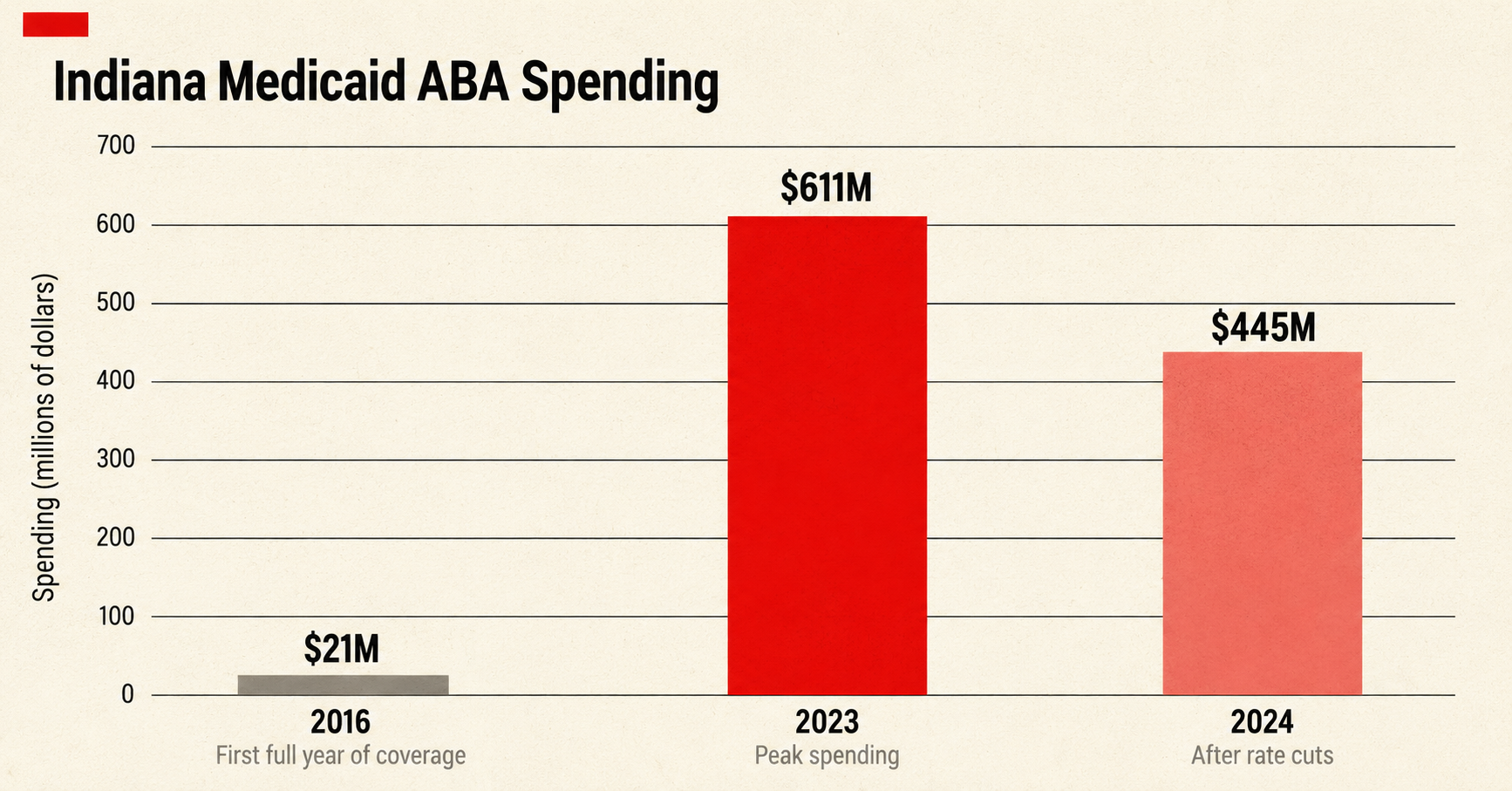
The fiscal backdrop explains the urgency. Indiana Medicaid began covering ABA in 2016, spending roughly 21 million dollars in the first year. Expenditures peaked at 611 million dollars in 2023 before falling to 445 million in 2024 after the state lowered reimbursement rates. By January 2026, more than 6,000 Hoosiers were receiving ABA through Medicaid, at a cost the agency pegged at roughly 35 million dollars in that single month. Over eight years, ABA grew from about 0.2 percent of the state’s Medicaid spending to 2.3 percent.
The catalyst for the crackdown was a March investigation by The Wall Street Journal that held up Indiana as a hotspot for runaway autism-therapy billing. It reported that the state paid one provider, Piece by Piece Autism Centers, roughly 29 million dollars in 2023 to treat just 84 patients, about 340,000 dollars per child, with some sessions billed at 600 dollars an hour. FSSA Secretary Mitch Roob responded by demanding that providers self-report any practices that could constitute fraud, waste, or abuse, and warned of expanded audits.
The pilot scans all Medicaid claims, not ABA alone. But it arrives in a state that has frozen new autism-therapy enrollment and is clawing back millions. No sector is more exposed to what the algorithm finds.
What Algorithmic Surveillance Actually Changes
For ABA providers, the shift is not simply more auditing; it is a change in when and how scrutiny happens. Traditional Medicaid integrity work is largely retrospective: claims are paid, then sampled and audited months or years later, as in the attendant-care review through which Indiana is now seeking to recover some 200 million dollars in alleged improper payments. AI-driven prepayment review moves the checkpoint to the front of the process. A model that flags claims before payment, suggests prior-authorization triggers, and scores providers for risk can hold up reimbursement in near real time, a serious cash-flow consideration for clinics that run on thin margins and frequent, high-volume claims.
ABA billing has features that make it especially legible to pattern-detection software. Services are billed in standardized time units, often for many hours per week per child, across large caseloads of technicians. That structure produces exactly the kind of high-volume, repetitive data in which an algorithm can spot outliers: impossible daily hour totals, billing that clusters at suspicious thresholds, mismatches between supervision and direct service, or documentation gaps. The same characteristics that made ABA attractive to high-growth, investor-backed operators also make it straightforward to model and to flag.
The Promise and the Risk
Used well, claims-surveillance AI could benefit honest providers and families alike. Faster detection of genuine fraud protects the public dollars that sustain the benefit, and a credible integrity system strengthens the case against blunt instruments like rate cuts or enrollment freezes that fall on everyone. If the technology can distinguish bad actors from legitimate clinics, it could, in principle, narrow enforcement to the former.
The risk is that it does not. Pattern-detection models can mistake legitimate clinical variation for fraud, especially in a field where high service intensity is often medically appropriate. A child who genuinely requires many hours of therapy a week can look, to a model tuned for outliers, like an anomaly. False positives carry real costs: delayed payments, administrative burden, and the chilling effect of providers trimming legitimate, intensive treatment plans to avoid scrutiny. Transparency is the crux. The agency itself has committed to identifying the legal and privacy issues that need to be fixed before any wider use, an implicit acknowledgment that the tools are not turnkey. How an algorithm decides what counts as suspicious, and whether providers can see and contest that logic, will determine whether this protects the benefit or simply adds a faster, more opaque layer of denial.
A Template Other States Will Study
The most consequential feature of the Indiana pilot may be that it is explicitly designed to be copied. The arrangement tasks the state with assessing whether Oracle’s models can be exported to other Medicaid programs, and it is paired with a new federal law that will reduce a state’s Medicaid matching rate based on its error rate, giving every state a direct financial incentive to drive down improper payments. States already wrestling with rapid ABA growth, several of which have pursued moratoria, rate cuts, and tighter utilization controls, will be watching what Indiana’s algorithm catches, and what it costs.
For ABA organizations, the practical implications are immediate regardless of where they operate. Documentation rigor, accurate time-unit billing, electronic visit verification, supervision records, and defensible medical-necessity determinations are no longer just audit hygiene; they are the inputs a model will read. Providers in growth mode, particularly those weighing acquisitions or expansion in states with rising ABA spend, should assume that enrollment, ownership changes, and utilization patterns are being watched at the front door, not just the back. The era in which a clinic’s billing was reviewed by a human, sometimes after the fact, is giving way to one in which the first reviewer may be a model that never stops watching.
AT A GLANCE
| What happened: | Indiana FSSA joined a CMS pilot using Oracle AI to flag suspect Medicaid claims pre-payment |
| Pilot length: | 90 days; Indiana to assess whether other states can use the models |
| What it scans: | Claims for upcoding, ghost services; can suggest edits, prior-auth triggers, provider risk scores |
| ABA connection: | Lands amid a six-month freeze (from June 6) on new ABA provider-agency enrollment |
| Freeze authority: | CMS-approved under 42 CFR 455.470; covers ownership changes; runs through early December |
| ABA spending: | Indiana ABA Medicaid: ~$21M (2016) to a $611M peak (2023), $445M (2024) after rate cuts |
| Utilization: | 6,000+ Hoosiers in ABA as of Jan 2026; ~$35M in that month alone |
| The catalyst: | March WSJ report; one provider paid ~$29M for 84 patients in 2023 (~$340K/child) |
| Why it matters: | Prepayment AI review moves scrutiny to real time; other states have financial incentive to copy |
SOURCES & REFERENCES
| 1. | Indiana Capital Chronicle / Fort Wayne Journal Gazette. “Indiana FSSA to use AI to detect Medicaid fraud.” June 28, 2026. |
| 2. | Indiana Capital Chronicle. “Indiana pauses autism therapy provider signups.” June 2026.
https://indianacapitalchronicle.com/briefs/indiana-pauses-autism-therapy-provider-signups/ |
| 3. | WISH-TV. “Indiana pauses enrollment of new autism therapy providers amid rising costs” (FSSA release; 42 CFR 455.470). June 2026. |
| 4. | Indiana Capital Chronicle. “State coming down on autism therapy providers that potentially abused system.” March 24, 2026. |
| 5. | WBIW. “Indiana pauses new autism therapy provider signups over Medicaid spending surge.” June 8, 2026. |
| 6. | U.S. Department of Health and Human Services, Office of Inspector General. Indiana improper fee-for-service Medicaid payments for ABA (audit report). 2024. |
| 7. | Electronic Code of Federal Regulations. 42 CFR 455.470, Temporary moratoria on enrollment of new providers.
https://www.ecfr.gov/current/title-42/chapter-IV/subchapter-C/part-455/subpart-E/section-455.470 |