
The Event
SCOTTSDALE, ARIZ. — the Autism Investor Summit West, the only conference in the ABA industry built specifically for investors and operator executives, returns to the JW Marriott Scottsdale Camelback Inn Resort and Spa from May 13 through 15, 2026. Now produced by Behavioral Health Business (BHB), a WTWH Media brand, the summit brings together ABA service providers, private equity investors, payers, investment bankers, and technology vendors for two and a half days of panels, networking, and deal-making. Vendelux confirmed 319 speakers and attendees for the 2026 event.
The conference is organized around a three-tiered ticket structure that reflects the composition of the room and the commercial purpose of the gathering. Independent providers who have not raised outside capital receive discounted pricing. PE-backed providers and investors pay standard rates. Ancillary service firms, including software companies, law firms, investment banks, and accounting practices, pay a third tier. An Executive Connect program offers complimentary tickets to VP-level or above executives at providers with $5 million or more in annual revenue, in exchange for agreeing to 15-minute structured meetings with sponsors during the event. The structure makes the business purpose explicit: this is where capital meets clinical operations.
WTWH Media acquired the Autism Investor Summit from Jade Health (formerly the Behavioral Health Center of Excellence, or BHCOE) in 2024. Under WTWH Media’s ownership, the summit is now fully integrated with BHB’s editorial and events infrastructure, and the 2026 program reflects that editorial perspective: sessions address not just opportunity but margin pressure, compliance risk, and the structural tension between clinical quality and investor returns.
The summit occupies a distinctive position in the ABA conference calendar. CASP (April 26 to 28 in Las Vegas) serves operator and clinical leadership teams. ABAI (May 21 to 25 at Moscone Center West in San Francisco) serves researchers and frontline clinicians. The Autism Investor Summit serves the capital layer: the PE firms, venture capitalists, investment bankers, and operator-investors who finance the industry’s growth. In practice, the attendee list overlaps significantly with CASP, because the people who run multi-state ABA platforms attend both. But the conversation at AIS is different. The questions are about multiples, margin structures, payer risk, and exit timelines. The clinical content is framed through the lens of what drives or threatens enterprise value.
The Autism Investor Summit is the only conference in the ABA industry built specifically for investors and operator executives. The 2026 program addresses the central tension: how to maintain clinical integrity while achieving institutional scale.
The Agenda
Day one (May 13) opens with a BHB+ Summit Panel titled “Scaling Up Autism Practices,” featuring Mandy Ralston (CEO, KidsChoice), Dr. Ronit Molko (CEO, Alongside ABA), Jeff Beck (CEO, Answers Now), and Michael Quinn (President/CEO, Autism Support Now). The panel is moderated by BHB’s Laura Lovett and is followed by an audience Q&A. The day closes with a Welcome Reception presented by CentralReach, the ABA platform and Platinum Sponsor, held outdoors at the resort’s Mummy Mountain terrace. A private golf tournament at the JW Marriott Camelback Golf Club runs concurrently.
Day two (May 14) is the main conference day, with sessions running from 9 AM through late afternoon. The morning opens with “Mission, Margin, and the Middle: Running ABA When the Rules Keep Changing,” featuring Mellanie Page (EVP Operations, ABS Kids) and Jeffrey Morelli (CEO, Silna Health). The session addresses what the organizers describe as “an unprecedented moment of change: shifting payor criteria, tightening compliance scrutiny, and rate pressure that hits margin directly.” A state-of-the-industry panel follows: “Future-Proofing Autism Therapy: Bridging the Gap Between Clinical Excellence and Fiscal Reality,” with Daniel Byrdsong (CEO, Surpass Behavioral Health), Yagnesh Vadgama (VP Payor Strategy, CentralReach), Dr. Stuart Lustig (National Medical Executive, Cigna Healthcare), and Timothy Yeager (CCO, Centria Autism). The presence of a Cigna executive on the main stage signals that payer-provider dynamics are moving from the periphery to the center of the ABA investment conversation.
The afternoon splits into parallel tracks. One track features “Beyond Buyouts: An Affiliation Path to Scale,” presented by Inperium, which has completed more than 35 affiliations within a nonprofit network generating nearly $1 billion in consolidated revenue. The session positions affiliation as an alternative to traditional M&A that preserves local identity while unlocking shared services, capital access, and technology. A parallel track covers revenue cycle management: “The Revenue Engine: Synchronizing RCM and Leadership for Sustainable Growth,” presented by SimiTree with SLEA Therapies CEO Rina Barak.
“Small But Mighty: How Independent ABA Providers Can Thrive in a Consolidating Market” features Mordechai Meisels (Encore Support Services), Julie Gordon (The Hope Source), and Aaron Blocher-Rubin (Arizona Autism United), addressing the question that every non-PE-backed operator carries: whether clinical quality, local relationships, and agility can compete against platform scale. A session on integrating OT, PT, and speech therapy into ABA services features Elizabeth Broomfield (Managing Partner, Aquitaine Capital) alongside clinic operators, reflecting the movement toward multidisciplinary models. A franchise-model panel with Nichole Daher (Success On The Spectrum), Idris Demirci (Able Autism Franchise), Shaden Kassar (Autism Care Therapy), and Benjamin MacGowen (Hi-5 ABA) addresses whether local ownership through franchising can balance scale with clinical intimacy.
A workforce panel featuring Tia Glover (Regional Director, Devereux Advanced Behavioral Health), Saba Torabian (CEO, Intervention Center for Autism Needs), and Dr. Steven Merahn (Enterprise Chief Medical Officer, Perimeter Healthcare) addresses what the agenda describes as an industry that “faces high turnover, elevated wages, rate cuts, efforts to integrate ABA with several other care types and calls from all sides for the industry to prove its value.” The workforce conversation at AIS is framed differently than at clinical conferences; here, the question is not how to train better therapists but how to build compensation and career structures that retain them at scale. A separate panel on venture capital versus private equity funding demystifies the structural differences between the two models for providers considering their first outside capital raise.
The Market Context
The summit arrives at a moment when the ABA industry is navigating multiple simultaneous pressures. The autism therapy market is projected to more than double between 2026 and 2034, reaching approximately $19 billion. The ABA segment has been growing at roughly 25% compound annual growth over the past several years, a rate that has attracted more than 200 PE transactions since 2012. Mega-funds including Charlesbank Capital Partners (backing Action Behavior Centers, the largest ABA provider by location count), KKR (BlueSprig), General Atlantic (ACES), and Arsenal Capital Partners (Hopebridge) have established major positions, while Blackstone’s 2018 acquisition of CARD ended in a 2023 Chapter 11 filing that returned the company to founder Doreen Granpeesheh. The industry now includes several platforms operating 100 or more centers across multiple states.
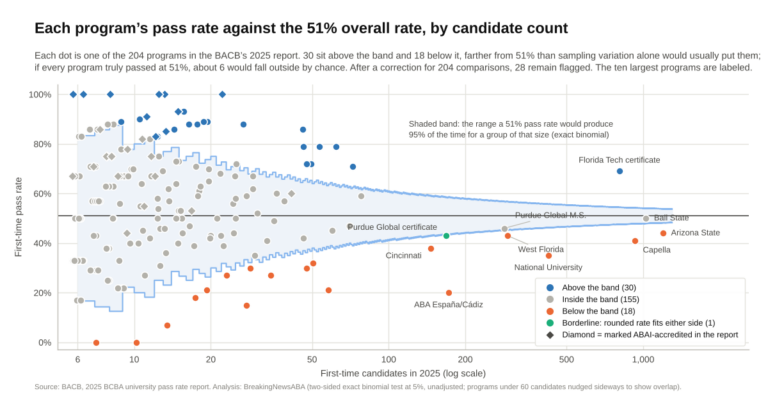
But growth is decelerating from its peak. Payers are tightening prior authorization criteria, reducing approved treatment hours, and increasing audit activity. BCBA workforce constraints persist: 83,586 active certificants face 132,307 job postings, and the first-time exam pass rate has declined to 51%. RBT turnover runs 65% to 103% annually, creating a replacement cost drag that erodes operating margins.
For PE investors, the margin profile of ABA has shifted. The earliest entrants in the sector, firms that acquired platforms between 2015 and 2019 and rode the wave of insurance mandate expansion, achieved strong returns on platforms that grew revenue through geographic expansion and de novo center openings. The current environment is different. Reimbursement rates in many states have flattened or declined, prior authorization requirements have added administrative cost, and the BCBA shortage has driven up clinician compensation. Platforms that built their models on high treatment hours and out-of-network single-case agreements face margin compression as payers consolidate networks and enforce in-network rate schedules. The AIS West sessions on RCM optimization, payer strategy, and margin defense directly address these dynamics.
The presence of Inperium on the agenda with its affiliation model introduces a structural alternative to the traditional PE rollup. Inperium’s model, which has completed more than 35 affiliations within a nonprofit network generating nearly $1 billion in consolidated revenue, offers providers access to shared services, capital, and technology without the equity transfer that defines a PE transaction. For founders who want institutional scale without ceding ownership, and for investors exploring structures beyond traditional buyouts, the affiliation model is a live experiment that the AIS West audience will evaluate in real time.
The AIS West agenda reflects this reality. The sessions that would have dominated in 2019 or 2020, pure growth stories, M&A deal structure, and market entry strategy, have been supplemented by sessions on margin defense, payer negotiation, RCM optimization, compliance risk, and alternative ownership models. The franchise panel and the affiliation-model session from Inperium represent new structural answers to the question that PE-backed consolidation raised but has not fully resolved: how to scale autism services without losing the clinical intimacy that drives outcomes.
The Intrepid Investment Bankers team, which has attended the summit since its inaugural edition, observed that the conference has evolved from a forum where mega-funds like Blackstone, KKR, TA Associates, and TPG showcased their positions to one where the conversation has shifted toward ancillary services, technology platforms, and the ecosystem that supports ABA delivery. Intrepid noted that payers are moving toward narrower provider networks built around outcome data and service quality, a trend that advantages large platforms with data infrastructure but also creates opportunities for technology firms that can aggregate outcomes across independent providers. The 2026 agenda’s emphasis on CentralReach as Platinum Sponsor and SimiTree’s RCM session reflects this technology-centric shift.
The conference also arrives as the CDC’s autism prevalence estimate has risen to 1 in 31 children, up from 1 in 36 in the prior data cycle and 1 in 44 in 2018. Each prevalence increase expands the addressable market for ABA services while simultaneously straining a workforce that already has 46% of U.S. counties without a single BCBA. The gap between diagnosed children and available treatment capacity remains the fundamental market condition that attracts investor capital to the sector, and the 2026 summit will test whether that capital is flowing toward solutions that close the gap or toward structures that extract value from it.
More than 200 PE transactions have occurred in autism services since 2012. The 2026 AIS West agenda shows the industry shifting from pure growth to margin defense, payer strategy, and alternative ownership models.
What to Watch
The Autism Investor Summit has historically been the venue where deal announcements, payer partnership reveals, and strategic pivots surface. Whether the 2026 event produces similar disclosures will depend on whether the current market environment, characterized by tighter payer controls and heightened regulatory scrutiny, has slowed deal flow or merely changed the terms on which transactions are completed. The presence of Cigna’s Stuart Lustig on the main stage and CentralReach as Platinum Sponsor suggest that payer-technology convergence is a defining theme for 2026.
The investor-facing format means that the hallway conversations may matter more than the panel sessions. In prior years, the summit has been the site of informal deal introductions, where providers exploring a capital raise meet PE firms screening the sector, and where PE firms with portfolio companies in ABA meet add-on acquisition targets. The Executive Connect program formalizes this dynamic by structuring 15-minute meetings between qualified provider executives and sponsors. For providers with $5 million or more in annual revenue who have not yet raised outside capital, the summit is effectively a curated introduction to the capital markets.
The Autism Investor Summit East, a separate event, has already sold out its original ticket allocation and is offering general admission at $2,000 per ticket. The West event runs concurrently with the broader behavioral health conference calendar: CASP concluded April 28, the ABAI Annual Convention opens May 21 in San Francisco, and the BHB VALUE Conference earlier in 2026 focused on value-based care infrastructure. Together, these events describe an industry that is professionalizing rapidly and whose leadership class is spending an increasing share of its time in conference rooms negotiating the terms of a maturing market. The question the AIS West attendees will carry back to their offices is whether the autism services sector is entering its next growth phase or a potential correction.
AT A GLANCE
| Event: | Autism Investor Summit West 2026 |
| Dates: | May 13 to 15, 2026 |
| Location: | JW Marriott Scottsdale Camelback Inn Resort and Spa, Scottsdale, AZ |
| Producer: | Behavioral Health Business (WTWH Media) |
| Attendees: | 319 confirmed speakers and attendees (Vendelux) |
| Platinum sponsor: | CentralReach (Welcome Reception) |
| Key sessions: | Margin pressure, payer strategy, franchise models, independent provider survival, RCM, affiliation models |
| Notable speakers: | Dr. Stuart Lustig (Cigna), Mellanie Page (ABS Kids), Daniel Byrdsong (Surpass), Timothy Yeager (Centria) |
| Market size: | ABA market projected to reach ~$19B by 2034 |
| PE activity: | More than 200 autism services transactions since 2012 |
| Ticket tiers: | Independent providers (discounted), PE-backed, investors, ancillary services |