
Rural Kansas
AMES, IOWA – Chris Whitmer grew up in rural Kansas, the son of two public school teachers. His father taught biology, chemistry, and physics. His mother taught as well. On days when school was not in session, Whitmer wandered through his father’s classroom, examining the fish tanks, the plants, the microscopes, and what he later described as “cool stuff” that made science feel alive rather than abstract. The experience left a mark that would shape both of his careers: the first in engineering education, and the second in autism.
Whitmer earned his bachelor of science at Kansas State University, then moved to Iowa State University for his master’s and PhD in mechanical engineering, completing the doctorate in 2009. He chose Iowa State over schools on both coasts because, as he told the university’s engineering publication, “the people, culture, and environment were welcoming, and the facilities were great. It just felt like a good choice for me.” Graduate school taught him, in his words, “the process for answering unknown questions, how to focus ideas into research, and how to effectively collaborate with others.” Those skills, designed for aerospace engineering, would later be applied to a problem no engineering textbook covers: how to extend behavioral therapy into the hours of a child’s day when no therapist is present.
After his PhD, Whitmer worked with a company developing aerospace software and early-stage engineering design tools. The work was technically demanding but not where his energy pointed. The son of two teachers wanted to teach. In 2015, he co-founded Parametric Studio Inc. with Atul Kelkar, then on the mechanical engineering faculty at Iowa State, Jerald Vogel, associate professor emeritus in aerospace engineering, and Mike Upah, the company’s CFO. The four started part-time, building on their own hours, until federal grants turned the project into a full-time company.
Parametric Studio and $3.5 Million in Federal Grants
Parametric Studio, based in Ames, Iowa, develops video game-based STEM education tools for K-12 students. The company’s flagship products include NEWTON, an augmented reality engineering puzzle sandbox designed for PreK through second grade, and a suite of project-based learning games that integrate core engineering and computer science concepts with grade-level math and science standards. The tools are designed for classroom integration, not as standalone apps, reflecting Whitmer’s belief that technology should support teachers rather than replace them.
The company secured over $3.5 million in grant funding from the National Science Foundation, the U.S. Department of Agriculture, the Department of Education, and the National Institutes of Health. Parametric Studio participated in the first cohort of Iowa State University’s Startup Factory in 2016, an accelerator program that helped Whitmer refine his pitch, business model, and go-to-market strategy. The grants funded research and development, classroom testing, and the company’s first commercial products. “These research and development grants have enabled us to build out the current functionalities of our core STEM education platform, test it in the classroom, and now roll out our first commercial products to schools, STEM organizations, and parents,” Whitmer told the Iowa State engineering news service.
The son of two public school teachers in rural Kansas built a STEM education company with $3.5 million in federal grants. Then his son Ethan was diagnosed with autism, and everything changed.
Ethan
Then Ethan was diagnosed with autism. Chris Whitmer and his wife, Karri Haen Whitmer, a teaching professor in Iowa State University’s Department of Genetics, Development and Cell Biology, experienced what millions of parents of children with autism know: the moment when a diagnosis reframes everything. The therapies, the schedules, the IEP meetings, the waitlists, the search for providers who understand your child, and the gap between the hours when a therapist is present and the hours when your child is on their own.
For the Whitmers, the gap was the problem. ABA therapy, when it is working, produces meaningful behavioral change during session hours. But a child’s day is longer than a therapy session. The strategies a BCBA develops, the prompts an RBT uses, the communication supports a speech therapist builds, all of these exist inside the clinical encounter. When the session ends, the family is left to generalize those strategies across the kitchen table, the grocery store, the school hallway, and every other setting where the child’s behavior and learning do not pause because a therapist is not present. The gap is not a failure of the therapist. It is a structural limitation of a service delivery model that bills by the session and ends at the door.
The research on generalization in ABA is clear and frustrating in equal measure. Skills acquired in a therapy setting do not automatically transfer to other environments. Generalization must be programmed, practiced, and reinforced across settings, people, and materials. But the practical reality for most families is that the BCBA creates the generalization plan, the RBT implements it during session hours, and then the family is left to carry the plan forward with limited support, limited training, and no technology designed to help. Caregiver training (CPT 97156) addresses part of this gap, but it is a human-delivered service constrained by the same scheduling, workforce, and reimbursement limitations as every other ABA service. What the Whitmers saw in Ethan’s daily life was a gap that no amount of additional session hours could close: the need for behavioral support that is always present, always personalized, and always aligned with the treatment plan.
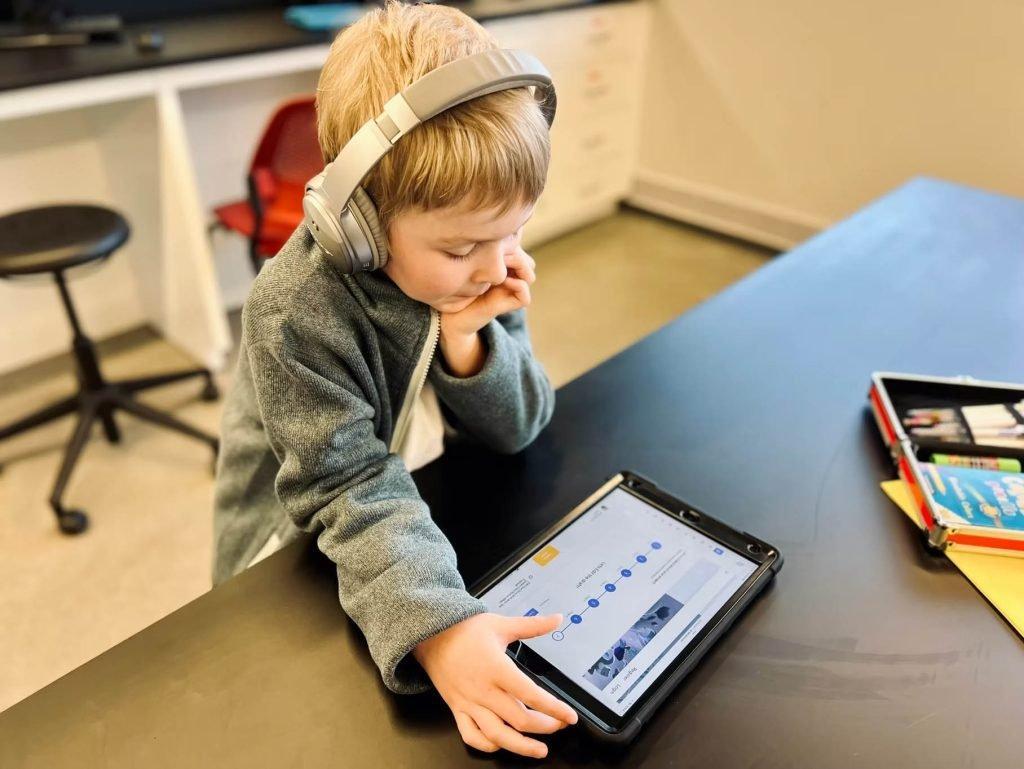
The Whitmers had the technical skills to build something. Chris brought engineering, product development, and a decade of experience turning federal grants into functional software products. Karri brought neurobiology, adaptive learning, accessibility design, and a faculty appointment that gave her access to Iowa State’s research infrastructure. Together, they built Ama AI.
Ama AI: The Digital Advocate
Ama AI, originally launched as NarrateAR, is an AI-driven assistive technology platform designed to support individuals with autism and cognitive differences by extending therapeutic strategies into everyday life. The system functions as a personalized learning companion that adapts to a child’s existing therapy goals and offers guidance for daily tasks, communication support, and continuity across home, school, and therapy settings. It does not replace therapists, teachers, or aides. It supplements them by ensuring that the strategies being used in clinical sessions are reinforced during the hours when no professional is present.
The platform reflects strategies already being used in therapy by adapting prompts and supports to an individual’s existing goals. This design principle is critical: Ama AI does not impose its own behavioral model. It reads the treatment plan, understands the clinician’s approach, and extends that approach into the child’s daily environment. For a BCBA who spends hours developing an individualized treatment plan, the tool offers something the field has never had at scale: a way to ensure that the plan’s strategies are present even when the BCBA is not.
The company participated in Iowa State’s Startup Factory’s 14th cohort in August 2023. Karri described the experience of pitching the product: “Getting up in front of strangers and pitching something so close to your heart is uncomfortable. The ISU Startup Factory helped me distill a complex AI system into language that people could understand. It was a really important shift.” Chris, who had participated in the Startup Factory’s first cohort seven years earlier with Parametric Studio, returned for the second time. “I had a great experience in 2016, and the program has gotten even stronger and more robust since then,” he said. The couple’s joint participation in the accelerator reflects how Ama AI was built: not by a solo technical founder chasing a market opportunity, but by two parents with complementary expertise, one in engineering and product development, the other in neurobiology and adaptive learning, solving a problem they live with every day.
The ethical dimension of the platform is central to the Whitmers’ design philosophy. Ama AI is parent-controlled and secure, meaning no data is shared without explicit parental consent and no AI-generated recommendation overrides the clinician’s treatment plan. In a field where the intersection of AI and behavioral data raises significant privacy and safety concerns, particularly for children who cannot advocate for their own data rights, the decision to build parent control into the architecture from day one is a deliberate ethical choice. The Whitmers have written publicly about their own initial skepticism toward AI in their son’s care, and how that skepticism informed the product’s design: “We were skeptical about AI too, so we built the digital advocate our child deserves.”
“That’s the hope for all parents of these kids – knowing that when we’re gone, our kid is going to be OK.” – Karri Haen Whitmer, Co-Founder, Ama AI (2025)
The MAC Midwest Pilot and 600 Kids
In late 2025, Ama AI launched a collaborative pilot with MAC Midwest, a Minnesota-based provider offering diagnostic services, ABA therapy, speech and occupational therapy, psychotherapy, and family-supports through a transdisciplinary model of care. The pilot embeds Ama AI’s platform within MAC Midwest’s existing care model, allowing the technology to be tested inside a clinical environment that values individualized planning, ethical implementation, and cross-disciplinary collaboration.
Karri framed the partnership in terms of continuity and collaboration: “Partnering with MAC Midwest allows us to explore this technology within a care model that values individualized planning, ethical implementation, and a truly transdisciplinary approach to care.” The pilot is designed to evaluate whether the AI companion produces measurable improvements in treatment generalization, the degree to which skills learned in therapy transfer to home and school settings. If the data show that Ama AI increases generalization without increasing clinician workload, the model becomes scalable across the broader ABA provider market.
Ama AI is now being piloted with several ABA therapy organizations and schools, reaching an estimated 600 young people. The company has received support from the USDA, the State of Iowa, NMotion (a Lincoln, Nebraska-based startup accelerator), and the New Schools Venture Fund. The funding mix, combining agricultural research grants, state economic development support, accelerator capital, and education venture philanthropy, reflects the cross-sector nature of the problem Ama AI addresses: autism does not stay inside a therapy room, and the tools that support it should not either.
What Comes Next
Chris Whitmer continues to serve as CTO of Parametric Studio while building Ama AI. The dual role is unusual but consistent with how the company was founded: on personal time, with personal motivation, before external funding arrived. The STEM education company and the autism assistive technology company share a common design philosophy: technology should support the people doing the work, whether those people are teachers, therapists, or parents, rather than replacing them. Both companies build tools that adapt to existing curricula, treatment plans, and goals rather than imposing new ones.
The ABA industry is entering a period of intense interest in AI, with platforms from CentralReach, Motivity, and dozens of startups offering AI-powered documentation, clinical decision support, and predictive analytics. Most of these tools are designed for providers: they reduce the BCBA’s documentation burden, flag patterns in session data, or automate scheduling and billing workflows. Ama AI occupies a fundamentally different niche. It is not a tool for providers. It is a tool for the hours between sessions, the period of a child’s waking life that happens outside a therapy room.
The distinction matters because it addresses a problem the provider-facing tools cannot solve. A BCBA can use CentralReach’s AI to write better session notes. She can use Motivity’s program builder to design a more individualized treatment plan. But neither tool helps the child practice those skills at 7 PM on a Tuesday when the therapist has gone home and the parent is cooking dinner. Ama AI is designed for that moment. The platform’s emphasis on ethical implementation, parent control, and alignment with existing clinical strategies reflects the Whitmers’ understanding that any AI tool operating in a child’s daily life must earn the trust of both the clinician who designed the treatment plan and the parent who lives with it.
Approximately 75% of individuals with any kind of disability are not working, a statistic that Karri has said made her “jaw drop.” She wants Ama AI to be something individuals can use as they advance beyond their school years and begin working professionally and living on their own. The vision extends far beyond childhood therapy. If the platform’s adaptive capabilities scale with the user, growing from a learning companion for a five-year-old to a vocational support tool for a 25-year-old, Ama AI becomes a lifespan technology rather than a childhood intervention.
If the MAC Midwest pilot and the school-based deployments demonstrate that the platform improves generalization without creating new risks, Whitmer will have built something the field has discussed for years but never delivered: a way to make therapy portable. The aerospace engineer from rural Kansas, who learned the value of education from his parents and the urgency of assistive technology from his son, is building the tool he wished had existed when Ethan was diagnosed.
AT A GLANCE
| Subject: | Dr. Chris Whitmer, Co-Founder and CTO, Ama AI |
| Co-Founder: | Karri Haen Whitmer, PhD, Teaching Professor, Iowa State University (Genetics, Development, Cell Biology) |
| Education (Chris): | BS, Kansas State University; MS and PhD in Mechanical Engineering, Iowa State University (2004-2009) |
| Parametric Studio: | STEM edtech company; co-founded 2015; $3.5M+ in NSF, USDA, DOE, NIH grants; CTO |
| Ama AI: | AI-driven assistive technology for autism; originally launched as NarrateAR; Ames, Iowa |
| Platform: | Personalized AI learning companion; extends ABA strategies into home, school, community settings |
| Pilot: | MAC Midwest collaborative pilot (transdisciplinary ABA model, Minnesota) |
| Reach: | ~600 young people across ABA therapy organizations and schools |
| Funding partners: | USDA, State of Iowa, NMotion (Lincoln, Nebraska startup accelerator), New Schools Venture Fund |
| ISU Startup Factory: | Cohort 1 (2016, Parametric Studio) and Cohort 14 (2023, NarrateAR/Ama AI) |
| Personal: | Son Ethan diagnosed with autism; grew up in rural Kansas; both parents were teachers |
| Design principle: | Supplements therapists, not replaces; adapts to existing treatment plans and goals |
SOURCES & REFERENCES
| 1. | Iowa State University News Service. “Bringing New Solutions to Market.” April 14, 2026. https://www.news.iastate.edu/news/bringing-new-solutions-market |
| 2. | Iowa State CALS. “Professor Developing Learning Companion for Students with Disabilities.” April 16, 2025. https://www.cals.iastate.edu/news/2025/professor-developing-learning-companion-students-disabilities |
| 3. | MAC Midwest. “MAC Midwest and Ama AI Launch Collaborative Pilot.” December 2025. https://www.mnautism.org/mac-midwest-and-ama-ai-launch-collaborative-pilot/ |
| 4. | Ama AI. Home page. Accessed May 2026. https://www.withama.ai/ |
| 5. | Iowa State Engineering News. “Using Video Game-Based Tools to Teach STEM.” November 10, 2021. https://news.engineering.iastate.edu/2021/11/10/using-video-game-based-tools-to-teach-stem/ |
| 6. | Parametric Studio Inc. “Using Video Game-Based Tools to Teach STEM.” November 2021. https://www.parametricstudioinc.com/blog/using-video-game-based-tools-to-teach-stem |
| 7. | EdTech Iowa / Clay & Milk. “Parametric Studio Is Changing STEM Education.” December 2021. https://www.edtechiowa.com/post/parametric-studio-is-changing-stem-education-with-project-based-software-and-games |
| 8. | Clay & Milk. “Parametric Studio Awarded $200,000 SBIR Grant.” September 2019. https://clayandmilk.com/2019/09/20/middle-bit-parametric-studio-awarded-200000-sbir-grant/ |
| 9. | ISU Pappajohn Center. “Iowa State University Startup Factory Announces Fourteenth Cohort.” August 2023. https://www.isupjcenter.org/2023/08/iowa-state-university-startup-factory-announces-fourteenth-cohort/ |
| 10. | NarrateAR. “Skeptical About AI? We Were Too.” March 30, 2025. https://www.narratear.com/post/skeptical-about-ai-we-were-too-so-we-built-the-digital-advocate-our-child-deserves |
| 11. | RocketReach. Christopher Whitmer, NarrateAR Co-Founder. Accessed May 2026. https://rocketreach.co/christopher-whitmer-email_27977974 |
| 12. | LinkedIn. Christopher Whitmer. Accessed May 2026. https://www.linkedin.com/in/christopher-whitmer-a6957a37 |