A Rule She Does Not Soften
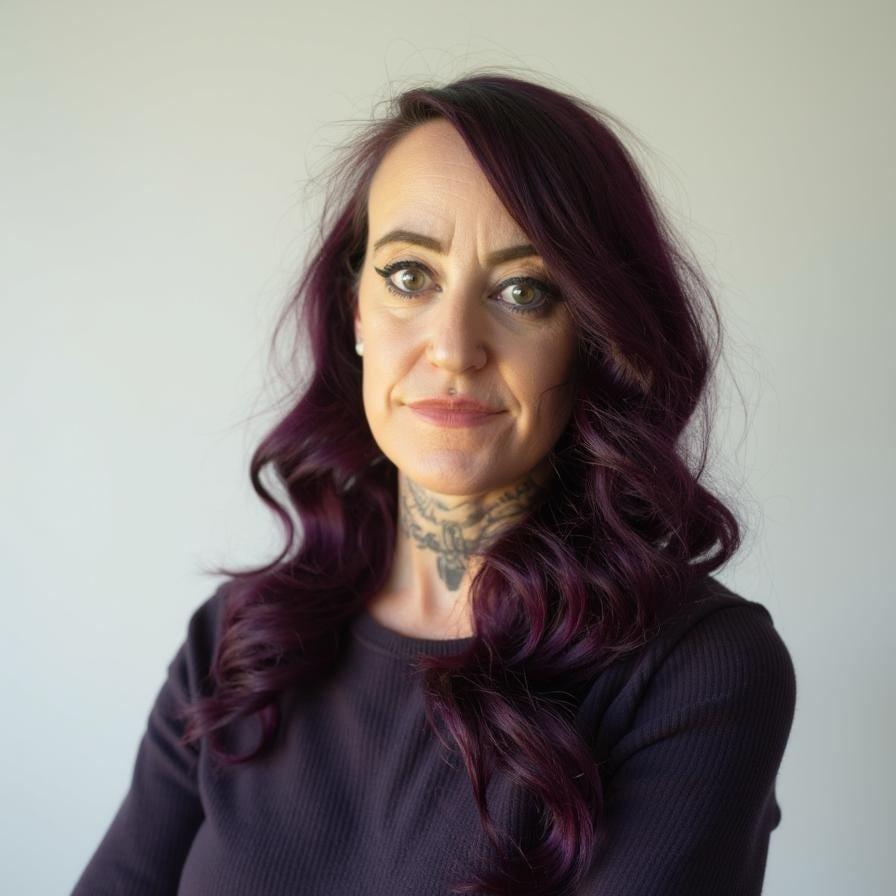
SALEM, OREGON – Samantha Parnham says getting rich in autism care is not complicated, and that she has decided against it. The founder and chief executive officer of Adventures with Autism runs a deliberately small applied behavior analysis practice in the Salem area, built on a rule she gives to families and staff, without softening: the children come first, ahead of the company’s growth and short-term profit.
That conviction has made Parnham one of the more outspoken independent voices in a field reshaped by outside capital. She is a Board Certified Behavior Analyst, and she holds a behavior analyst seat on the Oregon Behavior Analysis Regulatory Board, the state body that licenses the profession. She also writes a Substack, Reinforcement & Ruin, where she has documented litigation and billing practices at some of the industry’s largest providers.
She talks about the work the way she talks to everyone, she says, warning up front that she swears and will not use “kid gloves.” Behind the bluntness is a specific claim about incentives: that a company built to grow and sell will, sooner or later, treat a child as a line item. Parnham says she has organized her whole practice to avoid becoming that company.
A Path Through Criminal Justice
Parnham did not arrive in ABA the way many of her peers did. She earned undergraduate degrees in psychology and criminal justice, and later completed a master’s in applied behavior analysis and is all-but-dissertation for a PhD in business administration. She graduated into the 2007 recession, worked in many jobs even as a dog trainer, then spent about three years as a domestic violence counselor in Las Vegas, running an emergency protection-order hotline and accompanying survivors to court.
That period, she says, changed how she sees systems and the people they fail. She left it for early intervention work with children in Nevada, watched a colleague train to become a BCBA, and fell into the field almost by accident. She earned her own BCBA in 2015.
The detour is central to how she reads her own profession. People who come to ABA from another career, she said, tend to “learn how little you know” before they ever sit for the exam. She contrasts that with clinicians who go straight from an undergraduate degree into an ABA master’s and then into certification, and who she believes can mistake their training for a kind of authority over families they have never had to be part of.
Why She Left Corporate ABA
Early in her career, Parnham worked for one of the field’s large, corporately run providers. She says the job soured fast: months on payroll without a real caseload, then productivity targets she describes as unreachable, including a push for roughly 45 billable hours a week while driving between clients across a wide territory. She says she argued back, politely and persistently, that the targets were not attainable for her or anyone.
Her breaking point, she says, involved the death of a child. A boy had been added to her caseload on an intake she describes as rushed and incomplete; a few sessions in, she learned he had gotten out of his home at night and been killed in a traffic accident. Parnham does not blame herself, and she is careful not to assign legal fault. What she took from it was a conviction that a company that treated enrollment as a billing opportunity rather than a clinical decision had failed a child who depended on it.
“These babies are relying on us, and we’re just screwing them over, and I’m not doing it.” – Samantha Parnham, Adventures with Autism (2026)
She left to start her own practice. Adventures with Autism, which she has kept small across the Salem and Keizer area, is the result. Parnham says she has lost staff who could not live with her one non-negotiable: that the children come before the adults who serve them, and that she has run the company broke at times rather than compromise it.
Her Case Against Certain Business Approaches in ABA
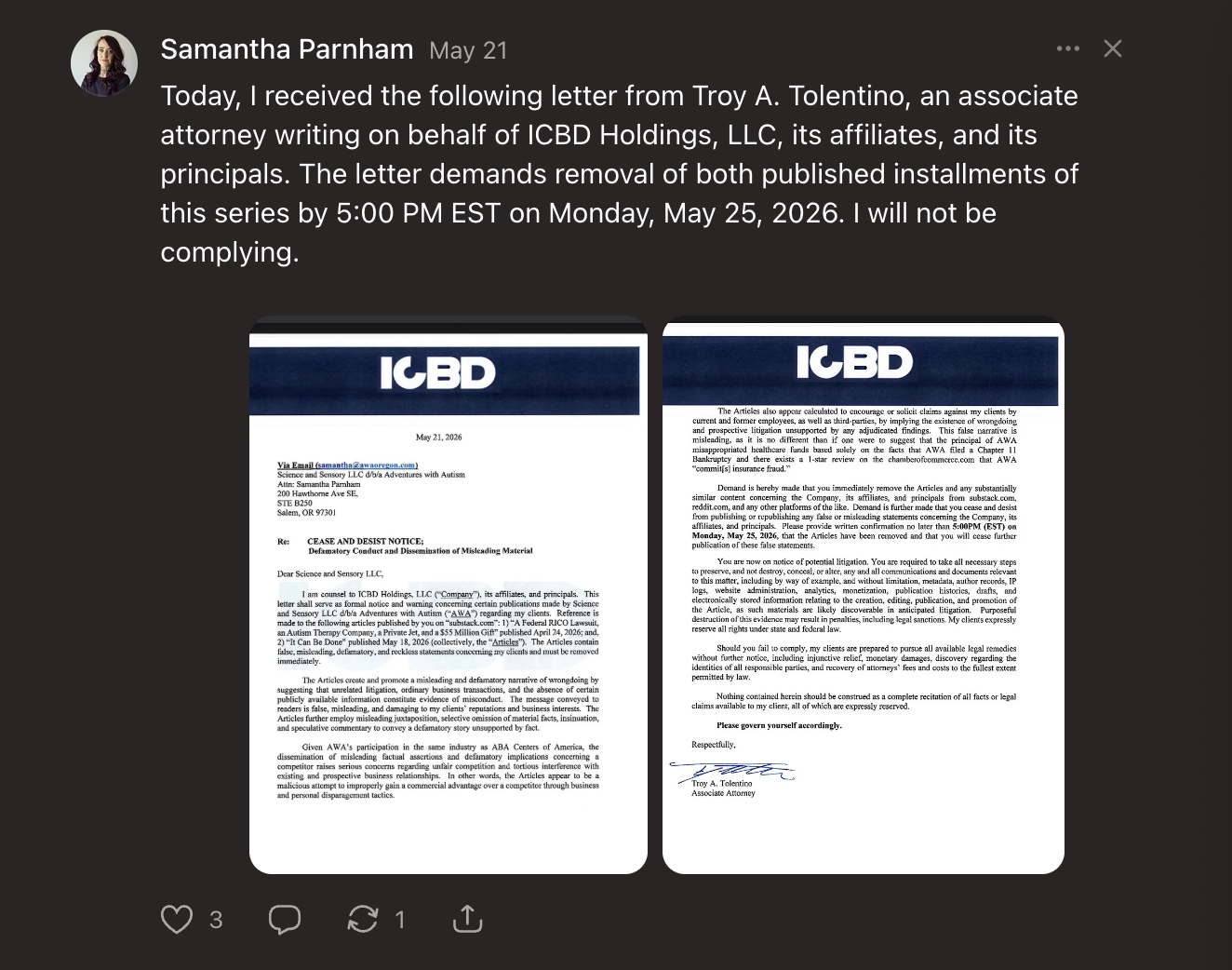
Parnham says her objection to private equity in ABA is not blanket opposition to profit. She is making a narrower claim about priorities, one she has not seen the money honor. She says she once hoped to find a private equity backer that was genuinely mission-driven, believes profit and values could coexist, and has simply never found the firm that proves it.
“I would love to not have a soul because you really could get rich in this space.” – Samantha Parnham, Adventures with Autism (2026)
On her Substack, Parnham has chronicled cases she argues show the incentives at work. One is Publix Super Markets’ federal racketeering suit against ABA Centers of America, filed in Florida in August 2025, which alleges the company billed as much as $500 for services the complaint pegs at a $13 network average and split claims across multiple tax identification numbers to avoid detection. Those are allegations, not findings; ABA Centers has countersued for unpaid claims, and no court has ruled.
She points, too, to the arc of the Center for Autism and Related Disorders. Blackstone acquired CARD in 2018 in a leveraged buyout valued at roughly $600 million; the chain grew to 265 clinics, then closed about 100 locations and filed for bankruptcy in 2023. To Parnham, it is the kind of trajectory that follows when scale and exit become the point.
Where She Says the Rot Is
Asked whether private equity or government payers are the bigger problem, Parnham spares neither, but she draws a line. Private equity, she says, is a bigger problem; Medicaid is “disconnected and bureaucratic.” In Oregon, she adds, the Medicaid managed-care organizations are consistent and communicative enough that she can pay staff well and still deliver care, and she is skeptical of BCBAs who open businesses expecting Medicaid to be easy. Tricare, the military health program, she avoids entirely, calling it a nightmare to work with.
What She Would Change
Given a free hand to rewrite the profession’s ethics rules, Parnham offers a short list. First, an independent, field-wide review board to approve any procedure that can harm a client. She points to contingent electric shock, which the United Nations special rapporteur on torture has condemned as torture. In her words, no code should permit anyone to “strap backpacks to people and shock them.”
Second, she would require BCBAs to have real grounding in child development, early intervention, and caregiver work before certification, so fewer clinicians reach families with no sense of what raising a child, let alone a disabled child, actually demands. She would keep the field’s ban on dual relationships. And she would change the gifts rule, which she says can wreck trust in homes where feeding a guest is a matter of respect, but can also add a power imbalance and stress for parents to find a “proper gift” for their BCBA.
The Culture She Calls Cult-Like
Parnham is blunt about the culture of her own field, which she says she loves and criticizes in the same breath. She describes parts of ABA as “cult-like,” organized around a belief that the science of behavior can fix nearly anything and that its practitioners know best. That certainty, she argues, is what lets otherwise reasonable people defend procedures they should refuse, and what keeps some clinicians from ever gaining exposure to a speech or occupational therapist who disagrees with them.
Her proposed corrective is mundane. She would require trainees to shadow speech-language pathologists and occupational therapists, the way medical residents rotate through departments they will never specialize in. Parnham says she often disagrees with those colleagues and takes data on their ideas anyway, and that the habit of being proven wrong is the thing the field’s most confident members tend to skip.
The bluntness is not a strategy, she says. She spent years being someone quieter, and the career since has left her unafraid of the people her candor tends to annoy. She says she checks herself and keeps people around who will check her, then commits to what she believes is right.
Her term on the Oregon Behavior Analysis Regulatory Board runs through October 31, 2027, a seat that keeps a self-described troublemaker inside the body that writes the rules she wants changed.
AT A GLANCE
| Subject: | Samantha Parnham, founder and chief clinical officer, Adventures with Autism |
| Location: | Salem and Keizer, Oregon |
| Credentials (as stated): | BCBA (2015); PhD with ABD status, business administration; M.A., applied behavior analysis |
| State board seat: | Behavior analyst member, Oregon Behavior Analysis Regulatory Board; term through October 31, 2027 |
| Prior career: | Domestic violence counselor, Las Vegas; early-intervention provider, Nevada |
| Publication: | Substack, “Reinforcement & Ruin” |
| Core principle: | Children come before profit and growth |
| PE in ABA: | 574 autism sites acquired by PE firms across 42 states, 2015–2024 (JAMA Pediatrics, Jan. 2026) |
| Case she has covered: | Publix RICO suit v. ABA Centers of America, filed Aug. 2025 (allegations; undecided) |
| Industry example cited: | CARD: Blackstone LBO 2018 (~$600M), bankruptcy 2023, founder buyback $48.5M |
| On harmful procedures: | Contingent electric shock (Judge Rotenberg Center); UN calls it torture |
SOURCES & REFERENCES
| 1. | Parnham, Samantha. Interview with BreakingNewsABA. July 2026. |
| 2. | Adventures with Autism. “About Us.” adventureswithautism.net. Accessed July 2026. https://adventureswithautism.net/about-us |
| 3. | Oregon Health Authority. Behavior Analysis Regulatory Board. State of Oregon. https://www.oregon.gov/oha/ph/hlo/pages/board-behavior-analysis-regulatory.aspx |
| 4. | Parnham, Samantha. “Reinforcement & Ruin.” Substack. https://samanthastempeste.substack.com/ |
| 5. | Arnold DR, et al. “Private Equity in Autism Services.” JAMA Pediatrics. Published online January 5, 2026. |
| 6. | Brown University. “Private equity firms acquired more than 500 autism centers in past decade, study shows.” January 7, 2026. https://www.brown.edu/news/2026-01-07/private-equity-autism-centers |
| 7. | Publix Super Markets, Inc., et al. v. ABA Centers of America, LLC, et al. U.S. District Court, Middle then Southern District of Florida, filed August 26, 2025. Docket via Justia (8:25-cv-02283; 0:25-cv-62146). |
| 8. | “ABA Centers of America, Publix Sue Each Other.” Behavioral Health Business. August 28, 2025. https://bhbusiness.com/2025/08/28/aba-centers-of-america-sues-publix/ |
| 9. | NBC News. “The Center for Autism and Related Disorders grew to 265 clinics. Then private equity took over.” https://www.nbcnews.com/health/health-care/card-blackstone-kids-autism-private-equity-bankruptcy-rcna118544 |
| 10. | Blackstone. “Blackstone to Acquire Center for Autism and Related Disorders (CARD).” Press release. April 13, 2018. https://www.blackstone.com/news/press/blackstone-to-acquire-center-for-autism-and-related-disorders-card/ |
| 11. | STAT News. “As FDA misses deadline on electric shock ban, disability advocates speak out.” June 1, 2026. https://www.statnews.com/2026/06/01/fda-misses-deadline-electric-shock-ban-disability-advocates-speak-out/ |
| 12. | Autistic Self Advocacy Network. “#StopTheShock: The Judge Rotenberg Center, Torture, and How We Can Stop It.” autisticadvocacy.org. |