

When the pandemic began, Shouberte Abreu worried about the families whose behavior technicians might no longer be coming through the door.
She was working as a registered behavior technician at the time. She said toilet training was one of her favorite parts of the job. If families lost that support, she wanted to give them something they could use themselves.
So, one morning, she started writing.
That idea became her book, Toilet Training (And Other Personal Care) Techniques: A Guide for Parents, Teachers & Providers, published in 2021.
A few years later, Abreu said, another concern pushed her to act. This time, the people providing care needed somewhere to turn.
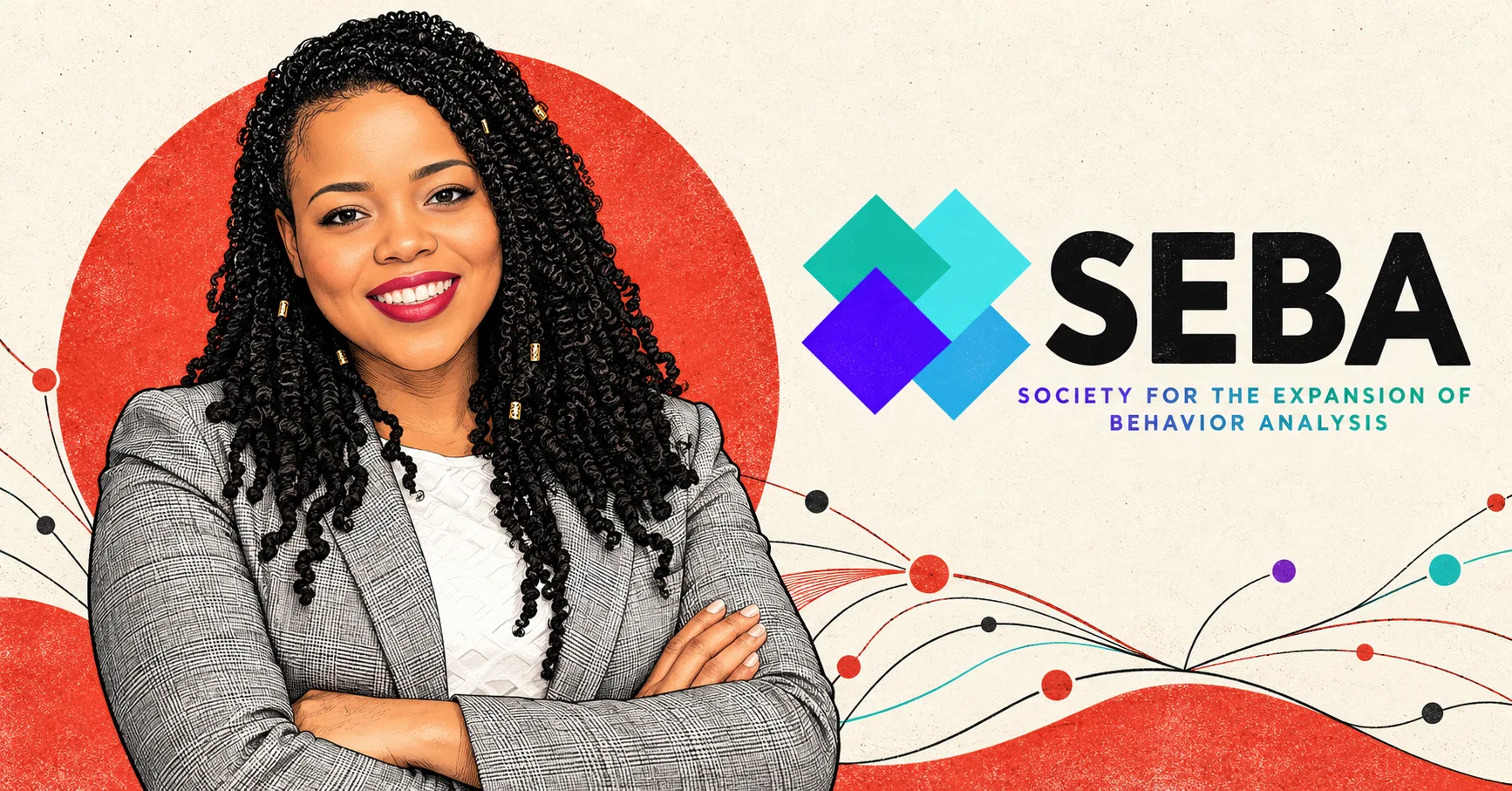
In spring 2025, she was reading LinkedIn posts from behavior analysts who said they were underpaid, leaving the field, or unsure where else their training could take them. She began building the Society for the Expansion of Behavior Analysis (SEBA).
By her count, close to 250 people had signed up by September 2026.
Abreu, SEBA’s co-founder and president, wants the organization to help behavior analysts explore work in feeding, sleep, substance use, organizational behavior management, animal behavior, and much more. The society’s stated mission centers on expanding the science into populations and settings where it is less commonly used.
For Abreu, that mission is also about making a living. She worries that behavior analysts who depend entirely on insurance-funded autism services have too few options when reimbursement changes.
An Unexpected Path into ABA
It is a concern that reaches back to her own introduction to the field. One reason she considered behavior analysis, she said, was that someone told her it paid better.
Abreu had studied communication sciences and disorders at the University of Central Florida. At graduation, she recalled, her cousin showed her a brochure for a master’s program in applied behavior analysis.
Her cousin described work that seemed connected to their speech background, with the possibility of higher pay. Both caught Abreu’s attention.
She did not take a direct route there. Abreu said she considered becoming a school principal, then spent about six months studying organizational psychology. She eventually enrolled at Nova Southeastern University, where she pursued a master’s in counseling with an ABA concentration.

Her work took her through behavior technician and RBT roles, infant and toddler development, and the University of Miami’s Department of Pediatrics, she said. She later became a qualified behavior analyst.
Her professional biography lists QBA and licensed behavior analyst credentials. She is also the founder and CEO of Behaviour Lifestyle, which offers ABA education and learning resources.
As Abreu puts it, the roles changed, but the interest in leadership stayed. She wanted to help people move forward.
The Saturday SEBA Began
SEBA began with that same impulse.
Among the posts that caught her attention were those from psychologist Scott O’Donnell. Abreu said they discussed doing something to address the frustrations they were seeing in the field.
She also reached out to her friend Di-Anne Elise and a BCBA who owned a practice. The practice owner warned her that starting a nonprofit would take considerable work.
Abreu said she did not yet understand how much.
On a Saturday when she was off work, she created a sign-up form. She sent it to Elise and asked her to become the first member. Then she shared it with others and promoted it on LinkedIn.
The response gave her people to work with. It also gave her more responsibility.
Abreu said members helped draft the organization’s bylaws. Other volunteers brought the structure needed to move her ideas forward.
She sees herself as the person who imagines what could happen. She relies on others to help organize how it will happen.
The Cost of Having Few Options
The problem she wants to address extends beyond reimbursement.
Abreu said she sees behavioral health job postings that seek social workers, family therapists, or psychologists without listing behavior analysts. In some of those postings, she recognizes skills she believes analysts could bring to the work.
She wants analysts to become better at explaining those skills to employers and potential clients. That includes learning how to build a business, describe a service, and advocate for a role in settings beyond autism care.
She also worries about the cost of changing direction.
Analysts may already have paid for graduate education before discovering they need additional training to pursue an interest in sleep or organizational behavior management, she said. She wants students to understand those possibilities earlier.
The financial pressure she describes has a current example in New York.
According to the New York State Department of Health, Medicaid fee-for-service reimbursement for technician-delivered ABA under CPT code 97153 will fall to $9.63 per unit on October 1, 2026.
That is a payment for a billed service, not an analyst’s hourly wage. The state’s announcement specifically concerns services delivered by unlicensed individuals or technicians.
For Abreu, changes like these reinforce her concern about building an entire career around one service market.
She points to substance use treatment as one area where she sees room for behavior analysts to contribute.
Virginia has taken steps to recognize that role. Its 2024 legislation directed the state Medicaid agency to include licensed behavior analysts in the definition of credentialed addiction treatment professionals. A corresponding regulatory amendment published in September 2026 lists an October 22 effective date, according to the Virginia Register of Regulations.
Abreu wants SEBA to help pursue more opportunities like that.
Opening More Doors
For 2027, she said, the organization is planning a student development initiative. Practicing analysts would help students identify programs that match their interests, including feeding, substance use, animal behavior, and organizational behavior management.

She also wants SEBA to write to lawmakers and advocate for insurance coverage of additional behavior-analytic services.
Her longer-term plans reach into specialty training.
Within roughly five years, Abreu hopes SEBA could offer subspecialty certifications. She envisions analysts gaining additional preparation in a particular area after earning their broader professional credential.
The Behavior Analyst Certification Board lists RBT, BCaBA, and BCBA certifications. Its certification structure does not include separate examinations for each of the practice areas Abreu wants SEBA to support.
She also imagines a system of supervised rotations. An analyst could spend time learning from a feeding specialist, then work with someone in organizational behavior management. SEBA could maintain a directory to help make those connections.
Those rotations and certifications remain her vision for the organization.
SEBA has already begun offering continuing education and developing its public presence. BreakingNewsABA’s profile of the society described its educational programming and podcast, The Evolving Behavior Analyst.
Building Something That Lasts
Keeping that work moving takes time, Abreu said. Sometimes, she is still handling SEBA responsibilities at 1 or 2 a.m.
She pushes volunteers because she wants the organization to accomplish something. She also recognizes that they have jobs and responsibilities outside SEBA.
That balance is part of what she is still learning.
Abreu described her presidency as a two-year term. She is documenting her plans in Trello and the organization’s shared drive so whoever follows her can understand what she hoped to build.
She wants a successor who thinks several years ahead. Someone who brings ideas of their own and is willing to do the work behind them.
Abreu said she usually prefers working behind the scenes. Public appearances and interviews have not been where she puts most of her energy.
But she is beginning to think she needs to step forward more.
For now, she is also writing things down. The society that began with a Saturday sign-up form needs a plan someone else can carry forward one day. For now, Abreu does so with inspiring vision and a passionate drive!
SOURCES & REFERENCES
| 1. | AbeBooks listing, Toilet Training (And Other Personal Care) Techniques (2021). https://www.abebooks.co.uk/9798598968987/Toilet-Training-Personal-Care-Techniques/plp |
| 2. | Society for the Expansion of Behavior Analysis (SEBA), mission statement. https://sebaimpact.org/ |
| 3. | Behaviour Lifestyle, About (Shouberte Abreu biography). https://www.behaviourlifestyle.com/about |
| 4. | New York State Department of Health, Medicaid Update, August 2026 (No. 9). https://www.health.ny.gov/health_care/medicaid/program/update/2026/no09_2026-08.htm |
| 5. | Virginia Register of Regulations, Vol. 43, Iss. 2 (September 2026). https://register.dls.virginia.gov/vol43/iss02/v43i02.pdf |
| 6. | Behavior Analyst Certification Board (BACB). https://www.bacb.com/ |
| 7. | BreakingNewsABA, SEBA industry profile (July 2026). https://breakingnewsaba.com/industry-profile/seba-wants-take-behavior-analysis-beyond |