
The Frontier Market Thesis
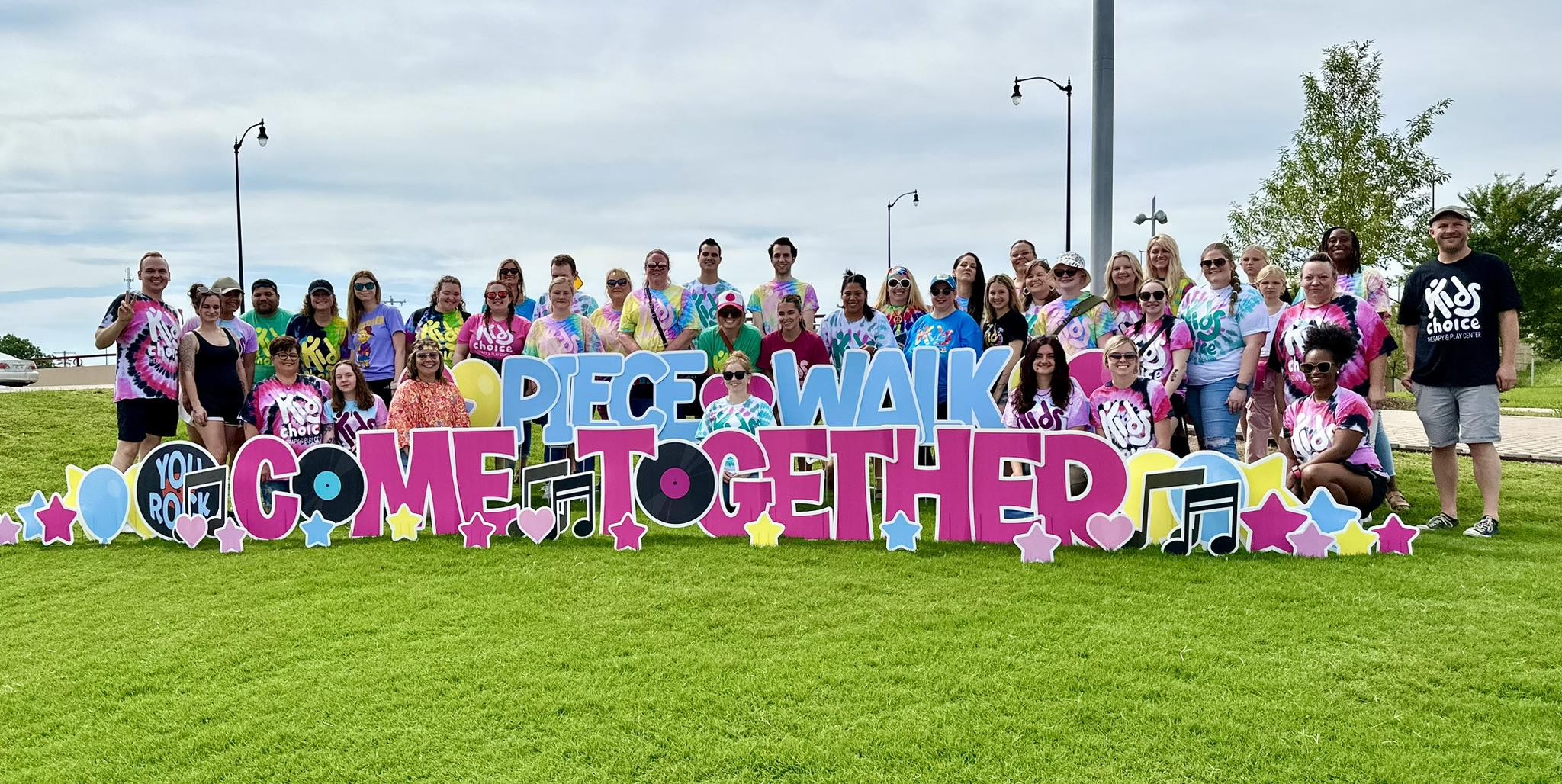
OKLAHOMA CITY, OKLAHOMA — Aquitaine Capital made a majority investment in KidsChoice Therapy and Play Center on January 21, marking the New York-based fund’s entry into the ABA sector with a deliberate bet on Oklahoma’s underdeveloped autism therapy market.
The terms of the transaction were not disclosed. What was disclosed is the strategy: Aquitaine is backing a six-clinic, multimodality operator in a state where Medicaid coverage for autism services only became available in 2020, provider density remains thin outside the Oklahoma City metro, and no dominant PE-backed platform has yet claimed the market.
KidsChoice serves children ages 0-18 through applied behavior analysis, occupational therapy, speech therapy, and counseling. That service breadth, combined with an existing clinic footprint that already reaches into smaller Oklahoma cities, is what made it attractive as a platform rather than a tuck-in.
“We want KidsChoice to be one of the best therapy providers in Oklahoma. That means supporting clinicians, investing in quality and consistency, and ensuring families can count on ethical care as the company grows.” — Elizabeth Broomfield, Managing Partner, Aquitaine Capital (2026)
The deal introduces a fund with an unusual profile for ABA. Aquitaine was founded in 2024 by Elizabeth Broomfield, who previously worked at Carlyle Group in its flagship U.S. buyout fund, at Stonecourt Capital where she led the investment team, and at Hg Capital. The firm is women-owned and targets majority stakes in family- and founder-owned businesses with $3 million to $30 million in EBITDA. KidsChoice is its first disclosed healthcare transaction.
Six Clinics Before Outside Capital
One of the more consequential details in this deal is how much KidsChoice had already built on its own. By the time Aquitaine signed, the company was operating six clinics across Oklahoma: Oklahoma City, Norman, Shawnee, Ada, Weatherford, and Elk City. That footprint is not just notable for a five-year-old startup. It tells a specific story about the founders’ thesis.
Ada, Weatherford, and Elk City are not major metropolitan markets. Ada has a population of roughly 17,000. Elk City sits in the western Oklahoma panhandle with around 12,000 residents. Weatherford is roughly 11,000. These are communities with limited specialist healthcare infrastructure and, historically, few options for families seeking autism therapy outside a long drive to Oklahoma City or Tulsa.
That rural penetration before any PE capital is a meaningful signal. It suggests the founding team was not building for a quick flip to a large platform. It also means Aquitaine is acquiring proven operational capability in lower-density markets, not just a metro-concentrated clinic chain that happens to be valued attractively.
Growth plans: The company has announced it will continue expanding through new clinic openings, strategic acquisitions, and the buildout of its speech and occupational therapy offerings. Co-President Nic Newton, who led due diligence efforts during the Aquitaine transaction, will focus on business operations. Co-President Sierra Harrington will oversee clinical growth.
Oklahoma’s Coverage Landscape
To understand why a first-time healthcare investor would target Oklahoma as a launch market, it helps to understand the state’s relatively recent entry into ABA coverage.
Oklahoma established behavior analyst licensing laws in 2009 through the creation of the Oklahoma Licensed Behavior Analyst Board, one of the first states to do so. But Medicaid coverage for autism services came much later. The Oklahoma Health Care Authority did not amend its SoonerCare plan to include autism-related services until 2020. For providers, that six-year gap between licensing infrastructure and meaningful payer coverage kept the market from developing at the pace seen in states like Texas, California, and Florida.
SoonerCare now covers ABA therapy for individuals with autism spectrum disorder under the age of 21, provided services are delivered by licensed and certified providers. Commercial insurance mandates also apply across the state. However, utilization management protocols vary by payer, and the relatively new coverage environment means many families are still learning to navigate the system.
States with early insurance mandates built dense provider networks over a decade. Oklahoma is roughly where those markets were in 2015. That gap is the opportunity.
The practical result: providers who can navigate SoonerCare credentialing, build relationships with commercial payers, and staff up in rural markets are operating in a market with demand that materially outstrips current supply. KidsChoice already accepts SoonerCare alongside commercial plans, which matters for patient volume and mission alignment in a state where a significant share of children with autism come from households that depend on Medicaid.
Coverage specifics: SoonerCare covers ABA therapy for children under 21 with autism spectrum disorder, requiring services from licensed and certified providers. Commercial insurance mandates apply statewide. Utilization management protocols vary by payer, and prior authorization is typically required.

The Workforce Picture
Any investor entering the ABA market in Oklahoma has to reckon with the workforce. The state requires a dual credentialing process: clinicians must hold both BCBA certification from the national Behavior Analyst Certification Board and a separate state license issued by the Oklahoma Licensed Behavior Analyst Board. That adds friction to hiring from out of state and means the local BCBA pipeline matters more than in states with simpler credentialing structures.
Nationally, demand for BCBAs increased 28 percent from 2024 to 2025, according to data published by the BACB in early 2026. The top five demand states were California, New Jersey, Texas, Massachusetts, and North Carolina. Oklahoma was not among them, which cuts two ways: it means the state faces less competition for new graduates from high-demand coastal markets, but it also reflects a smaller existing BCBA workforce relative to the size of the population.
The job market confirms the tension. In early 2026, ABA providers actively recruiting in Oklahoma were offering sign-on bonuses ranging from $10,000 to $30,000 to attract BCBAs to the state. BlueSprig and ACES, two national platforms already operating in Oklahoma City, were among the companies posting competitive packages. That level of incentive spending is typical of markets where provider growth is being throttled by workforce constraints rather than demand.
What Aquitaine’s capital changes: PE backing gives KidsChoice the resources to compete on compensation and professional development, which are the two primary levers in BCBA retention. Structured career development programs, internal supervision pathways, and CEU support are increasingly decisive in a labor market where experienced BCBAs have no shortage of offers. The KidsChoice announcement cited investment in clinical quality and staff infrastructure as core priorities.
The company has also outlined plans to grow its occupational therapy and speech therapy pipelines, which compete in separate but equally constrained labor pools. Having all three disciplines under one organizational umbrella creates some scheduling efficiencies and can improve retention by giving clinicians a more varied caseload than a pure-play ABA clinic can offer.
The Multimodality Play
KidsChoice’s service model reflects a broader shift in how serious operators are thinking about autism care. The industry’s legacy is pure-play ABA: a single discipline, heavy on one-to-one therapy hours, typically billed to a single payer authorization. That model worked for a decade of rapid growth. It is increasingly showing its limits.
Families navigating an autism diagnosis rarely need just ABA. Speech delays, sensory processing challenges, fine motor development, and mental health co-occurrence are common. Historically, families have addressed these needs by coordinating across multiple providers, often in separate locations, with separate intake processes, separate billing relationships, and no structured communication between clinical teams. The logistical burden on parents is substantial.
The integrated model KidsChoice has built reduces that burden. By offering ABA, occupational therapy, speech therapy, and counseling in the same facility, the company can coordinate care across disciplines, reduce the number of appointments a family has to schedule, and develop treatment plans that account for how each modality interacts with the others. The clinical literature supporting coordinated multimodal care for autism is well established.
From an investor’s perspective, multimodality also changes the revenue profile. ABA authorizations are typically large in hours and can be highly variable based on utilization reviews. Adding speech and OT creates additional revenue streams with different authorization structures and different payer relationships. KidsChoice’s plans to expand its speech and OT capacity post-investment reflect Aquitaine’s awareness that diversified service mix reduces dependence on any single payer decision.
The counseling component: KidsChoice also offers counseling services for children and adolescents, which is relatively uncommon in pure ABA platforms. Behavioral health co-occurrence in children with autism is well documented, and adding mental health services positions the company to address needs that fall outside ABA authorization scope while building deeper relationships with families who might otherwise need to seek that care elsewhere.
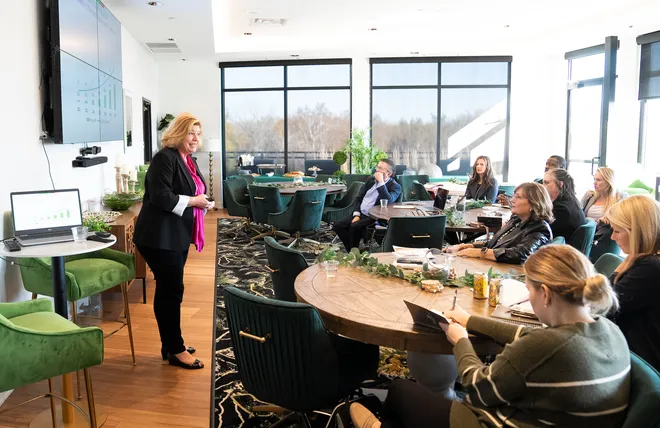
The Ralston Factor: The choice of Amanda “Mandy” Ralston as CEO is one of the more distinctive aspects of the deal. Ralston has been certified as a BCBA since approximately 2001. Over her career she has founded two ABA clinics, the most recent of which was acquired in 2019. After that exit, she launched NonBinary Solutions, a data analytics and technology firm that built clinical decision support tools for ABA providers.
That background is different from the profile of most executives who end up running PE-backed autism therapy platforms. Many are operators who came up through healthcare administration, finance, or adjacent services. Ralston is a clinician who became an entrepreneur twice, then built a technology company in the ABA space before returning to direct operations.
Behavioral Health Business named Ralston among the autism therapy industry executives to watch in 2026, noting that her background in repeat entrepreneurship, corporate leadership, and advocacy “stands apart from many of the executives who are brought in to lead private equity platform plays.” BHB also observed that her appointment reflects Aquitaine’s stated preference for thoughtful, clinically grounded growth over speed.
Ralston has been explicit about her clinical priorities. In posts following the announcement, she described caring less about optics and more about whether children can sleep in their own beds, get dental work without general anesthesia, and access ethical care across their social determinants of health. That is not standard CEO messaging. It is the language of a clinician who has spent years watching what happens when ABA companies scale without sufficient clinical infrastructure.
Leadership structure: Nic Newton serves as Co-President of Business Operations, having led due diligence during the Aquitaine process. Sierra Harrington serves as Co-President of Clinical and Growth. The board includes Dr. Joseph Cunningham, former President of Blue Cross and Blue Shield across Oklahoma, Illinois, Montana, New Mexico, and Texas, and Kathleen Stengel, a BCBA and healthcare executive with more than two decades in pediatric behavioral health.
Aquitaine’s Healthcare Focus
Aquitaine Capital was founded in 2024, which makes it unusual by private equity standards: a firm less than two years old closing its first healthcare deal. Broomfield’s prior experience at Carlyle Group, Hg Capital, and Stonecourt Capital brings institutional PE credentials to what is still an emerging fund. The firm targets majority investments of $10 million to $200 million in North American family- and founder-owned businesses with $3 million to $30 million in EBITDA.
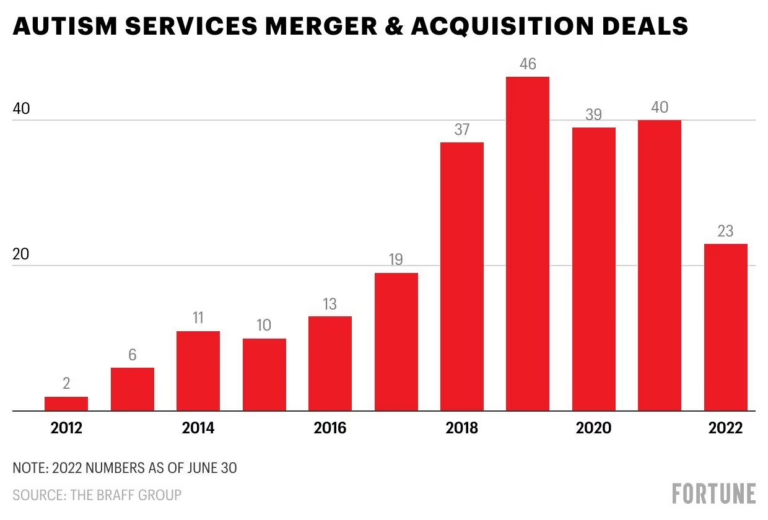
Aquitaine’s stated philosophy distinguishes it from the roll-up playbook that has characterized much of PE activity in ABA since 2015. The firm describes itself as not interested in being “flippers, consolidators, or cost-cutters,” language that directly addresses the reputational baggage that has accumulated around PE in healthcare over the past decade. Whether that framing translates into operational practice will be tested as KidsChoice grows.
The women-owned designation is factual and notable. Women-owned PE firms remain rare. Bringing clinical credibility through Ralston’s appointment and a women-owned capital partner to a market that is predominantly female in its clinical workforce creates an organizational identity that differs from the standard PE-backed ABA platform. How that resonates with clinician recruiting in Oklahoma will be worth watching.
Aquitaine has indicated it will support KidsChoice’s growth through additional clinic openings, strategic acquisitions of smaller Oklahoma providers, and continued investment in clinical infrastructure. The board composition, with a former multistate BCBS president and an experienced BCBA executive, suggests the firm is building governance capacity alongside operational capacity rather than treating the board as a formality.
This represents Aquitaine’s first disclosed healthcare transaction. The fund’s interest in specialized healthcare services with regulatory credentialing requirements and recurring revenue is consistent with the investment thesis of several larger funds that entered ABA before 2020 and generated strong returns. Oklahoma’s later-stage coverage environment gives Aquitaine a version of the same demand curve those funds rode, at a different point on the timeline.
AT A GLANCE
| KidsChoice founded: | 2020 in Oklahoma City |
|---|---|
| Clinic locations: | Oklahoma City, Norman, Shawnee, Ada, Weatherford, Elk City (6 total) |
| Services offered: | ABA, occupational therapy, speech therapy, counseling |
| Target age range: | 0-18 years old |
| Aquitaine Capital founded: | 2024, based in New York (women-owned) |
| Investment focus: | $10M-$200M majority stakes, $3M-$30M EBITDA |
| Managing Partner background: | Elizabeth Broomfield: Carlyle Group, Stonecourt Capital, Hg Capital |
| New CEO: | Amanda “Mandy” Ralston, BCBA (credentialed since ~2001, 2 prior clinic exits) |
| Oklahoma ABA coverage: | SoonerCare expanded to autism services in 2020; licensing established 2009 |
| BCBA demand nationally: | 28% increase from 2024 to 2025 (BACB, 2026) |
| OK BCBA market indicator: | Sign-on bonuses of $10K-$30K active in market as of early 2026 |
| Growth strategy: | New clinic openings, strategic M&A, expanded speech and OT capacity |
| Board expertise: | Dr. Joseph Cunningham (former BCBSOK), Kathleen Stengel (BCBA executive) |
| Transaction announced: | January 21, 2026; financial terms not disclosed |
SOURCES & REFERENCES
| 1. | Behavioral Health Business. “Aquitaine Capital Makes Major Investment in Oklahoma Autism Provider KidsChoice.” January 21, 2026. https://bhbusiness.com/2026/01/21/aquitaine-capital-makes-major-investment-in-oklahoma-autism-provider-kidschoice/ |
|---|---|
| 2. | PR Newswire. “KidsChoice Announces Majority Investment from Aquitaine Capital to Support Growth and Clinical Excellence.” January 21, 2026. https://www.prnewswire.com/news-releases/kidschoice-announces-majority-investment-from-aquitaine-capital-to-support-growth-and-clinical-excellence-302666656.html |
| 3. | Behavioral Health Business. “7 Autism Therapy Industry Executives to Watch in 2026.” February 4, 2026. https://bhbusiness.com/2026/02/04/7-autism-therapy-industry-executives-to-watch-in-2026/ |
| 4. | L.E.K. Consulting. “Investing in Autism Therapy: Key Trends Shaping the U.S. ABA Therapy Sector.” July 18, 2025. https://www.lek.com/insights/hea/us/so/investing-autism-therapy-key-trends-shaping-us-aba-therapy-sector |
| 5. | PitchBook. “Elizabeth Broomfield JD Profile.” https://pitchbook.com/profiles/person/208943-29P |
| 6. | BACB. “US Employment Demand for Behavior Analysts: 2010-2025.” January 2026. https://www.bacb.com/wp-content/uploads/2025/02/Lightcast2026_260127-2-a.pdf |
| 7. | KidsChoice Therapy and Play Center. Company website and clinic locations. https://kidschoicetherapy.org/ |
| 8. | Behavioral Innovations. “Oklahoma ABA Centers Now Accepting SoonerCare.” https://behavioral-innovations.com/blog/behavioral-innovations-now-accepts-soonercare/ |
| 9. | Oklahoma Licensed Behavior Analyst Board. Agency overview and licensing requirements. https://olbab.oucpm.org/ |
| 10. | Stax. “Autism & Applied Behavioral Analysis (ABA) Therapy Market Overview.” February 2, 2026. https://www.stax.com/insights/autism-applied-behavioral-analysis-aba-therapy-overview |
| 11. | LinkedIn. Nic Newton, Co-President of Business Operations, KidsChoice Therapy and Play Center. Post, January 2026. |

Join the discussion ▾