Why ABA Scheduling Is Uniquely Hard
ACROSS THE UNITED STATES — ABA scheduling is unlike any other healthcare scheduling problem. A typical practice coordinates 10 to 50 RBTs (registered behavior technicians), each with different language skills, capabilities, availability windows, geographic service areas, and client assignments. Each client carries a treatment plan specifying authorized hours per week, a supervising BCBA who must observe at specified intervals, treatment goals that may require particular RBT skill sets, and family preferences that can change frequently.
The authorization dimension alone separates ABA from other disciplines. Each client’s services are pre-authorized by the payer for a specific number of hours per week or month. Schedule fewer hours than authorized, and revenue is left on the table. Schedule more, and the excess sessions get denied while the practice eats the cost of the unbillable time. Tracking authorization usage in real time across hundreds of clients is a data problem that manual scheduling cannot handle at scale. Silna Health, a VC backed company that offers an AI-native ABA authorization management solution, has experienced explosive growth demonstrating the complexity and need of this one work flow.
Credential matching adds another layer. A scheduling system that does not track credentials in real time risks assigning uncredentialed technicians to clients, the kind of compliance failure that recent OIG audits flagged in several states.
A typical ABA practice coordinates 10 to 50 RBTs against an equal number of clients, each with their own credentials, authorization caps, supervision requirements, and family preferences. The combinatorial complexity is what scheduling software has to solve.
Drive time optimization is the geographic dimension. For home-based ABA providers, RBTs travel between client homes throughout the day. The scheduling system has to minimize drive time to maximize billable hours while respecting the geographic constraints of each RBT’s service area. A 30-minute drive between clients is 30 minutes of unbillable time, and across a team of 30 RBTs making three to four client transitions per day, the cumulative revenue loss from suboptimal routing runs into six figures annually for a mid-sized practice.
Cancellation recovery is the real-time dimension. ABA therapy has high cancellation and no-show rates. Families dealing with the demands of raising children with autism cancel sessions due to illness, behavioral crises, schedule conflicts, or caregiver burnout. When a cancellation occurs, the scheduling system must immediately identify available RBTs, match them with clients who have unused authorization hours, verify credential compatibility, and rebook the session, all within the window before the time slot is lost.
CentralReach ScheduleAI
CR ScheduleAI is the most widely deployed scheduling automation tool in ABA, reflecting CentralReach’s position as the dominant platform with more than 4,000 organizations and over 200,000 professionals on its system. ScheduleAI is part of CentralReach’s broader AI suite, cari, which the company says was trained on over a billion data points with input from more than 40 BCBAs.
CentralReach reports that customers using ScheduleAI see at least a 20 percent increase in appointments by maximizing RBT-to-client availability across language preferences, preferred providers, location of services, drive time, authorized service hours, and cancellations. Behavioral Innovations, a multi-state ABA provider, transitioned its scheduling operations to CR ScheduleAI in early 2025.
ScheduleAI’s edge is integration depth. Because it sits inside the CentralReach ecosystem, it has native access to authorization data, credential records, billing history, and treatment plan information. The scheduling engine can act on the full context of each client’s care, not just calendar availability. That is hard for standalone scheduling tools to replicate, and it is the primary reason that practices already on CentralReach tend to adopt ScheduleAI rather than seek external scheduling solutions.
The limitation is access. CentralReach’s enterprise pricing puts the full platform, including ScheduleAI, out of reach for many small and mid-size practices. The result is a two-tier market where enterprise operators get AI-powered scheduling and smaller practices rely on manual processes or basic calendar tools.
Hi Rasmus AI Scheduling
Hi Rasmus’s AI scheduling tool takes a different angle, focused on clinical workflow integration over operational breadth. Texana Center, a Texas behavioral health organization that serves more than 16,000 clients annually, was among the first to adopt the feature when it went live with Hi Rasmus on July 29, 2025. The Hi Rasmus tool enables real-time oversight of staff availability, streamlined coordination of session logistics, and clearer visibility for clinical teams and caregivers.
Hi Rasmus highlighted the redesigned scheduling tool as the top entry on its top 10 features of 2025 list, citing speed, accuracy, and ease-of-use improvements built around drag-and-drop functionality, conflict detection, and staff utilization views. The AI layer suggests optimal schedule configurations based on client needs, staff qualifications, and authorization parameters. For practices that use Hi Rasmus as their primary clinical platform, the scheduling integration delivers the same contextual advantage that ScheduleAI offers within CentralReach’s ecosystem.
Motivity Smart Scheduling
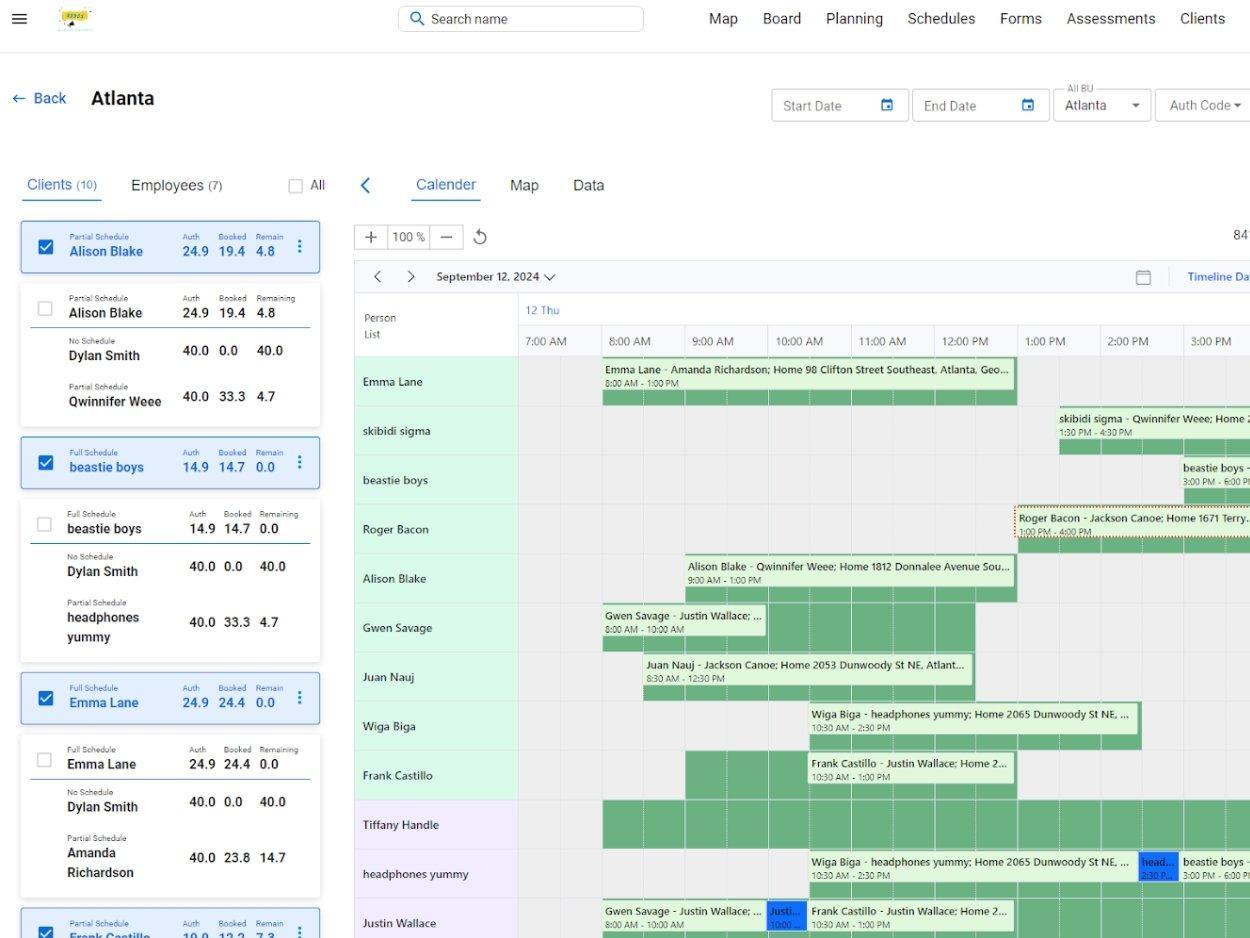
Motivity’s approach to scheduling automation focuses on the mid-market, serving practices that need more than basic calendar tools but less than enterprise-scale scheduling engines. Motivity’s AI scheduling matches clients with best-fit providers based on credentials and skills, applies compliance, capacity, and authorization checks automatically, and offers smart travel scheduling that optimizes routing for in-home sessions. The platform’s clinical data collection strength creates natural synergy with scheduling: the system can flag clients whose treatment progress data suggests additional sessions and surface schedule adjustments accordingly.
Motivity is one of the few ABA software vendors that publishes pricing publicly. The data collection or practice management tier starts at $24 per learner per month, billed monthly, with the all-in-one suite at $48 per learner per month. That makes the platform accessible to practices that find CentralReach’s quote-based enterprise pricing prohibitive. Scheduling is integrated with Motivity’s clinical workflows, so data collection, session documentation, and scheduling operate within a unified interface rather than across separate tools.
SPRY AI Scheduling Agent
SPRY’s AI Scheduling Agent represents the entry of a multi-specialty rehab platform into the ABA scheduling space. Unlike the ABA-native platforms, SPRY was built for physical therapy, occupational therapy, and speech-language pathology clinics, and it is extending its scheduling capabilities to ABA as part of a broader multi-specialty strategy. SPRY launched the Scheduling Agent publicly in November 2025.
The agent detects cancellations, matches them with eligible waitlisted patients, verifies coverage, and rebooks autonomously. SPRY reports that clinics using the agent consistently reach over 95 percent utilization, that front-desk call volumes drop by half, and that early partner clinics cut weekly scheduling time from 15 hours to 4 hours with an increase in completed appointments.
SPRY’s framing is distinctive because it treats scheduling as a revenue optimization problem rather than purely a logistics problem. The AI agent’s primary objective is to keep calendars full and minimize revenue leakage from cancellations, no-shows, and underutilized authorization hours. For multi-specialty clinics where ABA coexists with speech and occupational therapy, SPRY’s unified scheduling across disciplines eliminates the operational overhead of maintaining separate scheduling systems for each specialty.
The limitation is ABA-specific depth. SPRY’s scheduling intelligence was built for rehab therapy workflows and is being adapted for ABA. The credential matching, authorization tracking, and BCBA supervision scheduling that are unique to ABA may not be as fully developed as they are in ABA-native platforms. Practices evaluating SPRY for ABA should test how well the platform handles BCBA supervision scheduling, RBT credential verification, and payer-specific authorization rules.
The Unsolved Problems
Despite the progress of all four platforms, several ABA scheduling challenges remain only partially solved. BCBA supervision scheduling, ensuring that each RBT receives required supervision at the frequency mandated by BACB standards and state regulations, is a constraint that most scheduling tools treat as a secondary check rather than a core optimization variable. Recent OIG and state audit findings on ABA Medicaid programs have repeatedly flagged supervision and credentialing deficiencies, suggesting that current scheduling tools are not consistently enforcing supervision requirements.
Multi-location coordination is another gap. For practices operating across multiple centers and home-based programs, the scheduling system has to coordinate staff assignments across locations while respecting geographic constraints, center capacity limits, and client preferences. Most current tools handle single-location scheduling well but struggle with the cross-location optimization that multi-site operators require.
Family preference modeling is the human dimension. Families of children with autism have strong preferences about scheduling: consistency of therapist assignment (critical for children who struggle with transitions), session timing (aligned with school schedules, nap times, and family routines), and location (center versus home). These preferences are qualitative and change over time, which makes them hard to encode in algorithmic optimization.
Real-time rebooking at scale is the gap that has not been closed. When a cancellation hits 30 minutes before a session, the scheduling system has to identify, match, verify, and confirm a replacement in minutes. Current tools can suggest alternatives but typically still require human intervention to confirm the rebooking. Fully autonomous real-time rebooking, where the system handles the entire process end-to-end, would mark a step-change in scheduling efficiency. SPRY’s Scheduling Agent is the closest to delivering that capability today, though its ABA-specific depth is still being built.
What Comes Next
The platform that solves the remaining challenges will capture significant market share, since scheduling efficiency translates directly to revenue. Every unfilled session is lost revenue. Every credentialing mismatch is a compliance risk. Every missed supervision requirement is an audit finding.
The window to define the operating layer is short. The American Medical Association’s revised CPT code set for adaptive behavior services takes effect January 1, 2027, with six new codes, revisions to existing codes, and the retirement of the Category III T-codes (0362T and 0373T). Specifics remain confidential under AMA rules until the 2027 CPT Professional Code book is published in late 2026. Every scheduling platform on the market will have to remap workflows, billing logic, and authorization checks against the new code set inside a single calendar year. The scheduling tools that adapt fastest will set the floor for the next generation of ABA practice infrastructure.
AT A GLANCE
| Core challenge: | Match RBTs to clients across credentials, authorizations, geography, family preferences, and BCBA supervision requirements |
| CentralReach ScheduleAI: | 4,000+ organizations, 200,000+ professionals; cari trained on 1B+ data points with 40+ BCBAs; deepest integration |
| Hi Rasmus AI Scheduling: | Texana Center first adopter (live July 29, 2025); top feature of Hi Rasmus 2025 release wrap |
| Motivity Smart Scheduling: | $24/learner/month data collection or practice management; $48/learner all-in-one; AI scheduling + smart travel routing |
| SPRY AI Scheduling Agent: | Launched Nov 11, 2025 (PT/OT/SLP, extending to ABA); 95%+ utilization; front-desk call volumes drop by half |
| Unsolved problems: | BCBA supervision scheduling, multi-location coordination, family preference modeling, autonomous real-time rebooking |
| Revenue impact: | Suboptimal routing costs six figures annually for a mid-sized home-based practice |
| Compliance link: | OIG audits in IN, WI, CO, and ME flagged credentialing and supervision gaps in every sampled enrollee-month |
| BACB rule change: | New RBT standards effective Jan 1, 2026: biennial recert, 12 PDUs/cycle, BCBA/BCaBA-only supervision |
| Next CPT shift: | 6 new ABA CPT codes, revisions, and T-code retirement effective Jan 1, 2027 (AMA CPT Editorial Panel approval, Sep 2025) |
SOURCES & REFERENCES
| 1. | CentralReach. “Maximize Efficiency and Revenue with ABA Scheduling Software.” Product page. https://centralreach.com/products/scheduleai/ |
| 2. | CentralReach. “Behavioral Innovations Transforms Applied Behavior Analysis Scheduling Operations with CentralReach’s AI-Powered Scheduling Solution, CR ScheduleAI.” GlobeNewswire. January 28, 2025. https://www.globenewswire.com/news-release/2025/01/28/3016591/0/en/Behavioral-Innovations-Transforms-Applied-Behavior-Analysis-Scheduling-Operations-with-CentralReach-s-AI-Powered-Scheduling-Solution-CR-ScheduleAI.html |
| 3. | CentralReach. Homepage (cari, 40+ BCBAs, 1B+ data points). https://centralreach.com/ |
| 4. | Hi Rasmus. “Texana Center Goes Live with Hi Rasmus to Enhance Clinical Programming and Care Coordination.” July 29, 2025. https://hirasmus.com/2025/07/29/texana-center-goes-live-with-hi-rasmus-to-enhance-clinical-programming-and-care-coordination/ |
| 5. | Hi Rasmus. “Top 10 Hi Rasmus Features of 2025” (year-end wrap, redesigned scheduling tool listed first). https://hirasmus.com/ |
| 6. | Motivity. “Best ABA Practice Management Software [2026].” Pricing disclosure ($24/learner/month, $48 all-in-one). https://www.motivity.net/blog/best-aba-practice-management-software |
| 7. | Motivity. “ABA Practice Management Software” (AI scheduling, smart travel scheduling features). https://www.motivity.net/solutions/aba-practice-management-all-in-one |
| 8. | SPRY. “SPRY Launches AI Scheduling Agent to Cut Therapy Wait Times by 20% and Reduce Admin Burden by 73%.” BusinessWire. November 11, 2025. https://www.businesswire.com/news/home/20251111207296/en/ |
| 9. | SPRY. AI Scheduling Agent product page (95%+ utilization, call-volume reduction). https://www.sprypt.com/spry-ai |
| 10. | BACB. “RBT Certification Changes Effective January 1, 2026” (3rd Edition TCO, biennial recert, 12 PDUs, supervisor changes). https://www.bacb.com/ |
| 11. | ABA Coding Coalition. “ABA CPT Codes Update.” October 7, 2025 (six new codes, T-code retirement, January 1, 2027 effective date). https://abacodes.org/aba-cpt-codes-update/ |
| 12. | HHS-OIG. Audit A-09-22-02002, Indiana FFS Medicaid ABA Payments ($56M improper, 2019-2020). https://oig.hhs.gov/ |
| 13. | HHS-OIG. Audit A-06-23-01002, Wisconsin FFS Medicaid ABA Payments ($18.5M improper, $94.3M potentially improper, 2021-2022). https://oig.hhs.gov/documents/audit/10497/A-06-23-01002.pdf |
| 14. | HHS-OIG. Audit on Colorado FFS Medicaid ABA Payments ($77.8M improper, 2022-2023, including credentialing deficiencies). February 25, 2026. https://oig.hhs.gov/reports/all/2026/colorado-made-at-least-778-million-in-improper-fee-for-service-medicaid-payments-for-applied-behavior-analysis-provided-to-children/ |
| 15. | Raven Health. “Top 6 ABA Practice Management Softwares in 2025.” https://ravenhealth.com/blog/top-aba-practice-management-softwares/ |