Three Philosophies, One Market
ACROSS THE UNITED STATES — For most of the past decade, ABA data collection was a commodity feature. Every platform offered some version of the same workflow: a tablet-based interface where RBTs recorded discrete trial data, frequency counts, and duration measures during therapy sessions, then synced the results to a web dashboard where BCBAs reviewed graphs and adjusted programs. The differentiation between platforms was largely cosmetic—color schemes, button placement, navigation flow. The core functionality was interchangeable.
That era is over. In 2026, the ABA data collection market has fractured into fundamentally different philosophies about what clinical technology should do, who it should serve, and how it should be built. Three platforms have emerged as the most significant competitors, not because they are the only options—Ensora Data Collection, Rethink, Raven Health, and a growing roster of newcomers all compete for market share—but because Motivity, Hi Rasmus, and CentralReach each represent a distinct thesis about the future of ABA clinical tools. Understanding those theses is essential for any practice owner, BCBA, or PE operator evaluating technology investments.
Motivity was built from research grants. Hi Rasmus was built around outcomes measurement. CentralReach was built for enterprise scale. Each platform’s origin story shapes its architecture, its strengths, and its blind spots—and each is now backed by enough institutional capital to scale its vision aggressively.
Motivity: The Research-Funded Clinician’s Platform
Motivity’s origin is unique in the ABA technology market. The company was founded in 2012 by Rex Jakobovits, a computer scientist and researcher affiliated with the University of Washington Autism Center. Unlike most ABA software companies, which were bootstrapped or venture-funded, Motivity was built with $11 million in Small Business Innovation Research grants from the National Institutes of Health, including the National Institute of Mental Health. The platform was designed in a research setting, by researchers, with the explicit goal of improving clinical decision-making through better data tools.
That provenance shows in the product. Motivity’s data collection interface gives BCBAs granular control over program design through a no-code builder that allows clinicians to create custom data collection interfaces, define their own mastery criteria, configure prompt hierarchies, and build program simulations without any technical configuration. The platform’s template library contains more than 370 pre-built programs covering academic skills, language, social skills, and daily living domains. BCBAs can use these templates as starting points and customize them extensively, or build entirely from scratch.
The clinical workflow reflects Motivity’s research orientation. Data appears in real time for all users without requiring a page refresh, meaning a supervising BCBA can monitor an RBT’s data collection during a live session from a separate device. Multi-learner group session support allows therapists to toggle between data collection tabs for different children during group therapy. Automatic note and report generation populates session notes with learner, staff, and session data, and imports program data directly into progress reports—reducing the documentation burden that BCBAs consistently rank as their most significant source of professional dissatisfaction.
In March 2025, Motivity received a $27 million investment from Five Elms Capital, a software-focused investment firm with $3 billion in assets under management and a portfolio of more than 70 software platforms globally. The investment triggered a leadership transition: Jakobovits moved to Chief of Strategy and Innovation, while Smith Anderson, previously an operator at Five Elms, became CEO. The company announced plans to accelerate product innovation, expand its team, and develop a parent-facing home support system designed to help caregivers reinforce therapy strategies through mobile-based prompts integrated into daily routines.
Motivity was the only ABA data collection platform in the market built entirely from NIH research grants. That origin gave it clinical depth that competitors built for billing or operations have struggled to replicate.
Motivity’s user satisfaction metrics are exceptional by industry standards. The platform carries a 5.0 out of 5.0 rating on GetApp, with reviewers consistently citing ease of customization, clinical flexibility, and responsive support. The company reports that 97 percent of staff can be trained on the platform in under 20 minutes, and 84 percent of users report improved job satisfaction. More than 550 organizations across seven countries use the platform, with collective savings of more than 5,000 hours annually attributed to automation features.
The tradeoff is scope. Until recently, Motivity was primarily a clinical data collection platform, not a full practice management system. Practices using Motivity for clinical tools needed a separate platform—AlohaABA, for instance—for scheduling, billing, and payroll. That has begun to change: Motivity now offers scheduling, billing, and credentialing modules as add-ons. But the practice management features are newer and less mature than the clinical core, and practices that need enterprise-grade billing automation may find Motivity’s operational layer less developed than competitors that have been building those features for years.
Hi Rasmus: The Outcomes Ecosystem
Hi Rasmus approaches the ABA data collection problem from a different angle: outcomes measurement. While most platforms focus on the mechanics of data collection—how to record a discrete trial, how to graph a frequency count—Hi Rasmus has built its differentiator around the question of what that data means in aggregate. The platform’s signature innovation is the HiQ Impact Score, a framework that combines measures of access to care, clinical quality, and user experience into a single, standardized metric designed for organizational leaders navigating the transition to value-based care.
The HiQ Impact Score represents a strategic bet on where ABA reimbursement is headed. As payers increasingly move toward outcomes-based payment models—where reimbursement is tied to demonstrated clinical progress rather than hours delivered—practices need tools that can quantify their clinical effectiveness in standardized, auditable ways. Hi Rasmus’s Outcomes Ecosystem provides data validation assessments, real-time visual reports, customizable metrics aligned to organizational KPIs, benchmarking tools for cross-organization comparison, and clinical outcomes consultation. The company positions this not as a feature but as a practice-level strategic capability.
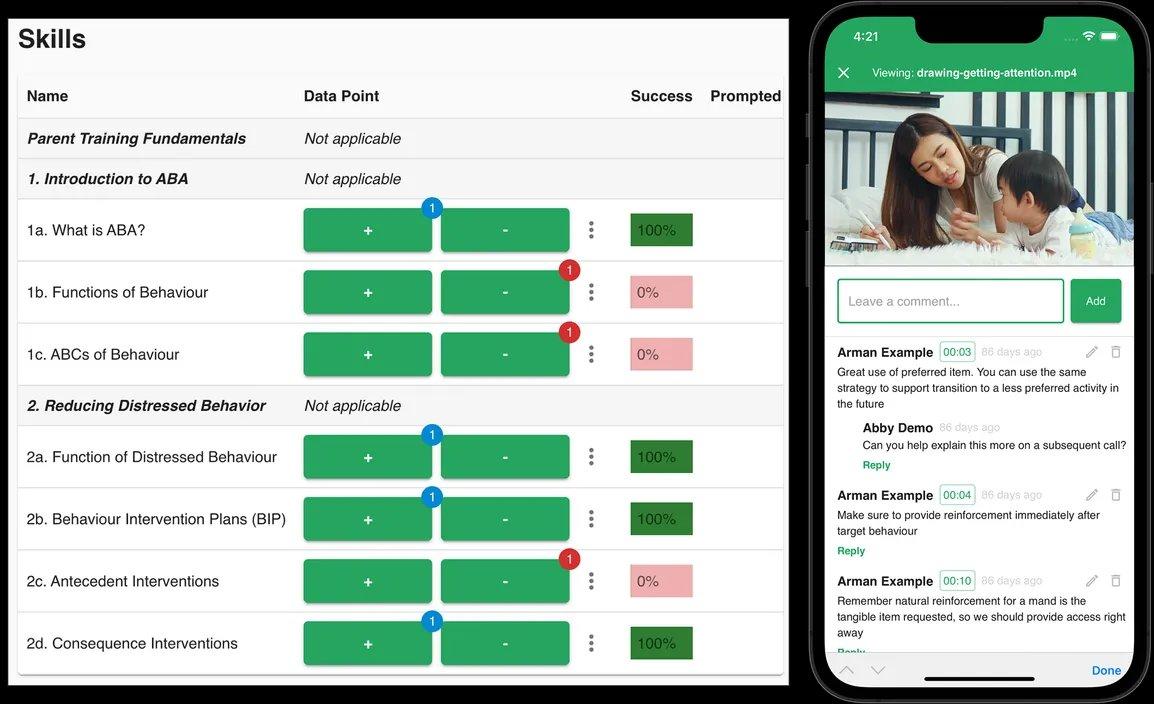
At the data collection level, Hi Rasmus offers a collaboration-first design philosophy. Practices can invite unlimited team members—BCBAs, RBTs, teachers, school staff, and caregivers—to a learner’s profile. Team members can comment directly on sessions, reports, and treatment plans, participate in live sessions remotely, leave video feedback, and make real-time updates to programs. This multi-stakeholder approach extends naturally to school settings, where multiple professionals may be involved in a child’s care plan, and to multidisciplinary organizations that deliver ABA alongside speech, occupational therapy, and educational services.
The platform has invested heavily in AI capabilities. Hi Rasmus offers AI-generated session notes that reduce documentation time for clinicians, AI-powered treatment plan generation, and an AI-based scheduling feature that provides real-time oversight of staff availability and session logistics. The company’s mission statement targets delivering high-quality behavioral therapy to one million children with autism—a scale ambition that shapes its product decisions toward enterprise and multi-site organizations.
Hi Rasmus’s client base includes organizations like Texana Center in Texas, Verbal Beginnings, and First Steps for Kids. The platform integrates with AlohaABA for practice management, functioning as the clinical layer in a best-of-breed stack. User reviews on Capterra highlight the integration with AlohaABA as a significant workflow advantage, though the dependency on an external practice management platform introduces the synchronization risks common to all best-of-breed architectures.
Hi Rasmus’s bet is that the future of ABA reimbursement will be outcomes-based, not hours-based. The HiQ Impact Score is built for a world where practices must prove their clinical effectiveness in standardized, auditable terms—a world that is arriving faster than many providers realize.
Hi Rasmus’s challenge is market visibility. The platform is well regarded among organizations that use it, but it does not carry the brand recognition of CentralReach or the clinician-community advocacy of Motivity. Its positioning around outcomes measurement and value-based care resonates strongly with PE-backed operators and accreditation-focused organizations but may feel abstract to small practice owners who are focused on day-to-day clinical and operational workflows. The platform’s depth in outcomes reporting is a genuine differentiator, but it requires organizational maturity to fully leverage.
CentralReach: The Enterprise Operating System
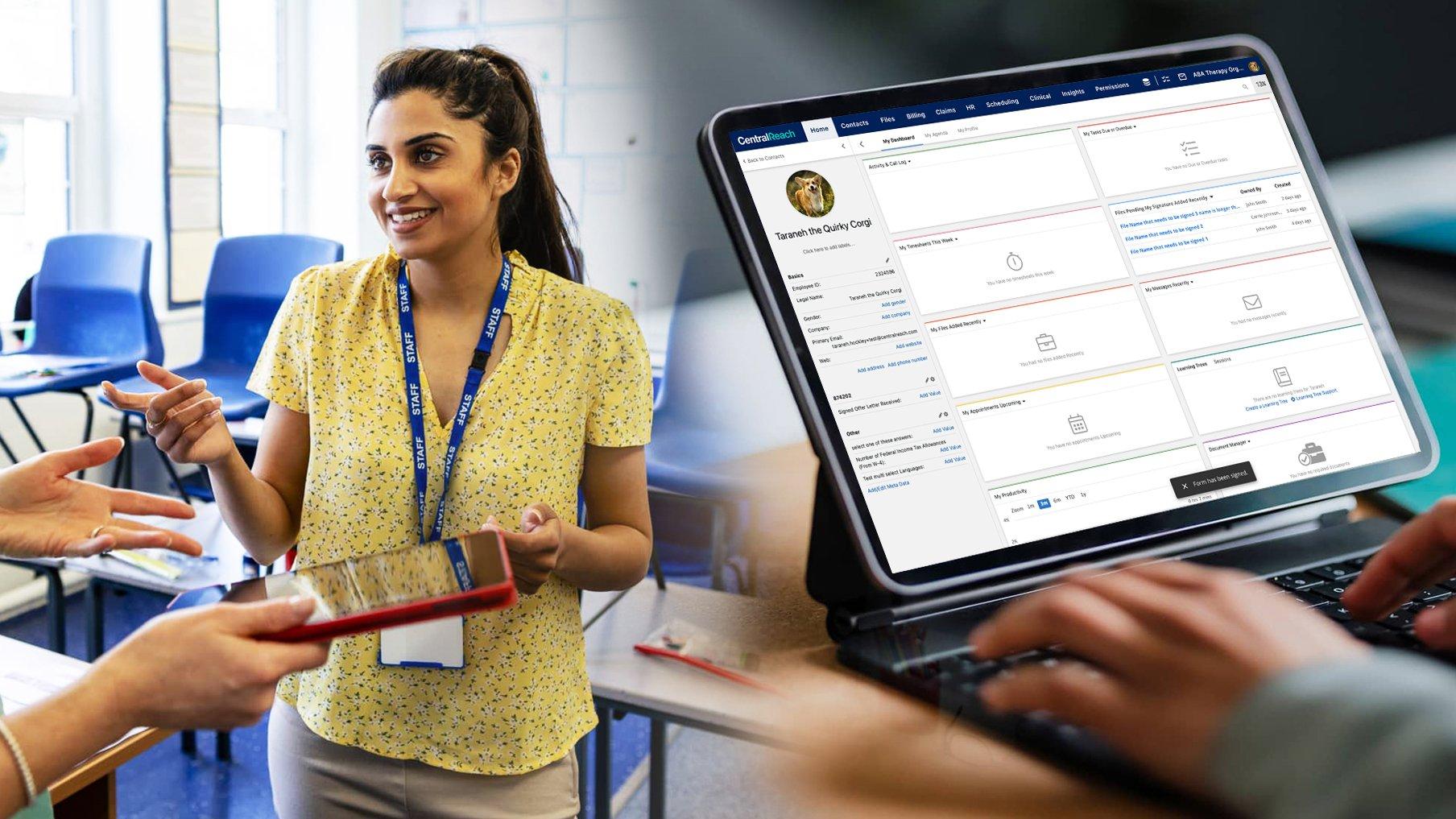
CentralReach occupies a different category entirely. With approximately $175 million in projected annual revenue, more than 200,000 professional users, and a $1.65 billion acquisition by Roper Technologies completed in 2025, CentralReach is less a data collection tool and more the operating system on which a large segment of the ABA industry runs. Its data collection capabilities are embedded within a comprehensive platform that encompasses practice management, scheduling, billing, payroll, analytics, AI-powered automation, and staff training through its CR Institute.
The clinical data collection experience in CentralReach is built around its Care360 suite. Program books sync directly with data sheets, eliminating the need to re-enter program information across clinical and documentation systems. Automated clinical reports are generated from session data without manual compilation. The mobile app supports offline data collection with automatic synchronization, and EVV-compliant time tracking is built into the session workflow. For practices operating across multiple states with different Medicaid EVV requirements, this native compliance is a material operational advantage.
CentralReach’s AI investments have been substantial. The platform offers AI-powered scheduling optimization that accounts for authorization windows, staff credentials, geographic constraints, and client preferences. AI-assisted clinical documentation generates session summary drafts from collected data. Revenue cycle management automation uses AI to predict and prevent claim denials before submission. These are not roadmap features—they are deployed and in production across the user base.
The platform’s enterprise positioning is both its strength and its limitation. For large, multi-site ABA organizations—particularly those backed by private equity—CentralReach’s all-in-one architecture offers consolidated reporting, standardized clinical protocols across locations, and a single billing infrastructure that scales across payer systems. Roper Technologies, a $60 billion public company, chose CentralReach specifically because of its market leadership, mission-critical positioning, and compelling business model.
But for smaller practices and clinician-led startups, CentralReach can feel like an enterprise system designed for administrators, not therapists. User reviews consistently describe a learning curve that is steeper than competitors, onboarding processes that require dedicated training staff, and a pricing structure that can be prohibitive for practices with fewer than 20 clinicians. The platform’s depth in billing and compliance features means the clinical data collection interface carries more visual complexity than clinician-first alternatives. For a BCBA whose primary concern is designing effective programs and collecting clean data, that complexity can feel like overhead.
CentralReach is not competing to be the best data collection tool. It is competing to be the operating system for the ABA industry. The data collection layer is one module in a platform that stretches from intake to claim payment—and that comprehensiveness is exactly what large organizations need and small practices find overwhelming.
The Comparison That Matters: What BCBAs Actually Care About
When BCBAs evaluate data collection platforms, their priorities consistently center on a specific set of clinical capabilities that do not always align with the features that dominate vendor marketing materials. Independent reviews and clinician surveys identify several recurring themes.
Program design flexibility. BCBAs need to build programs that match their clinical methodology, not adapt their methodology to fit the software. Motivity leads here with its no-code builder, program simulations, and 370-plus template library. Hi Rasmus offers deep customization with collaboration tools that extend program access to the full care team. CentralReach provides program books that sync with data sheets but within a more structured framework that some clinicians describe as less flexible than purpose-built alternatives.
Speed and simplicity for RBTs. The person using the data collection interface most frequently is the RBT, not the BCBA. An RBT collecting discrete trial data during a session needs an interface that is fast, responsive, and requires minimal navigation. Motivity’s training-in-under-20-minutes metric and high satisfaction scores suggest strong RBT usability. Hi Rasmus’s mobile interface is designed for in-session flow with minimal screen interaction. CentralReach’s mobile app is functional and EVV-compliant but carries the navigational complexity of an enterprise platform.
Real-time graphing and progress visualization. BCBAs make clinical decisions based on visual analysis of graphed data. All three platforms offer real-time graphing, but the quality, customizability, and interpretability of graphs differ. Motivity’s interactive graphs are consistently praised in user reviews. Hi Rasmus provides instant data visualization with mastery and regression notifications. CentralReach’s graphing integrates with its broader analytics suite, offering longitudinal views that are powerful for organizational reporting but can require more configuration for individual clinical analysis.
Offline capability. ABA therapy frequently occurs in homes and schools where internet connectivity is unreliable. Motivity supports offline data collection with automatic sync. Hi Rasmus offers mobile functionality designed for field settings. CentralReach’s mobile app includes offline mode with data syncing when connectivity is restored. Ensora Data Collection (formerly Catalyst) has historically been the strongest performer in offline scenarios, a legacy of its DataFinch origins.
Outcomes reporting and accreditation support. Hi Rasmus holds a clear advantage in standardized outcomes reporting through the HiQ Impact Score and Outcomes Ecosystem. CentralReach offers enterprise analytics that serve organizational reporting needs. Motivity’s reporting is clinically oriented and growing in sophistication. For practices pursuing accreditation through BHCOE or the Council of Autism Service Providers (CASP), Hi Rasmus’s framework is most directly aligned with accreditation data requirements.
The Capital Behind the Competition
The investment landscape behind these three platforms reveals the stakes of the competition. CentralReach’s $1.65 billion sale to Roper Technologies in March 2025 established it as the most valuable company in ABA technology. Roper’s autonomous operating model allows CentralReach to continue operating independently while benefiting from the financial strength of a $60 billion public company. The deal was led by CentralReach CEO Chris Sullens, with Insight Partners exiting after an investment that began in 2018.
Motivity’s $27 million from Five Elms Capital in March 2025 was smaller but strategically significant. Five Elms specializes in scaling software companies, and its operational value creation team is designed to accelerate growth, expand executive teams, and improve sales and marketing efficiency. For Motivity, the investment represents a transition from a research-funded clinical tool to a commercially scaled platform competing for enterprise accounts while maintaining its clinical-first identity.
Hi Rasmus has not publicly disclosed a comparable institutional funding round, but its partnership model—integrating with practice management platforms like AlohaABA rather than building those capabilities internally—suggests a capital-efficient strategy focused on clinical depth rather than operational breadth. The company’s Outcomes Ecosystem positions it as a high-value partner for PE-backed organizations that need accreditation-grade reporting, a positioning that could attract strategic investment as value-based care models gain traction in ABA.
For practice owners, the capital story matters because it signals staying power and product trajectory. A platform backed by institutional investors is more likely to sustain development investment, ship new features, and maintain customer support infrastructure over a multi-year horizon. But institutional capital also introduces new incentives—pricing optimization, cross-sell pressure, and eventual exit considerations—that may not always align with the interests of a BCBA running a 15-person practice.
The Verdict: Which Platform for Which Practice
The honest answer to which platform is winning BCBA adoption is: it depends on which BCBAs you ask, and what kind of practice they run. The data collection wars are not converging toward a single winner. They are stratifying the market.
Motivity is the strongest choice for clinician-led practices that prioritize program design flexibility, RBT usability, and clinical decision support. Practices where the BCBA is the primary technology decision-maker—rather than a CFO or operations director—will find Motivity’s research-driven design philosophy most closely aligned with their priorities. The $27 million investment signals that the platform is building toward full practice management, but practices that need mature billing automation today may need a supplementary solution.
Hi Rasmus is the strongest choice for outcomes-oriented organizations that are preparing for value-based care, pursuing accreditation, or need to demonstrate clinical effectiveness to payers and investors. Practices backed by private equity, operating across multiple sites, or delivering services in school settings will find Hi Rasmus’s collaboration tools and outcomes measurement framework uniquely valuable. The tradeoff is dependency on external practice management platforms for billing and scheduling.
CentralReach is the strongest choice for enterprise organizations that need a single, consolidated platform for clinical, operational, and financial workflows. Practices with more than 50 clinicians, multi-state operations, and complex billing arrangements will benefit most from CentralReach’s all-in-one architecture and AI-powered automation. The tradeoff is cost, complexity, and a user experience that favors operational comprehensiveness over clinical simplicity.
The data collection wars are ultimately about something larger than feature comparisons. They are about what the ABA technology market values most: clinical depth, outcomes accountability, or operational scale. Each platform has chosen its answer. The practices that choose wisely will be the ones that understand which question matters most for their own trajectory.
AT A GLANCE
| Motivity — Founded: | 2012; funded by $11M in NIH/NIMH SBIR research grants; $27M investment from Five Elms Capital (March 2025) |
| Motivity — Scale: | 550+ organizations across 7 countries; 370+ clinical templates; 5.0/5.0 rating on GetApp |
| Motivity — Differentiator: | No-code program builder; program simulations; 97% of staff trained in under 20 minutes; research-driven clinical design |
| Hi Rasmus — Focus: | Outcomes measurement and value-based care readiness; HiQ Impact Score combining access, quality, and user experience |
| Hi Rasmus — Capabilities: | AI session notes; AI scheduling; collaboration-first design with unlimited team members; Outcomes Ecosystem with benchmarking |
| Hi Rasmus — Integration: | Pairs with AlohaABA for practice management; clients include Texana Center, Verbal Beginnings, First Steps for Kids |
| CentralReach — Scale: | $1.65B acquisition by Roper Technologies (2025); ~$175M revenue; 200,000+ professional users; 20%+ organic growth projected |
| CentralReach — Platform: | All-in-one: EMR, PM, scheduling, billing, payroll, analytics, CR Institute training; Care360 clinical suite with AI modules |
| CentralReach — Tradeoff: | Enterprise pricing and complexity; steeper learning curve; clinical interface carries weight of administrative features |
| Best For — Motivity: | Clinician-led practices prioritizing program design flexibility and RBT usability |
| Best For — Hi Rasmus: | PE-backed organizations, school settings, and practices preparing for value-based care and accreditation |
| Best For — CentralReach: | Enterprise organizations with 50+ clinicians, multi-state operations, and complex billing requirements |
SOURCES & REFERENCES
| 1. | Motivity. “Motivity Announces $27M Growth Investment from Five Elms Capital.” Press release. March 12, 2025. https://www.motivity.net/blog/ |
| 2. | HealthExec. “Clinical Support Tool for Pediatric Autism Earns $27M from Private Equity.” March 2025. https://healthexec.com/ |
| 3. | Crunchbase. Motivity Company Profile. 2026. https://www.crunchbase.com/organization/motivity-systems |
| 4. | Motivity. “Best ABA Practice Management Software [2026].” January 2026. https://www.motivity.net/blog/best-aba-practice-management-software |
| 5. | Motivity. “A Better Alternative to CentralReach.” Comparison page. 2025. https://www.motivity.net/compare/motivity-vs-centralreach |
| 6. | Capterra. Motivity Software Reviews. 2026. https://www.capterra.com/p/231675/Motivity/ |
| 7. | Hi Rasmus. “Hi Fives by Hi Rasmus: Celebrating Progress with Purpose.” June 2025. https://hirasmus.com/ |
| 8. | Hi Rasmus. “Powering Data-Driven Decisions: Introducing the Hi Rasmus Outcomes Ecosystem.” January 2025. https://hirasmus.com/ |
| 9. | Hi Rasmus. “How Technology is Transforming Outcomes in ABA.” May 2025. https://hirasmus.com/ |
| 10. | Hi Rasmus. “Driving Value-Based Care with Outcomes Reporting and Clinical Insight.” April 2026. https://hirasmus.com/ |
| 11. | Google Play Store. Hi Rasmus app description and features. 2026. https://play.google.com/store/apps/details?id=com.hirasmus.app |
| 12. | Roper Technologies. “Roper Technologies to Acquire CentralReach.” Press release. March 24, 2025. https://www.ropertech.com/ |
| 13. | CentralReach. “CentralReach Joins Forces with Roper Technologies.” March 24, 2025. https://centralreach.com/blog/ |
| 14. | CentralReach. “ABA Practice Management Software.” Product page. 2025. https://centralreach.com/products/ |
| 15. | Behavioral Health Business. “Roper Technologies to Buy CentralReach for $1.65 Billion.” March 24, 2025. https://bhbusiness.com/ |
| 16. | Passage Health. “7 Best ABA Data Collection Software for Clinics in 2026.” January 2026. https://www.passagehealth.com/blog/aba-data-collection-software |
| 17. | Raven Health. “Top 5 ABA Data Collection Softwares in 2025.” January 2026. https://ravenhealth.com/blog/ |
| 18. | Capterra. AlohaABA Software Reviews. 2026. https://www.capterra.com/p/192774/AlohaABA/ |
| 19. | Mission Viewpoint. “CentralReach Joins Roper: A Pivotal Moment for the ABA Market.” 2025. https://www.missionviewpoint.com/ |
| 20. | Behavioral Collective. “Best ABA Data Collection Software [2024].” 2024. https://behavioralcollective.com/tools/ |