

The Update No One Chose
Most of the debate about artificial intelligence in autism therapy has centered on purpose-built clinical tools. The quieter shift is that general-purpose office AI has arrived in ABA clinics without anyone deciding to adopt it. Since early 2025, Google has folded its Gemini assistant into the Workspace plans that countless practices already run for email, documents, and scheduling, and raised the price to match. For a clinic, the AI did not arrive as a purchase. It arrived as a feature update.
That is the real meaning of the pitch now circulating that Google Workspace AI is reshaping ABA operations. The tools are marketed for documentation, staff training, and practice management, with promises of measurable time savings for behavior analysts and technicians. Some of that promise is genuine. Some of it points straight at the work where the compliance and clinical stakes are highest. And almost none of it comes with independent evidence that ABA clinics are saving time or money. The useful question is not whether to let office AI into the practice. It is already there. The question is which tasks it should be allowed to touch.
How the AI Actually Arrived
In January 2025, Google announced that Gemini, its generative AI assistant, would be built into Google Workspace Business and Enterprise plans rather than sold as a separate add-on. The change took effect for subscriptions renewing on or after March 17, 2025, and it carried a price increase of roughly 17 to 22 percent across plans. Business Standard rose from 12 to 14 dollars per user each month, and Business Plus from 18 to 22 dollars. The former Gemini add-ons, which had cost 20 to 30 dollars per user, went away.
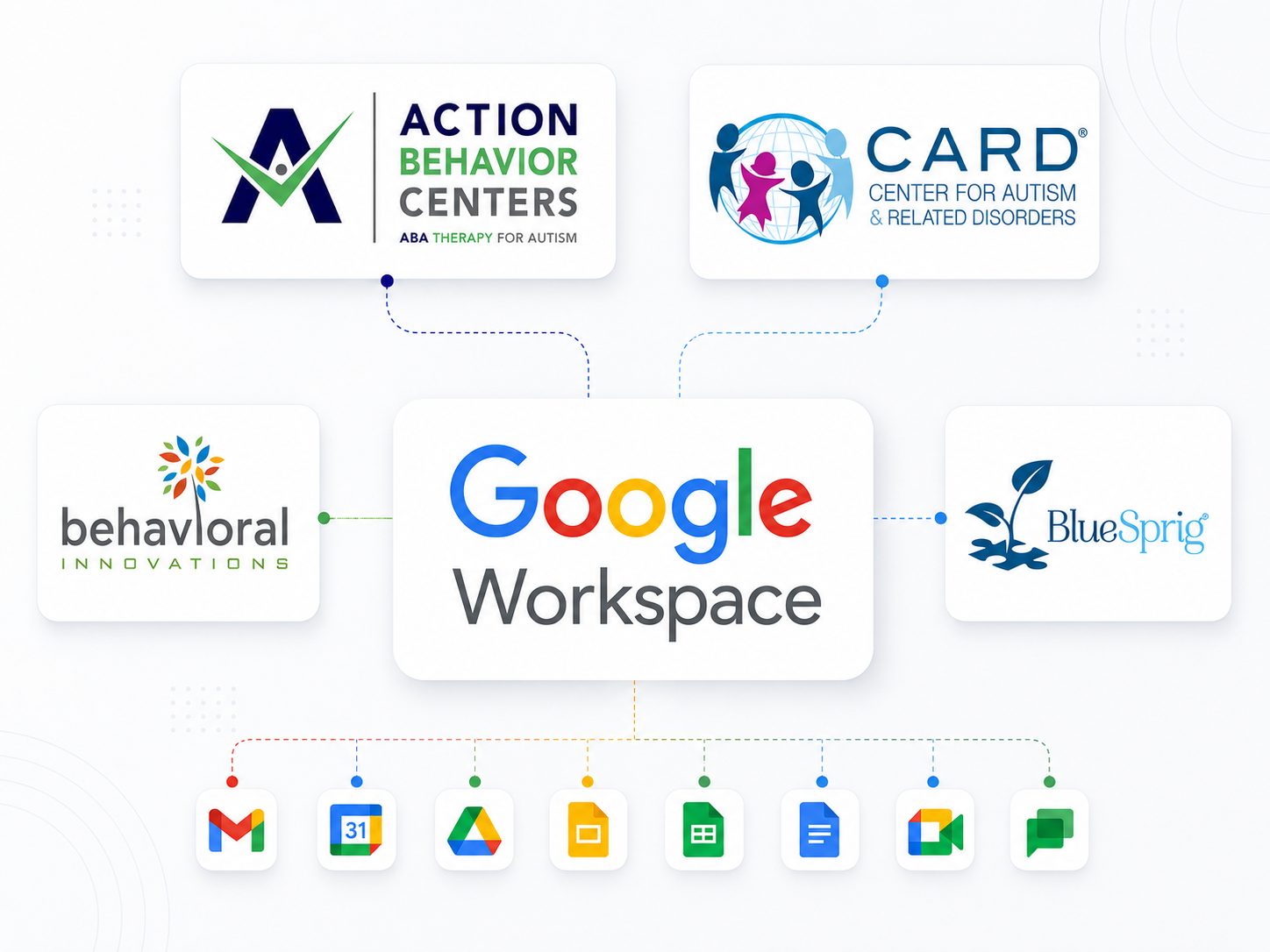
The practical result is that a clinic paying for Workspace in 2026 very likely has Gemini features active already, whether or not its staff have noticed. The assistant appears as a side panel in Gmail, Docs, Sheets, Drive, and Meet, offering to draft text, summarize threads, and take meeting notes; Business Standard and higher tiers carry the full set, while the entry-level Starter plan is limited to Gmail and a small number of daily prompts. Google had built an install base of more than 10 million businesses before adding the AI, so the feature reached an enormous footprint at once. For ABA practices, Workspace often sits just behind the electronic health record as a core part of the technology stack, which is exactly why the change matters.
What It Can Genuinely Help With
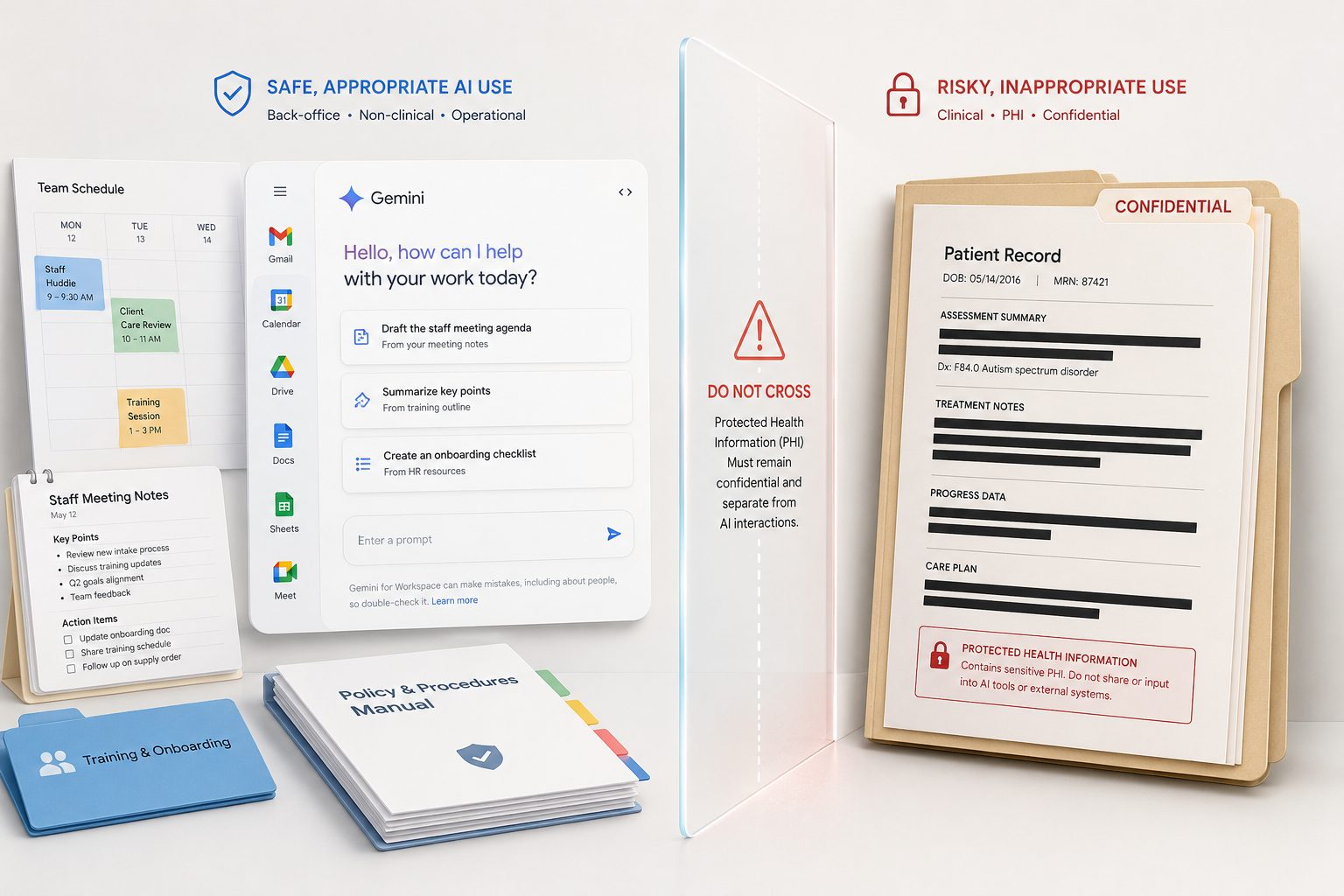
Stripped of the marketing, there is a real and defensible case for office AI in a clinic, and it lives in the back office. Drafting internal training materials, building document templates, summarizing a staff meeting, writing a job posting, tightening a policy document, or generating marketing copy are all tasks that generative AI handles competently and that carry no protected health information. Compliance specialists who advise mental health practices have landed in the same place: Gemini can be a strong tool for internal operations and the business side of a practice, as long as it stays away from client content.
That distinction is not a technicality. The administrative load in ABA is heavy and well documented, and it ranks among the most consistently cited drivers of clinician burnout. Any tool that takes non-clinical paperwork off a behavior analyst’s plate has obvious appeal in a field short on credentialed staff. A November 2024 survey by SimplePractice found that half of clinicians were already using AI for daily work, though only 13 percent had brought it into client documentation, the line most practices instinctively hesitate to cross.
Where the Shiny-Object Risk Lives
That hesitation is well founded, because the splashiest use cases are also the riskiest. Google markets Workspace AI to healthcare with examples that include generating patient summaries and discharge notes, simplifying intake, and analyzing patient populations, all under its Business Associate Agreement. The capability is real. Whether a given clinic can use it lawfully is a separate question, and the answer is usually not by default.
Gemini is not HIPAA compliant out of the box on any plan. Compliance requires a covered Workspace edition, a signed Google BAA executed through the admin console, and configuration that keeps protected health information away from any surface the agreement does not cover. The free consumer version of Gemini sits outside the BAA, can have its prompts reviewed by people and used to train public models, and must never see a child’s record. A clinic that lets staff paste session details into the wrong Gemini window has created a breach, not a workflow.
The safe, useful version of office AI lives in the back office, drafting templates and training notes. The risky version is the one pointed at a child’s clinical record.
Even with a BAA in place, the specialists who advise clinical practices draw a firmer line than Google’s marketing does. A general-purpose office assistant, they note, is not built for clinical documentation, which demands clinical nuance and the accuracy and bias safeguards that purpose-built healthcare tools are designed around. The Behavior Analyst Certification Board warned its certificants in 2024 that information entered into generative AI can be absorbed into a model and surfaced later, and peer-reviewed work by Jennings and Cox has stressed that the behavior analyst stays accountable for anything produced under their name. Using Gemini to write a clinical note also raises an informed-consent question many practices have not worked through.
The ROI Question Nobody Has Answered
Set the compliance issues aside and the promotional framing still has a hole in it. The claim driving the current wave of coverage is efficiency: that Workspace AI, and the ABA-specific platforms it is often paired with, such as the note-generation features sold by CentralReach and Rethink, deliver measurable time savings. The savings are plausible. The evidence that ABA clinics are realizing them is thin, and what exists tends to come from the vendors selling the tools rather than from independent measurement.
That gap is what the field’s own guidance is built to close. The Council of Autism Service Providers published practice parameters for AI use in ABA in 2025 that tell organizations to scrutinize how they select, oversee, and audit these tools rather than adopt them on a vendor’s word. A practice that cannot say how many minutes a tool saves per note, or whether the drafts it produces need so much correction that the savings evaporate, is buying a promise. For a clinic already paying more for Workspace because of the AI now folded into it, the honest accounting question is whether any of that added cost is coming back as real productivity.
The documentation burden is real, and so is the marketing. What is missing is independent evidence that any of these tools save ABA clinics time or money.
What Operators Should Actually Ask
None of this argues for ignoring the technology. It argues for treating it as what it is, a capable set of office tools that happens to sit inside software the clinic already owns, not a clinical breakthrough. The practical checklist is short. Confirm the Workspace edition and execute the BAA before any staff member uses AI near protected health information. Keep clinical documentation on tools built and validated for it. Pilot the non-clinical uses with a real before-and-after measure of time saved, not a vendor estimate. And recognize that the AI is already on the invoice, which makes proving its value the clinic’s job, not the vendor’s.
Whether Google Workspace AI turns out to be real efficiency or an expensive distraction will be settled clinic by clinic, in the gap between what the tools are marketed to do and what a behavior analyst can safely and measurably get from them. The technology has already entered ABA operations. The proof has not.
AT A GLANCE
| The product: | Gemini, Google’s generative AI, built into Google Workspace (Gmail, Docs, Sheets, Slides, Meet, Drive) |
| How it arrived: | Bundled into Workspace Business and Enterprise plans in January 2025; the separate Gemini add-on was retired |
| Price effect: | Base-plan prices rose about 17 to 22% (Business Standard $12 to $14; Business Plus $18 to $22 per user/month) |
| Access by tier: | Business Starter: Gemini in Gmail and limited prompts. Business Standard and up: full Gemini across apps |
| HIPAA reality: | Not compliant by default; requires a covered Workspace SKU, a signed Google BAA, and configuration. Consumer/misconfigured Gemini must never touch PHI |
| Expert caution: | Compliance specialists advise limiting Gemini to non-clinical work; it is not built for clinical documentation |
| Google’s pitch: | Markets clinical use cases (patient summaries, discharge notes, intake) to healthcare under its BAA |
| ABA-specific tools: | Platforms such as CentralReach and Rethink sell their own note-generation and AI features for ABA |
| Adoption signal: | A Nov. 2024 SimplePractice survey found 50% of clinicians use AI for daily tasks; 13% for client documentation |
| Field guidance: | CASP’s 2025 AI practice parameters urge vetting of AI selection, oversight, and auditing; the BACB warned in 2024 on generative-AI privacy |
| The ROI question: | Time-savings claims are largely vendor-reported; independent, ABA-specific ROI evidence is thin |
| Bottom line: | The AI is already in many clinics’ Workspace, and on the invoice; value depends on confining it to safe, non-clinical uses |
SOURCES & REFERENCES
| 1. | Google Workspace Blog. “The future of AI-powered work for every business” (Gemini bundled into Business and Enterprise plans; more than 10 million businesses). January 15, 2025. https://workspace.google.com/blog/product-announcements/empowering-businesses-with-AI |
| 2. | iFeeltech. “Gemini in Google Workspace: What’s Included and What Works” (bundling, tiers, side panel; many teams unaware features are active). April 2026. https://ifeeltech.com/blog/google-workspace-gemini-features-guide |
| 3. | Google Workspace. “Transform Healthcare and Life Sciences with AI | Google Workspace with Gemini” (clinical use cases marketed; HIPAA under BAA). Accessed June 2026. https://workspace.google.com/industries/healthcare/ |
| 4. | Strac. “Is Gemini HIPAA Compliant? 2026 Guide (BAA, Workspace, Vertex AI, and the Gaps)” (not compliant by default; covered SKU, signed BAA, configuration). 2026. https://www.strac.io/blog/is-gemini-hipaa-compliant |
| 5. | Person Centered Tech. “Google’s Gemini AI Tool and HIPAA Compliance in Mental Health Practices” (limit to non-clinical use; not built for clinical documentation; informed consent). November 6, 2024. https://personcenteredtech.com/2024/11/06/googles-gemini-ai-tool-and-hipaa-compliance-in-mental-health-practices/ |
| 6. | SimplePractice. “What Therapists Must Know About HIPAA-Compliant AI Note-Taking” (November 2024 survey: 50% use AI for daily tasks, 13% for documentation). https://www.simplepractice.com/blog/hipaa-compliant-ai-note-taking/ |
| 7. | Council of Autism Service Providers. “Practice Parameters for Artificial Intelligence Use in Applied Behavior Analysis” (selection, oversight, and auditing of AI tools). 2025. https://www.casproviders.org/practice-parameters-for-ai |
| 8. | Behavior Analyst Certification Board. “BACB Newsletter, July 2024” (warning on generative AI privacy and legal risks to certificants). https://www.bacb.com/wp-content/uploads/2024/07/BACB_July2024_Newsletter-241021-a.pdf |
| 9. | Jennings, A. M., & Cox, D. J. “Starting the Conversation Around the Ethical Use of Artificial Intelligence in Applied Behavior Analysis.” Behavior Analysis in Practice, 17(1), 107-122 (2024). doi:10.1007/s40617-023-00868-z. https://link.springer.com/article/10.1007/s40617-023-00868-z |
| 10. | Stevens, David (CentralReach), via MedCity News. “Understanding the Ethics of AI in ABA Therapy” (ABA-specific AI tools and oversight). January 2025. https://medcitynews.com/2025/01/understanding-the-ethics-of-ai-in-aba-therapy/ |