A Podcast Episode, and a Field Catching Up to It
ACROSS THE UNITED STATES — A recent episode of ABA in MIA, a podcast hosted by BCBAs Mariam Nawabi and Karelix Alicea, brought on Adam Ventura, the BCBA founder and CEO of Intraverbal AI, to discuss how artificial intelligence is moving into ABA clinics. The framing was largely optimistic. The clinical and economic reality on the ground is more complicated.
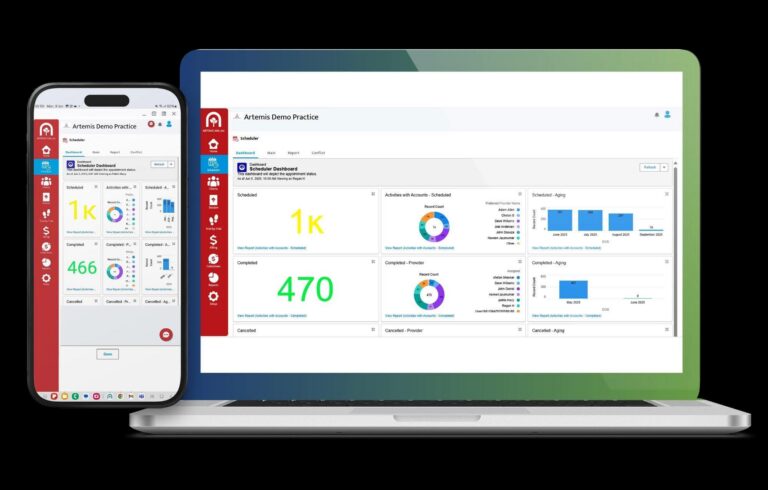
Eight of the ten ABA practice management platforms reviewed in a 2026 industry comparison published by VGSoft now ship some form of AI-generated session notes. CentralReach offers two: NoteDraftAI and NoteGuardAI. RethinkBH ships Session Note AI. Ensora Health has rolled out AI Session Assistant across its TheraNest and Fusion platforms, with its ABA suite the next likely host. Theralytics, Raven Health, Artemis ABA, Passage Health (through Frontera AI), and VGPM all offer their own variants. Intraverbal is one entrant in a fast-crowding field.
The peer-reviewed literature on AI in applied behavior analysis is, by contrast, thin. Jennings and Cox published the field’s first dedicated ethics framing in Behavior Analysis in Practice in November 2023, and Cox and Jennings followed it with a companion piece on AI’s promises and possibilities in behavior-analytic service delivery in the same journal in early 2024. A small number of additional commentaries and reviews have appeared in Behavior Analysis in Practice and Perspectives on Behavior Science since. The Behavior Analyst Certification Board has not issued AI-specific guidance, leaving the existing Ethics Code provisions on truthfulness and effective treatment as the only formal anchor BCBAs have when evaluating these tools. Payer audit rules are catching up even more slowly.
That gap is the story. The vendor field has moved from absent in 2023 to near-saturated in 2026 without a peer-reviewed evidence base, without BACB-specific guidance, and without payer policy keeping pace. The podcast is one signal among many. The harder question is what BCBAs and clinic owners should ask before adopting any of these tools.
What Intraverbal AI Actually Does
Intraverbal AI is, in product terms, a behavior-analysis-specific layer on top of large language model technology. The platform offers a chatbot connected to ABA journal articles, a goal bank for treatment planning, a transcription tool that converts supervision and meeting recordings into structured summaries with feedback ratios, and an “Insights” tool that pulls session data and graphs directly from a clinician’s screen and turns them into reauthorization drafts. The company tells users its tools get drafts “80 to 85 percent of the way there,” leaving clinical judgment and final approval to the human in the loop.
Ventura, a BCBA with nearly two decades in the field, brings business credibility to the pitch. He founded and scaled the multi-state ABA provider World Evolve and exited in 2018. He is a Florida International University alum and adjunct professor in its behavior analysis department, where he has taught since 2009. In Spring 2026 Intraverbal launched a partnership with Felician University in New Jersey, where ABA graduate students train on the platform as part of their coursework. That distribution channel matters. It puts the tool in the hands of the BCBAs who will be running clinics in 2028 and 2029.
Intraverbal’s public-facing claims on the compliance dimension are specific. The company states the platform is HIPAA and FERPA compliant, that client data is “encrypted end-to-end,” and that interactions are not used to train models. Those are the right claims for a healthcare AI vendor to make. The relevant question for adopting clinics is whether each claim survives a Business Associate Agreement review and an independent security audit.
The 2026 question for BCBAs is not whether to use AI. It is whether the vendor can answer three things: where the model runs, what data it was trained on, and what happens when it gets a billable detail wrong.
The Vendor Field BCBAs Are Walking Into
Eight vendors with materially different products are now competing for the same documentation budget at the average ABA clinic. The differences matter more than the marketing suggests.
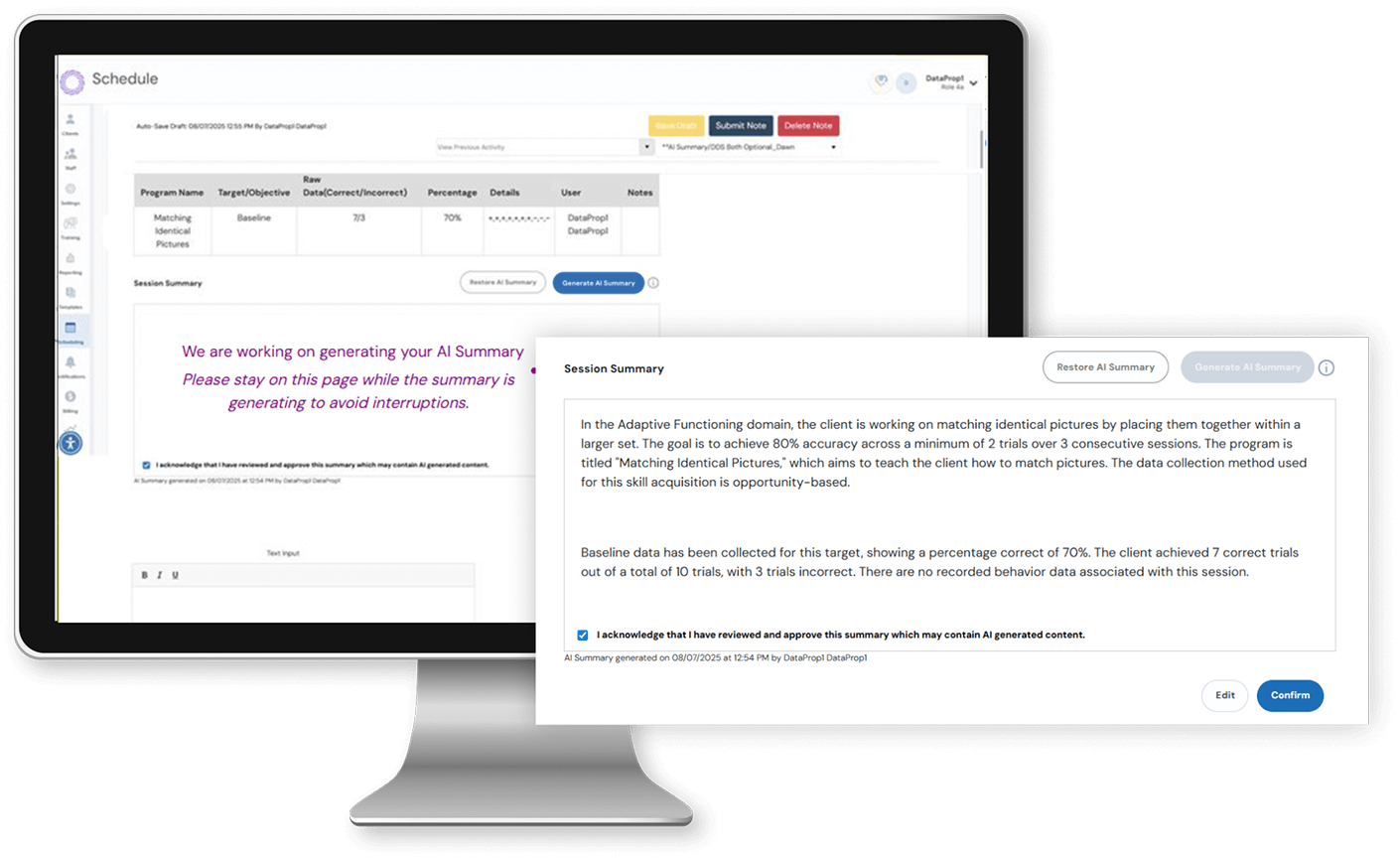
The first structural split is what the AI actually produces. Some platforms, including CentralReach’s NoteDraftAI, RethinkBH’s Session Note AI, and VGPM, fill the entire structured session-note form, populating discrete billable fields from session data. Others, including Theralytics, Raven Health, Ensora’s AI Session Assistant, Artemis ABA, and Passage Health through Frontera AI, generate a single narrative summary that the clinician then rewrites or copies into the structured form.
That distinction is more than cosmetic. A fill-the-form product is generating content that goes directly into the billing record. If the model hallucinates a behavior occurrence, a duration count, or a specific antecedent, that hallucination lives inside a CPT-coded line item. A narrative-summary product still produces text the clinician has to translate, which preserves more clinical friction and, with it, more chance to catch errors before submission.
For clinics operating in an environment where the HHS Office of Inspector General has launched aggressive audit efforts, the distinction has direct billing-risk implications. A recurring theme in those audit reports is documentation that does not match the billed service. AI tools that auto-populate the billed service from inferred session content are operating in exactly the zone the OIG is now reviewing.
Where the Evidence Sits
The foundational peer-reviewed citation in the field remains Jennings AM, Cox DJ. “Starting the Conversation Around the Ethical Use of Artificial Intelligence in Applied Behavior Analysis.” Behavior Analysis in Practice, November 2023. The paper is a starting framework, not an outcomes study. A companion piece by Cox and Jennings, “The Promises and Possibilities of Artificial Intelligence in the Delivery of Behavior Analytic Services,” appeared in the same journal in 2024. Neither paper tests any specific vendor product. Neither provides a safety profile, a measure of clinical accuracy, or a comparison against unassisted clinician notes. More than two years on, the two pieces remain the most cited works in the area.
The most consequential skeptical voice outside the journals has come from clinical educators. David J. Cox—co-author of the 2023 Jennings and Cox ethics paper—and Ryan O’Donnell published a September 8, 2025 piece for The Behavior Academy arguing that many tools marketed as “AI for ABA” are functionally LLM wrappers, products that pass user inputs through a commercial model like GPT, Gemini, or Claude with a custom interface and minimal additional engineering. The piece warned that unless vendors document otherwise, BCBAs should assume their client data may move through third-party servers and may be retained.
That LLM-wrapper critique is the question every ABA AI vendor will be asked through 2026, including Intraverbal. The defensible answer is documentation: a Business Associate Agreement, a model architecture description, a data-handling diagram, and an independent security review. The indefensible answer is a marketing page that asserts compliance without showing the underlying mechanics.
BACB Ethics Code and the Human-in-the-Loop Question
The BACB Ethics Code does not yet name artificial intelligence. The provisions that apply by analogy are Code 1.01, Being Truthful, and Code 2.01, the requirement to deliver effective treatment. Both are now being read by ethics commentators to require what the field is calling a “human-in-the-loop” approach: every AI-generated clinical note, treatment goal, or supervision summary must be reviewed and approved by the responsible BCBA before it enters the clinical record.
Informed consent is the other open question. If a clinic uses an AI tool to draft notes or treatment plans, the position taken by most ethics commentators is that the client or guardian must be told. There is no current BACB rule that explicitly requires this disclosure, but the analog provisions in the Ethics Code on confidentiality and the obligation to be truthful with clients about the services being delivered are difficult to read any other way.
“If you’re a BCBA, RBT, clinical director, or a university instructor shaping the next generation of analysts, it isn’t optional to understand what a ‘LLM wrapper’ is.” – The Behavior Academy (September 2025).
What Clinic Owners Should Ask Before Adopting
Six questions form a minimum technical and ethical due-diligence checklist for any ABA AI tool a clinic owner is considering this year.
Architecture. Does the vendor own and fine-tune its own model on ABA-specific data, or is the product a wrapper around a commercial LLM with a custom prompt and interface? Both can be defensible. Neither is automatically secure.
Data residency. Where does protected health information actually get processed? In the vendor’s own infrastructure, in a HIPAA-eligible cloud region, or in a general-purpose LLM provider’s shared infrastructure? Get this in writing.
Training use. Is your client data used to train, fine-tune, or evaluate any model, the vendor’s own or a third party’s? The defensible answer is no, with that no in the contract.
Business Associate Agreement. Will the vendor sign a BAA, and does the BAA flow down to any subprocessors, including the underlying LLM provider? An unsigned BAA is a regulatory finding waiting to happen.
Payer alignment. Does the AI output map to your specific payer’s session-note requirements, including any state Medicaid-specific fields, or does it produce a generic clinical note that still requires manual translation?
Error profile. What is the vendor’s documented rate of factual error on session-content elements? Has the vendor published anything beyond marketing testimonials on accuracy? If not, your clinic is the dataset.
A vendor that answers all six in writing is worth a pilot. A vendor that answers most of them with reassurance instead of documentation is worth a longer look at competitors.
What to Watch
Three things will shape this market through the end of 2026. First, the Felician University–Intraverbal partnership in Spring 2026 will be one of the first natural experiments in how an ABA AI tool performs when introduced at the graduate-training level. Second, the BACB has not signaled when, or whether, it will issue AI-specific guidance, and the field is operating without it. Third, the OIG’s ongoing state-by-state Medicaid ABA audit program will at some point reach a clinic whose notes were drafted by an AI tool, and the finding in that audit, when it lands, will reset the market.
Until then, the gap between vendor pace and evidence pace is the story. Clinic owners who adopt without doing the due diligence above are betting that the regulators will move slowly. The regulators have moved slowly so far. Whether that continues is now an empirical question.
AT A GLANCE
| News peg: |
ABA in MIA podcast Episode 7, “The Future of ABA: How AI Is Changing Therapy Forever,” featuring BCBAs Nawabi, Alicea, and Ventura |
| Adam Ventura: |
Founder & CEO, Intraverbal AI; BCBA with nearly two decades in the field; FIU adjunct professor since 2009; founded World Evolve (exited 2018) |
| Intraverbal AI product: |
ABA-specific chatbot, goal bank, supervision transcription, “Insights” reauth-draft tool; HIPAA and FERPA compliance claimed |
| Felician University partnership: |
Spring 2026; ABA graduate students train on Intraverbal as part of coursework |
| ABA platforms shipping AI notes: |
8 of 10 reviewed in VGSoft’s 2026 ABA session-notes comparison (vgsoft.co); Motivity and AlohaABA are the two without public AI note generation |
| Two structural product types: |
Fill-the-form (CentralReach NoteDraftAI, RethinkBH, VGPM) and narrative summary (Theralytics, Raven, Ensora, Artemis, Passage/Frontera) |
| Peer-reviewed ABA AI ethics paper: |
Jennings & Cox, Behavior Analysis in Practice, Nov 2023 (ethics framing) plus companion paper Cox & Jennings, BAP 2024 (promises and possibilities); the field’s primary citations |
| BACB AI-specific guidance: |
None as of May 2026; Ethics Code provisions 1.01 (Being Truthful) and 2.01 (Effective Treatment) apply by analogy |
| Independent skeptical voice: |
The Behavior Academy “Behind the Curtain of AI Tools in ABA,” September 8, 2025; critiques LLM-wrapper products and data residency |
| Required clinical posture: |
“Human-in-the-loop” review of every AI-generated clinical artifact; informed consent for AI use in client documentation |
| OIG documentation audit context: |
Hundreds of millions in improper Medicaid ABA payments flagged across initial state audits; documentation-vs-billing mismatch is recurring finding |
| Minimum due-diligence questions: |
Six: architecture, data residency, training use, BAA terms, payer alignment, error profile |
SOURCES & REFERENCES
| 1. |
Community Newspapers / CNEWS TV. “ABA in MIA – Episode 7: The Future of ABA: How AI Is Changing Therapy Forever.” 2026. https://communitynewspapers.com/videos-2/aba-in-mia-episode-7-the-future-of-aba-how-ai-is-changing-therapy-forever/ |
| 2. |
Intraverbal AI. Company website and product description. Accessed May 2026. https://www.intraverbal.ai/ |
| 3. |
Intraverbal AI. “About Us.” Accessed May 2026. https://www.intraverbal.ai/about-us |
| 4. |
Felician University. “Where Education Meets Artificial Intelligence: Enhancing Applied Behavior Analysis with Intraverbal AI.” 2026. https://felician.edu/news/where-education-meets-artificial-intelligence-enhancing-applied-behavior-analysis-with-intraverbal-ai/ |
| 5. |
Jennings AM, Cox DJ. “Starting the Conversation Around the Ethical Use of Artificial Intelligence in Applied Behavior Analysis.” Behavior Analysis in Practice. November 2023. doi:10.1007/s40617-023-00868-z. https://link.springer.com/article/10.1007/s40617-023-00868-z |
| 6. |
Jennings AM, Cox DJ. PMC mirror. https://pmc.ncbi.nlm.nih.gov/articles/PMC10891004/ |
| 7. |
The Behavior Academy. “Behind the Curtain of AI Tools in ABA: What Every BCBA Needs to Know.” September 8, 2025. https://www.thebehavioracademy.com/blog/llm-wrappers-in-aba |
| 8. |
CentralReach. “Leveraging AI for Note Generation To Manage the Complexities of ABA Session Notes Compliance & Audits.” Accessed May 2026. https://centralreach.com/blog/managing-the-complexities-of-aba-session-notes-leveraging-ai-for-session-note-audits/ |
| 9. |
VGSoft. “Top 10 ABA Session Notes Software Compared (2026).” Accessed May 2026. https://vgsoft.co/blog/aba-session-notes-software-2026 |
| 10. |
Behavior Analyst Certification Board. “Ethics Codes.” https://www.bacb.com/ethics-information/ethics-codes/ |
| 11. |
Praxis Notes. “ABA Documentation AI Ethics: BACB Compliance Guide.” Accessed May 2026. https://www.praxisnotes.com/resources/aba-documentation-ai-ethics |
| 12. |
MedCity News. “Understanding the Ethics of AI in ABA Therapy.” January 2025. https://medcitynews.com/2025/01/understanding-the-ethics-of-ai-in-aba-therapy/ |
| 13. |
Capterra. Intraverbal AI product listing. Accessed May 2026. https://www.capterra.com/p/10031007/Intraverbal-AI/ |
| 14. |
Behavior Analysis Blogs (ABAI). “Navigating the Ethical Terrain of Generative AI in Behavior Analysis: A Three-Part Series.” January 2024. https://behavioranalysisblogs.abainternational.org/2024/01/12/6836/ |
| 15. |
HHS Office of Inspector General. “Audits of Medicaid Applied Behavior Analysis for Children Diagnosed With Autism.” Work plan and reports series. https://oig.hhs.gov/reports/work-plan/browse-work-plan-projects/srs-a-25-029/ |
| 16. | Cox DJ, Jennings AM. “The Promises and Possibilities of Artificial Intelligence in the Delivery of Behavior Analytic Services.” Behavior Analysis in Practice. 2024. doi:10.1007/s40617-023-00864-3. https://link.springer.com/article/10.1007/s40617-023-00864-3 |
| 17. | Cox DJ, O’Donnell R. “Behind the Wrapper: What You Need to Know About LLM-Powered Tools / Behind the Curtain of AI Tools in ABA: What Every BCBA Needs to Know.” The Behavior Academy. September 8, 2025. https://www.thebehavioracademy.com/blog/llm-wrappers-in-aba |
| 18. | Intraverbal AI. Home page FAQ (“approximately 80–85% of the drafting process”) and About Us (Adam Ventura biography). Accessed May 2026. https://www.intraverbal.ai/ ; https://www.intraverbal.ai/about-us |
| 19. | VGSoft. “Top 10 ABA Session Notes Software Compared (2026)” (used as basis for the 8-of-10 figure; VGSoft is also the publisher of VGPM, one of the eight platforms listed). https://vgsoft.co/blog/aba-session-notes-software-2026 |