
MIAMI — On a recent episode of the ABA in MIA podcast, two board certified behavior analysts sat down with a third who has spent recent years building artificial intelligence tools for their field. The conversation, framed around how AI could reshape autism therapy, documentation, parent training, and clinic operations, kept circling a single question that now hangs over the entire industry. It is not whether artificial intelligence will enter the ABA clinic. It already has. The question is where, in a discipline built on human relationships and individualized care, the line should be drawn.
Hosts Mariam Nawabi and Karelix Alicea, both BCBAs, were joined by Adam Ventura, a BCBA who founded and runs Intraverbal AI, a company that builds AI tools for behavior analysts. That lineup is itself telling. The people arguing over AI in ABA are not technologists on one side and clinicians on the other. They are behavior analysts debating among themselves, which is why the conversation moved quickly past the easy talking points and into the harder territory of risk, ethics, and where artificial intelligence actually earns its place.
The Question Is No Longer Whether
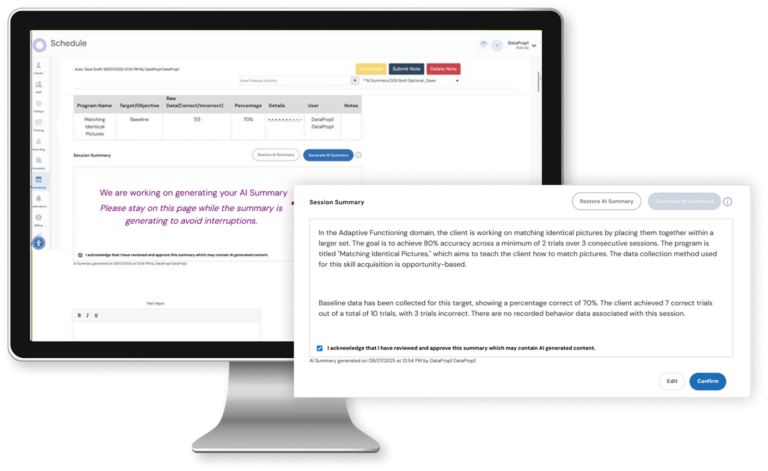
The premise that AI is already embedded in ABA is not in dispute. Documentation tools that draft session notes from collected data are now sold by most of the field’s major platforms, and adoption has been brisk. A November 2024 SimplePractice survey found that half of clinicians were already using AI for daily work, though only 13 percent had brought it into client documentation, the task where the clinical and compliance stakes are highest. Ventura’s own Intraverbal markets a behavior-analysis chatbot, a goal generator, and an assessment and treatment-plan drafter; CentralReach and RethinkBH sell their own note-generation tools. The tools exist, providers are buying them, and the genie is not going back in the bottle.
That is what makes the framing of the debate matter. When a technology is optional, the argument is about adoption. When it is already in the building, the argument becomes about boundaries: which tasks belong to the software, which belong to the clinician, and how a practice tells the difference. The ABA in MIA conversation, like a growing number across the field, was less a referendum on AI than an attempt to map that boundary.
The Builder’s Case
Ventura makes the optimist’s argument, but a more careful version than the marketing around AI usually allows. His framing, and the stated philosophy of Intraverbal, is augmented intelligence rather than artificial intelligence: tools that take on the time-consuming, repetitive work surrounding care so that scarce clinical expertise can stretch further. In that telling, AI drafts the insurance-ready report, generates a first pass at treatment goals, organizes session data, and supports parent training and supervision, while a behavior analyst reviews, corrects, and signs off on everything that matters. A partnership Intraverbal struck with Felician University illustrates the model: a trainee uploads a diagnostic assessment, the tool summarizes it and drafts an insurance-ready report, and a BCBA then peer-reviews that draft before it is used.
The appeal is easy to understand in a field strained by workforce shortages and burnout. Behavior technicians and BCBAs spend significant time on documentation and administrative tasks that pull them away from clients, and that load is among the most consistently cited drivers of turnover. If software can absorb the paperwork while leaving clinical judgment with the clinician, the argument goes, the result is less burnout, more time with children, and a way to extend a limited supply of credentialed analysts to more families. The builders are careful to say the human stays in the loop. The question the hosts press is what happens when, in practice, the loop gets loose.

The Clinician’s Caution
The case for caution does not rest on technophobia. It rests on what ABA actually is. Behavior analysis is built on individualized assessment and a relationship between a clinician, a child, and a family, and its core decisions, what to target, how to respond in the moment, when to change course, depend on clinical judgment that a model trained on other people’s data does not have. The fear is not that AI will think for the clinician. It is that the convenience will quietly erode the habits and skills that make a clinician worth trusting, especially for trainees who learn the craft by doing the very tasks AI now offers to do for them.
Then there are the documented risks, which the field has begun to catalog in detail. Generative tools can fabricate, producing fluent text describing interventions that were never delivered, and in a clinical record that fiction becomes a false document and, in a Medicaid-funded service, the raw material of a payer audit. They carry privacy exposure: the Behavior Analyst Certification Board warned its certificants in 2024 that information typed into generative AI applications can be absorbed into a model’s training data and later surfaced to others, a serious matter when the information is a child’s protected health record. Ultimate accountability stays with the clinician. Peer-reviewed work by Jennings and Cox, among the first to map AI ethics onto the BACB code, underscores that the behavior analyst remains responsible for everything done under their name, no matter which tool produced the draft.
The debate in ABA is no longer whether artificial intelligence enters the clinic. It is where the line sits between the back office and the therapeutic relationship.
Where the Field Is Drawing the Line
For all the heat the topic generates, a rough consensus is taking shape, and it runs through the middle of the debate rather than to either pole. The emerging view is that AI belongs in the clinic’s back office, drafting documentation, organizing data, easing the administrative load, and supporting training and supervision, but not in the seat where clinical decisions and the therapeutic relationship live. Notably, that is roughly where the builders place it too; even an AI founder like Ventura frames his tools as assistants that keep a credentialed human making the call. The disagreement is less about the principle than about the discipline required to hold the line once the tools are fast, cheap, and everywhere.
The field is also moving to write that boundary down. In 2025 the Council of Autism Service Providers published practice parameters for AI use in ABA, addressing payer, regulatory, and ethical questions alongside organizational oversight, selection, and auditing, an attempt to give providers a shared standard rather than leaving each clinic to improvise. Combined with the BACB’s cautions and the growing ethics literature, it signals a field trying to set norms while the technology is still young, rather than after a high-profile failure forces the issue.
Even the field’s AI builders frame their tools as augmented intelligence, with a behavior analyst, not an algorithm, making the clinical call.
Why It Matters
The stakes in getting the line right are practical, not abstract. Drawn well, with AI confined to the administrative work and a clinician firmly in control of care, the technology could return hours to overstretched practitioners, ease the burnout fueling turnover, and widen access for families stuck on waitlists. Drawn badly, with AI creeping into clinical judgment or running on consumer tools that leak protected data, it could produce privacy breaches, false records, deskilled clinicians, and an erosion of the human relationship that makes the therapy work in the first place. What the ABA in MIA conversation captured is a field aware of both outcomes and trying, in real time, to steer toward the first. The tools are already here. The work now is deciding, deliberately rather than by default, exactly where they belong.
AT A GLANCE
| The hook: | ABA in MIA podcast, Episode 7, “The Future of ABA: How AI Is Changing Therapy Forever” (May 2026) |
| Who took part: | Hosts Mariam Nawabi, BCBA and Karelix Alicea, BCBA, with guest Adam Ventura, BCBA, founder and CEO of Intraverbal AI |
| The real question: | Not whether AI enters the ABA clinic (it already has), but where the line sits between back office and bedside |
| Intraverbal AI: | Coral Gables firm offering a behavior-analysis chatbot, goal generator, and assessment/treatment-plan drafter; frames its approach as “augmented intelligence” |
| Adoption reality: | A November 2024 SimplePractice survey found 50% of clinicians use AI for daily tasks; 13% for client documentation |
| The builder’s case: | AI absorbs documentation and admin work, easing burnout and extending scarce BCBA capacity, with a human reviewing and signing |
| The clinician’s caution: | ABA is relational and individualized; risks include deskilling, hallucinated records, privacy exposure, and unmoved accountability |
| BACB warning (2024): | Data entered into generative AI may be absorbed into training data and surfaced to other users |
| Liability: | The behavior analyst remains responsible for every record produced under their name, regardless of the tool (Jennings & Cox, 2024) |
| Emerging consensus: | AI in the back office (documentation, data, training); clinical decisions and the therapeutic relationship stay with the clinician |
| Field guidance: | CASP published practice parameters for AI use in ABA (payer, regulatory, ethical, and oversight matters), 2025 |
| The stakes: | Drawn well: less burnout, more access. Drawn badly: privacy breaches, false records, deskilling, and eroded trust |
SOURCES & REFERENCES
| 1. | ABA in MIA, Episode 7. “The Future of ABA: How AI Is Changing Therapy Forever.” Miami’s Community Newspapers, May 2026. https://communitynewspapers.com/videos-2/aba-in-mia-episode-7-the-future-of-aba-how-ai-is-changing-therapy-forever/ |
| 2. | Intraverbal AI. “About Us” (Adam Ventura, MS, BCBA, Founder and CEO; company approach). Accessed June 2026. https://www.intraverbal.ai/about-us |
| 3. | ABA on Tap. “Transforming Applied Behavior Analysis Through AI-Powered Tools with Adam Ventura” (Ventura background and philosophy). 2025. https://abaontap.buzzsprout.com/783968/contributors/109557-adam-ventura-bcba |
| 4. | Felician University. “Where Education Meets Artificial Intelligence: Enhancing Applied Behavior Analysis with Intraverbal AI.” December 2025. https://felician.edu/news/where-education-meets-artificial-intelligence-enhancing-applied-behavior-analysis-with-intraverbal-ai/ |
| 5. | Council of Autism Service Providers. “Practice Parameters for Artificial Intelligence Use in Applied Behavior Analysis.” 2025. https://www.casproviders.org/practice-parameters-for-ai |
| 6. | Behavior Analyst Certification Board. “BACB Newsletter, July 2024” (warning on generative AI privacy and legal risks to certificants). https://www.bacb.com/wp-content/uploads/2024/07/BACB_July2024_Newsletter-241021-a.pdf |
| 7. | Jennings, A. M., & Cox, D. J. “Starting the Conversation Around the Ethical Use of Artificial Intelligence in Applied Behavior Analysis.” Behavior Analysis in Practice, 17(1), 107-122 (2024). doi:10.1007/s40617-023-00868-z. https://link.springer.com/article/10.1007/s40617-023-00868-z |
| 8. | SimplePractice. “What Therapists Must Know About HIPAA-Compliant AI Note-Taking” (November 2024 survey: 50% use AI for daily tasks, 13% for documentation). https://www.simplepractice.com/blog/hipaa-compliant-ai-note-taking/ |
| 9. | Stevens, David (CentralReach), via MedCity News. “Understanding the Ethics of AI in ABA Therapy.” January 2025. https://medcitynews.com/2025/01/understanding-the-ethics-of-ai-in-aba-therapy/ |