The Fragmentation Tax
ACROSS THE UNITED STATES — A typical mid-size ABA practice in 2026 operates with a technology stack that would be unrecognizable to a primary care physician. An RBT in the field collects discrete trial data on a tablet using one application. The session note is documented in a second system. The BCBA reviews the data and updates the treatment plan in a third interface. The scheduling team manages appointments in a fourth. The billing department submits claims through a clearinghouse connected to yet another platform. And the practice owner pulls financial reports from a dashboard that draws on data from some, but not all, of these systems.
This is not an edge case. It is the operational norm for a significant share of the approximately 4,000 ABA practices operating in the United States. The ABA technology market evolved not as a unified ecosystem but as a collection of point solutions (clinical data collection, practice management, billing, scheduling, credentialing) without a shared data architecture connecting them. The result is an interoperability gap that imposes real costs: duplicated data entry, synchronization errors, delayed claim submissions, unbilled sessions, and clinical-operational disconnects that undermine both care quality and revenue.
Among behavioral health treatment facilities themselves, fewer than half of those using EHRs allow clients to view their medical information online, per ONC’s 2024 N-SUMHSS analysis. Behavioral health sits at the bottom of healthcare’s interoperability hierarchy, and ABA, as a sub-specialty within behavioral health, inherits every one of those structural disadvantages while adding its own layer of clinical data complexity.
The ABA technology market evolved as a collection of point solutions, without a shared data architecture connecting them. The cost of that fragmentation is paid every day in duplicated data entry, delayed claims, and lost revenue.
The All-in-One Versus Best-of-Breed Debate
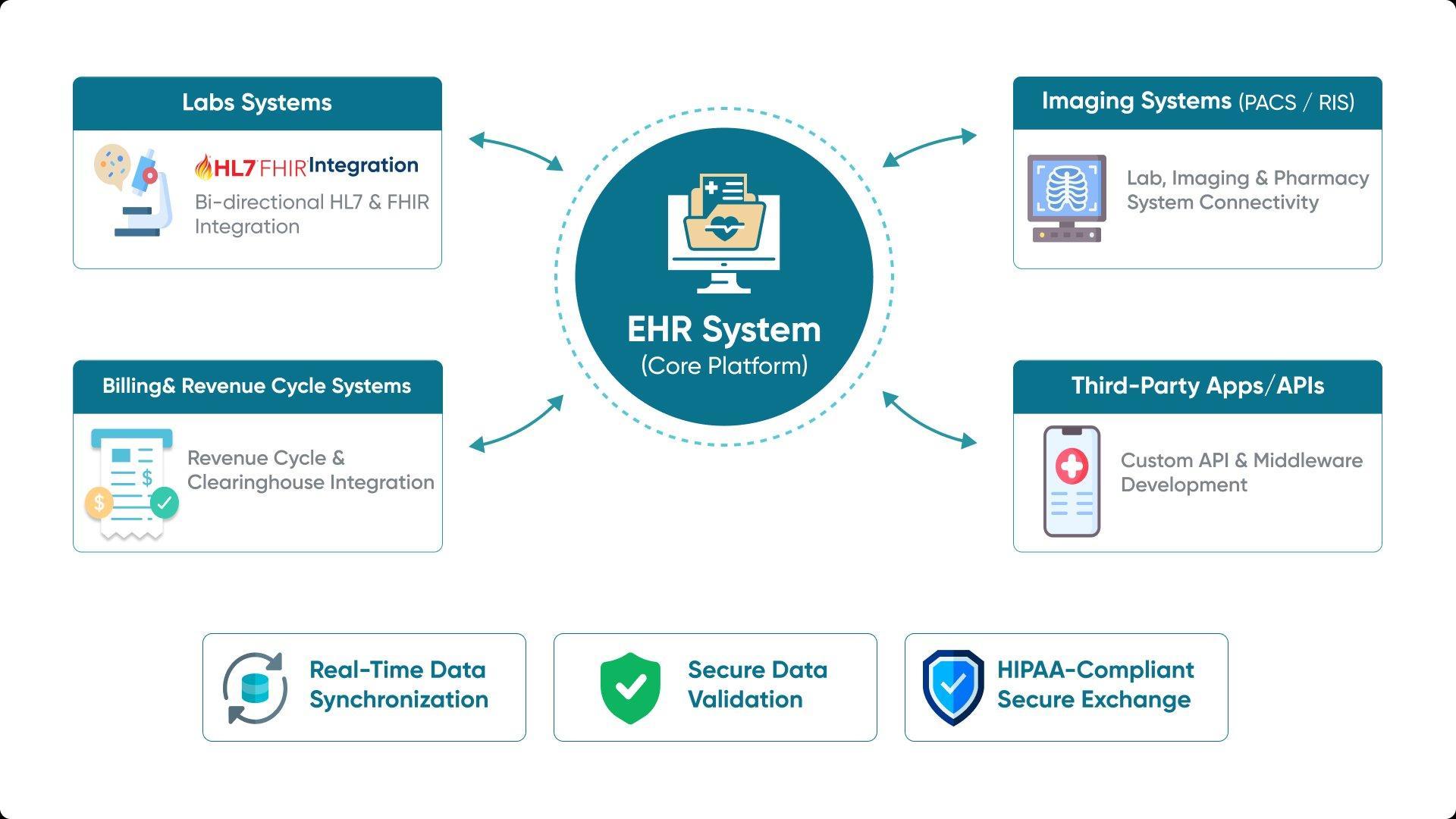
The ABA market’s response to the interoperability problem has split along a fundamental architectural divide. All-in-one platforms store clinical, scheduling, and billing data in a single database. Best-of-breed stacks combine specialized tools from different vendors connected through APIs and middleware.
The all-in-one model is best represented by CentralReach, which offers clinical data collection, practice management, scheduling, billing, payroll, and analytics in a single platform. When an RBT documents a session in CentralReach, that data is immediately available in the billing module because both use the same underlying database. Authorization tracking automatically adjusts when sessions are completed. Claims can be generated directly from session documentation without manual re-entry. The value proposition is straightforward: one system, one login, one source of truth. Roper Technologies’ $1.65 billion acquisition of CentralReach, announced in March 2025 and closed that spring, was a bet on the durability of this architecture. With approximately $175 million in projected revenue for the twelve months ending June 30, 2026 and more than 200,000 professional users, CentralReach has established itself as the default operating system for large ABA organizations.
The all-in-one model carries its own costs. CentralReach’s pricing is enterprise-oriented, and smaller practices frequently find the platform’s complexity and cost prohibitive. Onboarding requires significant training investment. And because the platform controls the entire workflow, practices that are dissatisfied with one module, billing for instance, or clinical data collection, cannot easily swap in a preferred alternative without leaving the entire ecosystem. Vendor lock-in is built into the architecture by design.
The best-of-breed model is exemplified by platforms like AlohaABA, which provides practice management, scheduling, billing, and payroll while integrating with external clinical data collection tools, including Hi Rasmus, Motivity, and Ensora Data Collection (the rebranded Catalyst by DataFinch). AlohaABA connects to clearinghouse infrastructure for claim submission and offers API-based data exchange with its clinical partners. The appeal is flexibility. A practice can choose the clinical tool its BCBAs prefer while running billing and scheduling through AlohaABA’s operational layer. Practices save around 30 percent compared to bundled enterprise pricing, according to AlohaABA’s published materials.
The tradeoff is friction. When clinical data and billing data live in separate databases connected by APIs, synchronization is not instantaneous. Session documentation completed in Motivity or Hi Rasmus must transmit to AlohaABA’s billing module, and any delay, mapping error, or API interruption creates a gap that someone, usually an administrator, must manually resolve. User reviews of best-of-breed stacks consistently cite double data entry, login fatigue from maintaining credentials across multiple platforms, and the overhead of troubleshooting integration failures as pain points.
A third category has emerged. Platforms market themselves as all-in-one but are architecturally assembled from acquired products. Ensora Health, the rebrand of Therapy Brands announced in April 2025, is the most prominent example. Its ABA product line combines Ensora Data Collection (formerly Catalyst by DataFinch) and CodeMetro (formerly WebABA Enterprise), products built by different development teams that now share a brand name but operate on different codebases. The Ensora Platform, unveiled at the National Council for Mental Wellbeing’s NatCon25 conference in May 2025, represents the company’s roadmap for true integration. As of early 2026, the degree to which these modules function as a single system varies by implementation.
The question for practice owners is not whether to choose all-in-one or best-of-breed. It is whether the integration layer, whether built by one vendor or assembled across several, actually works in the daily reality of running a practice.
Where the Data Breaks
The interoperability gap in ABA technology manifests most acutely at five specific points in the clinical-operational workflow, each of which directly affects either revenue or care quality.
1. Session-to-claim conversion. The most consequential handoff in any ABA practice is the conversion of a completed session into a billable claim. In a fully integrated system, the session note, including CPT code, duration, modifier, rendering provider, and place of service, flows automatically into the claims engine. In a disconnected stack, this conversion requires manual entry, copy-paste, or batch export and import. Every manual step introduces error risk. A mismatched CPT code, a missing modifier, or an incorrect duration can trigger a claim denial. For a practice processing hundreds of sessions per week, even a small error rate compounds into significant revenue leakage.
2. Authorization tracking. ABA therapy is delivered under payer-authorized hour limits. Exceeding authorized hours results in denied claims. Under-utilizing authorized hours represents lost revenue. Tracking authorization consumption requires real-time visibility into both scheduled and completed sessions, reconciled against the authorization record. When scheduling lives in one system and clinical documentation in another, the authorization balance may be inaccurate, stale, or visible only after manual reconciliation. Practices without real-time authorization dashboards report chronic under-utilization or, worse, discover overage only after claims are submitted and denied.
3. Credential-to-schedule matching. Payers require that services are rendered by appropriately credentialed providers and that billing reflects the correct rendering and supervising provider relationships. In a disconnected system, the scheduling module may not have real-time visibility into which staff members are credentialed with which payers, leading to sessions that are clinically appropriate but administratively unbillable. The problem intensifies in multi-site practices where staff rotate across locations and payer panels.
4. Electronic Visit Verification (EVV). An increasing number of states require EVV for Medicaid-funded ABA services, mandating that session time, location, and provider identity be electronically verified. EVV compliance requires that the data collection tool, the scheduling system, and the billing platform share a common record of when, where, and by whom a session was delivered. When these systems are disconnected, EVV compliance becomes a manual reconciliation exercise rather than an automated workflow, adding administrative burden to an already documentation-heavy field.
5. Reporting across clinical and financial domains. Practice owners and PE-backed operators need visibility into both clinical outcomes and financial performance. How many authorized hours are being utilized? Which payers have the highest denial rates? Which clinicians are most productive? Which clients are making the most progress? Answering these questions requires data that spans the clinical and billing divide. In a fragmented stack, generating a cross-domain report typically requires exporting data from multiple systems into a spreadsheet. The process is slow, error-prone, and inherently backward-looking rather than real-time.
The Federal Interoperability Push
For the first time, federal policy is directly addressing behavioral health data interoperability. The Behavioral Health Information Technology (BHIT) Initiative, originally launched by the Office of the National Coordinator for Health Information Technology and the Substance Abuse and Mental Health Services Administration in February 2024 and expanded into a $20 million effort, is now led by ASTP/ONC (the Assistant Secretary for Technology Policy and the Office of the National Coordinator for Health IT) in partnership with SAMHSA. The initiative centers on two standards development efforts: the USCDI Plus Behavioral Health (USCDI+ BH) dataset and the FHIR Behavioral Health Profiles Implementation Guide (BH IG).
The USCDI+ BH dataset establishes a core set of standardized, interoperable data elements designed to capture treatment data for individuals with mental health and substance use disorders. The FHIR BH IG provides the technical specifications for how those data elements should be formatted, transmitted, and consumed across systems. Together, they represent the first federal attempt to bring the same interoperability standards that have transformed general healthcare (through the 21st Century Cures Act, the TEFCA framework, and FHIR-based APIs) into behavioral health specifically.
Forty-five exchange partners across nine pilot sites, in Colorado, Connecticut, Delaware, Florida, Massachusetts, North Carolina, Oregon, Rhode Island, and Washington, D.C., are testing the standards in real-world behavioral health settings using awards ranging from $300,000 to $690,000. The pilots cover consent management for substance use disorder records under 42 CFR Part 2, data exchange through Health Information Exchanges, and integration of social determinants of health data. Findings are due by the end of 2026, and ASTP/ONC has signaled that the Behavioral Health Information Resource being developed alongside the pilots is slated for nationwide adoption in 2027.
The implications for ABA are indirect but significant. The BHIT Initiative does not specifically address ABA’s clinical data collection needs. Discrete trial data, skill acquisition tracking, and behavior reduction protocols are not represented in the current USCDI+ BH dataset. But the broader infrastructure it creates (standardized APIs, consent management frameworks, and expectations of interoperability) will increasingly apply to ABA platforms as behavioral health data exchange standards mature. ABA vendors that build FHIR-ready APIs now will be positioned for the regulatory environment of 2028 and beyond. Those that do not may find themselves unable to connect with the broader healthcare ecosystem as payers, health systems, and government agencies demand standardized data exchange.
Few behavioral health EHRs currently carry ONC certification, which requires FHIR API support and USCDI v3 compliance. Among ABA-specific platforms, ONC certification remains rare. Theralytics’ Practice Management and Data Collection Software is one of the first ABA-specific platforms to achieve ONC Health IT certification (Drummond Certified), and few others have followed. That gap is not principally a technology issue. ABA platforms were built for a specialty market that historically operated outside the certification framework. As that framework expands to encompass behavioral health, the gap between certified and non-certified platforms will become a competitive differentiator.
What Practice Owners Should Ask Their Vendors
For ABA practice owners evaluating their technology stack in 2026, the interoperability question is no longer abstract. It has direct implications for revenue cycle performance, compliance risk, staff workload, and the ability to scale. Several specific questions can reveal whether a platform’s integration claims hold up under scrutiny.
Does clinical, scheduling, and billing data exist in one database or multiple databases connected through APIs? True integration stores everything in one place. API-connected systems create synchronization risk. The distinction is not always obvious from a product demo, and vendors may describe API-connected architectures as integrated. Ask directly.
What is the session-to-claim conversion workflow? Request a live demonstration of the end-to-end path from a completed therapy session to a submitted claim. Count the number of manual steps, screen transitions, and data re-entry points. In a well-integrated system, the number should be close to zero.
How does the system handle authorization tracking in real time? Ask to see the authorization dashboard while a session is in progress. Does it reflect consumed and remaining hours accurately, or does it update only after a batch sync? Real-time authorization visibility prevents both over-utilization and under-utilization.
What happens when the API connection fails? For best-of-breed stacks, API downtime will happen. Ask the vendor what happens to session data, scheduling updates, and claim queues when the connection between systems is interrupted. Is there a manual fallback? How is data reconciled after the connection is restored? The answer reveals the system’s operational resilience.
Is the platform building toward FHIR-based interoperability? This question may not have immediate practical consequences, but it signals whether the vendor is preparing for the regulatory environment that is coming. A vendor that has invested in FHIR APIs, even at an early stage, is more likely to interoperate with health information exchanges, payer systems, and adjacent therapy platforms in the future.
What Comes Next
The ABA data problem is, at its core, a maturity problem. The field’s technology infrastructure was built during a period of rapid growth when practices needed individual tools fast (a data collection app here, a billing platform there) and integration was a secondary concern. Now, as the market consolidates, payer expectations rise, and federal interoperability standards reach behavioral health, the cost of fragmentation is becoming untenable.
The market is converging toward integration along divergent paths. CentralReach and other all-in-one platforms are deepening their single-database advantage with AI-powered automation and enterprise-scale analytics. Best-of-breed vendors like AlohaABA are investing in tighter API connections and building their own clinical data collection tools. AlohaABA’s Welina product, currently in beta, represents a move toward offering an integrated clinical-operational platform without requiring external clinical partners. Newer entrants like Raven Health and Passage Health are building natively integrated systems from the ground up, avoiding the legacy architecture constraints that plague assembled platforms.
For the estimated 4,000 ABA practices in the United States, the strategic question is not whether to invest in integrated technology but when. Practices operating on fragmented stacks absorb hidden costs in administrative time, claim denials, unbilled sessions, and staff frustration that compound as the practice grows. Those costs are already material. With BHIT pilot findings due by the end of 2026 and the federal Behavioral Health Information Resource slated for nationwide adoption in 2027, the regulatory pressure will intensify. The practices that solve their data problem now will be positioned to scale, optimize revenue, and meet the data-exchange standards their payers and partners will require.
AT A GLANCE
| Core Problem: | ABA clinical data collection tools do not natively integrate with billing and practice management systems, forcing manual re-entry and middleware workarounds |
| Market Size: | Approximately 4,000 ABA practices operating in the United States |
| Hospital-to-BH Data: | Only 17% of U.S. hospitals routinely send summary-of-care records to behavioral health providers (ONC Data Brief No. 71, May 2024) |
| Client Access Gap: | Fewer than half of behavioral health facilities allow clients to view records online: 44% of EHR-only and 33% of mixed (ONC 2024 N-SUMHSS analysis) |
| All-in-One Leader: | CentralReach: single-database architecture; $1.65B acquisition by Roper Technologies (March 2025); ~$175M projected revenue; 200,000+ users |
| Best-of-Breed Example: | AlohaABA: integrates with Hi Rasmus, Motivity, and Ensora Data Collection via APIs; ~30% savings vs. enterprise pricing |
| Assembled Platform: | Ensora Health (rebrand of Therapy Brands, April 2025): Ensora Data Collection (formerly Catalyst) and CodeMetro (formerly WebABA Enterprise); Ensora Platform announced May 2025 |
| Federal Initiative: | BHIT Initiative: $20M ASTP/ONC and SAMHSA effort; USCDI+ BH dataset and FHIR BH IG; 9 pilot sites; 45 exchange partners |
| Pilot Awards: | $300,000 to $690,000 per site; findings due end of 2026 |
| Behavioral Health Information Resource: | Slated for nationwide adoption in 2027 |
| ONC Certification: | Few behavioral health EHRs carry ONC certification (FHIR API + USCDI v3); Theralytics is among the first ABA-specific platforms to be ONC Health IT certified (Drummond Certified) |
| Key Failure Points: | Session-to-claim conversion, authorization tracking, credential matching, EVV compliance, and cross-domain reporting |
| New Entrants: | Raven Health, Passage Health, ABA Matrix, Theralytics building natively integrated platforms |
| Strategic Imperative: | Practices on fragmented stacks absorb hidden costs in admin time, denials, and unbilled sessions that compound with scale |
SOURCES & REFERENCES
| 1. | Roper Technologies. “Roper Technologies to Acquire CentralReach.” Press release, March 24, 2025. https://www.ropertech.com/news-releases/news-release-details/roper-technologies-acquire-centralreach |
| 2. | Behavioral Health Business. “Roper Technologies to Buy ABA Software Company CentralReach for $1.65 Billion.” March 24, 2025. https://bhbusiness.com/2025/03/24/roper-technologies-to-buy-aba-software-company-centralreach-for-1-65-billion/ |
| 3. | CentralReach. “CentralReach Joins Forces with Roper Technologies to Accelerate Outcomes for Individuals with Autism and IDDs.” March 24, 2025. https://centralreach.com/blog/centralreach-joins-forces-with-roper-technologies/ |
| 4. | ASTP/ONC and SAMHSA. “Advancing the Future of Behavioral Health Data Exchange.” HealthIT.gov Blog. February 2026. https://healthit.gov/blog/behavioral-health/advancing-the-future-of-behavioral-health-data-exchange/ |
| 5. | SAMHSA. “Advancing the Future of Behavioral Health Data Exchange.” February 2026. https://www.samhsa.gov/blog/advancing-future-behavioral-health-data-exchange |
| 6. | ASTP/ONC. “SAMHSA and ONC Launch the Behavioral Health Information Technology Initiative.” Buzz Blog, original launch announcement. https://healthit.gov/blog/behavioral-health/samhsa-and-onc-launch-the-behavioral-health-information-technology-initiative/ |
| 7. | Healthcare IT News. “ONC makes push for meaningful behavioral health record interoperability.” 2026. https://www.healthcareitnews.com/news/onc-makes-push-meaningful-behavioral-health-records-interoperability |
| 8. | Healthcare IT News. “SAMHSA and HHS announce behavioral health data exchange pilots.” February 2026. https://www.healthcareitnews.com/news/samhsa-and-hhs-announce-behavioral-health-data-exchange-pilots |
| 9. | HL7 FHIR. “US Behavioral Health Profiles Implementation Guide v0.1.0.” ASTP/BHIT continuous build. https://build.fhir.org/ig/HL7/us-behavioral-health-profiles/index.html |
| 10. | ONC Data Brief No. 71 (May 2024). “Interoperable Exchange of Patient Health Information Among U.S. Hospitals: 2023.” https://healthit.gov/wp-content/uploads/2024/05/Interoperable-Exchange-of-Patient-Health-Information-Among-U.S.-Hospitals-2023.pdf |
| 11. | ONC Data Brief. “Electronic Health Record Adoption and Exchange Capabilities Among Substance Use and Mental Health Treatment Facilities, 2024.” https://healthit.gov/data/data-briefs/electronic-health-record-adoption-and-exchange-capabilities-among-substance-use-and-mental-health-treatment-facilities-2024/ |
| 12. | Ensora Health. “Ensora Health Unveils Platform to Enable Intelligent, Whole Person Care.” May 5, 2025. https://ensorahealth.com/news/ensora-health-unveils-platform-to-enable-intelligent-whole-person-care/ |
| 13. | Ensora Health. “Therapy Brands Is Now Ensora Health.” April 7, 2025. https://ensorahealth.com/news/therapy-brands-is-now-ensora-health/ |
| 14. | Ensora Health Knowledge Base. “CodeMetro Platform Overview” (formerly WebABA Enterprise). https://experience.ensorahealth.com/codemetro-47 |
| 15. | Ensora Health. “ABA Data Collection Software” (formerly Catalyst by DataFinch). https://ensorahealth.com/product/aba-suite/aba-data-collection-software/ |
| 16. | AlohaABA. “Practice Management Software” (clinical partner integrations and Welina). https://alohaaba.com/features/practice-management |
| 17. | AlohaABA. “Welina ABA Data Collection.” 2026. https://alohaaba.com/features/data-collections |
| 18. | Theralytics. “Theralytics Security and Compliance” (ONC Health IT / Drummond Certified, SOC 2 Type II, HIPAA). https://www.theralytics.net/security |