
A doctoral-level practice opens against the consolidation tide
MELVILLE, NY. The pitch fits on a business card. Doctoral-level behavioral consultation, family-centered, independent, in Melville. The argument behind it takes longer.
Douglas Kupferman, BCBA-D, Ph.D., LBA-NY, opened Kupferman Behavioral Consulting (KBC) in March 2026 after roughly 14 years inside the field, including a stretch building clinical infrastructure at multi-site ABA organizations. The credentials are unusual. The BCBA-D designation, which requires doctoral or postdoctoral training in behavior analysis on top of an active BCBA, sits with a small minority of the U.S. behavior-analyst workforce.
Kupferman earned his master’s at LIU Post and his doctorate at Caldwell University, one of a small number of U.S. institutions offering a Ph.D. specifically in Applied Behavior Analysis, where doctoral students rotate through the on-campus Center for Autism and ABA under faculty who publish in the field’s leading journals.
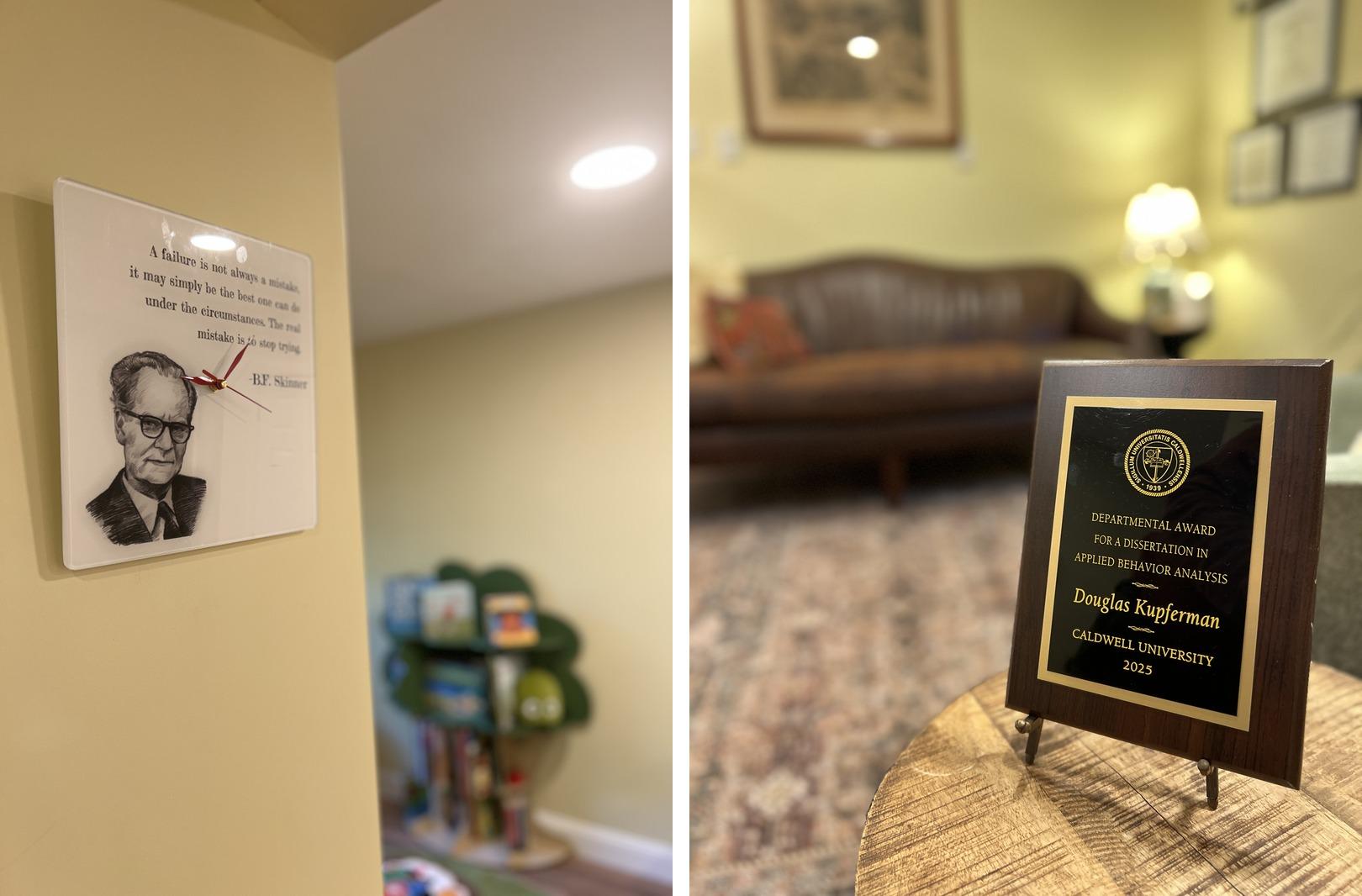
That training shows up on his CV. He is a co-author on a 2021 Journal of Applied Behavior Analysis paper that taught abduction-prevention skills to individuals with autism using video modeling, including the harder case of lures from people the participant already knew. He chaired a symposium at the 45th annual ABAI conference in Chicago in 2019. He has presented at NYSABA and BABAT meetings between 2015 and 2025. In Spring 2025 his department at Caldwell awarded him its Dissertation Award for “The Effects of Gamified Computer-Based Instruction on Acquisition of Compassionate Communication,” a study of how technology-based training can teach behavior analysts to engage more compassionately with families.
What he is doing in Melville is not academic. The practice is consultation-based, parent-coached, and built to be the doctoral-level option that the standard insurance-funded ABA pipeline does not produce by default. The thesis is structural: the field has, in the author’s framing, drifted toward utilization-led decision-making in ways that compress the kind of individualization the science was built around, and there is a category of family that is being underserved as a result.
Skinner built this field around the individual organism. Not the group. Not the aggregate. The individual. Douglas Kupferman, BCBA-D, founder, Kupferman Behavioral Consulting (2026)
The Two Experts model
The product Kupferman is selling is not therapy hours. It is consultation. Parents are the primary agents of change in the home. The clinician brings the science, the assessment, and the recommendations; the family brings the irreplaceable knowledge of the child. He calls it the Two Experts model and uses it as the operating frame for how a case is structured.
That distinction matters in this market. Most insurance-funded ABA in the U.S. is delivered as direct one-to-one therapy hours, billed in 15-minute units under behavioral health treatment codes, with the BCBA running supervision and program design while a Registered Behavior Technician carries the bulk of the in-home contact. The model has scaled enormously over the last decade. It has also drawn growing scrutiny over the gap between the published research base, which is largely built on individualized assessment and intensive supervision, and the typical case as actually delivered, where caseload sizes and documentation demands compress the individualization the science assumes.
Kupferman’s consultation model sits next to that standard delivery rather than against it. The work is built around comprehensive behavioral assessment that captures the contingencies operating at home and at school, since those are rarely the same, and around coaching the parent or caregiver to run the strategies in the contexts where behavior actually occurs. The recommendations have to generalize across home, school, and community, because the consultant is not in the home for 30 hours a week.
At the doctoral level, the depth of assessment is the thing being sold. The same is true of complex cases that have not responded to standard approaches. Whether a family pays out of pocket or eventually accesses the practice through insurance once credentialing is complete, the asset is the BCBA-D running the case and the time spent on the assessment that frames it.

What the macro picture looks like underneath
The conditions Kupferman is opening into are familiar to anyone watching this market. The U.S. ABA market was valued at roughly $7.97 billion in 2025 and is projected to reach $9.96 billion by 2030, a compound annual growth rate of about 4.56%. The active U.S. BCBA workforce sat at roughly 75,600 as of mid-2025, against more than 103,000 open BCBA-level postings at the end of 2024. Smaller centers report annual turnover near 80%. Burnout surveys put roughly 93% of behavioral-health workers somewhere on the spectrum from mild to severe.
Demand is moving the other way. The CDC’s Autism and Developmental Disabilities Monitoring Network now estimates 1 in 31 children is diagnosed with autism spectrum disorder, up from 1 in 36 in the prior cycle. New York’s Long Island region alone produces enough referral volume that ABA waitlists routinely run six months or longer. Insurance-funded services start when they start. The clock on a child’s developmental window does not.
Layered on top of those workforce numbers is the structural shift that has reshaped how most U.S. ABA gets delivered. Over the last decade, private equity capital has driven significant consolidation in the sector, with multi-state platforms acquiring local clinics and integrating them into shared back-office, billing, and clinical-supervision infrastructure. The arithmetic of those platforms favors throughput. Utilization rates, session counts, and billing efficiency are easier to monitor across hundreds of clinicians than the texture of any single case. The trade-off is not unique to ABA. It is the same trade-off that operates in primary care, dentistry, and physical therapy, and it is what makes the operational scale possible in the first place.
Kupferman’s critique, in his own framing, is not aimed at any specific operator. It is aimed at what happens when utilization replaces individualization as the organizing principle of care. Single-subject methodology, individual data, and individual contingencies are the defining epistemological commitments of behavior analysis as a science. When the data system above the practitioner is built for throughput, those individual variables become harder to see at the case level. The behavioral question that should drive a clinical decision (why is this practitioner seeing this child more frequently this month, why are cancellations rising, what is the function of the parent’s reduced engagement) gets crowded by the operational question that drives the dashboard.
When you lose sight of the individual data points, it is easy to lose the trees in the forest. Douglas Kupferman, BCBA-D, founder, Kupferman Behavioral Consulting
The CPSE gap, and what KBC is built to fill
Nowhere is the gap between organizational design and family need more concrete than in the New York preschool special-education system. The Committee on Preschool Special Education (CPSE) is the local committee that determines eligibility and develops the Individualized Education Program for children ages three to five. CPSE-funded services include speech-language therapy, occupational therapy, physical therapy, special-education itinerant teaching, and integrated and self-contained classroom placements. Functional behavioral assessments and standalone behavioral consultation are not part of the CPSE-funded service catalogue in any standardized form. A family navigating significant behavioral challenges during that three-to-five window is, in practical terms, on its own to find that expertise.
That gap is the most legible product-market fit Kupferman has at launch. Large multi-site operators do not build service lines for non-billable categories. There is no utilization metric for a service the funding system does not name. Independent doctoral consultation, paid for privately or once insurance credentialing is complete, sits in exactly the slot the public-funding architecture leaves open. The same logic applies to families whose children do not meet eligibility thresholds for school-based services at all, families in active dispute with their school districts over IEP placement, and families on the six-month-plus ABA waitlists who need bridge support to keep developmental gains from slipping while they wait.
None of those use cases are theoretical. They are the four family profiles Kupferman lists as KBC’s natural referral pattern: families who do not qualify for school-based services, families who have run the institutional gauntlet and want doctoral-level attention, families in active CSE or IEP disputes who need an expert on their side of the table, and families bridging the waitlist gap. The categories overlap. They share a structural feature: the existing system was not designed around them.
What KBC does, and what it does not
Three operational features anchor the model.
Doctoral-level depth of assessment. The asset is the BCBA-D running the case. Comprehensive behavioral assessments that capture contingencies operating across home and school, written recommendations grounded in those assessments, and the time to actually do that work are the deliverables. The depth of training is what separates the offering from a master’s-level service line at scale, and it is what the practice charges for.
Family-centered consultation, not direct therapy hours. KBC does not bill behavioral health treatment codes for hours of one-to-one therapy delivered by an RBT under BCBA supervision. The clinical model is consultation: assessment, parent-coaching sessions, advocacy support in IEP and CSE meetings, and follow-up to track whether the strategies are running in the home as designed. The Two Experts framing is the operating principle.
Doctoral-level oversight on every case. At launch, Kupferman is the practitioner running every consultation from intake to closure. As the practice grows, that doctoral-level oversight is intended to remain the constant: any future direct-service capacity built into the model would operate under his supervision rather than around it. The structural commitment is to quality and individualization, not to a particular size.
What KBC does not claim. KBC is not an ABA agency in the standard sense. It does not, at launch, deliver intensive in-home one-to-one therapy as its primary service line. It is not yet in-network with major commercial payers, though credentialing is in progress. And the Two Experts framework, while operationally specific, has not been the subject of a published efficacy study in its current form. What is being sold is doctoral-level consultation and the depth of assessment that level of training supports.
Whether KBC eventually grows beyond solo practice is a separate question from what it is at launch; the constant is that doctoral-level oversight stays at the center of the model regardless of structure.
The next decade
The near-term work is operational. Build the caseload. Complete commercial-payer credentialing to widen access beyond private-pay families. Deepen the referral relationships already forming with pediatricians, preschool programs, allied health providers, and special-education attorneys, all of whom encounter the CPSE-gap families before KBC does and route them somewhere when they recognize the need.
What separates KBC’s growth thesis from the standard ABA-platform expansion path is the architecture underneath. The practice is built, by design, to scale without diluting the model. Kupferman’s operations background, accumulated across years of clinical-infrastructure work inside larger ABA organizations, sits behind the planning. Future growth would extend direct-service capacity through highly trained clinical staff operating under doctoral-level supervision, paired with a structured training framework so that the Two Experts model can be delivered with fidelity by clinicians other than Kupferman himself. The doctoral layer stays in place regardless of how the practice grows. The category KBC is opening into is defined by depth of assessment and individualization, not by clinician count, and the scaling plan is built around protecting that.
The longer-term move is more ambitious. Kupferman’s research interest in compassionate communication, the subject of his award-winning dissertation, is an active scholarly thread. He is a peer reviewer for Education and Treatment of Children. He has signaled interest in publishing and speaking on the consultation-based model and the Two Experts framework, and in developing technology tools to support behavioral data collection in formats that are usable by families rather than only by clinicians. The practice is, in that sense, both the clinical delivery vehicle and a platform for the next phase of his academic work.
The structural questions are open. Will the Behavior Analyst Certification Board move toward a separate or more formal recognition of doctoral-level practice scope, beyond the BCBA-D designation as it currently functions? Will state Medicaid programs or commercial payers introduce billable codes for behavioral consultation distinct from the direct-therapy CPT codes that anchor the existing market? Will CPSE-equivalent committees in other states close the behavioral-consultation gap on the public-funding side, or will the gap continue to be filled by independent doctoral practices charging out-of-pocket? Each of those questions affects the size and shape of the category Kupferman is opening into.
The clinical case is straightforward. The macro case is the harder one to make. Behavior analysis as a science was built around the individual organism. The largest delivery model in the U.S. has scaled by aggregating thousands of those individuals into operational data. KBC is a bet that the slice of families who want the original methodology, doctoral-level and undiluted, is large enough to support an independent practice and that the referral network already sees the gap clearly enough to fill it from day one. The early signal, by Kupferman’s account, is that referral sources are responding less out of courtesy and more out of recognition. They have been seeing this gap in their own work for years.
AT A GLANCE
| Founder & Director: | Douglas Kupferman, BCBA-D, Ph.D., LBA-NY |
| Headquarters: | Melville, NY (Long Island) |
| Founded: | March 2026 |
| Doctoral training: | Ph.D. in Applied Behavior Analysis, Caldwell University, 2025 |
| Master’s training: | Behavior Analysis, LIU Post |
| BCBA history: | Originally certified BCBA in 2017; subsequently BCBA-D |
| Service model: | Doctoral-level behavioral consultation, parent-coached, family-centered |
| Operating framework: | Two Experts model (clinician brings the science; family brings the child knowledge) |
| Payer mix at launch: | Private-pay; commercial insurance credentialing in progress |
| Peer-reviewed publication: | Abadir, DeBar, Vladescu, Reeve, Kupferman (2021), Journal of Applied Behavior Analysis |
| Recent recognition: | Department Dissertation Award, Caldwell University, Spring 2025 |
| U.S. ABA market context: | $7.97B in 2025; projected $9.96B by 2030; ~75,600 active BCBAs vs. 103,000+ open BCBA-level postings |
SOURCES & REFERENCES
| 1. | Kupferman Behavioral Consulting. Submission to BreakingNewsABA, including company materials, founder bio, and Career Journey narrative. April 2026. |
| 2. | Kupferman, D. LinkedIn profile. Retrieved April 2026. https://www.linkedin.com/in/dkupferman/ |
| 3. | Kupferman Behavioral Consulting. Company website. Retrieved April 2026. http://Kupfermanbehavioral.com |
| 4. | Abadir, C. M., DeBar, R. M., Vladescu, J. C., Reeve, S. A., & Kupferman, D. M. Effects of video modeling on abduction-prevention skills by individuals with autism spectrum disorder. Journal of Applied Behavior Analysis. 2021. https://pubmed.ncbi.nlm.nih.gov/33683702/ |
| 5. | Caldwell University. Department of Applied Behavior Analysis and Center for Autism and ABA. Faculty and program information. Retrieved April 2026. https://caldwelluniversityautismcenter.org/staff.php |
| 6. | New York State Education Department. The Committee on Special Education (CSE) / Committee on Preschool Special Education (CPSE) Process and IEP Development. Retrieved April 2026. https://www.nysed.gov/special-education/committee-special-education-csecommittee-preschool-special-education-cpse-process |
| 7. | New York State Education Department. Information for Parents of Preschool Students with Disabilities Ages 3-5. Retrieved April 2026. https://www.nysed.gov/special-education/information-parents-preschool-students-disabilities-ages-3-5 |
| 8. | Behavior Analyst Certification Board. BCBA and BCBA-D certification requirements and certificant counts. Retrieved April 2026. https://www.bacb.com/bcba/ |
| 9. | Centers for Disease Control and Prevention. ADDM Network autism prevalence reports. 2024-2025 release. |
| 10. | Global Market Insights and related industry research firms. U.S. ABA market sizing (2025-2030 projections). Trade publication summaries, 2025-2026. |