


When I first started creating CEUs, I wasn’t trying to build a passive income stream.
I saw a gap in my own personal and professional development. I knew the science of behavior analysis could be applied much more broadly than I was seeing, but very few trainings actually motivated me to take what I learned and do something with it.
There was plenty of information. There wasn’t nearly as much application.
So I started creating the kind of continuing education I wanted to take.
A few years and more than 100 CEUs later, that library has become a sizable passive income stream for me. More importantly, I regularly hear from practitioners who tell me something they learned helped them solve a meaningful problem, grow as a clinician, or advance their career.
That’s the opportunity I think more BCBAs are missing.
Creating CEUs isn’t just another way to make money. It’s a way to turn expertise you already have into an asset that can continue educating people and generating income, long after you’ve finished creating it.
We’re Confusing Information With Value
Most BCBAs dramatically overcomplicate creating their first CEU.
We’re conditioned to believe that professional growth requires more. More research. Another certification. Another degree. A deeper dive into the literature.
Then, when it’s our turn to teach, we bring that same mentality with us.
We try to cram everything we know into 50 minutes.
The problem is that when we overteach, we lose our audience. We might sound intellectual, but we don’t necessarily inspire action.
We’re confusing information with value.
A participant doesn’t need to leave your CEU knowing everything you know. They need to leave knowing something they can actually do.
Instead of asking, What information should I include?, start by asking:
What problem am I helping this person solve?
That’s the difference between presenting information and creating valuable continuing education.
Clear, Engaging, Useful
After creating more than 100 CEUs, I use a very simple framework to build them.
Conveniently, the acronym is CEU: Clear, Engaging, Useful.
Clear means you’re incredibly specific about the problem you’re solving.
I start with the problem and reverse engineer the steps someone needs to take to get to the outcome. I generally focus on no more than three major concepts. If I need seven different concepts to teach a 50-minute CEU, that’s usually a sign that I haven’t gotten narrow enough.
Each milestone should have a purpose, and I should be able to support it with examples, data, research, or evidence that helps someone translate the concept into practice.
Engaging means people are thinking instead of simply listening.
That might mean polls, questions, scenarios, reflection, sharing experiences, agreeing or disagreeing with an example, or identifying where a concept applies in their own work.
Engagement isn’t about adding animations to your slides.
It’s about repeatedly moving someone from I understand what you’re saying to I can see exactly where this applies to me.
And finally, Useful means you equip their hands.
Give them the worksheet.
Give them the script.
Give them the checklist.
Give them the resource, template, guide, decision tree, or tool that makes it easier to use what you just taught them.
I don’t want someone to finish one of my CEUs simply feeling inspired.
I want them thinking: I know what I’m going to do differently tomorrow.
Start With a Problem, Not a Topic
One of the first questions I hear from clinicians interested in creating CEUs is, What would I even teach?
Start with the intersection of three things:
Passion + Problem + Proficiency.
What are you genuinely interested in?
What meaningful or painful problem exists in the field?
And where do you have the experience and competence to actually help?
Then get narrower than feels comfortable.
Let’s say you’re interested in Organizational Behavior Management.
OBM is a field, not a CEU.
“Staff performance management” is better, but it’s still a broad topic.
Now take it one step further:
Staff Performance Management: How to Reduce Cancellations Through More Effective Feedback.
Now we have a problem.
Specificity is valuable because it forces you to decide what the training is actually supposed to accomplish. It also makes the CEU significantly easier to market because your potential buyer can immediately recognize whether the problem applies to them.
You aren’t selling 50 minutes of information about performance management.
You’re selling a path toward solving something that matters.
“But Who Am I to Teach This?”
This is probably one of the biggest things holding qualified BCBAs back.
You know something well. You’ve applied it. You’ve solved problems with it. Colleagues regularly ask you questions about it.
Then you consider teaching it and suddenly you’re comparing yourself to someone with a PhD, 30 publications, and two decades of experience.
The BACB already establishes requirements around who can coordinate and instruct ACE events, including requirements related to credentials, experience, and demonstrable expertise in the subject matter.
If you meet the applicable requirements and the topic falls within your competence, I’d argue that your attention should shift from:
Do I have enough expertise to teach?
to:
Do I know how to communicate what I know in a way that motivates someone else to use it?
Those are very different questions.
The field doesn’t necessarily need more people demonstrating how much they know.
It needs people who can help other practitioners do something with what they know.
Becoming an ACE Provider Is More Accessible Than You Might Think
If you want to provide qualifying continuing education for BCBAs and BCaBAs, you’ll want to explore the BACB’s Authorized Continuing Education, or ACE, Provider requirements.
Under the requirements effective July 1, 2026, there are Individual ACE Providers and Organization ACE Providers, with an ACE Coordinator responsible for ensuring the provider and its events meet the BACB’s requirements.
There are eligibility requirements. There are rules around qualifying content and instructors. Participation, documentation, certificate, and recordkeeping requirements apply.
You need to understand them.
But don’t let the existence of a handbook convince you that you need to build an education company with 14 employees before you’re allowed to start.
You don’t.
Read the current BACB ACE Provider Handbook, determine whether you meet the requirements, and decide whether becoming an ACE Provider makes sense for you.
The handbook – not a blog post, social media post, or something another provider told you – is where you should verify current requirements.
If you qualify, know your topic, and can demonstrate the required expertise, go for it.
Too much valuable information stays trapped in our field because competent people convince themselves they aren’t qualified enough to share it.
Build Backward From the Outcome
Once you know the problem you’re solving, building the CEU becomes much easier.
Start with the desired outcome and reverse engineer the path.
What does someone need to understand first?
What are the two or three major milestones between where they are and where you’re trying to help them go?
What research supports those steps?
Where will they need examples?
Where should they stop and apply the concept to their own practice?
And what could you give them that would make implementation easier?
For a roughly 50-minute CEU, I often have somewhere around 30 to 50 slides.
That doesn’t mean 50 information-packed slides.
Quite the opposite.
I prefer a faster visual pace instead of sitting on the same dense slide for ten minutes while I lecture. A slide might contain one question, one example, one graphic, or one concept.
Remember, your job isn’t to fit everything you know into the training.
Your job is to move someone toward an outcome.
The Part That Makes Passive Income Possible
Once you’ve created the CEU, have a small group experience it before you try to scale it.
Ask them where they got confused. What felt unnecessary? Where did they need another example? What did you assume they understood that they didn’t? Most importantly, ask what they’re actually going to do differently because of the training.
Shore up the gaps.
Then get it out there.
You can place your CEU in an existing marketplace or create your own store. Platforms such as CEU Lab, BehaviorLive, and OpenCEU offer different options for CEU creators, while creating your own storefront gives you the ability to build a branded library of assets over time.
This is also where the word passive needs an asterisk.
Creating the CEU isn’t passive.
Research isn’t passive. Developing the framework isn’t passive. Recording isn’t passive. Creating the resources isn’t passive. Marketing isn’t passive.
The opportunity comes after you’ve done that work.
With the right technology behind it, someone can discover your CEU, purchase it, complete the training and required participation activities, and receive their documentation without you manually managing every transaction.
Without those systems, you haven’t built passive income.
You’ve made yourself the system.
You’re manually verifying attendance. You’re chasing down information. You’re generating certificates. You’re answering the same administrative questions every time someone buys.
At volume, that’s another job.
You Don’t Need a $1,000 Product
CEUs are particularly interesting because there’s already built-in demand.
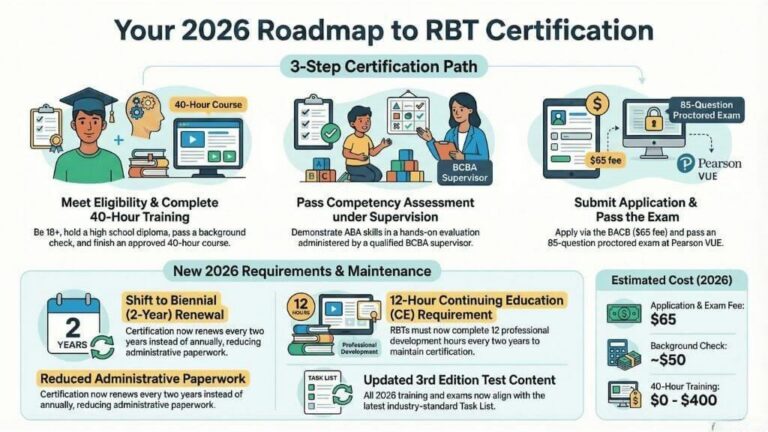
BCBAs and BCaBAs need continuing education to maintain certification, and as of 2026, RBTs also have ongoing professional development requirements.
That doesn’t mean you can upload anything and expect people to buy it.
But it does mean you’re not trying to convince an entire market that continuing education matters.
The market already exists.
Pricing varies substantially, but many individual CEUs fall somewhere between free and approximately $15-$20.
Free CEUs can be excellent audience-building tools. They introduce people to your expertise, grow your email list or community, and give someone a reason to experience your teaching before buying something else.
Paid CEUs compensate you for the expertise, research, creation, and systems behind the content, and can fund the creation of the next asset.
This isn’t necessarily a big-ticket business.
It can be a volume business.
And that makes the math interesting.
Could You Sell a $10 CEU to 10 People?
Imagine your technology costs approximately $100 per month.
Could you create one useful $10 CEU and sell it to 10 people each month?
For most clinicians with meaningful expertise and a willingness to learn basic marketing, that doesn’t feel particularly outrageous.
You’ve covered the hypothetical platform expense.
Now what happens when you have five CEUs?
Ten?
Twenty?
I have more than 100.
That’s where the economics change.
Instead of constantly asking, What can I sell this month?, you’re building a library of intellectual property that continues to exist after the initial work is complete.
One CEU can be a small side project.
A growing library can become an income stream.
The RBT Market Just Got More Interesting
There’s another reason I think this is an interesting time to develop these skills: Under the BACB’s 2026 requirements, RBTs now complete ongoing professional development as part of their two-year recertification cycle.
That includes 12 hours of qualifying professional development.
For ACE Providers, that creates another population of professionals looking for high-quality educational content.
RBT PDUs aren’t simply interchangeable with BCBA CEUs, and providers need to understand the specific BACB requirements for offering qualifying RBT professional development.
But zoom out for a moment.
There are a lot of professionals in this field who need ongoing education.
They’re going to spend time somewhere learning.
They’re going to learn from someone.
The opportunity isn’t simply to become another person selling CEUs.
It’s to become someone creating education worth consuming.
Your First CEU Is an Asset
This is the shift I want entrepreneurial BCBAs to understand.
You can create one CEU, present it once, collect a speaker fee, and move on.
Or you can think differently about what you’ve created.
You built intellectual property.
You can present it live.
You can offer an on-demand version.
You can build another CEU that solves the next problem.
You can eventually create bundles, libraries, memberships, conferences, organizational offerings, or other products around your expertise.
In the span of a few years, I’ve created more than 100 CEUs that now produce meaningful income.
And that income gives me something that’s harder to quantify: capacity.
Capacity to choose what I work on.
Capacity to disseminate ideas I care about.
Capacity to create something new without needing every hour of my calendar attached to revenue.
That’s why I don’t think the real opportunity is making $10 from a CEU.
The opportunity is learning how to turn what you know into an asset.
“We’re often confusing information with value. If instead we created a path toward an outcome, result, or solution, we would have tons more value.” – Mellanie Page, Founder, Clinical Boss
Start With One
You don’t need to create 100 CEUs.
You need to create the first one.
Find the intersection of your passion, a painful problem, and your proficiency.
Get painfully clear about the problem you’re solving.
Reverse engineer the path.
Teach fewer concepts.
Make people think.
Equip their hands.
Then put the systems behind your expertise that keep it working when you’re no longer in the room.
If you haven’t explored becoming an ACE Provider, start by reviewing the current BACB ACE Provider requirements.
If you’re interested in learning how to create and sell CEUs or PDUs, join the free Clinical Boss community for ACE Providers and start learning how to turn your expertise into an income stream. You can also explore CEU platforms and storefronts such as CEU Lab to see what it would actually take to get your first training online.
You probably don’t need another degree before you have something valuable to teach.
You might just need to clarify the problem you already know how to solve.
AT A GLANCE
The path from expertise to passive CEU income:
| 1. Find the problem: | Look for the intersection of passion, a painful problem, and proficiency. |
| 2. Get specific: | Don’t teach a broad topic. Solve a recognizable problem. |
| 3. Explore ACE Provider status: | Review the current BACB eligibility and compliance requirements. |
| 4. Build backward: | Start with the outcome and teach no more than three major concepts whenever possible. |
| 5. Use the CEU framework: | Make your training Clear, Engaging, and Useful. |
| 6. Equip their hands: | Give participants something they can actually use: scripts, worksheets, checklists, guides, or resources. |
| 7. Test before scaling: | Let a small group identify gaps and blind spots. |
| 8. Automate delivery: | Your technology should handle as much of the purchase, training, participation, and documentation process as possible. |
| 9. Build a library: | One CEU creates income. A growing collection creates assets that can compound over time. |
| The economics question: | If your technology costs $100 per month, could you sell a $10 CEU to 10 people each month? |
| The real opportunity: | Don’t just sell information. Build intellectual property that continues creating impact and income when you’re not in the room. |
SOURCES & REFERENCES
| 1. | Behavior Analyst Certification Board. “ACE Provider Handbook 2026.” Requirements effective July 1, 2026. https://www.bacb.com/wp-content/uploads/2025/08/ACE-Provider-Handbook-2026_260424-a.pdf |
| 2. | Behavior Analyst Certification Board. “Authorized Continuing Education (ACE) Providers.” https://www.bacb.com/authorized-continuing-education-providers/ |
| 3. | Clinical Boss. “CEU Lab Community for ACE Providers.” https://learn.clinicalboss.com/communities/groups/ceu-lab/home?invite=6a977008dcb0beb32f9d6732 |
| 4. | CEU Lab. “Products.” https://ceulab.com/products |







Join the discussion ▾