

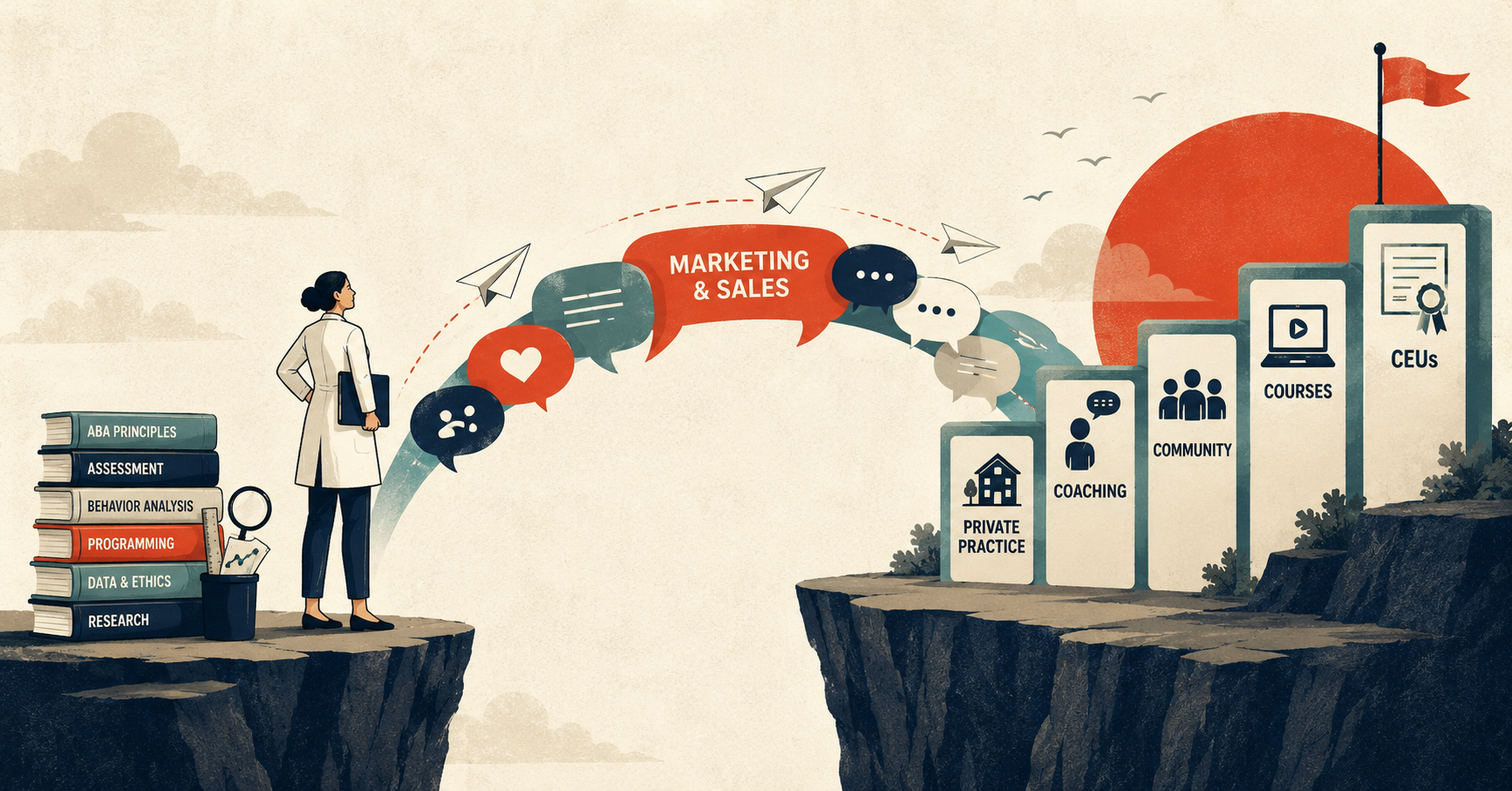
If you’ve typed “what can BCBAs do besides ABA” into Google at 11pm, you already know the problem with the answers. Most lists give you jobs. Clinical Director. Case manager. Maybe “consultant,” with zero explanation of what that means or how you’d land your first client.
These are five paths clinicians are actually building right now, outside the therapy room, using the same skill set that got you certified. None of them require a new degree. All of them require something most of us were never trained in.
Escaping the Insurance Model, Without Leaving the Field
Private practice is the least “unexpected” path on this list. It’s the one most clinicians think about when they consider alternative career options. For this transition, you’re simply changing who pays for the services you already provide.
For some clinicians, it starts small: private-pay sessions added alongside an existing job, filling the gaps insurance won’t cover or the client’s insurance won’t take. For others, it becomes the whole plan, a full-time or part-time pivot away from the insurance model entirely.
There are a few reasons private work can be such a natural transition. You can choose how many clients you take on while keeping your full-time job. A small caseload of private-pay clients also gives you the perfect opportunity to develop, test, and refine your framework. And perhaps most importantly, attracting private-pay clients is evidence that people are willing to pay you to solve a specific problem, whether or not there’s a diagnosis or insurance funding to cover it.
The honest part: most people who go this route already have everything they need clinically. What stalls them is not knowing how to price themselves, get new clients, or market their services without stumbling on their words.
Selling Access to What You Know
This one confuses people at first because it sounds like a generalist role, but it’s quite the opposite when done right. BCBAs are building coaching and consulting businesses in health and wellness, habit development, leadership, parent coaching, and organizational consulting, applying the same behavior change principles you use with clients to adults who will never qualify for traditional services.
Behavior analysis can be applied in so many contexts and across a broad range of clients. The issue? Clinicians have become so reliant on insurance funding and pediatric referral pipelines that they rarely explore the opportunity to solve different human behavior problems with the same expertise.
Instead of billing session by session, you’re selling access to your expertise directly. That’s a real transition. It’s still built on what you know, but now you’re the product, and that means learning to talk about what you do in a way that makes someone want to pay you for it.
Building a Room Instead of a Product
This one surprises people the most, because it doesn’t look like starting a business at first. It looks like a group.
Clinicians are building paid communities around a shared clinical interest like feeding, telehealth, early intervention, or around a shared transformation, like caregivers raising teens with ADHD or teachers interested in using behavior science in the classroom.
These communities are perfect for introverted and entrepreneurial clinicians (yes, you can be both) and can start with gathering and connection, before asking anyone for a single dollar.
The appeal is that you don’t need a polished product to start. You need people who want to be in the room with each other, and a reason for them to stay.
Meghan Edwards, a member inside the Clinical Boss program, has doubled her community of school-based BCBAs in less than a year by learning how to get specific about who she is talking to, the problem she solves, and her value proposition. Strong marketing and systems did the rest.
Getting Paid for Your Knowledge When You’re Not in the Room
Building a course or program is where you start productizing what you know instead of selling your time. A course exists whether you’re actively working or not, which is a truly passive income stream once it’s built and the right systems are in place.
BCBAs are building courses for families who need help with bedtime routines or managing meltdowns, and specialized programs around feeding, sleep, toileting, and other specific, highly painful problems parents are already Googling at midnight.
Packaging your expertise for the first time can get tricky. Most clinicians want to share everything they know, and it’s easy to scope creep. The goal of a course or program is to deliver reliable results.
Start with coaching and consulting to refine your process with multiple clients before transferring it to a course curriculum.
The tradeoff is upfront effort. You’re not paid for your time anymore; you’re paid for the value of what you built, which means the work happens before the money does, not after.
“We think the bridge to more opportunity is more information. It isn’t. It’s marketing and sales, and most clinicians confuse that with manipulation the moment they hear it.”
— Mellanie Page, Founder, Clinical Boss
The Easiest Entry, but Highest Administrative Burden
Creating CEUs is the easiest opportunity to start on this list, and I want to be clear about what “easy” actually means before anyone runs off assuming it’s simple.
Becoming an ACE provider is relatively straightforward and inexpensive. Maintaining ACE requirements, however, is a real process. Documentation, event standards, ongoing compliance. The value of this path is that it’s aligned with most clinicians’ skill sets, more accessible than most clinicians assume, and you do not need a company behind you or a team to get started.
One of the core challenges: the market has already decided what CEUs are worth, and it isn’t much. Most CEU content sells somewhere between free and $20. That means this is not a big-ticket business. It’s a volume game. You are not building a product you sell to a handful of people for a lot of money. You are building something you sell to a lot of people for a little money, over and over.
That changes what “passive” actually requires. The income can genuinely become passive: content built once, sold on repeat, but only if your tech setup is doing the work. Without it, you are the tech setup. You’re the one verifying attendance, chasing down who actually watched the training, collecting names and certificant numbers by hand, and generating certificates one at a time whenever someone finishes a course. At volume, that is not passive.
The Skill Gap Nobody Talks About
Every one of these paths requires a skill that goes beyond clinical training, and it’s not the skill most of us feel excited to learn about initially.
We’re trained to believe more information is the answer. Another certificate. Another degree. If I just know more, we tell ourselves, the opportunities will follow.
They won’t. Not on their own.
What most clinicians actually need to build any of these five paths is marketing and sales. And I’ve talked to enough clinicians to know exactly what you’re thinking and feeling when you read that sentence. You hear “sales” and think manipulation. Coercion. Convincing someone to buy something they don’t need.
That’s not what skillful marketing is. Done right, it’s the same clinical skill you already have: identifying a real problem and offering a real solution to the person who actually needs it. The difference is you’re doing it out loud, publicly, instead of one client at a time in a session.
Most clinicians reading this could start today. Not after another course. Not after another certificate. The skill gap isn’t clinical knowledge. It’s learning to talk about what you know in a way that reaches the people who need it. That’s the whole leap, and most of us are overthinking it far more than necessary.
If one of these five paths is pulling at you and you’re not sure which one fits how you think and work, I built a free quiz to help you figure that out: [Expert Era Quiz link].
AT A GLANCE
Five paths, ordered by effort to start:
| 1. Private Practice: | Same clinical service, different payer. Lowest lift. |
| 2. Coaching or Consulting: | Sell access to your expertise directly, not by the session. |
| 3. Community: | Build a room around a shared interest or shared transformation. |
| 4. Courses and Programs: | Package your knowledge into something that sells without you in the room. |
| 5. Creating CEUs: | Easiest entry, highest administrative burden. A volume game at free – $20 price points that only becomes passive with the right tech behind it. |
| 6. The real skill gap: | Not clinical knowledge. Marketing and sales. |







Join the discussion ▾