
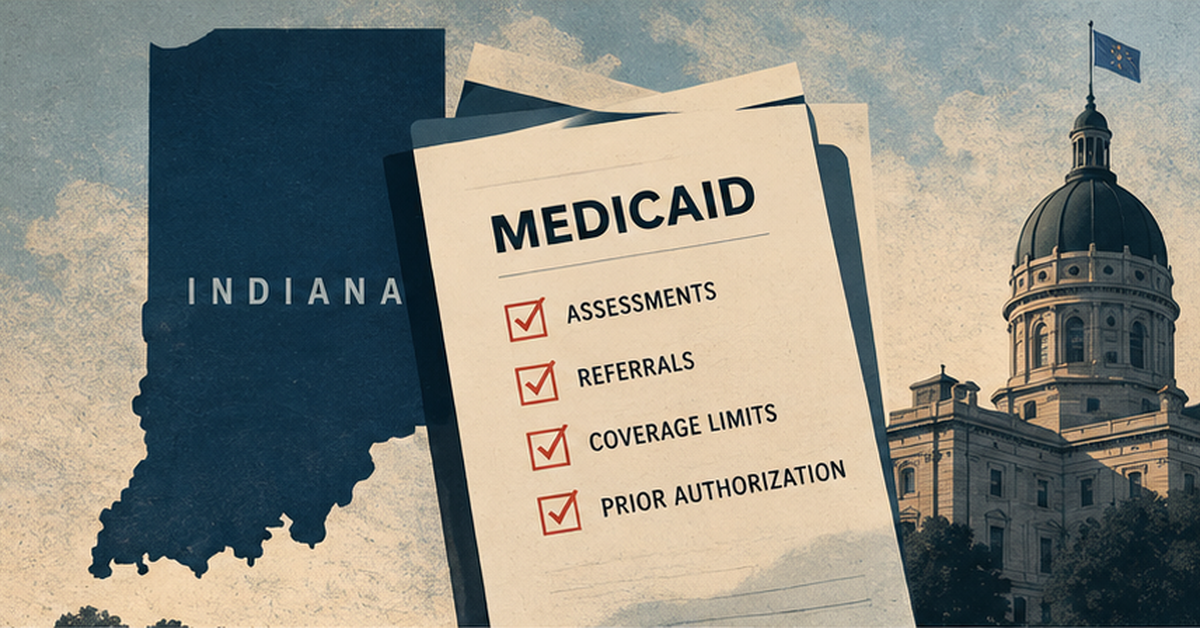
INDIANAPOLIS – Indiana Medicaid told applied behavior analysis (ABA) clinics on Sept. 29 that children in therapy “must not be kept awake or woken up by physically moving them, forcing them to engage in activities, tickling or other efforts.” The nap policy is one of four new bulletins addressing ABA or prior authorization, issued two days before the Oct. 1 cutoff for covering ABA services for members 21 and older.
A second bulletin requires a complete functional behavior assessment, starting Oct. 29, for each behavior targeted in a behavior intervention plan. A third clarifies that a board-certified behavior analyst (BCBA) credential alone does not qualify a practitioner to complete the statement of need, or referral for ABA. The fourth ends peer-to-peer reviews on Nov. 1 for prior-authorization requests in Traditional Medicaid, the fee-for-service program.
The policies follow broader changes to Indiana’s ABA benefit. A state working group reported in November 2025 that Medicaid ABA spending rose from $21 million in 2017 to $611 million in 2023, then fell to $445 million in 2024. Rules effective April 1 set a 4,000-hour lifetime allotment for comprehensive ABA, with additional comprehensive therapy covered when a further review finds it medically necessary. Targeted therapy remains available to eligible members for up to 15 hours weekly, and school corporation services are exempt from the allotment. The rules also cut maximum nongroup rates by 6% and required an hour of clinical supervision for every eight hours of technician-delivered therapy. On June 6, the state began an initial six-month enrollment moratorium for new ABA groups and ownership changes, with limited exceptions to protect access.
Chrissy Barosky, chief clinical officer of Bierman Autism Centers, wrote in an Oct. 1 column in the Indiana Capital Chronicle that the lifetime limit and new supervision requirements “are poised to leave many children without medically necessary care.”
The Sept. 29 bulletins address assessments, referrals, and children’s need for sleep. More than 8,000 Hoosiers, most ages 3 to 8, relied on Medicaid for ABA in November 2025, the Capital Chronicle reported.
An Assessment Behind Every Behavior Plan
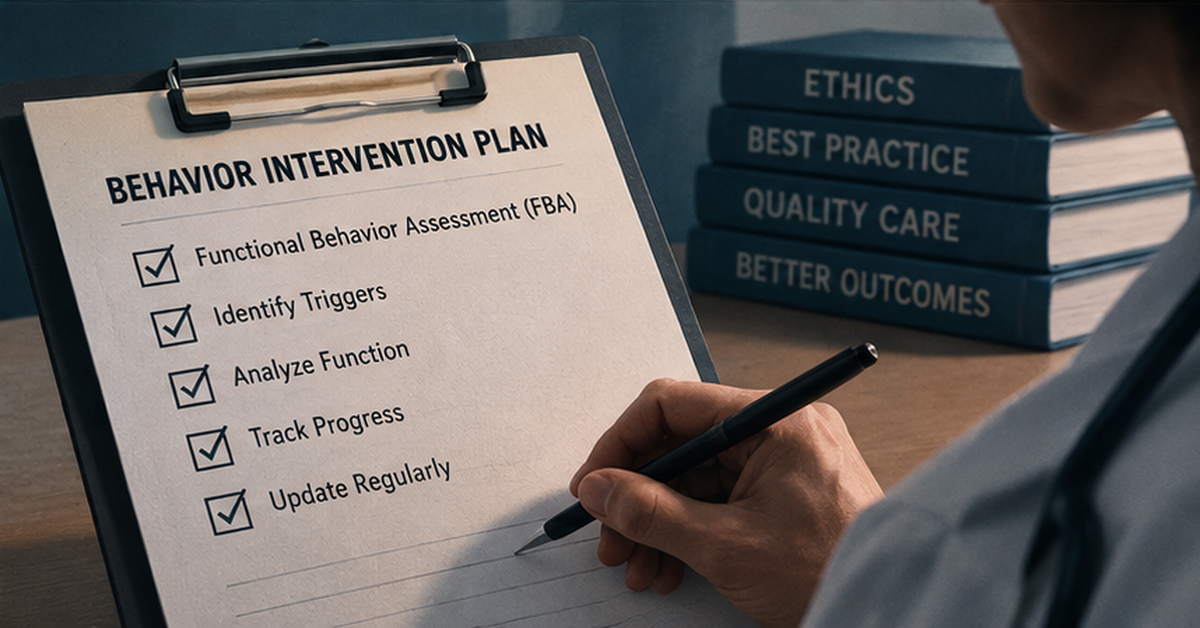
A behavior intervention plan is the part of a treatment plan aimed at reducing challenging behavior. Starting Oct. 29, each behavior it targets needs a complete functional behavior assessment, or FBA. The assessment identifies the behavior’s likely function so the plan can teach a replacement that serves the same purpose. The state says it has received reports of treatment plans containing a behavior intervention plan without an FBA.
Each assessment must use at least one of six listed questionnaires or interviews with a parent, guardian, or registered behavior technician and include the original responses and graphed results. It must document what happens before, during, and after the behavior, identify triggers and warning signs when applicable, and explain the behavior’s suspected function. Providers must update it at each reauthorization, typically every six months. They decide whether a separate functional analysis is needed.
The bulletin cites the profession’s ethics code and calls an FBA “standard clinical practice.” It specifies the required assessment components and tools, and requires the behavior plan to change when the behavior’s function changes, interventions become ineffective, or the assessment identifies a different function.
Who Can Sign the Referral
The referral bulletin, which the state calls a clarification, treats the statement of need and the referral as the same document. It must come from a licensed physician, advanced practice registered nurse, physician assistant, or doctoral-level licensed clinical psychologist endorsed as a health service provider in psychology. Each must have specialized training in applying the latest autism diagnostic criteria. The bulletin excludes master’s-level BCBAs, bachelor’s-level assistant behavior analysts, physical therapists, speech-language pathologists, and occupational therapists.
A referral is required when therapy begins with a diagnostic evaluation more than a year old, at reauthorization when an evaluation becomes more than a year old, and with each new authorization request after a six-month gap in services. Referrals are not otherwise required at every reauthorization or annually.
A February 2025 FAQ already identified the four professions authorized to refer a patient for ABA. May 2025 guidance required a statement of need to include both a referral and the clinic’s current behavior assessment. The new bulletin treats the statement of need as the referral itself; reassessment and an updated treatment plan remain due at least every six months. It does not specify a course or credential for the required autism diagnostic training.
Naps Are Unbillable, and Now Protected
The nap bulletin cites “media reports” that children receiving ABA “are only permitted to nap for seven minutes at a time, if at all.” It identifies no outlet or provider. In May, The New York Times reported that Compleat Kidz, a North Carolina chain, capped naps at seven minutes. The company told the Times the rule prevented fraud because clinics could be paid only when children were awake and receiving services.
Under Indiana’s policy, providers must allow needed naps even though that time is not billable. They must follow age-based American Academy of Pediatrics sleep guidance, coordinate with parents or guardians, and include needed naps in the treatment schedule. If naps become necessary during an authorization period, the plan must record their duration, when the need began, and subsequent changes, and explain any resulting reduction in technician-delivered therapy. The bulletin permits waking a child after an appropriate nap but prohibits physically moving the child to do so. It sets no fixed nap length; AAP guidance addresses total sleep over 24 hours, including naps.
“Members must not be prevented from napping during ABA therapy hours due to it being nonbillable time.” – Indiana Medicaid
When medical conditions affect sleep, providers must coordinate with the child’s primary care provider and parents or guardians and document the plan. They must also adjust therapy schedules when children are repeatedly sent home to nap. Neither the nap bulletin nor the referral clarification states a separate effective date.
Traditional Medicaid Ends Peer-to-Peer Reviews
The fourth bulletin reaches beyond ABA. Starting Nov. 1, Traditional Medicaid will stop offering peer-to-peer reviews on prior-authorization requests. These optional discussions supplement the formal review and appeal process and can currently occur alongside it. Providers will instead use the existing administrative review and appeal procedures. The bulletin provided no reason for the change.
The change applies to Traditional Medicaid; managed care plans use their own authorization processes. The bulletin leaves members’ appeal rights unchanged.
For ABA and other nonpharmacy requests, a provider disputing a denial or modification must submit a written request for administrative review within seven business days of receiving notice. The program’s prior-authorization medical director or a designee decides the review. A provider challenging that decision may request a hearing through the Office of Administrative Law Proceedings within 33 calendar days of the administrative review decision. Peer-to-peer scheduling ends Oct. 31.
AT A GLANCE
| Bulletins covered: | Four issued Sept. 29, 2026, addressing naps, referrals, peer-to-peer reviews, and functional behavior assessments |
| Age cutoff: | No Medicaid authorization or reimbursement for ABA services provided to members 21 or older on or after Oct. 1, 2026 |
| Assessment rule: | A complete FBA for each behavior targeted by a behavior intervention plan, updated at every reauthorization; effective Oct. 29, 2026 |
| Who may sign the referral: | A physician, advanced practice registered nurse, physician assistant, or doctoral-level clinical psychologist with a health service provider endorsement; all must be licensed and have specialized autism diagnostic training. BCBA certification alone is insufficient. |
| Naps: | Needed naps must be allowed despite being unbillable. Clinics may not keep children awake or wake them by moving them, forcing activities, tickling, or similar efforts. |
| Effective-date detail: | The Sept. 29 nap and referral bulletins state no separate effective date. |
| Peer-to-peer reviews: | End Nov. 1, 2026, in Traditional Medicaid; scheduling ends Oct. 31. For nonpharmacy requests, providers have seven business days from receipt of a denial or modification notice to request administrative review. |
SOURCES & REFERENCES
| 1. | Indiana Health Coverage Programs. IHCP Bulletin BT2026159, “IHCP announces policy for sleeping and naps during ABA therapy.” Sept. 29, 2026. https://www.in.gov/medicaid/providers/files/bulletins/BT2026159.pdf |
| 2. | Indiana Health Coverage Programs. IHCP Bulletin BT202627, “IHCP announces changes to applied behavior analysis (ABA) therapy services.” Feb. 26, 2026. https://www.in.gov/medicaid/providers/files/bulletins/BT202627.pdf |
| 3. | Indiana Health Coverage Programs. IHCP Bulletin BT2026162, “IHCP requires functional behavior assessments for ABA therapy and behavior intervention plan.” Sept. 29, 2026. https://www.in.gov/medicaid/providers/files/bulletins/BT2026162.pdf |
| 4. | Indiana Health Coverage Programs. IHCP Bulletin BT2026160, “IHCP clarifies ABA therapy requirements related to statement of need and referrals.” Sept. 29, 2026. https://www.in.gov/medicaid/providers/files/bulletins/BT2026160.pdf |
| 5. | Indiana Health Coverage Programs. IHCP Bulletin BT2026161, “Update to prior authorization process: Peer-to-peer reviews ending Nov. 1, 2026.” Sept. 29, 2026. https://secure.in.gov/medicaid/providers/files/bulletins/BT2026161.pdf |
| 6. | Indiana Family and Social Services Administration. “Executive Order 25-31 Applied Behavior Analysis (ABA) Working Group Recommendations.” Nov. 12, 2025. Spending history, p. 5. https://www.in.gov/fssa/files/EO-25-31_ABA-Work-Group-Recs.pdf |
| 7. | Indiana Health Coverage Programs. IHCP Bulletin BT202692, “IHCP receives approval for an ABA provider enrollment moratorium.” June 4, 2026. https://www.in.gov/medicaid/providers/files/bulletins/BT202692.pdf |
| 8. | Barosky, Chrissy. “Indiana children with autism can’t become a casualty of Medicaid challenges.” Indiana Capital Chronicle (commentary). Oct. 1, 2026. https://indianacapitalchronicle.com/2026/10/01/indiana-children-with-autism-cant-become-a-casualty-of-medicaid-challenges/ |
| 9. | Bonilla Muñiz, Leslie. “Governor’s group recommends ABA usage cap, rate changes as Medicaid costs rise.” Indiana Capital Chronicle. Nov. 12, 2025. https://indianacapitalchronicle.com/2025/11/12/governors-group-recommends-aba-usage-cap-rate-changes-as-medicaid-costs-rise/ |
| 10. | Indiana Health Coverage Programs. IHCP Bulletin BT202519, “IHCP publishes formal FAQ for ABA therapy requirements.” Feb. 6, 2025. https://www.in.gov/medicaid/providers/files/bulletins/BT202519.pdf |
| 11. | Indiana Health Coverage Programs. IHCP Bulletin BT202562, “IHCP issues updated guidance for FFS and managed care ABA therapy prior authorizations.” May 15, 2025. https://www.in.gov/medicaid/providers/files/bulletins/BT202562.pdf |
| 12. | Kliff, Sarah, and Margot Sanger-Katz. “Short Naps, Long Hours: How Autism Clinics Squeeze Medicaid Dollars Out of Preschoolers.” The New York Times, May 23, 2026; republished by WRAL June 11, 2026. https://www.wral.com/news/ap/health-autism-therapy-clinics/ |
| 13. | Indiana Health Coverage Programs. IHCP Bulletin BT202368, “Kepro transition begins July 1; additional Atrezzo Provider Portal benefits announced.” June 20, 2023. Peer-to-peer process, p. 2. https://www.in.gov/medicaid/providers/files/bulletins/BT202368.pdf |
| 14. | Indiana Health Coverage Programs. “Prior Authorization.” Provider Reference Module, Version 7.3. Published Sept. 29, 2026. Provider reviews and appeals, pp. 23–25. https://www.in.gov/medicaid/providers/files/modules/prior-authorization.pdf |
| 15. | American Academy of Pediatrics. “Healthy Sleep Habits: How Many Hours Does Your Child Need?” HealthyChildren.org. Updated Aug. 7, 2026. https://www.healthychildren.org/English/healthy-living/sleep/Pages/healthy-sleep-habits-how-many-hours-does-your-child-need.aspx |








Join the discussion ▾