

DENVER – Colorado Medicaid is proposing age-based thresholds for weekly ABA hours, with additional clinical justification required for more intensive treatment. The Department of Health Care Policy and Financing (HCPF) draft sets 25 hours for children ages 18 months through 5, 16 hours for ages 6 through 12, and 10 hours for ages 13 through 20. The amounts “are not an absolute limit or hard cap,” the draft says. All requested hours must be medically necessary; requests above the thresholds must explain the extra hours’ therapeutic purpose and why the child’s needs cannot be met within those amounts.
The proposal covers pediatric behavioral therapy, including ABA. It would require supervisors to directly observe technicians delivering services and include live supervision, in person or by live video. Reviewing recordings and data afterward could supplement that oversight but could not replace it.
The draft lists 12 categories Medicaid would not cover, including custodial nap and lunchtime, services delivered by a parent or guardian, academic tutoring, and technician supervision conducted remotely without direct observation. Providers could not recommend withdrawing a child from school, reducing required attendance, or switching to home instruction solely to fit their preferred treatment schedule.
HCPF has scheduled a second stakeholder meeting for Tuesday, Sept. 22, from 2:30 to 4 p.m. Mountain time on Zoom. The department says the proposal will then proceed through regular rulemaking before the Medical Services Board.
What Else the Draft Would Require
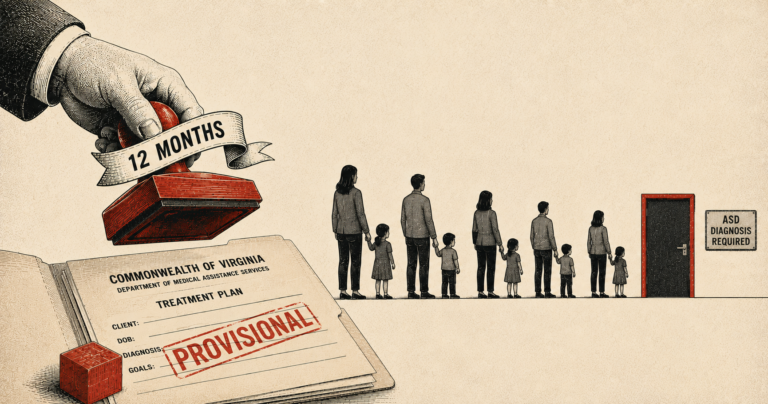
The draft would retain prior authorization for all services and approvals lasting no more than six months. Requests would need an assessment or reassessment performed within two months, a treatment plan developed or updated within two months, and an order, prescription, or referral completed within 12 months by an eligible physician, physician assistant, nurse practitioner or licensed psychologist. Plans would identify criteria for continuing, reducing, or ending services and estimate the episode of care’s duration. Centers for Medicare & Medicaid Services (CMS) guidance permits hour thresholds only with individualized review and coverage of additional medically necessary care under Medicaid’s children’s benefit.
“A provider shall not require or recommend that a member withdraw from school, reduce required school attendance, or receive home instruction solely to accommodate a provider’s preferred treatment schedule.” – HCPF’s draft pediatric behavioral therapy rule
Technicians would need certification from the Behavior Analyst Certification Board, the Qualified Applied Behavior Analysis Credentialing Board, or another entity recognized by the state licensing board with nationally accredited credentialing programs. The draft uses state licensing titles for supervisors, although individual licensure will not become mandatory until July 1, 2028, under the law Gov. Jared Polis signed June 2. It includes no express transition provision.

Other exclusions include life coaching, vocational rehabilitation, etiquette goals, experimental therapies, and administrative supervision. The draft distinguishes custodial care from treatment: developing, restoring, or maintaining self-help, daily-living, or safety skills under a treatment plan would remain covered. Supervising a nap or meal as custodial care would not.
An earlier certification proposal stalled before the Medical Services Board. At its Dec. 12, 2025 hearing, six Action Behavior Centers representatives spoke. Bryan Davey supported certification but asked for a supervised grace period for technicians in training. Jennifer Miles of Frontline Public Affairs said the three accepted certifications had not been announced until Oct. 31 and urged a Feb. 1 deadline.
The Colorado Association for Behavior Analysis requested a no vote. The board tabled the proposal. In its February bulletin, HCPF said the Dec. 12 certification deadline was “no longer in effect” and that a new date would be announced. The current draft retains certification and includes a conditional 45-day billing period while technicians pursue it.
CMS’s nonbinding ABA toolkit, released Aug. 4, says 40 hours of ABA a week “is not a best practice,” citing audit risks and the need for daily-living breaks. It does not reduce states’ obligation to cover medically necessary care for children. Arizona proposed additional documentation above 25 weekly hours, or 15 for full-time students; Colorado would instead vary its thresholds by age.
Separately, the Colorado Department of Human Services says operating ABA clinics must obtain facility licenses by Aug. 1, 2027, under the June law, 11 months before individual licensure becomes mandatory.
What Happens Next
HCPF and its authorization-review contractor, Acentra Health, are already reminding providers about documentation requirements. HCPF’s September bulletin encourages authorization requests 14 to 21 days before the requested start date. It says plans using cognitive behavioral therapy, social stories, mindfulness, yoga, sensory diets, or weighted blankets as primary interventions need clear clinical and behavioral justification. The bulletin expressly says these approaches are not automatically prohibited or excluded from coverage. Providers must connect them to assessed needs, measurable goals, and progress measures; insufficient documentation can lead to additional review or denial.
The Sept. 22 session, “Rule Edits and Questions,” is the final meeting in the two-part series HCPF announced. The department plans to take the proposal through regular rulemaking, including two public readings before the Medical Services Board. As of Sept. 18, HCPF had not announced a board hearing date. The proposal was absent from the Sept. 11 agenda, and the draft specifies no effective date. The remaining 2026 board meetings are Oct. 9 in Limon, Nov. 13 and Dec. 11.
AT A GLANCE
| Proposed weekly hours: | 25 hours weekly for ages 18 months through 5; 16 for ages 6 through 12; 10 for ages 13 through 20. Additional medically necessary hours could be authorized with clinical justification. |
| Authorization: | Prior authorization for all services; approvals up to six months. Assessment or reassessment and treatment-plan development or update within two months; order, prescription or referral within 12 months. |
| Supervision: | Direct observation and live supervision, in person or by live audio-video. Reviewing recordings and data alone would not satisfy the requirements. |
| Not covered: | 12 categories, including custodial nap and lunch time, services by a parent or guardian, academic tutoring and experimental therapies. Treatment of daily-living skills would remain covered. |
| School hours: | Providers could not recommend leaving school, reducing required attendance or home instruction solely to fit their preferred schedule. Treatment during school hours would need documented medical necessity. |
| Records and grace period: | Records within 15 calendar days unless the written request sets another deadline. A conditional 45-day billing period for technicians pursuing certification; billing afterward would require certification or separate department authorization. |
| Audit backdrop: | OIG estimated at least $77.8 million in improper and $207.4 million in potentially improper payments among $289.5 million in payments covered by its 2022–23 audit. Colorado disputed the $42.6 million federal refund recommendation. |
| Emergency rule: | The Medical Services Board tabled the technician-certification proposal on Dec. 12, 2025. HCPF’s February bulletin said the old certification deadline was no longer in effect. |
| Next steps: | Stakeholder meeting: Sept. 22, 2026, 2:30–4 p.m. Mountain time, via Zoom. Remaining 2026 board meetings: Oct. 9 in Limon, Nov. 13 and Dec. 11. The draft specifies no effective date. |
SOURCES & REFERENCES
| 1. | Colorado Department of Health Care Policy and Financing (HCPF). 8.281 Pediatric Behavioral Therapy. Current draft linked with Aug. 31, 2026 stakeholder materials; reviewed Sept. 18, 2026. https://docs.google.com/document/d/1wKzJzWCRkSgKZFC2OS6_3kmZ0ZN1em_FNis4eFWf5HI/view |
| 2. | HCPF. Complete Rules: Pediatric Behavioral Therapy (PBT) Meeting. Meeting materials and Sept. 22 schedule; accessed Sept. 18, 2026. https://hcpf.colorado.gov/PBT-rulemaking-meetings |
| 3. | HCPF. Pediatric Behavioral Therapies. Current prior-authorization requirements; accessed Sept. 18, 2026. https://hcpf.colorado.gov/pediatric-behavioral-therapies |
| 4. | Centers for Medicare & Medicaid Services (CMS). Early and Periodic Screening, Diagnostic, and Treatment (EPSDT) Guide for States: Coverage in the Medicaid Benefit for Children. May 2026, pp. 19–21. https://www.medicaid.gov/medicaid/benefits/downloads/epsdt-coverage-guide.pdf |
| 5. | Colorado General Assembly. HB26-1425, Applied Behavior Analysis Services. Signed June 2, 2026; 2026 Session Laws, Chapter 299, enacted text. https://leg.colorado.gov/laws/session-laws/HB26-1425/299/download |
| 6. | The Denver Post. Colorado is proposing major changes to autism therapy — and families are worried. Full republication by the Colorado Association of Health Plans, March 25, 2026. https://colohealthplans.org/colorado-is-proposing-major-changes-to-autism-therapy-and-families-are-worried/ |
| 7. | U.S. Department of Health and Human Services, Office of Inspector General (HHS-OIG). Colorado Made at Least $77.8 Million in Improper Fee-for-Service Medicaid Payments for Applied Behavior Analysis Provided to Children. A-09-24-02004. Feb. 25, 2026. https://oig.hhs.gov/documents/audit/11493/A-09-24-02004.pdf |
| 8. | HHS-OIG. Audits of Medicaid Applied Behavior Analysis for Children Diagnosed With Autism. Work Plan SRS-A-25-029; completed Colorado, Indiana, Maine and Wisconsin reports. Accessed Sept. 18, 2026. https://oig.hhs.gov/reports/work-plan/browse-work-plan-projects/srs-a-25-029/ |
| 9. | Colorado Medical Services Board. Minutes of the Dec. 12, 2025 meeting, pp. 5–6. https://hcpf.colorado.gov/sites/hcpf/files/Dec%20Minutes%20-%20Jan%202026.pdf |
| 10. | HCPF. Health First Colorado Provider Bulletin B2600534. February 2026, p. 14, Compliance Update — Registered Behavior Technician (RBT) Certification Requirement. Official Colorado State Publications Library copy: https://spl.cde.state.co.us/artemis/hcpserials/hcp613internet/hcp613202602internet.pdf |
| 11. | CMS. State Medicaid & Children’s Health Insurance Program Applied Behavior Analysis Toolkit. August 2026, p. 36. https://www.medicaid.gov/medicaid/downloads/autism-services-aba-toolkit.pdf — CMS Launches New State Toolkit to Protect Children with Autism, Strengthen Oversight of Applied Behavior Analysis Services. Aug. 4, 2026. https://www.cms.gov/newsroom/press-releases/cms-launches-new-state-toolkit-protect-children-autism-strengthen-oversight-applied-behavior |
| 12. | Arizona Health Care Cost Containment System. Applied Behavior Analysis (ABA) Services Updates for Providers (320-S AMPM). April 15, 2026, pp. 20–21. https://www.azahcccs.gov/Members/Downloads/BehavioralHealthServices/ABA_Policy_320-S_UpdatesForProviders.pdf |
| 13. | Colorado Department of Human Services, Family First in Colorado. ABA Clinic Resources. Facility licensing guidance; accessed Sept. 18, 2026. https://cofamilyfirst.org/tag/aba-clinic/ |
| 14. | HCPF. Health First Colorado Provider Bulletin B2600542. September 2026, pp. 8–11, Pediatric Behavioral Therapy (PBT) Provider Education Update. https://hcpf.colorado.gov/sites/hcpf/files/Bulletin%200926_B2600542_0.pdf |
| 15. | HCPF. Medical Services Board. Meeting procedures and 2026 schedule; accessed Sept. 18, 2026. https://hcpf.colorado.gov/medical-services-board — Sept. 11, 2026 agenda: https://hcpf.colorado.gov/sites/hcpf/files/MSB%20Agenda%20-%20Sep%202026.pdf |



Join the discussion ▾