

RICHMOND, VIRGINIA – Virginia’s 2026 budget directed the state’s Medicaid agency to require an autism diagnosis for applied behavior analysis (ABA), subject to federal approval and exceptions. Draft rules would add a requirement the budget did not specify: an in-person diagnostic evaluation using an evidence-based tool, such as the Autism Diagnostic Observation Schedule (ADOS).
The budget also directed a 20-hour weekly limit, with additional hours available through Early and Periodic Screening, Diagnostic, and Treatment (EPSDT) review. This Medicaid benefit requires coverage of medically necessary services available under federal Medicaid law for eligible children under 21. The draft sets out the documentation needed to seek more hours.
State data show the potential reach of the changes. About 1,200 children receiving Medicaid ABA in 2025 had no autism diagnosis recorded in the data presented by the state, and many young children received more than 20 hours in at least one week.
As of Nov. 3, the draft remained under review on Virginia Regulatory Town Hall. The Department of Medical Assistance Services (DMAS) had listed Oct. 22 as its planned effective date, the day after comments closed. The website says the agency “is considering feedback” and has not decided whether to confirm or delay the changes. DMAS told providers in July that the authorization process would remain unchanged until approval from the Centers for Medicare & Medicaid Services (CMS) and completion of the manual.
What the Draft Would Change
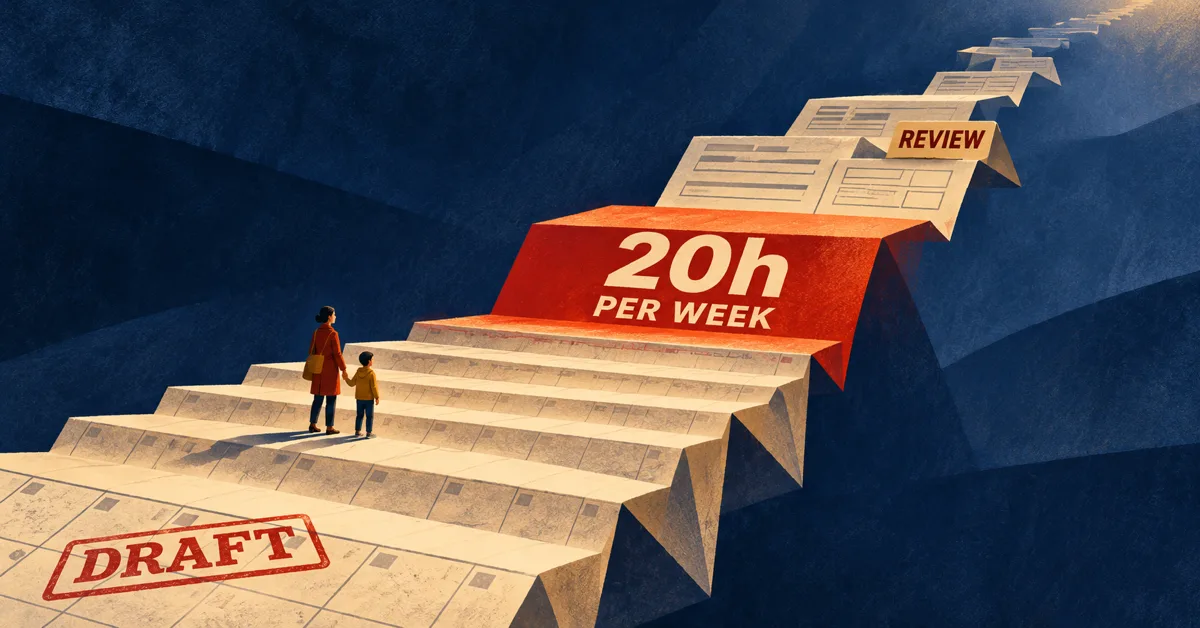
Hours. The current manual sets no weekly cap, but all hours require medical necessity approval, and requests above 20 hours must include an individualized schedule linking sessions to treatment goals. Under the draft, ABA “may not exceed 20 hours per week, except as authorized under EPSDT review.” Requests above 20 hours would require that review and an individualized schedule.
Diagnosis. Current eligibility criteria allow a primary diagnosis corresponding to the Diagnostic and Statistical Manual of Mental Disorders (DSM) or a provisional psychiatric diagnosis, along with other clinical requirements. They do not require autism. The draft would require an autism diagnosis from a licensed mental health professional, based on an in-person evaluation using an evidence-based tool such as the ADOS. Documentation must identify the evaluator by name, credential, and National Provider Identifier (NPI). The current manual already requires a separate, in-person assessment of ABA needs. Neither the budget nor the proposed state plan amendment specifies in-person diagnostic evaluations or particular tools. The budget directs DMAS to issue documentation guidance and an ABA workgroup to review “standard assessment tools and diagnostic criteria.”
Young children. The current manual permits a provisional psychiatric diagnosis without a separate age cutoff within the under-21 benefit. The draft would limit provisional autism eligibility to children age 5 and under at admission, with proof that a full diagnostic evaluation is scheduled or that the child is on a waiting list. After six months without an evaluation, the provider would have to update that proof and document continued medical necessity. After 12 months without a final autism diagnosis, continued services would require EPSDT review, including evidence of ongoing clinical benefit.
The draft requires EPSDT review before denying any ABA service request, including requests above 20 hours or for children who do not meet its diagnostic criteria. That review does not guarantee approval. The budget separately exempts local educational agencies billing through the Medicaid fee-for-service school-based program from its new diagnosis and hours requirements.
Who the Rules Would Reach
The workgroup, which the budget charged with identifying strategies “to control costs while still preserving access to care,” held its first meeting Sept. 22. DMAS’s slides counted 10,766 children receiving Medicaid ABA in 2025, including 9,543 with a recorded autism diagnosis. Under the draft, children without a qualifying final or provisional autism diagnosis would need EPSDT review. The 2025 figures do not establish their current diagnostic status.
Sentara Health Plans reported that $11.3 million, or 12.2%, of its 2025 ABA payments went to claims with a primary diagnosis other than autism. ADHD was the largest such category. The slide cautioned that diagnosis coding “does not independently establish clinical indication or appropriateness.” A different primary diagnosis also does not establish that a child lacks autism. The slides did not specify whether Sentara’s figures covered only Medicaid members.
According to the slides, average weekly hours were highest among children 10 and under. For children age 4 and under, 55% appeared in the chart’s 21-to-38-hour weekly category and about 16% in its 38-or-more category at least once in 2025. For ages 5 to 10, the shares were 43% and about 10%. Children could appear in multiple categories, so the percentages cannot be added.
What Providers Told DMAS
A BreakingNewsABA review of the 62 public comments found no submission endorsing the draft without changes. Most came from ABA providers, their staff, and trade groups; three explicitly identified their authors as parents, and several gave no affiliation. The 20-hour provision drew widespread objections. Dozens of submissions asked DMAS to accept telehealth or hybrid diagnostic evaluations.
The Council of Autism Service Providers (CASP), a national trade group, asked DMAS to “clarify that 20 hours per week is a utilization-management threshold, not a limit on the amount of medically necessary ABA that may be covered.” The Virginia Association for Behavior Analysis (VABA) asked that the 20-hour measure count face-to-face time with the child, counting each hour once even when two staff members bill for it. Otherwise, it warned, a 20-hour treatment week with two hours of concurrent clinician direction “would register as 22 hours and trigger EPSDT review.” Mosaic Pediatric Therapy argued that the draft would presume additional hours were not medically necessary.
“The current standard asks whether more hours are medically necessary. The proposed standard presumes they are not.” – Callie Plattner, chief clinical officer, Mosaic Pediatric Therapy, in an Oct. 15 public comment
On diagnosis, the Virginia Association of Community-Based Providers wrote, “Evaluator waitlists are about one year; provide a grace period.” VABA asked DMAS to specify an EPSDT route for children without an autism diagnosis, including minimum documentation. Commenters also challenged two existing manual provisions: limiting school sessions to observation and collaboration, and requiring discharge after a service lapse of more than 31 consecutive calendar days.
Waiting on DMAS and CMS
The budget specified July 1 for the 20-hour limit but conditioned implementation on federal approval. In an Aug. 7 letter, Marvin B. Figueroa, Virginia’s secretary of health and human resources, asked CMS to approve the proposed state plan amendment “as quickly as possible.” DMAS filed amendment 26-018 on Aug. 17, requesting an Oct. 1 effective date. As of Nov. 3, no approval appeared in CMS’s database or DMAS’s approved-amendment list.
DMAS has said it will announce the effective date in a later notice. The workgroup is scheduled to meet online Nov. 10 at 10 a.m. The meeting notice lists a review of utilization-management data and a public comment period.
AT A GLANCE
| The draft: | Appendix D of DMAS’s Mental Health Services manual; published Sept. 21, 2026; comments closed Oct. 21 (62 submissions) |
| Status: | Town Hall still listed the draft as under review on Nov. 3; Oct. 22 was the planned effective date |
| Hours: | Proposed limit of 20 hours a week, with additional hours through EPSDT review; requests above 20 need an individualized schedule |
| Diagnosis: | Autism (ICD-10 F84.0) diagnosed by a licensed mental health professional; in-person evaluation using an evidence-based tool such as the ADOS; evaluator’s name, credential, and individual NPI |
| Age 5 and under: | Age at admission; provisional autism diagnosis with scheduled or wait-listed evaluation; screening tool such as RITA-T or STAT for children 36 months and under; updated proof after six months; EPSDT review after 12 months without a final diagnosis |
| Federal approval: | Amendment 26-018; cover letter Aug. 7; filed Aug. 17; requested Oct. 1 effective date; no approval listed by CMS or DMAS as of Nov. 3 |
| Children in Medicaid ABA, 2025: | DMAS reported 10,766 recipients, including 9,543 with an autism diagnosis recorded |
| Workgroup meeting 4 of 6: | Scheduled for 10 a.m. Nov. 10, online; utilization-management discussion and public comment |
SOURCES & REFERENCES
| 1. | Virginia Department of Medical Assistance Services. Mental Health Services Manual, Appendix D: Intensive Community Based Support – Youth (proposed revision, “Revision Date: TBD”). Virginia Regulatory Town Hall; published in the Virginia Register Sept. 21, 2026. https://townhall.virginia.gov/L/GetFile.cfm?File=C%3A%5CTownHall%5Cdocroot%5CGuidanceDocs_Proposed%5C602%5CGDoc_DMAS_8724_20260827.pdf |
| 2. | Virginia Department of Medical Assistance Services. Mental Health Services Manual, Appendix D: Intensive Community Based Support – Youth. Revision date July 17, 2025, pp. 22–28. https://vamedicaid.dmas.virginia.gov/sites/default/files/2025-07/MHS%20-%20Appendix%20D%20%28updated%207.17.25%29_Final.pdf |
| 3. | Virginia Regulatory Town Hall. Guidance document forum 2982, “Update to Mental Health Services Manual, Appendix D,” and its 62 public comments. Accessed Nov. 3, 2026. https://www.townhall.virginia.gov/L/GDocForum.cfm?GDocForumID=2982 ; https://www.townhall.virginia.gov/L/Comments.cfm?GdocForumID=2982 |
| 4. | Commonwealth of Virginia. State Plan Amendment 26-018, “Autism Spectrum Disorder Service Updates,” with cover letter from Secretary of Health and Human Resources Marvin B. Figueroa to CMS, Aug. 7, 2026. https://dmas.virginia.gov/media/unifn0g3/spa-26-018_autism-spectrum-disorder-service-updates.pdf |
| 5. | Virginia Department of Medical Assistance Services. “SPAs Filed with CMS” and “Approved SPAs.” Accessed Nov. 3, 2026. https://www.dmas.virginia.gov/about-us/mission-and-values/state-plan/spas-filed-with-cms ; https://www.dmas.virginia.gov/about-us/mission-and-values/state-plan/approved-spas/ |
| 6. | Centers for Medicare & Medicaid Services. Medicaid State Plan Amendments (approved SPAs). Accessed Nov. 3, 2026. https://www.medicaid.gov/medicaid/medicaid-state-plan-amendments |
| 7. | Virginia General Assembly. 2026 Appropriation Act (HB30, Chapter 1, 2026 Special Session I), Item 291, paragraphs WW.2 and WW.3. https://budget.lis.virginia.gov/item/2026/2/HB30/Chapter/1/291/ |
| 8. | Virginia Department of Medical Assistance Services. “Applied Behavior Analysis (ABA) Policy Changes.” Provider bulletin from Director Steve Ford. July 28, 2026. https://vamedicaid.dmas.virginia.gov/node/3789 |
| 9. | Virginia Department of Medical Assistance Services. Applied Behavior Analysis Utilization Workgroup, Meeting #1 slide deck, Sept. 22, 2026, slides 3, 4, 7–9, and 14. https://www.dmas.virginia.gov/media/dhblkfpz/aba_workgroup_meeting-1_slide-deck_092226.pdf |
| 10. | Virginia Regulatory Town Hall. “ABA Workgroup Meeting #4,” meeting notice for Nov. 10, 2026. Accessed Nov. 3, 2026. https://www.townhall.virginia.gov/L/ViewMeeting.cfm?MeetingID=44238 |
| 11. | Council of Autism Service Providers. Public comment on Appendix D, signed by Mariel C. Fernandez, Vice President of Government Affairs. Oct. 14, 2026. https://www.townhall.virginia.gov/L/viewcomments.cfm?commentid=242388 |
| 12. | Virginia Association for Behavior Analysis. Public comment on Appendix D. Oct. 15, 2026. https://www.townhall.virginia.gov/L/viewcomments.cfm?commentid=242430 |
| 13. | Virginia Association of Community-Based Providers. Public comment on Appendix D (ABA). Oct. 19, 2026. https://www.townhall.virginia.gov/L/viewcomments.cfm?commentid=242747 |
| 14. | Mosaic Pediatric Therapy. Public comment on Appendix D, signed by Callie Plattner, PhD, LPA, BCBA-D, Chief Clinical Officer. Letter dated Oct. 14, posted Oct. 15, 2026. https://www.townhall.virginia.gov/L/viewcomments.cfm?commentid=242438 |
| 15. | Centers for Medicare & Medicaid Services. “Early and Periodic Screening, Diagnostic, and Treatment.” Medicaid.gov. Accessed Nov. 3, 2026. https://www.medicaid.gov/medicaid/benefits/early-and-periodic-screening-diagnostic-and-treatment |