

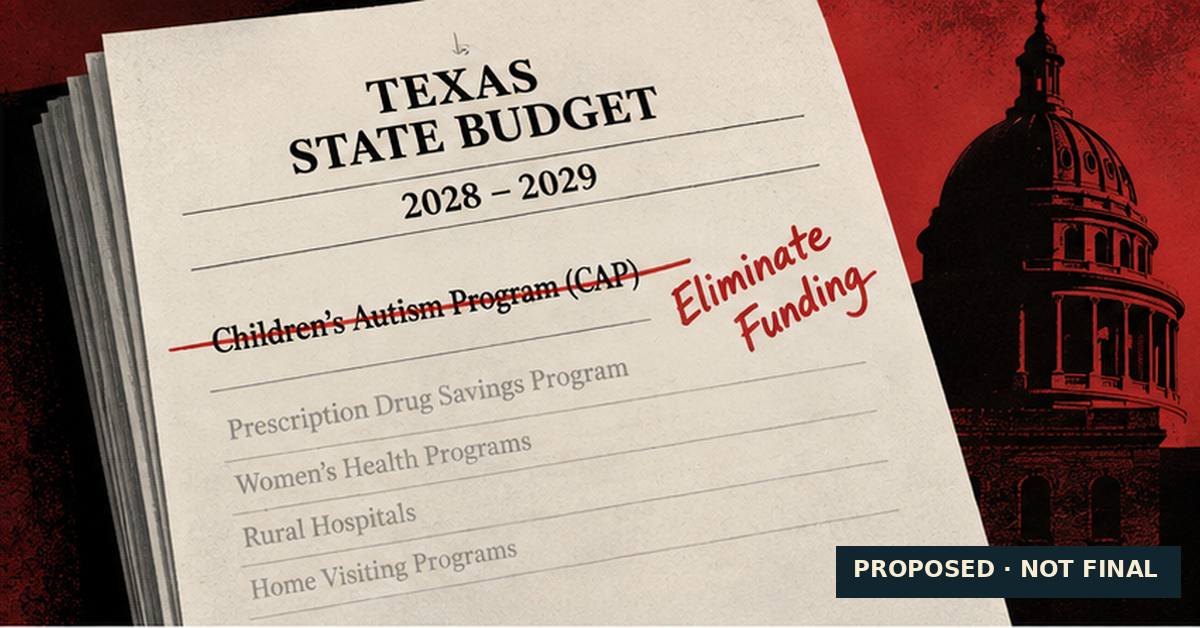
AUSTIN, TEXAS – In August 2026, the Texas Health and Human Services Commission (HHSC) expanded eligibility for the state’s Children’s Autism Program through age 21 and lifted its cap on yearly therapy hours. Within weeks, the agency proposed eliminating the program’s funding for 2028 and 2029.
The program, known as CAP, contracts with 16 providers to deliver focused applied behavior analysis (ABA), therapy targeting specific skills or behaviors. Families’ costs depend on their income and insurance. In fiscal year 2026, CAP funded treatment for 583 children, and contractors report at least 1,000 more on waitlists, The Texas Tribune reported October 12. HHSC lists $13.7 million in estimated and budgeted funding for 2026–27.
The proposal responds to a 3% reduction that Gov. Greg Abbott, Lt. Gov. Dan Patrick, and House Speaker Dustin Burrows ordered in agencies’ base budget requests. The Legislature, which convenes January 12, 2027, will decide CAP’s funding. If lawmakers end the program, services would continue through August 2027, HHSC told the Tribune.
“We were really shocked to see nothing, and it’s just blank where the line item should be,” Jacquie Benestante, executive director of the Autism Society of Texas, told the Tribune.
How CAP Landed on the Cut List
The leaders’ July 14, 2026, letter required the reduction as “the starting point for budget deliberations.” It exempted amounts needed to maintain Medicaid and Children’s Health Insurance Program (CHIP) benefits and eligibility required by state law, including projected caseload growth. CAP had no such exemption.
Asked why it chose to eliminate the program, HHSC pointed the Tribune to its reduction summary, which says the agency “focused reductions on the lowest direct service impact to clients and minimizing impacts to federal funding.” Jeff Miller, a senior policy specialist at Disability Rights Texas, told the Tribune that CAP, which runs entirely on state money, may have looked like an easy way to save money without putting federal funding at risk.
HHSC’s budget request also proposes eliminating funding for the state’s Prescription Drug Savings Program and reducing state funding for women’s health programs, rural hospitals, and home visiting for mothers and young children.
What Changed in August
HHSC filed the proposal April 20, and it was published May 1. The new rules took effect August 25, 2026, expanding eligibility from ages 3 through 15 to people with an autism diagnosis younger than 22. They removed the 180-hour yearly limit but retained a 720-hour lifetime cap under the program.
HHSC predicted “increased access to services by expanding the age of eligibility.” It projected no state or local fiscal impact from the rules during their first five years.
Who Relies on the Program
Texas Medicaid’s ABA coverage for eligible enrollees younger than 21 took effect February 1, 2022. CAP helps families facing gaps in coverage or access. Low Medicaid reimbursement rates can make it difficult to find providers willing to accept Medicaid patients, advocates told the Tribune. HHSC’s budget request also acknowledges the provider shortage.
“The demand for services exceeds the availability of qualified providers, especially in rural parts of the state.” – Texas Health and Human Services Commission, 2028-29 budget request (2026)
Jolene Pohl, advocacy director for the Coalition of Texans with Disabilities, told the Tribune it “would make more sense to increase the funding and get those kids off the waitlist,” and that delaying services would cost the state more in the end.
Emily Pena’s 5-year-old daughter, Lila Rodriguez, is on Medicaid, but Pena struggled to find a provider. Lila attended a CAP-funded program at the University of Houston-Clear Lake until she graduated in June 2026. Pena told the Tribune the program let her daughter enjoy “somewhat of a normal childhood.”
That program is part of the university’s Center for Autism and Developmental Disabilities, where CAP-affiliated programs served 41 families last year and 200 more families are waiting, director Dorothea Lerman told the Tribune. “There is no other option for the majority of them, and so they would basically have no services,” she said. The center does not have the infrastructure to take Medicaid or insurance, Lerman said, and she called the proposal “devastating.”
If the cut goes through, the center would have until August 2027 to find another funding source before its CAP-affiliated programs shut down, the Tribune reported.
AT A GLANCE
| Program: | Children’s Autism Program (CAP), launched in 2008; focused ABA through 16 contracted providers |
| Proposed cut: | $13,663,084 for 2028–29; HHSC requests no funding for CAP in either year |
| Children served: | 583 in fiscal year 2026; contractors report at least 1,000 more children waiting statewide |
| New rules: | Effective August 25, 2026: eligibility younger than 22, previously ages 3–15; 180-hour yearly cap removed; 720-hour lifetime cap under CAP retained |
| Budget order: | July 14, 2026: 3% reduction in agency base requests, with exceptions including Medicaid and CHIP benefits and eligibility required by state law |
| If the cut stands: | Services would continue through August 2027, HHSC told the Tribune |
| Legislature convenes: | January 12, 2027 |
SOURCES & REFERENCES
| 1. | Draeger-Mazer, Sasha. “Texas health agency proposes eliminating children’s autism program.” The Texas Tribune. October 12, 2026. https://www.texastribune.org/2026/10/12/texas-childrens-autism-program-elimination-threat/ |
| 2. | Texas Health and Human Services Commission. Adopted rules, 26 TAC Chapter 358, Children’s Autism Program. Texas Register. August 21, 2026. Filed August 5; effective August 25, 2026. https://www.sos.state.tx.us/texreg/archive/August212026/Adopted%20Rules/26.HEALTH%20AND%20HUMAN%20SERVICES.html |
| 3. | Texas Health and Human Services Commission. Proposed rules, 26 TAC Chapter 358, Children’s Autism Program. Texas Register, 51 TexReg 2869. May 1, 2026. Filed April 20, 2026. https://www.sos.state.tx.us/texreg/archive/May12026/Proposed%20Rules/26.HEALTH%20AND%20HUMAN%20SERVICES.html |
| 4. | Texas Health and Human Services Commission. Legislative Appropriations Request for Fiscal Year 2028 and 2029, Volume I. September 4, 2026. Strategy request, pp. 3.A. 43, 60, 80, 119, and 325. https://www.hhs.texas.gov/sites/default/files/documents/lar-joint-budget-hearing-fy2028-2029.pdf |
| 5. | Gov. Greg Abbott, Lt. Gov. Dan Patrick, and Speaker Dustin Burrows. Policy letter on Legislative Appropriations Requests for the 2028–29 biennium. July 14, 2026. https://www.lbb.texas.gov/Documents/Instructions/LAR/Policy_Letter.pdf |
| 6. | Texas Legislative Council. “Dates of Interest | 89th Legislature.” Accessed October 14, 2026. https://tlc.texas.gov/docs/legref/Dates-of-Interest.pdf |
| 7. | Texas Health and Human Services Commission. “2028–29 Biennium 3 Percent Reductions.” Revised September 2026, pp. 5 and 8. https://www.hhs.texas.gov/sites/default/files/documents/2028-29-biennium-reduction-schedule-summary-three-percent.pdf |
| 8. | Centers for Medicare & Medicaid Services. Texas State Plan Amendment 21-0002 approval package. January 27, 2022. Effective February 1, 2022. https://www.medicaid.gov/medicaid/spa/downloads/TX-21-0002.pdf |
| 9. | University of Houston-Clear Lake. “Center for Autism and Developmental Disabilities.” Accessed October 14, 2026. https://www.uhcl.edu/autism-center/ |








Join the discussion ▾