
WASHINGTON, D.C. – The Labor Department is narrowing its reviews of health plan restrictions while keeping exclusions of applied behavior analysis (ABA) for autism among its priorities. Federal parity law generally bars plans subject to the law from restricting mental health and substance use disorder benefits more than medical and surgical benefits.
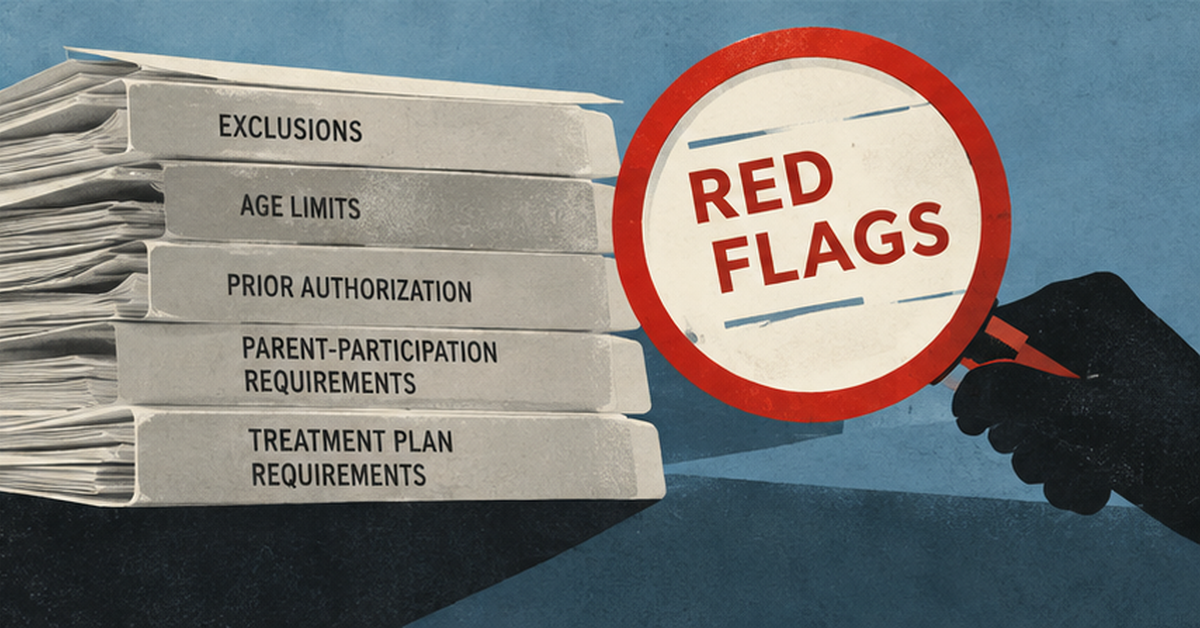
In a September 8 bulletin, the department’s Employee Benefits Security Administration (EBSA) directed staff to focus requests for written comparisons of treatment restrictions on three areas. The bulletin never mentions autism, but an updated companion list of “red flags,” issued the same day, opens with exclusions of ABA, speech therapy, or occupational therapy for autism when medical and surgical care has no similar exclusions.
EBSA chief Daniel Aronowitz wrote that the three areas carry “the highest potential for significant harm.” They are exclusions and other limits that apply only to mental health or substance use disorder benefits; medical-necessity standards and reviews, including prior authorization; and network adequacy, particularly how plans admit and pay providers. The red-flags page’s main list follows the same categories.
Age limits on ABA, or on all autism services, are flagged when medical benefits in the same benefit category carry few or none. The page also flags parent-participation requirements and repeat autism diagnostic testing when medical care has no equivalent. Treatment-plan requirements draw scrutiny, especially when claims are denied over content and formatting or plans apply the requirements more frequently than for medical care.
The list identifies potential compliance problems, not automatic violations. It is guidance, not a new rule, and the bulletin itself creates no enforceable rights.
What Past Cases Show
In two resolved investigations described on the page, one plan removed an ABA exclusion prospectively and retroactively and invited potentially affected participants to resubmit claims. Another voluntarily dropped an ABA age limit, notified participants, and reprocessed affected claims.
Autism restrictions accounted for 14 of the 77 treatment limits for which EBSA requested comparative analyses from plans and insurers between August 1, 2023, and July 31, 2025, according to the department’s 2025 report to Congress. Six involved ABA exclusions; eight involved other autism limits, including age limits and parent-participation requirements. The report also described a national administrator removing an ABA exclusion from its standard documents for self-funded plans. The change affected 97 client plans covering more than 319,000 participants and their families.
Enforcement on Hold
The departments of Labor, Health and Human Services, and the Treasury finalized new parity requirements in September 2024. The ERISA Industry Committee, which represents large employers, challenged the rule in January 2025. That May, the departments announced they would not enforce provisions new in 2024 for compliance failures occurring before a final decision in the case or during the following 18 months.
In March 2026, they told the court that, “rather than defend the Rule,” they would issue a new proposal that they anticipated would carry “significant revisions” to the challenged provisions. They said they intended to propose it by December 31, 2026.
The bulletin reaffirms the federal enforcement pause, including for the 2024 requirement to collect and evaluate data on how restrictions affect access to care. Under the Consolidated Appropriations Act, 2021, plans and insurers must still compare in writing how they design and apply restrictions such as exclusions and prior authorization to mental health and substance use disorder benefits versus medical and surgical benefits. The bulletin cites “significant input from the regulated community” that past enforcement created “substantial confusion and unnecessary burdens on health plans.”
What EBSA Will Still Enforce
EBSA will still enforce the 2013 rule and the parity law itself, including the statutory written-comparison requirement. Plans can set medical-necessity standards, the bulletin says, but generally cannot impose blanket treatment exclusions for covered mental health or substance use disorder conditions when similar treatments are covered for medical or surgical conditions.
“EBSA will focus its resources on cases involving blanket treatment exclusions applicable only to [mental health and substance use disorder] benefits, but may also address more limited exclusions, especially in response to complaints.” – Employee Benefits Security Administration
Complaints can prompt investigations of narrower exclusions and issues beyond the three priorities. Plans that use proprietary clinical guidelines to decide medical necessity must make them available to participants and beneficiaries on request, the bulletin says.
The network priority also reaches provider pay. The guidance flags different reimbursement formulas for mental health and medical providers, in network or out. One example is a set percentage discount for master’s-level mental health providers when master’s-level medical providers receive no discount or a smaller one.
What South Carolina Didn’t Check
Prior authorization, part of EBSA’s medical-necessity priority, is also the subject of a separate Medicaid audit issued September 3 by the Health and Human Services Department’s inspector general. It examined South Carolina’s oversight of Medicaid managed care, where plans handle ABA authorizations for their enrollees, according to the state’s Medicaid agency.
The audit covered three of the state’s five Medicaid managed care plans in 2023, together serving about 80% of managed care enrollees. All three plans’ written prior-authorization practices complied with parity requirements, but the auditors found failures in data and state oversight. States and Medicaid managed care plans were required to comply by October 2, 2017.
None of the three supplied accurate and complete authorization data. At one plan, 169 of 822 requests, about one in five, remained recorded as denied after approval on further review or appeal and payment of the claims. Another data problem involved 18,647 denied pharmacy requests with no specific service identified; 4,639 also lacked essential information to distinguish mental health and substance use disorder requests from medical and surgical requests. The auditors said these gaps prevented the state from completing the associated parity analyses.
The state did not review the data behind the plans’ quarterly authorization reports, which were inadequate for required parity analyses. The auditors found two plans noncompliant during 2023, citing missing documents for one and a late parity assessment for the other. That assessment, completed in December 2024, found the second plan compliant at that point.
The state’s outside reviewer had identified actual or potential problems at all three plans, including higher denial rates for mental health and substance use disorder requests. Such differences alone do not establish a parity violation, the auditors noted. State officials said they had not known of the issues because the agency had not reviewed the assessments.
South Carolina’s Medicaid agency agreed to improve monitoring, validate plan data, and address noncompliance. It said it had added reporting fields and clarified data-reporting duties in plan contracts in July 2024. The audit does not name the plans or identify autism services among the requests reviewed. Its findings follow August audits that also identified gaps in Medicaid prior-authorization oversight in New York and Arizona.
The court’s April 2 order sets September 30 for the next status report in the lawsuit. In March, the departments said they intended to propose revisions by December 31.
AT A GLANCE
| Guidance: | Field Assistance Bulletin 2026-03 and the red-flags page, both issued September 8, 2026 (EBSA) |
| Enforcement priorities: | Limits applying only to mental health or substance use disorder benefits; medical-necessity standards and reviews; network adequacy, including provider admission and pay |
| ABA red flags: | ABA, speech, or occupational therapy exclusions for autism without similar medical exclusions; autism age limits where medical benefits in the same category have few or none |
| Other autism-related flags: | Parent-participation requirements and repeat autism diagnostic testing (when medical care has no equivalent); treatment-plan requirements that trigger denials over formatting or apply more often than for medical care |
| Autism in EBSA’s requests: | 14 of 77 treatment limits for which EBSA requested comparative analyses, August 1, 2023–July 31, 2025; six ABA exclusions and eight other autism limits |
| 2024 parity rule: | Federal nonenforcement of provisions new in 2024 covers compliance failures before a final litigation decision and for 18 months afterward; revised proposal planned by December 31, 2026 |
| South Carolina audit: | Issued September 3, 2026; three plans covering about 80% of managed care enrollees in 2023; written policies complied, but data and oversight failures remained |
| Next date: | April 2 court order sets September 30, 2026, for the next joint status report in ERISA Industry Committee v. HHS (federal court in Washington) |
SOURCES & REFERENCES
| 1. | U.S. Department of Labor, Employee Benefits Security Administration. Field Assistance Bulletin No. 2026-03, “Guiding Principles for EBSA’s Enforcement of the Mental Health Parity and Addiction Equity Act’s Nonquantitative Treatment Limitation Requirements.” September 8, 2026. https://beta.dol.gov/policy-regulations/reference-materials/guidance-searches/ebsa-field-assistance-bulletin-no-2026-03 |
| 2. | U.S. Department of Labor, Employee Benefits Security Administration. “Identifying Potential Problems: If You See the Following in Written Plan Provisions or Plan Operations, Think Twice about Possible MHPAEA Compliance Problems.” Issued September 8, 2026. https://beta.dol.gov/policy-regulations/pay-benefits/health-plans/mental-health-and-substance-use-disorder-parity/identifying-potential-problems-possible-mhpaea-compliance-problems |
| 3. | U.S. Departments of Labor, Health and Human Services, and the Treasury. 2025 MHPAEA Report to Congress (reporting period August 1, 2023, to July 31, 2025). February 20, 2026. https://beta.dol.gov/research-data/surveys-reports-publications/2025-mhpaea-report-congress |
| 4. | U.S. Departments of Labor, Health and Human Services, and the Treasury. “Statement Regarding Enforcement of the Final Rule on Requirements Related to the Mental Health Parity and Addiction Equity Act.” May 15, 2025. https://www.cms.gov/files/document/statement-regarding-enforcement-final-rule-requirements-related-mhpaea.pdf |
| 5. | Internal Revenue Service, Employee Benefits Security Administration, and Centers for Medicare & Medicaid Services. “Requirements Related to the Mental Health Parity and Addiction Equity Act.” Final rule. Federal Register. September 23, 2024. https://www.federalregister.gov/documents/2024/09/23/2024-20612/requirements-related-to-the-mental-health-parity-and-addiction-equity-act |
| 6. | The ERISA Industry Committee. Complaint, ERISA Industry Committee v. U.S. Department of Health and Human Services, No. 1:25-cv-00136-TJK (D.D.C.), ECF No. 1. January 17, 2025. https://litigationtracker.law.georgetown.edu/wp-content/uploads/2025/01/ERIC_2025.01.17_COMPLAINT.pdf |
| 7. | Joint Status Report. ERISA Industry Committee v. U.S. Department of Health and Human Services, No. 1:25-cv-00136-TJK (D.D.C.), ECF No. 18. March 30, 2026. https://litigationtracker.law.georgetown.edu/wp-content/uploads/2025/01/ERISA-INDUSTRY-COMMITTEE-v.-DEPARTMENT-OF-HEALTH-AND-HUMAN-SERVICES-et-al_2026.03.30_JOINT-STATUS-REPORT.pdf |
| 8. | U.S. Department of Health and Human Services, Office of Inspector General. “South Carolina Did Not Ensure That Selected Medicaid Managed Care Organizations Complied With Mental Health and Substance Use Disorder Parity Requirements Related to Prior Authorization.” Report A-04-24-07115. September 3, 2026. https://oig.hhs.gov/documents/audit/11877/A-04-24-07115.pdf |
| 9. | South Carolina Department of Health and Human Services. “Updates to ASD Services Provider Manual.” June 26, 2026. https://scdhhs.gov/communications/updates-asd-services-provider-manual-0 |
| 10. | U.S. Department of Health and Human Services, Office of Inspector General. “New York Did Not Ensure That Selected Medicaid Managed Care Organizations Complied With Mental Health and Substance Use Disorder Parity Requirements Related to Prior Authorization.” Report A-02-24-01011. August 13, 2026. https://oig.hhs.gov/documents/audit/11847/A-02-24-01011.pdf |
| 11. | U.S. Department of Health and Human Services, Office of Inspector General. “Arizona Did Not Ensure That Selected Medicaid Managed Care Organizations Complied With Mental Health and Substance Use Disorder Parity Requirements Related to Prior Authorization.” Report OAS-24-09-002. August 20, 2026. https://oig.hhs.gov/documents/audit/11861/OAS-24-09-002.pdf |
| 12. | U.S. District Court for the District of Columbia. Minute Order, ERISA Industry Committee v. U.S. Department of Health and Human Services, No. 1:25-cv-00136-TJK. April 2, 2026. https://litigationtracker.law.georgetown.edu/wp-content/uploads/2025/01/ERISA-Industry-Committee_2026.04.02_SCHEDULING-ORDER.pdf |
| 13. | U.S. Department of Labor. “Directions to the U.S. Department of Labor National Office.” Undated; accessed September 28, 2026. https://www.dol.gov/general/aboutdol/visit |







Join the discussion ▾