
The Numbers That Frame the Problem
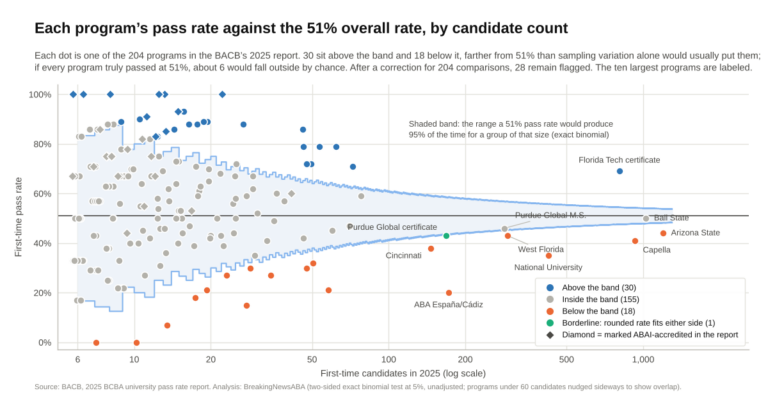
PORTAGE, MICHIGAN – The data tell a story of rapid expansion and declining outcomes occurring simultaneously. The BACB’s 2024 pass-rate report, published in May 2025, documented 9,911 first-time BCBA exam candidates across 192 university training programs. The first-time pass rate was 54 percent. In 2025, that figure dropped further to 51 percent, with 23,151 total candidates tested and 8,021 newly certified BCBAs joining the field. For context, the first-time pass rate peaked at 66 percent in 2020. The retake pass rate has hovered in the low-to-mid 20s — 25 percent in 2024, 23 percent in 2025.
The decline is not random. It reflects the convergence of three forces: exam content restructuring (the transition from the 4th to 5th to 6th Edition Task List, each emphasizing deeper conceptual reasoning over rote memorization), a dramatic expansion in the number and diversity of training programs feeding candidates into the exam pipeline, and significant variation in program quality across those 192 reporting institutions. The BACB publishes program-level pass rates annually, and the spread is vast — from programs producing near-100 percent first-time pass rates to programs where pass rates fall below 40 percent.
A peer-reviewed study published in Behavior Analysis in Practice examined first-time BCBA exam pass rates across Verified Course Sequences from 2013 to 2020 and found meaningful differences associated with mode of instruction and ABAI accreditation status. The study noted that a small number of large programs were contributing the greatest number of exam candidates — meaning that the aggregate pass rate was being disproportionately shaped by a handful of high-volume programs, some of which were fully online.
The first-time BCBA exam pass rate has dropped from 66 percent in 2020 to 51 percent in 2025. The retake pass rate sits at 23 percent. The BACB now reports data for 192 training programs, with pass rates ranging from near-100 percent to below 40 percent.
The Two-Pathway System: What Changed on January 1, 2026
Understanding the current accreditation landscape requires understanding a structural transition that culminated on January 1, 2026. For years, the primary route to BCBA exam eligibility for most candidates was Pathway 2: complete a master’s degree from a regionally accredited institution, take the required graduate-level behavior analysis coursework through an ABAI Verified Course Sequence, and accumulate the supervised fieldwork hours. The VCS system, administered by ABAI, verified that a specific sequence of courses met the BACB’s minimum content requirements.
In January 2023, ABAI and the BACB jointly announced that the VCS system would sunset on December 31, 2025. ABAI stopped accepting new VCS applications on January 1, 2025. The system was fully discontinued at the end of that year. What replaced it is a bifurcated structure with a clear expiration date.
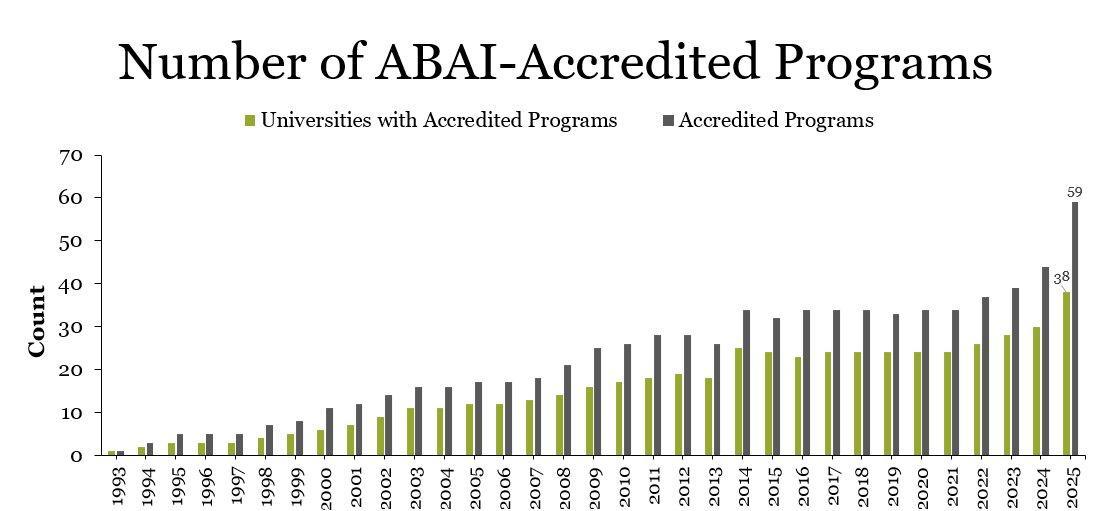
Pathway 1 (ABAI/APBA-Accredited Programs): Graduates of programs accredited by the Association for Behavior Analysis International or the Association of Professional Behavior Analysts automatically meet the BACB’s degree and coursework requirements for BCBA certification. No additional course verification is needed. This has been the case since January 1, 2022. As of late 2023, there were approximately 26 universities with ABAI-accredited master’s programs and roughly 40 accredited programs at all levels. The ABAI Accreditation Board is recognized by the Council for Higher Education Accreditation. Accreditation requires a comprehensive self-study, a site visit by experienced behavior analysts, and demonstrated alignment with ABAI standards for curriculum design, faculty qualifications, supervised experience, and student outcomes.
Pathway 2 (Coursework Attestation, Ending 2031): Pathway 2 remains active but is being phased out. The BACB has announced that Pathway 2 will be discontinued after December 31, 2031. In the interim, programs that are not ABAI- or APBA-accredited can still qualify students for BCBA exam eligibility if they designate a full-time, BCBA-certified faculty member as a Pathway 2 Program Contact who attests that the student’s coursework meets BACB requirements. This is a meaningful shift from the VCS system: under the VCS, ABAI verified the program’s course sequence in advance. Under Pathway 2 attestation, the verification happens at the individual student level, after coursework is completed, by a single designated faculty member.
The message from the BACB is unambiguous: the long-term future of BCBA certification runs through accredited programs. After 2031, only Pathway 1 graduates — from ABAI- or APBA-accredited programs — will be eligible to sit for the exam. Every program that currently operates under Pathway 2 must either achieve accreditation or accept that its graduates will eventually be ineligible for BCBA certification.
The Online Program Boom: Access vs. Rigor
The growth of online BCBA programs has been one of the defining trends in ABA education since 2020. Before 2022, ABAI accreditation was only available to on-campus and hybrid programs. The extension of accreditation eligibility to fully online programs opened a new frontier — but the reality is that most online programs are not yet accredited. They have operated under the VCS system and will now need to navigate the Pathway 2 attestation process or pursue full ABAI accreditation before the 2031 deadline.
The appeal of online programs is real and defensible. The ABA workforce is overwhelmingly young — 44 percent of all current BCBAs earned their certifications within the last five years. Many aspiring BCBAs are working full-time as RBTs while pursuing their master’s degrees. Online programs offer the flexibility these students need. Programs like Pepperdine University’s online MS in Applied Behavior Analysis (ABAI-verified, completable in as few as 12 months), Simmons University’s online MS in Behavior Analysis (ABAI-accredited, 86 percent BCBA exam pass rate, 20 months), and Walden University’s online MS in ABA (completable in 15 months) have attracted large cohorts of working professionals. Ball State University offers a 10 percent tuition discount for its ABA program. Florida Institute of Technology, long a leader in behavior analysis education, offers both campus and online options.
But flexibility and rigor are not automatically aligned. The BACB’s program-level pass rate data reveals significant variation among online programs. Some high-quality online programs produce pass rates that match or exceed campus-based programs. Others fall well below the national average. A key differentiator is whether the program requires a thesis or capstone project, the depth of its supervised fieldwork integration, and the qualifications of its faculty. ABAI accreditation evaluates all of these dimensions. Programs that have not submitted to the accreditation process have not been externally reviewed on these criteria.
Before 2022, ABAI accreditation was only available to on-campus programs. The extension to online programs is recent — and most online BCBA programs are not yet accredited. They must achieve accreditation before 2031 or their graduates will no longer be eligible for certification.
What Accreditation Actually Measures
ABAI accreditation is not a simple checkbox. It is a peer-review process in which a program completes a comprehensive self-study evaluating its curriculum, faculty qualifications, training facilities, supervised experience opportunities, and student outcomes. An ABAI-appointed site visit team — composed of experienced behavior analysts — visits the program, meets with faculty and students, and verifies the self-study. The Accreditation Board then evaluates the evidence against published standards and issues a decision. Programs seeking re-accreditation go through the process again, typically on a five- to seven-year cycle.
The standards cover specific domains that matter directly to clinical quality. Faculty must hold doctoral-level credentials in behavior analysis. The curriculum must cover the BACB’s required content areas with sufficient depth, not merely the minimum hours. Supervised fieldwork must be integrated into the program in a way that provides students with structured, mentored experience — not merely a requirement to log hours independently. Student outcome measures, including exam pass rates, must be tracked and reported.
For students, the practical difference is significant. Graduates of ABAI-accredited programs (Pathway 1) can apply directly for BCBA certification with no additional coursework verification. Their program’s accreditation serves as the quality assurance mechanism. Graduates of non-accredited programs (Pathway 2) must go through the attestation process, which relies on a single faculty member’s confirmation rather than an institutional review. And after 2031, that pathway disappears entirely.
What This Means for the Industry
The accreditation question is not merely an academic policy debate. It has direct implications for every ABA provider, every payer, and every family.
For providers: The declining exam pass rate means that a growing share of BCBA candidates are failing on their first attempt. For ABA companies that invest in growing their own clinical workforce — sponsoring RBTs through master’s programs, offering tuition reimbursement, building internal training pipelines — the choice of which program to partner with has become a material business decision. A company that steers its employees toward a program with a 40 percent pass rate is making a different investment than one that partners with a program producing 80 percent pass rates.
For payers: As the field matures, payers may begin to scrutinize not just whether a provider holds a BCBA credential but where that credential was earned. Accreditation status could become a factor in credentialing, network inclusion, and rate negotiations. The parallel to other health professions — where program accreditation is a baseline expectation for licensure and reimbursement — is increasingly relevant.
For families: Parents of children with autism have no easy way to evaluate whether their child’s BCBA completed a rigorous training program or a minimally qualifying one. The BACB exam is designed to be the quality filter, but a 51 percent first-time pass rate means the filter is allowing nearly half of candidates through on retakes or not at all — and retake pass rates of 23 percent suggest that many candidates who fail initially may never pass. The accreditation system is designed to push program quality upstream, before the exam becomes the last line of defense.
For students: The financial stakes are substantial. A master’s degree in ABA can cost $30,000 to over $90,000 depending on the program and residency status. Students who enroll in a non-accredited program after 2025 are betting that their program will achieve accreditation before 2031 — or that they will complete their degree, pass the exam, and obtain certification before Pathway 2 closes. Students who choose accredited programs eliminate that risk entirely.
The ABA field is following the trajectory of every maturing health profession: from a period of rapid, loosely regulated growth to a system in which programmatic accreditation becomes the standard. The VCS sunset and the Pathway 2 expiration date are not ambiguous signals. They are a countdown. The programs that invest in accreditation will produce the next generation of BCBAs. The programs that do not will eventually produce graduates who cannot sit for the exam at all.
AT A GLANCE
BCBA first-time pass rate: 51% in 2025, down from 66% in 2020 (BACB, 2026)
Retake pass rate: 23% in 2025 (BACB, 2026)
Total BCBA certificants: 81,566 as of 2025, up 10% year-over-year (BACB)
Training programs reporting: 192 programs with 6+ first-time candidates in 2024 (BACB)
First-time candidates (2024): 9,911 tested; 54% passed (BACB, May 2025)
ABAI-accredited master’s programs: ~26 universities / ~40 programs at all levels (as of late 2023)
VCS system sunset: December 31, 2025. ABAI stopped accepting new VCS applications January 1, 2025.
Pathway 2 expiration: December 31, 2031. After this date, only Pathway 1 (accredited program) graduates eligible.
Pathway 1: ABAI- or APBA-accredited program graduates. No additional coursework verification required.
Pathway 2 (current): Non-accredited program + Pathway 2 Coursework Attestation from designated BCBA faculty member.
ABAI accreditation scope: Curriculum, faculty qualifications, fieldwork, student outcomes. Recognized by CHEA.
Key pass rate range: Programs range from near 100% to below 40% first-time pass rates (BACB annual data).
SOURCES & REFERENCES
1. – BACB. University Examination Pass Rates. 2025. https://www.bacb.com/university-examination-pass-rates/
2. – BACB. BCBA Examination Pass Rates for University Training Programs (2024 data). May 2025. https://www.bacb.com/wp-content/uploads/2025/05/BCBA-2024-Pass-Rates-Combined-250617-a.pdf
3. – BACB. University Training for Those Pursuing BCBA Certification (Pathway updates). January 2026. https://www.bacb.com/university-faculty-resources/university-training-for-those-pursuing-bcba-certification/
4. – BACB. BACB Certificant Data. 2026. https://www.bacb.com/bacb-certificant-data/
5. – ABAI Accreditation Board. Accredited Programs. 2026. https://accreditation.abainternational.org/accredited-programs.aspx
6. – ABA Technologies. Certification Pathways, VCSs, & Accreditation: A Student’s Guide. December 2025. https://www.abatechnologies.com/blog/certification-pathways-vcss-accreditation-a-students-guide
7. – ABA Technologies. Inside 2024 BACB University Exam Pass Rates. November 2025. https://www.abatechnologies.com/blog/inside-2024-bacbr-university-exam-pass-rates
8. – Nosik MR, et al. An Investigation of BCBA Exam Pass Rates as a Quality Indicator of Applied Behavior Analysis Training Programs. Behavior Analysis in Practice. 2022. doi:10.1007/s40617-022-00735-z
9. – Applied Behavior Analysis EDU. ABAI-Accredited ABA Graduate Programs by State. 2026. https://www.appliedbehavioranalysisedu.org/graduate-programs-with-pre-approved-course-sequence/
10. – Applied Behavior Analysis EDU. 50 ABAI-Accredited ABA Programs. 2026. https://abamastersprograms.org/abai-accredited-bcba-programs/
11. – Ohio State University Online. Why ABAI Accreditation Matters for Your ABA Master’s Degree. February 2026. https://online.osu.edu/content-hub/blogs/why-abai-accreditation-matters-for-your-applied-behavior-analysis-masters-degree
12. – BACB & Lightcast. US Employment Demand for Behavior Analysts: 2010–2025. February 2026.
13. – Certifynd ABA. BCBA Exam Pass Rate 2024–2025: Stats & How to Pass. 2026. https://certifyndaba.com/blog/ABA%20Certification/bcba-exam-pass-rate
14. – Applied Behavior Analysis EDU. ABAI-Accredited Master’s Programs: Full List. March 2026. https://www.appliedbehavioranalysisedu.org/2025/06/abai-accredited-masters-in-aba-most-streamlined-way-to-earn-bcba/