FORT LAUDERDALE, FL — On the morning of October 10, 2025, Christopher Barnett walked into a ceremony at Temple University and handed the school a check for $55 million — the single largest gift in the institution’s history. It was, depending on how you count it, a promise made good. More than two decades earlier, Barnett had made a different kind of entrance to Temple: he showed up uninvited to the office of the director of transfer admissions after being denied, sat in the waiting area for hours, and refused to leave until she agreed to see him. She admitted him on the spot. He promised to graduate with honors and to give back. He did both.
The story has become something of a founding myth for the 42-year-old entrepreneur, and it encodes everything that defines him: the refusal to accept a rejection, the belief that physical presence can move things that paperwork cannot, and the conviction that gratitude is an obligation, not a sentiment. It also prefigures, almost exactly, the logic behind ABA Centers of America, the autism care company Barnett founded in December 2020 and grew to the nation’s fastest-growing autism provider in less than five years.
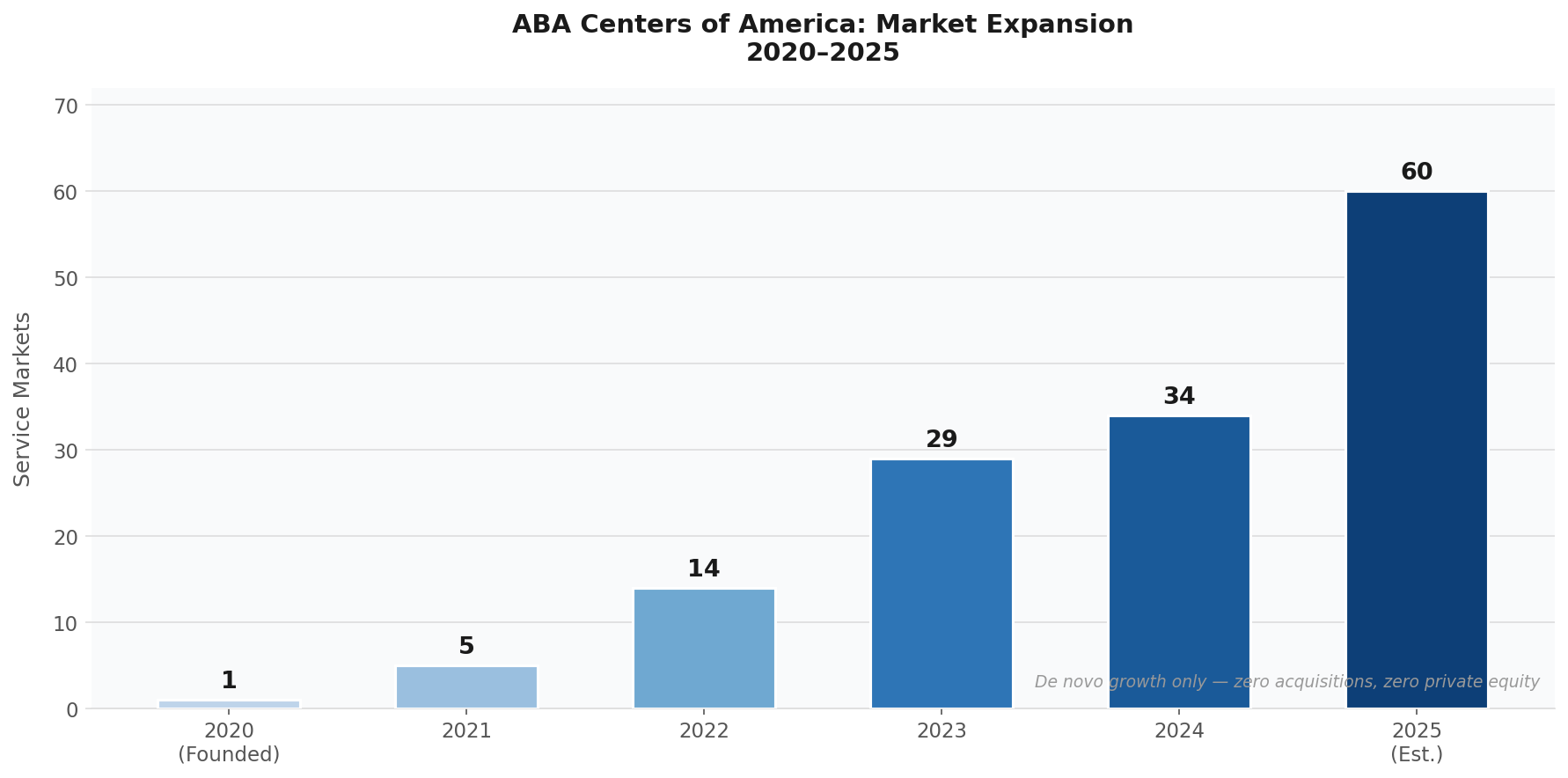
From a single clinic staffed by one employee in Fort Lauderdale, ABA Centers expanded to more than 60 service markets across 12 states and Puerto Rico without taking on private equity, without acquiring a single competitor, and without asking for permission from anyone who might have told him it couldn’t be done that quickly.
THE EDUCATION
Barnett grew up an entrepreneur. By his own account, he launched his first ventures at 18, cycling through businesses in real estate, advertising, and professional services long before he arrived in healthcare. He holds a Bachelor of Arts in Political Science from Temple University (Class of 2010) and a Juris Doctor from Nova Southeastern University. His legal training, he has said, shaped how he thinks about contracts, payer relationships, and institutional risk — disciplines that would prove essential in an industry where the difference between a sustainable business and a distressed one often turns on a single-case agreement.
The real estate years were formative in a different way. The 2008 financial crisis wiped out the sector Barnett had spent years building. “I knew what I was doing,” he has said. “I identified the right projects, I built the right team, I managed for maximum efficiency — and none of it mattered when the market went down.” It was the kind of lesson that hardens certain operators and breaks others. For Barnett, it became a framework: understand the things you can control, build relentlessly against them, and don’t be afraid of failure you didn’t cause.
Healthcare came next. Over the course of roughly a decade, Barnett built, bought, and sold more than a dozen healthcare assets across mental and behavioral health, medical billing, physician group management, and advertising. His company GateHouse Treatment, a behavioral healthcare center in Nashua, New Hampshire, became the cornerstone of what would eventually become ICBD Holdings — the Fort Lauderdale-based holding company that today controls ABA Centers, Curative AI, Exact Billing Solutions, and several other ventures.
“I learned that sometimes failure is out of your control, so you can’t be afraid to fail. I was in real estate, then 2008 happened. I made the right decisions — and it didn’t matter.”
— Christopher Barnett, Founder & Chairman, ABA Centers of America
THE CATALYST
The private version of the story matters more. Barnett and his wife Julie have five daughters. One of them, Madison, showed signs in early childhood of being on the autism spectrum. A prior assessment dismissed it: she was diagnosed with speech and language issues and sent home. The correct diagnosis would come years later, after Madison had missed the early intervention window that research shows is most consequential for children with autism.
“I couldn’t even get access to a diagnosis,” Barnett recalled. What he found, as a parent navigating the system rather than as an entrepreneur evaluating a market, was infuriating: months-long waitlists, fragmented care, and a supply of qualified providers that bore no relationship to the scale of demand. The national average wait for a child to receive autism care exceeds four months. Some families wait years. In Massachusetts, the number of children with autism enrolled in special education had grown more than 400 percent over the prior two decades. The problem was not obscure. It simply had not been solved.
Barnett believed he had the infrastructure to solve it. Through ICBD, he had spent a decade building and operating healthcare assets at scale. He understood data systems, payer relationships, workforce economics, and the operational mechanics of rapidly opening facilities across multiple states. In December 2020, with those tools in hand, he opened the first ABA Centers of America clinic in Fort Lauderdale with a single employee and a straightforward ambition: get a child into diagnosis within 14 days, deliver a diagnostic report within a week, and have that child in active therapy within 47 days from first contact. The national average was more than four months.
THE BUILD
What Barnett built over the next four years was, by any measure, one of the fastest-growing healthcare provider organizations in American history.
ABA Centers grew from that single Fort Lauderdale clinic to 29 service markets in 2023, 34 markets in 2024, and more than 60 markets by 2025, spreading first along the East Coast and then west into new states. The company entered Massachusetts, New Hampshire, New Jersey, Pennsylvania, Georgia, Tennessee, Texas, and eventually Puerto Rico — its first international location. In each market, it built from scratch.
The growth numbers are staggering. Between 2020 and 2023, ABA Centers recorded revenue growth of 32,192 percent — earning it the No. 5 ranking on the 2024 Inc. 5000.
On that list, among those companies ranked in the top tier, ABA Centers was the only one to achieve its ranking without completing a single acquisition. The following year, the company ranked No. 25 on the 2025 Inc. 5000, with 7,755 percent growth between 2021 and 2024. The Financial Times ranked it the No. 1 fastest-growing company in the Americas for 2025, based on an absolute growth rate of 33,511.5 percent over three years. It was No. 1 on the Inc. Regionals: Southeast list for two consecutive years.
The operating model is deliberately different from the industry standard. Where most ABA providers bill insurers as in-network providers under managed care agreements, ABA Centers built much of its early revenue through out-of-network single-case agreements — individually negotiated arrangements with payers that typically carry higher reimbursement rates than standard contracts. The company also structured its clinical model around shorter weekly hours: its average is under 25 hours per week, compared to 40 hours at many competitors, a design choice Barnett argued was both clinically appropriate and commercially advantageous with payers. In hiring, the company paid above market rates to attract qualified clinicians, reduced individual BCBA caseloads to create sustainable supervision ratios, and built an in-house training academy — the ABA Academy of Excellence — to develop its own workforce pipeline.
“We’ve proved the model. We’ve proved the concept. We proved our scalability. Now it’s about maintaining clinical excellence and scaling it even more rapidly — because there are kids who need help.”
— Christopher Barnett
By late 2023, the company employed more than 1,500 people across two countries. By the time Barnett stepped back from day-to-day management in September 2024, that headcount had grown past 2,000. He handed the CEO title to Jason Barker, a 30-year healthcare veteran who had been Chief Operating Officer at ChenMed during that company’s national expansion. Barnett moved to Chairman, retaining strategic oversight while turning his attention to what he described as the highest-leverage work he could do: CurativeAI, the AI platform he had been quietly incubating inside ABA Centers since the company’s early days.
THE TECHNOLOGY BET
Barnett has self-funded $9.8 million into CurativeAI, building a technology stack that includes a proprietary electronic health record, clinician-level data collection systems, and AI-driven outcomes tracking tools designed to negotiate with payers on the basis of clinical results rather than utilization. The company is structured as a separate venture within the ICBD Holdings portfolio and has, to date, not been made available to outside organizations. The intellectual property is still incubating, but Barnett has described it publicly as a next-generation platform he believes will eventually transform healthcare more broadly, not just autism care.
The investment reflects a conviction he has expressed consistently: that healthcare provider organizations that do not build proprietary data infrastructure will be permanently disadvantaged in payer negotiations, workforce management, and clinical outcomes. “We use data to negotiate with payers,” he told Behavioral Health Business. “We’re getting sustainable wages in order to build and grow a business and treat the population like they need to be treated.”
THE CONTROVERSY
The company’s billing model, which generated the revenue that powered its growth rankings, became a source of legal exposure in 2025. In August of that year, ABA Centers of America and the grocery chain Publix filed dueling lawsuits in Florida courts. ABA Centers of Florida sued Publix in state court, seeking payment for authorized out-of-network ABA claims covering ten children whose coverage ran through Publix’s employee health plan. ABA Centers said it had received approvals from Publix’s contracted health plans, Blue Cross Blue Shield of Florida and South Carolina, and had continued treating the children despite non-payment for ten months.
Publix’s federal counterclaim was sharper. The company alleged that ABA Centers had fraudulently billed more than $15 million through inflated charges, improper coding, and failure to satisfy medical necessity and prior authorization standards. Publix’s amended complaint invoked the Racketeer Influenced and Corrupt Organizations Act, characterizing the billing arrangement as “a purely profit-driven scheme” motivated by ABA Centers’ interest in growth rankings. A separate payer, Point32Health in Massachusetts, filed a counterclaim against ABA Centers seeking to recover $19 million it said it had paid based on what it characterized as false claims and fabricated documentation. All of these claims remain unresolved allegations. No court has made findings of fact or liability in any of these matters.
The litigation put a spotlight on the out-of-network billing strategy that had been central to ABA Centers’ early revenue model. Behavioral Health Business noted that the use of single-case agreements and out-of-network billing arrangements, while common in certain ABA markets, is atypical for large multi-site ABA providers, most of whom operate primarily within in-network agreements. ABA Centers disputed the characterizations in both suits and maintained that its claims were authorized and its services were delivered.
THE PROMISE KEPT
In November 2024, Barnett was named the EY Entrepreneur of the Year National Overall winner — selected from 214 regional winners representing 185 companies. He was the first healthcare provider in the award’s nearly 40-year history to take the national overall title.

Whatever the courts eventually decide about the billing disputes, the philanthropic record is unambiguous. In October 2022, Barnett donated $1 million to Temple University to establish the ABA Centers of America Autism Lab in the College of Public Health — a multidisciplinary hub for autism research, clinical training, and diagnostic services available to patients regardless of their ability to pay. He endowed the Barnett Irvine Cherry Pantry, an on-campus food bank. In 2024, alongside the School of Social Work, he established Maddy’s Room, a sensory-friendly respite space for students and faculty at Temple — named for Madison, the daughter whose misdiagnosis set everything in motion.
Then in October 2025, the $55 million gift arrived. It was the largest donation in Temple’s history, more than doubling the previous record. The gift, directed to the College of Public Health, which will now bear Barnett’s name, is intended to fund research, clinical services, and workforce development in autism and behavioral health. It came with a scholarship program funding full tuition for roughly 20 ABA Centers BCBAs to complete their master’s degrees through Temple, an investment in the clinical workforce shortage that Barnett has consistently described as the binding constraint on the entire field. “I believe in Temple University,” he said at the announcement. “Temple took a chance on me when the odds were uncertain. And it helped shape who I am and what I’ve been able to do for my communities.”
Barnett now sits on Temple’s Board of Trustees, appointed in May 2025. He also holds board seats at Memorial Healthcare System’s Memorial Foundation, Joe DiMaggio Children’s Hospital Foundation, and Eden II Programs, a New York-based nonprofit serving adults with autism. Through the Christopher M. Barnett Family Foundation — which he has said he expects to eventually become his full-time occupation — he has organized around five pillars: stable housing, food insecurity, developmental disabilities, opportunities for underprivileged children, and women’s empowerment. The Fort Lauderdale chapter of Sleep in Heavenly Peace, which builds beds for children who lack them, is among the programs he has personally organized.
He has also said, with more clarity than most executives would permit themselves, what all of this is ultimately about. “One day when I am no longer in this CEO seat,” he told Authority Magazine, “my next and last role will be as CEO of my family foundation. We are going to pick causes that change the world.” That day, for Barnett, appears to be arriving sooner than most expected.[divider line_type=”Full Width Line” line_thickness=”1″ divider_color=”default”]At a Glance
Full Name: Christopher M. Barnett, J.D.
Current Title: Founder & Chairman, ABA Centers of America; Founder & Chairman, ICBD Holdings
Location: Fort Lauderdale, FL (also Philadelphia, PA)
Education: B.A. Political Science, Temple University (Class of 2010); J.D., Nova Southeastern University
Founded ABA Centers: December 2020 (Fort Lauderdale, FL)
Revenue Growth (2020–2023): 33,511.5% (Financial Times); 32,192% (Inc. 5000)
Rankings: Inc. 5000 No. 5 (2024); No. 25 (2025); FT Americas No. 1 (2025)
Geographic Footprint: 60+ service markets, 12 states + Puerto Rico (2025)
Employees: 2,500+ (2025 est.)
Growth Strategy: De novo only — no acquisitions, no private equity, no significant debt
AI Platform: CurativeAI (self-funded $9.8M, incubating within ABA Centers)
Awards: 2024 EY Entrepreneur of the Year National Overall Winner (first healthcare provider)
Philanthropy: $55M to Temple University (2025, record gift); $1M ABA Centers Autism Lab (2022); Maddy’s Room (2024)
Board Seats: Temple University; Memorial Healthcare System; Joe DiMaggio Children’s Hospital Foundation; Eden II Programs
Family Foundation: The Christopher M. Barnett Family Foundation
Contact & Links
Company: ABA Centers of America
Headquarters: Fort Lauderdale, Florida
Website: abacenters.com
Holding Company: icbd.com
LinkedIn: linkedin.com/in/christopher-barnett-ceo
Foundation: christophermbarnetffamilyfoundation.org
Temple Gift: cph.temple.edu/about/christophermbarnett