
Functional communication training is a common ABA treatment for problem behavior such as hitting or screaming. It can teach a child to ask for a break instead of hitting to escape schoolwork. Therapists typically reinforce every instance of the taught request at first. Later, they may require some work before a break becomes available, and problem behavior can return.
Reducing how often or how much reinforcement a response receives is called schedule thinning. The research behind it reaches back to Schedules of Reinforcement, the 741-page book Charles Ferster and B.F. Skinner published in 1957. Their experiments showed how reinforcement rules shape patterns of responding. In a 2024 review in Behavior Analysis in Practice, Michael Kranak and Katherine Brown described thinning as an essential part of functional communication training and warned that problem behavior can recur during the process.
Where the Book Came From
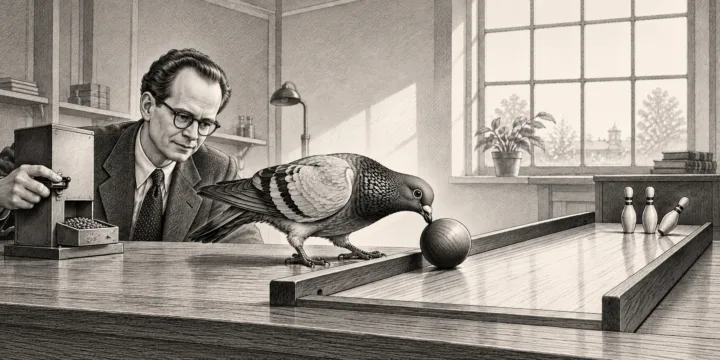
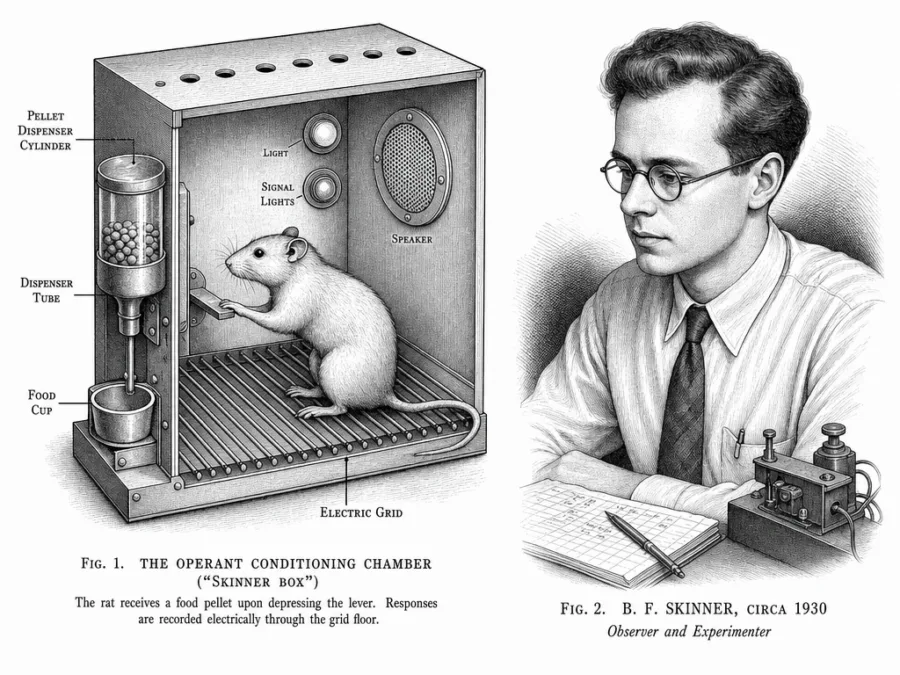
The book’s subject traces back to the 1930s, when a looming shortage of food pellets led Skinner to reinforce only some of a rat’s lever presses, an episode he recounted in his 1956 essay “A Case History in Scientific Method.” He reported early findings in The Behavior of Organisms in 1938. Most of the work behind the later book was conducted with pigeons at Harvard under Office of Naval Research contracts spanning 1949 to 1955.
Ferster, then completing his doctorate at Columbia, joined the work in 1950 and spent the next five years as Skinner’s research fellow. The finished book carried more than 900 figures, most of them cumulative records: running tallies of each bird’s responses over time under different reinforcement rules.
Four Schedules, Four Patterns
The basic schedules differ in two ways: whether reinforcement depends on a number of responses (a ratio) or the first response after a period of time (an interval), and whether that requirement is fixed or variable. Fixed-ratio schedules often produce a pause followed by rapid responding; fixed-interval schedules often produce a pause followed by accelerating responding. Variable-ratio schedules can sustain high, steady responding with little pausing, while variable-interval schedules commonly sustain more moderate, steady rates.

Why Intermittent Reinforcement Matters
Skinner saw the variable ratio at work outside the lab. In Science and Human Behavior in 1953, he called it “much more powerful” than a fixed ratio with the same average requirement, noting that a pigeon on it might respond five times a second for hours. Gambling houses, he added, had long understood its power.
“The efficacy of such [variable-ratio] schedules in generating high rates has long been known to the proprietors of gambling establishments.” – B.F. Skinner, Science and Human Behavior, 1953
Lloyd Humphreys documented a related effect in 1939. College students learned to blink at a light that preceded a puff of air to the eye. Those who received the puff on half the training trials showed more conditioned blinking after the puffs stopped than those who received it after every light. The finding demonstrated the partial-reinforcement extinction effect in a conditioned reflex; the experiment did not test tantrums or clinical treatment.
Thinning in Practice
Clinicians thin reinforcement schedules to make treatment more practical for caregivers, Kranak and Brown wrote. Approaches include lengthening the wait after a request, increasing the work required before a break, and signaling when reinforcement is available. The 1957 book devoted chapters to chained and multiple schedules. In functional communication training, a chained schedule can require task completion before a break request is honored. A multiple schedule can use green and red cards to signal availability and unavailability. Simply extending delays can bring problem behavior back and weaken the taught communication response, the review cautioned.
Behavior analysts call the return of an old behavior resurgence when reinforcement for its replacement becomes less favorable. In a 2021 inpatient study, Kranak and John Falligant reported resurgence during 22 of 24 treatment applications involving 20 patients. Applications were separate treatment evaluations, sometimes addressing different behavioral functions in the same patient. Researchers counted resurgence when the highest rate after a thinning step exceeded the highest rate in the preceding sessions; behavior did not have to return to pretreatment severity. Research has also tested ways to manage these increases. In a three-participant study, Louis Hagopian and colleagues found that access to individually assessed competing items generally allowed faster thinning with lower levels of problem behavior.
The six case series discussed by Kranak and Brown came from specialized clinical programs and included pediatric feeding treatment. Their findings may not apply equally to all ABA services. The authors called for comparable studies in homes, schools, and community settings, where resources, treatment intensity, and the behaviors being treated may differ.
Next in this series: Project Pigeon, Skinner’s wartime effort to train pigeons to guide a missile.
AT A GLANCE
| The book: | Ferster and Skinner’s Schedules of Reinforcement, published in 1957; 741 numbered pages and more than 900 figures |
| The research: | Pigeon research at Harvard, largely supported by Office of Naval Research contracts spanning 1949–1955; Ferster joined in 1950 |
| The four basic schedules: | Fixed ratio, variable ratio, fixed interval, and variable interval |
| Variable ratio: | Can sustain high, steady responding with little pausing; Skinner discussed its connection to gambling in 1953 |
| Partial-reinforcement extinction effect: | Humphreys’s eyelid-conditioning study found more persistent responding after partial than continuous light–air-puff pairing |
| Functional communication training: | Typically begins by reinforcing each taught request, then moves toward a schedule caregivers can implement |
| Resurgence during thinning: | 22 of 24 treatment applications involving 20 patients in one inpatient study; recurrence does not establish treatment failure |
| Where the data come from: | Specialized clinical programs; the review called for comparable research in homes, schools, and community settings |
SOURCES & REFERENCES
| 1. | Ferster CB, Skinner BF. Schedules of Reinforcement. New York: Appleton-Century-Crofts; 1957 (vii + 741 pp.). B.F. Skinner Foundation reprint, including forewords: https://www.bfskinner.org/wp-content/uploads/2015/05/Schedules_of_Reinforcement_PDF.pdf |
| 2. | Catania AC. “Ferster, C.B.” In: Volkmar FR, ed. Encyclopedia of Autism Spectrum Disorders. Springer; 2013:1274–1277. https://link.springer.com/rwe/10.1007/978-1-4419-1698-3_1293 |
| 3. | Skinner BF. “A Case History in Scientific Method.” American Psychologist. 1956;11(5):221–233. https://www.appstate.edu/~steelekm/classes/psy5300/Documents/Skinner1956.pdf |
| 4. | Skinner BF. The Behavior of Organisms: An Experimental Analysis. New York: Appleton-Century; 1938. Original-edition record: https://books.google.com/books?id=P-vaAAAAMAAJ |
| 5. | Skinner BF. Science and Human Behavior. New York: Macmillan; 1953 (p. 104). https://www.bfskinner.org/wp-content/uploads/2014/02/ScienceHumanBehavior.pdf |
| 6. | Humphreys LG. “The Effect of Random Alternation of Reinforcement on the Acquisition and Extinction of Conditioned Eyelid Reactions.” Journal of Experimental Psychology. 1939;25(2):141–158. https://doi.org/10.1037/h0058138 |
| 7. | Kranak MP, Brown KR. “Updated Recommendations for Reinforcement Schedule Thinning following Functional Communication Training.” Behavior Analysis in Practice. 2024;17(1):87–106. Published online October 11, 2023. https://pmc.ncbi.nlm.nih.gov/articles/PMC10891008/ |
| 8. | Kranak MP, Falligant JM. “Further Investigation of Resurgence following Schedule Thinning: Extension to an Inpatient Setting.” Behavioral Interventions. 2021;36(4):1003–1012. https://doi.org/10.1002/bin.1831 |
| 9. | Haney SD, Greer BD, Mitteer DR, Randall KR. “Relapse during the Treatment of Pediatric Feeding Disorders.” Journal of Applied Behavior Analysis. 2022;55(3):704–726. https://pmc.ncbi.nlm.nih.gov/articles/PMC10091143/ |
| 10. | Hagopian LP, Contrucci Kuhn SA, Long ES, Rush KS. “Schedule Thinning following Communication Training: Using Competing Stimuli to Enhance Tolerance to Decrements in Reinforcer Density.” Journal of Applied Behavior Analysis. 2005;38(2):177–193. https://pmc.ncbi.nlm.nih.gov/articles/PMC1226154/ |
| 11. | Skinner BF. “Pigeons in a Pelican.” American Psychologist. 1960;15(1):28–37. https://www.appstate.edu/~steelekm/classes/psy3214/Documents/Skinner1960.pdf |