
Reinforcement, punishment, extinction, and shaping are central concepts in applied behavior analysis (ABA). They help explain how board-certified behavior analysts (BCBAs) strengthen useful skills and address behavior that interferes with daily life. Skinner’s work helped establish this framework. Assessment, context, and client needs also guide treatment. [1,8]
Reinforce, Punish, or Withhold
Skinner’s 1953 book, Science and Human Behavior, applied his analysis of operant behavior to human activity. [1] In current terminology, positive and negative describe what happens after a response: positive means something is added; negative means something is removed. Neither term means good or bad. [2]
Reinforcement increases the likelihood of a behavior in the future. Positive reinforcement adds a stimulus; negative reinforcement removes an aversive one. Punishment decreases future behavior: positive punishment adds a stimulus, while negative punishment removes one. These labels depend on the observed effect, not simply on whether a consequence seems pleasant or unpleasant. [2,5] Extinction discontinues the reinforcement maintaining a response, so that response decreases over time. It differs from negative punishment, which removes a reinforcer after a response. [1,3]
An extinction burst is a temporary increase in a response’s frequency after reinforcement stops. In a 1995 analysis of 113 data sets, Dorothea C. Lerman and Brian A. Iwata found bursts in 24 percent of cases: 36 percent with extinction alone and 12 percent with additional treatments. Those treatments included differential reinforcement, noncontingent reinforcement, and changes to instruction. The sample included 99 published cases and 14 unpublished data sets. Because the review compared different cases, it did not establish that the added treatments caused the lower rate. It measured frequency, not intensity, and does not predict every client’s response. [3]
Shaping Builds What Isn’t There
Shaping uses reinforcement to develop a response through successive approximations. A clinician reinforces behavior that resembles the goal, then raises the criterion as the learner progresses. Earlier approximations stop earning reinforcement as closer ones take their place. This can build a skill that does not yet occur in its final form. [1,2]
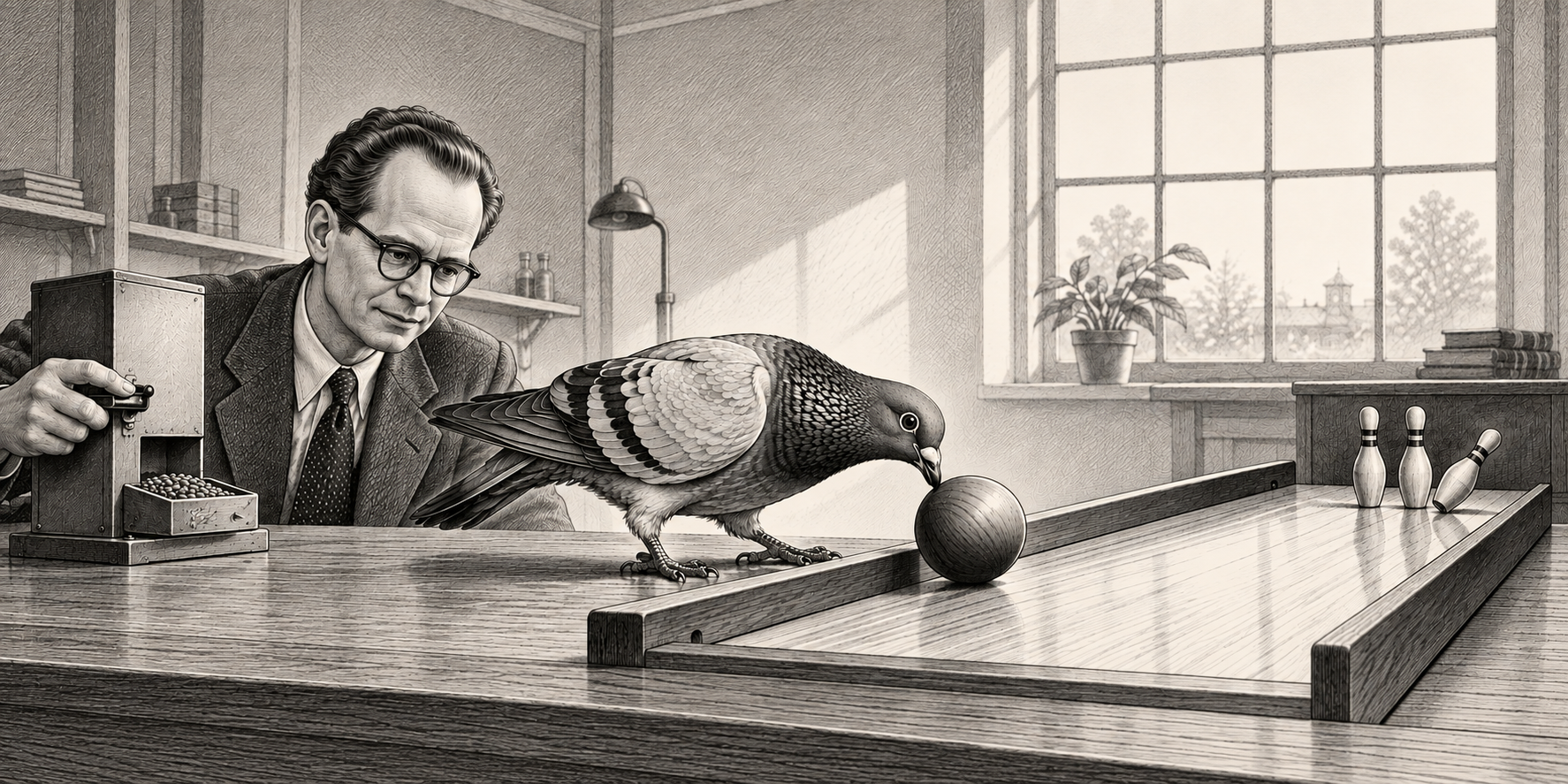
Skinner’s famous demonstration came in 1943, while he worked on a wartime project in a Minneapolis flour mill with Keller Breland and Norman Guttman. They set out to teach a pigeon to bowl by swiping a wooden ball with its beak. Using a hand-operated food dispenser, they reinforced movements progressively closer to a swipe. Within minutes, the bird was batting the ball around its box. In accounts reproduced by Gail B. Peterson in 2004, Skinner said the result “amazed us” and recalled the day as one “of great illumination.” Peterson distinguishes this episode from Skinner’s earlier work on successive approximations, published in 1938. The breakthrough was applying the method by hand. [4]
Skinner’s Case Against Punishment
Skinner questioned punishment’s lasting value and warned about its unwanted effects. [1]
“The commonest technique of control in modern life is punishment.” – B.F. Skinner, Science and Human Behavior (1953), p. 182. [1]
He argued that punishment could suppress behavior temporarily while encouraging fear, escape, or avoidance, and that immediate suppression could reinforce the person doing the punishing. [1] That historical position should not be read as proof that punishment is always weak or short-lived. Later research has documented lasting suppression under some conditions, alongside substantial variation across procedures and settings. A 2021 review by Rafaela M. Fontes and Timothy A. Shahan describes mixed evidence and the need for further research. Those findings do not establish that punishment is appropriate for a particular client. [5,8]
What a BCBA Does Now
Differential reinforcement of alternative behavior (DRA) strengthens an alternative response and often combines that reinforcement with extinction of the behavior being addressed. Extinction is not essential to every DRA procedure: a seven-child study found reductions without it when reinforcement favored the alternative response. [7] In functional communication training, a form of DRA, a team first assesses what maintains a behavior, then teaches a request that can serve the same purpose, such as asking for a break or attention. A 2020 review by the National Clearinghouse on Autism Evidence and Practice (NCAEP) identified differential reinforcement and functional communication training as evidence-based practices for autistic children, youth, and young adults through age 22. This classification concerns specific practices and studied outcomes; it does not guarantee benefit for every person or endorse an entire ABA program. [6]
The Ethics Code for Behavior Analysts from the Behavior Analyst Certification Board (BACB) requires interventions based on assessment and scientific evidence that prioritize positive reinforcement. It also requires attention to risks, client preferences, and informed consent. [8] If extinction is considered, planning should account for the possibility of a burst; the NCAEP report advises against using extinction alone. [3,6] Under BACB standard 2.15, restrictive or punishment-based procedures require documented failure of less intrusive means or an existing team’s determination that the risk of harm to the client outweighs the intervention’s risk. Required reviews and ongoing evaluation also apply; ineffective procedures must be changed or stopped. [8]
Reinforcement schedules add another question: how often should a response produce reinforcement? Continuous and intermittent reinforcement can affect learning and persistence when reinforcement stops. Their implications for maintaining skills are the subject of the next article in this series. [2]
AT A GLANCE
| Positive vs. negative: | Positive means adding a stimulus; negative means removing one. Neither means good or bad [2] |
| Reinforcement: | A consequence increases the future likelihood of the behavior it follows [2] |
| Punishment: | A consequence decreases the future likelihood of the behavior it follows [2,5] |
| Extinction: | Discontinuing the reinforcement maintaining a response, which decreases over time [1,3] |
| Extinction burst: | 24% of 113 data sets; 36% with extinction alone versus 12% with other treatments. A retrospective comparison, not an individual risk estimate [3] |
| Shaping: | Reinforcing successive approximations to a target response [1,2] |
| Shaping by hand: | 1943, Minneapolis: Skinner, Keller Breland, and Norman Guttman trained a pigeon to move a ball with its beak [4] |
| Skinner on punishment: | Questioned lasting effects and warned of side effects; later evidence complicates that account [1,5] |
| Key text: | Science and Human Behavior (1953), especially Chapters 5, 6, and 12 [1] |
| Autism evidence: | NCAEP’s 2020 review identifies differential reinforcement and functional communication training as evidence-based practices [6] |
| Modern ethic: | BACB: prioritize positive reinforcement; restrictive or punishment-based procedures require specific justification and monitoring [8] |
SOURCES & REFERENCES
| 1. |
Skinner BF. Science and Human Behavior. New York: Macmillan; 1953. Chapters 5, 6, and 12; quotation p. 182. https://www.bfskinner.org/wp-content/uploads/2014/02/ScienceHumanBehavior.pdf |
| 2. |
Spielman RM, Jenkins WJ, Lovett MD. Psychology 2e. OpenStax; April 22, 2020. Section 6.3, “Operant Conditioning.” https://openstax.org/books/psychology-2e/pages/6-3-operant-conditioning |
| 3. |
Lerman DC, Iwata BA. “Prevalence of the extinction burst and its attenuation during treatment.” Journal of Applied Behavior Analysis. 1995;28(1):93–94. https://doi.org/10.1901/jaba.1995.28-93 |
| 4. |
Peterson GB. “A Day of Great Illumination: B.F. Skinner’s Discovery of Shaping.” Journal of the Experimental Analysis of Behavior. 2004;82(3):317–328. https://doi.org/10.1901/jeab.2004.82-317 |
| 5. |
Fontes RM, Shahan TA. “Punishment and Its Putative Fallout: A Reappraisal.” Journal of the Experimental Analysis of Behavior. 2021;115(1):185–203. https://pmc.ncbi.nlm.nih.gov/articles/PMC7855474/ |
| 6. |
Steinbrenner JR, Hume K, Odom SL, et al. Evidence-Based Practices for Children, Youth, and Young Adults with Autism. UNC Frank Porter Graham Child Development Institute; 2020. pp. 75–77, 85, 89. https://ncaep.fpg.unc.edu/wp-content/uploads/EBP-Report-2020.pdf |
| 7. |
Athens ES, Vollmer TR. “An investigation of differential reinforcement of alternative behavior without extinction.” Journal of Applied Behavior Analysis. 2010;43(4):569–589. https://files.eric.ed.gov/fulltext/EJ910155.pdf |
| 8. |
Behavior Analyst Certification Board. Ethics Code for Behavior Analysts. Effective January 1, 2022; updated August 2024. Standards 2.11, 2.14–2.16. Accessed September 10, 2026. https://www.bacb.com/wp-content/ecba |









Join the discussion ▾