


The three minutes after a family hits submit
CHARM CITY AUTISM – When Akiva Schwartz demonstrated his intake system for BreakingNewsABA, the part he wanted noticed was not the form. It was what happened after it. Within about three minutes of a submission, he said, he could send back a document for signature with every field already filled in, and his billing company had the same information in hand.
Schwartz is the director of Charm City Autism, a Baltimore practice operating as Sar Shalom Holdings LLC. He says his market takes four months to move a child from an autism diagnosis to a first ABA session, and that he is trying to cut that to about two weeks.
“So imagine a three-and-a-half month win, and how efficient that could be,” he said in a September 11 interview.
That is a target rather than a result, and Schwartz said as much, describing it as what the practice is trying to do. The client agreement behind the system carries an effective date of August 1, 2026, which gives it roughly six weeks of operation. Within those six weeks, Schwartz and his team have started using this within their own clinic.
What Schwartz says the innovation is
What Schwartz points to is distribution. The same submission that generates a family’s documents also reaches, automatically and within minutes, his revenue cycle management provider, the consultant who handles intake follow-up and compliance, and the practice management platform the practice is moving to. According to Schwartz, none of them has to rekey the information or wait for someone to forward it.
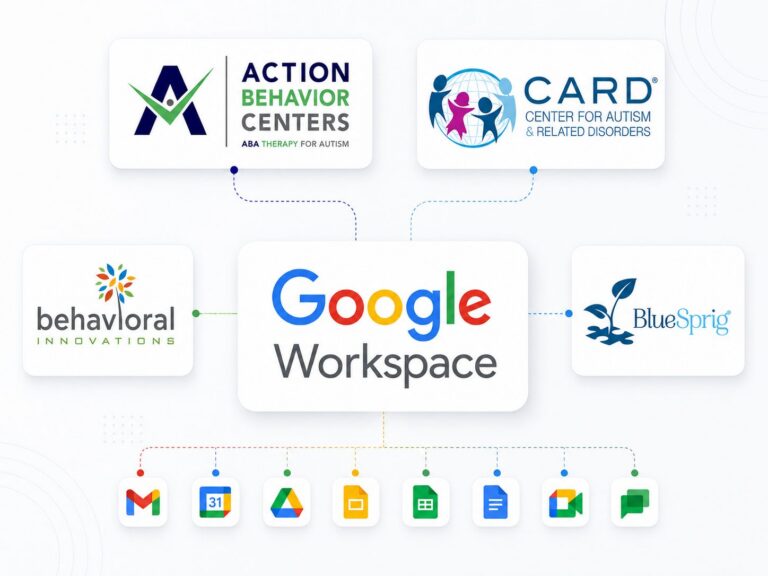
He also described a piece of the setup a family never sees. His website does not sit on a server cleared to hold protected health information, so the intake page is a wrapper built around a Google form rather than the form itself. That is why a family can submit without signing in to a Google account, he said, and why the data lands directly in Google’s environment. He cited Google’s business associate agreement as his reason for using its services, and said the practice expects to rebuild on Amazon Web Services.
Schwartz dates the build to the past six months and credits recent improvements in automation tooling for making it possible. He is particular about the vocabulary.
“I’d like to use the word automation, not AI, because when somebody uses the word AI, I feel sold to.” – Akiva Schwartz, Director, Charm City Autism (September 2026)
What he describes is an unbroken path. “Without a stop in the process, you could go from the website directly to the practice management system, which is the most innovative thing in healthcare,” he said in the September 11 interview.
An employee’s experience
Sarah Fakeye, who recently joined Charm City Autism, came to it from both administrative and direct-care work. Fakeye holds a B.A. in psychology, has spent more than five years in healthcare and behavioral health, including patient care coordination and telehealth coordination, and is a Registered Behavior Technician.
“What immediately stood out to me at Charm City Autism is how differently the company operates,” Fakeye said. “The technology is far more integrated into the day-to-day workflow than anything I’ve worked with before, and the speed at which problems are identified and solved is completely different.”
She also described a wait of her own. “In previous roles in ABA, I have personally waited as long as four months to begin working with a case as an RBT,” she said. “At Charm City Autism, there is a real focus on removing those bottlenecks and using technology to keep everything moving.”
“It is easily the most innovative and fast-moving healthcare environment I’ve worked in,” Fakeye said.
What the onboarding packet shows
The most concrete thing the system produces is paperwork. A demonstration copy of the practice’s client onboarding packet runs 55 pages across 14 numbered sections, with 13 initials blocks and a 26-point admissions certification in the final section.
The assignment of benefits is the part that carries the intake-to-billing argument. It authorizes the practice to verify eligibility, request authorization, submit claims, appeal denials, and receive remittance. A separate release addendum lets the practice request records from the clinician who diagnosed or referred the child.
Eli Koslowitz, whom Schwartz identified as the practice’s revenue cycle management provider, tied intake structure to later billing outcomes in his statement to BreakingNewsABA.
“By structuring critical information correctly at intake and carrying it consistently through the workflow, they addressed the root cause rather than the downstream symptoms.” – Eli Koslowitz, revenue cycle management provider, Charm City Autism (2026)
Koslowitz also wrote that the effect on his own team was “less administrative friction, fewer avoidable issues, and a more scalable process overall.” Schwartz said Koslowitz’s company serves 48 ABA providers.
Krista Denoff, founder and CEO of KD Consulting, advised on the system’s development and works with the practice on intake follow-up and compliance. She says she has helped start and support more than 50 ABA businesses. In her statement, she said the information a family provides “drives the documents, tasks, reminders, and staff follow-up that come next.”
Tracking the work as a fraud control
Schwartz’s second argument for the system has little to do with speed. He frames intake automation as a compliance measure.
“I see what I’m building not just as an intake form. It’s a compliance side of things, which means that everything is tracked, which gets rid of lots of fraud.” – Akiva Schwartz, Director, Charm City Autism (September 2026)
His reasoning comes from his accounting training. “One of the biggest issues I see in all these fraudulent type spaces is that you don’t have enough people seeing things,” he said, describing a rule about keeping two sets of eyes on a transaction. That is segregation of duties, stated in plain terms, and it is a reasonable thing to want in a field where federal auditors are active.
The bigger picture is that the compliance argument sits awkwardly beside the efficiency one. Schwartz described the system as “a massive cost cut” that “essentially takes an intake coordinator and a care coordinator and puts the roles together, essentially eliminating that position,” and said in the same breath that he had recently hired one person who now holds both roles. No one lost a job. A design that consolidates two roles into one is still, on its face, in tension with a rationale built on having more people look at the same information.
What comes next
Schwartz wants to turn the system into a product other providers can buy. He said he had not set out to build one, and that he understood what he had only when the people he showed it to told him.
The accounts gathered here explain what he is trying to change. Build cost, implementation time, and a before-and-after on wait times are what another provider would need to judge whether the approach travels.
Schwartz said the integration with the new practice management platform is in the process of being built. Until it runs, two weeks remains the thing he is building toward.
AT A GLANCE
| Practice: | Charm City Autism, Baltimore, Maryland (legal entity Sar Shalom Holdings LLC dba Charm City Autism) |
| Stated goal: | About two weeks from autism diagnosis to ABA therapy; a target, not a measured result (Schwartz, September 2026) |
| Baseline he cites: | Four months in his market, from the September 11, 2026 interview; no supporting source provided |
| What Schwartz calls the innovation: | Structured intake data reaching the billing provider, compliance consultant, and practice management platform within minutes, without rekeying (Schwartz, September 2026) |
| Technical setup: | A wrapper around a Google form so families submit without a Google account; data held in Google under its business associate agreement; a rebuild on Amazon Web Services is planned (Schwartz, September 2026) |
| Agreement effective date: | August 1, 2026, Document Version 1.0 |
| Visible output: | A 55-page onboarding packet, 14 sections, 13 initials blocks, and a 26-point admissions certification |
| Billing instrument: | Section 5.11, assignment of benefits: eligibility, authorization, claims, appeals, and remittance |
| Fraud provision: | Section 11.2 places fraud, waste, and abuse obligations on the family, not the practice |
| Staffing effect: | Intake coordinator and care coordinator roles combined into one position; one person hired into the combined role, no layoffs (Schwartz, September 2026) |
| Sourcing note: | Statements from Fakeye, Koslowitz, and Denoff were solicited by Schwartz, who supplied them a draft of this article beforehand |
| Undisclosed partner: | Schwartz reports free integration and a signed long-term partnership with the owner of the practice management platform; not named pending confirmation |
| Still to confirm: | Measured wait times, billing results, build cost, implementation time, and independent review of privacy safeguards |
SOURCES & REFERENCES
| 1. | Akiva Schwartz, Director, Charm City Autism. Follow-up interview, September 2026. Recorded; supplied as Recording 9. Covers system architecture, data distribution to partners, protected health information handling, partner relationships, and how the written statements in this article were obtained. |
| 2. | Akiva Schwartz, Director, Charm City Autism. Interview, September 11, 2026. Recorded; Recording 7, timecoded transcript. Three passages placed off the record at his request are not used here. |
| 3. | Charm City Autism. Client Onboarding Packet, Services Agreement and Admission Consents. Document Version 1.0, effective August 1, 2026. Demonstration copy generated September 4, 2026, 55 pages, read directly from the file. |
| 4. | Sarah Fakeye, Registered Behavior Technician, Charm City Autism. Written statement supplied for this article, September 2026, solicited by Schwartz. |
| 5. | Eli Koslowitz. Written statement supplied for this article, 2026, solicited by Schwartz. Identified by Schwartz as the practice’s revenue cycle management provider. |
| 6. | Krista Denoff, founder and CEO, KD Consulting. Written statement, 2026, solicited by Schwartz, on her ABA consulting experience and her input on the system. |
| 7. | Code of Maryland Regulations (COMAR) 10.09.36, cited in the Charm City Autism client agreement. |




Join the discussion ▾