

Charm City Autism Director Akiva Schwartz wants the people helping families start ABA to spend less time moving information from one document to another.
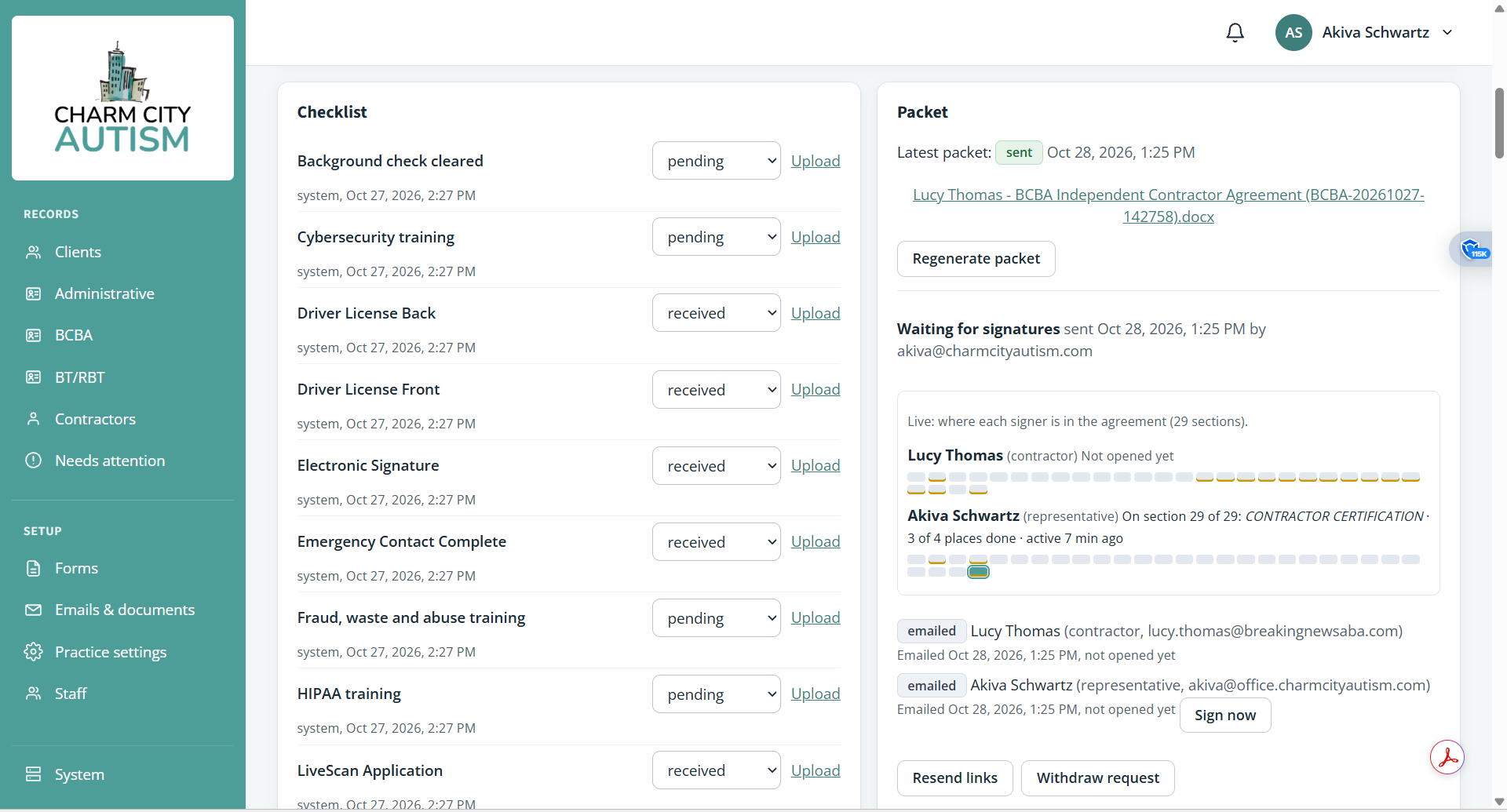
Since first sharing Charm City Autism’s intake automation project with Breaking News ABA, Schwartz has rebuilt the system. In a follow-up demonstration, he showed how information entered into a form can carry into documents, move through signature requests, and leave a record of what happened along the way.
The changes serve a practical goal: reduce the administrative work required to get people through the process so staff have more time to help them.
For families, Charm City Autism wants fewer steps between reaching out and beginning services. For the practice, he wants less time spent correcting paperwork and checking whether the next person has what they need.
The technology has advanced. The problem they are trying to solve remains familiar.
Building Around the Work
The approach starts with the tasks themselves. Before designing how a process should move, Schwartz said, he worked through the individual steps involved.
“I basically did every one of these tasks before designing the next task,” Schwartz said.
That experience shapes what he wants the system to do. An intake process can involve collecting information, checking documents, following up, and making sure the right person receives the right material. In his view, delays happen when information is entered incorrectly or doesn't move where it needs to go.
His answer is to build those connections into the process.
During the demonstration, Schwartz used sample information to walk through clinician onboarding. Details entered into the system carried into documents, including a W-9. He also showed how information could populate paperwork needed for a fingerprinting process.
Rather than asking someone to start over with each document, the system uses information already collected.
The demonstration focused on onboarding a clinician, but it illustrated the method behind his broader intake work. Both involve getting information into the right place before the next step can happen.
Catching the Small Problems Earlier
Along with moving information, Schwartz wants the technology to catch certain problems before paperwork moves forward.
One example was a Social Security number field requiring nine digits. An incomplete entry could be flagged before submission, reducing the need for someone to identify the missing information later and request it again.
That check does not establish whether a number is accurate. It addresses a specific problem: an entry that does not meet the required format.
For Charm City Autism, those details are part of the larger operational challenge. Different documents have different requirements, and staff needs to know what belongs where. When something is missing, the process can turn into another exchange of emails or another request to the person completing it.
The updated system runs on an internal server, Schwartz said. During the demonstration, he moved from collecting sample information to generating documents and requesting signatures.
The point was to show how those steps connect, with less manual work between them.
Knowing Where the Process Stands
Once paperwork has been sent, staff still need to know what happened to it.
Schwartz showed audit logs that record activity such as document views and signatures, with timestamps showing when actions occurred. He also demonstrated records associated with the email address used in the process.
That history gives staff a way to see whether a document has been viewed or signed and identify what still needs attention.
It also reflects another priority for Schwartz: accountability. He wants a record of who interacted with the paperwork and when, rather than relying on people to reconstruct the sequence afterward.
The interview included a preview of a further version still under development. Schwartz described plans to make progress through forms more visible so staff could better identify where someone needed help. Those planned features are separate from the functions demonstrated in the current system.
Making Room for the People
Schwartz sees three connected benefits in the project: reducing administrative costs, improving the record of activity, and giving the company more room to focus on other work.
That last piece brings the technology back to people. Time spent checking submissions and transferring information is time staff cannot spend talking with parents or supporting employees.
He described the opportunity as “talking to the parents, providing care, training staff.”
The staffing comparison he offered involved different companies, rather than a measured reduction in Charm City’s own intake team. His broader argument is that a practice can reduce the number of manual tasks involved without asking every employee to work faster through the same process.
Getting families into treatment within two weeks remains his goal. The demonstration showed administrative functions, not a completed measurement of treatment wait times. Faster paperwork is one part of the path he is trying to shorten.
For now, the rebuilt system makes that effort more tangible. Information carries into documents. Signature activity leaves a record. Some incomplete entries can be caught before they create another round of follow-up.
Each change targets work that someone would otherwise have to do manually. Schwartz wants the time saved to reach beyond the paperwork, giving staff more room to help the families waiting on the other side of it.
AT A GLANCE
| Who | Akiva Schwartz, Director, Charm City Autism (Baltimore) |
| What changed | A rebuilt intake and onboarding automation system |
| What it does | Carries form information into documents, moves them through signature requests, and keeps timestamped audit logs of views and signatures |
| Error check | Flags a Social Security number entry that is not nine digits before submission; it does not verify accuracy |
| Where it runs | An internal server |
| Goal | Getting families into treatment within two weeks |
| In development | A version that makes progress through forms more visible to staff |