

What the Budget Actually Says
RICHMOND, VIRGINIA – Steve Ford, director of the Department of Medical Assistance Services, told behavioral health providers, Cardinal Care managed care organizations and Acentra Health on July 28 that the agency is pursuing federal sign-off on two changes to applied behavior analysis, and that nothing about authorization changes yet. “Please note that no changes will be made to the current authorization process until CMS approves these changes and updates to the DMAS Mental Health Services Manual have been finalized,” the bulletin reads.
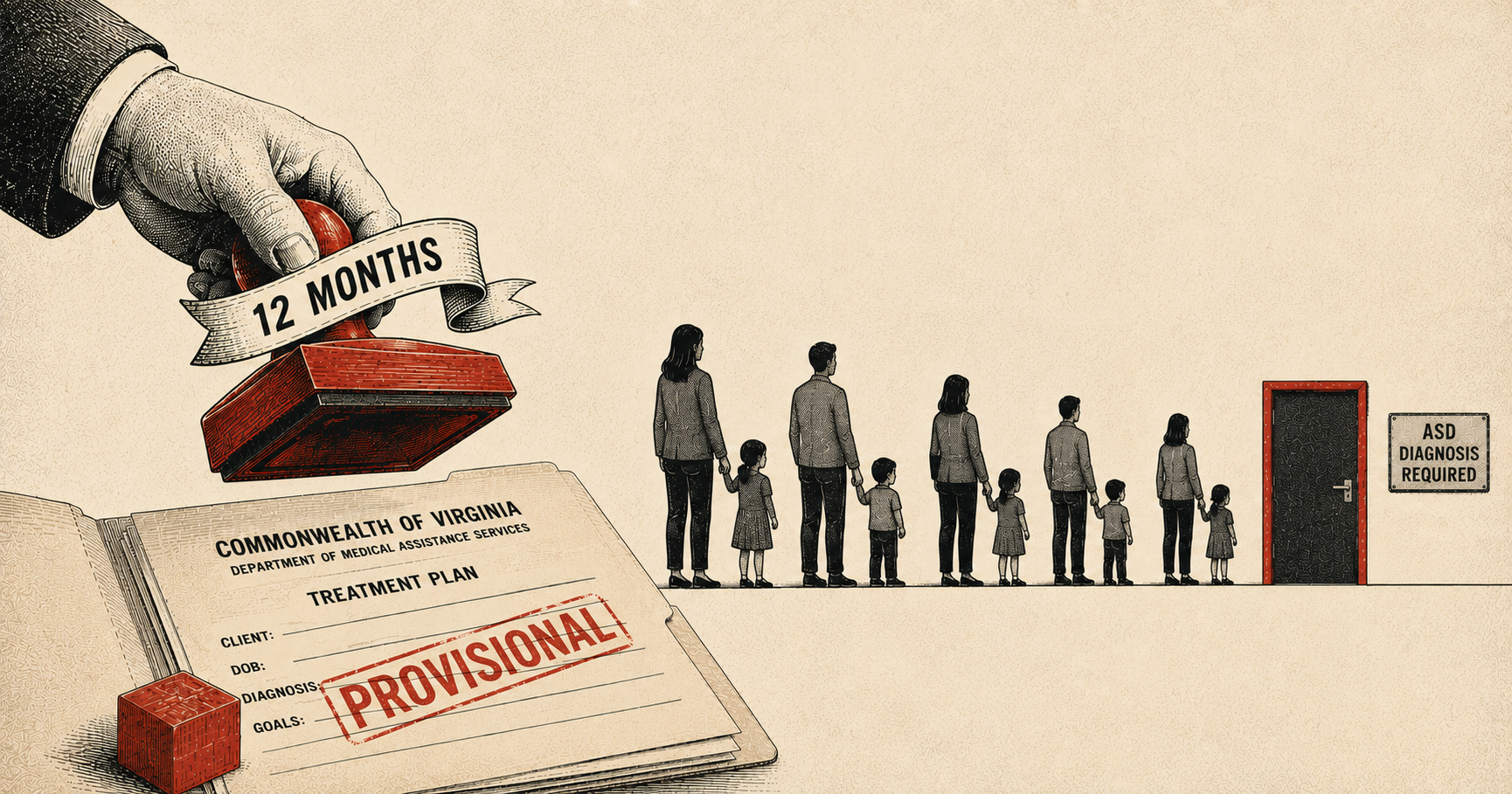
The mandate is Item 291, paragraph WW.2 of the budget approved June 29, Chapter 1 of the 2026 Special Session I. Its operative sentences are short. DMAS “shall impose a 20 hour per week cumulative limit per recipient on services provided under ABA, effective July 1, 2026; such limit can be exceeded based upon documented medical necessity under early and periodic screening, diagnostic and treatment (EPSDT).” The agency “shall require a diagnosis of autism spectrum disorder before authorizing ABA services; however, children age 5 and younger may receive a provisional diagnosis for one-year utilizing a protocol designated by DMAS.”
The same paragraph directs DMAS to issue documentation guidance, to “coordinate with managed care organizations (MCO) to perform periodic pre- and post-payment reviews of ABA payments,” and to require “specific reporting from each MCO that can be analyzed across MCOs, by region, by provider, and at a statewide level.” It exempts behavior therapy delivered by local education agency providers and reimbursed through the fee-for-service school-based services program. It authorizes emergency regulations “within 280 days or less from the enactment of this act.” And it closes with the clause that governs everything above it: DMAS “shall implement this change upon federal approval.”
Two dates therefore sit in one paragraph. The limit is effective July 1, 2026. Implementation waits on Washington.
The Diagnosis Rule Is the Narrowing
Virginia’s published ABA eligibility criteria do not mention autism. Appendix D of the DMAS Mental Health Services Manual, revised July 17, 2025, requires that the youth be under 21, that the youth “currently meets criteria for a primary ICD diagnosis that correlates to a DSM diagnosis or has a provisional psychiatric diagnosis as developed by an LMHP when no definitive diagnosis has been made,” that the youth meet at least two of five listed criteria covering communication, social interaction, behavioral outbursts, repetitive behaviors and sensory integration, and that a family or caregiver be available to participate. The word autism appears nowhere in the appendix.
That is what the budget overturns. Requiring an autism spectrum diagnosis before authorization removes eligibility from children whose qualifying diagnosis is intellectual disability or another developmental condition. It changes who can receive ABA at all, not how much an eligible child receives.
The current manual is also open-ended about provisional diagnoses. DMAS guidance states there is no timeframe for the use of a provisional psychiatric diagnosis. The budget replaces that with 12 months for children 5 and under only, on a protocol that DMAS has yet to designate.
The unwritten protocol is where the policy will be decided. Nothing published says which professionals may issue a provisional diagnosis, what screening must support it, whether the year runs from diagnosis, authorization, or first treatment, what becomes of a child who cannot obtain a full evaluation inside twelve months, or whether a break in Medicaid enrollment restarts the clock.
An advocacy campaign hosted on the platform FastDemocracy argues the wait is the problem. It tells families that in many parts of Virginia the wait for an autism evaluation runs up to 18 months and that under the proposal “children could receive no services during that wait.” The 18-month figure carries no citation, and BreakingNewsABA found no published Virginia data on evaluation wait times at DMAS, JLARC, the state behavioral health agency, or the VCU Autism Center for Excellence. A 2025 survey of 111 autism specialty centers across 38 states, sponsored by the diagnostic company Cognoa, reported that 15 percent had waits beyond one year or waitlists closed to new referrals, which makes the claim directionally plausible and unverified.
The campaign names no sponsoring organization. Its only image file is titled Two Capitols, which matches Two Capitols Consulting, a Richmond lobbying firm whose registered clients for May 2026 through April 2027 include the Virginia Association for Behavior Analysis and the Virginia Institute of Autism, according to the Virginia Public Access Project. Neither organization claims the campaign, and the connection rests on a filename and a lobbying registration rather than a disclosure.
“We are not asking for new funding; we are asking lawmakers to preserve the access to ABA that families currently have.” – Take Action to Preserve ABA Services in the Budget, advocacy campaign hosted on FastDemocracy (2026)
The 20-Hour Number Is Not New
Twenty hours has been the documentation threshold in Virginia for some time, and the state’s own phrasing cannot determine whether it falls within that threshold. Appendix D and both ABA authorization forms, effective September 1, 2025, use the same self-contradicting construction: “for all requests exceeding 20 hours (80 units) or more per week,” providers must submit the schedule of activities used to structure sessions and describe how the activity will facilitate implementation of the ABA treatment. Exceeding 20 hours and 20 hours or more are different triggers, and at exactly 80 units they point opposite directions. The forms themselves suggest an inclusive reading: their final page is headed “Schedule (20 Hours or more).”
What changes is the consequence, not the number. A threshold that triggered paperwork becomes a cumulative limit, with the EPSDT route left open. Because Virginia covers ABA only under EPSDT for recipients under 21, and some individuals over 21 reach behavior analysts through Therapeutic Consultation instead, the exception is available to every recipient to whom the limit applies.
How it lands depends on parties that DMAS does not control on a day-to-day basis. ABA runs through both fee-for-service, where Acentra Health handles authorization, and Cardinal Care Managed Care, which, since July 1, 2025, has included five plans: Aetna Better Health of Virginia, Anthem HealthKeepers Plus, Humana Healthy Horizons in Virginia, Sentara Community Plan, and UnitedHealthcare Community Plan. Humana joined, and Molina exited on June 30, 2025. Per guidance from the Virginia Association for Behavior Analysis, plans may be more lenient than state regulation but not stricter, so no plan can set a threshold below the state’s.
What the Money Says
The introduced budget booked the savings under the heading Appropriate Utilization of ABA: $67.6 million in general funds across the biennium, shown in parentheses on the Senate Finance and Appropriations Committee’s June 16 tally because it represents a reduction. The underlying amendment table splits it $30,835,157 in fiscal 2027 and $36,771,409 in fiscal 2028, with nongeneral fund savings of $32,820,192 and $39,036,323. One widely circulated amendment explanation describes the general fund figure as “$30.8 million from the general fund each year,” which understates the biennial total by roughly $6 million and contradicts the table printed above it.
Conference negotiators gave some back. Amendment 291 #18c, which created the provisional diagnosis pathway for children five and younger, restored $8,924,572 in fiscal 2027 and $10,628,353 in fiscal 2028. The committee’s June 22 conference briefing shows the arithmetic in a single line: $67.6 million in savings, $9.6 million restored, $58.0 million net.
Against that, Virginia has now twice declined to raise ABA rates. A 10 percent increase carrying $11.3 million in general funds and $11.8 million in nongeneral funds was filed as Item 288 #12h in the 2025 session by Delegate Sickles, on the stated ground that Virginia’s ABA rates rest on a rate study conducted before 2018. It never advanced past a member request, appearing in no committee-approved, floor-approved, or conference version, and the enacted 2025 budget contains no such provision. DMAS issued July 1, 2025 rate bulletins for home health, outpatient rehabilitation, personal care, waiver services, and addiction treatment, and none for ABA. A second attempt in the 2026 session, Item 291 #32h, also failed. Virginia’s most recent behavioral health rate action is as of January 1, 2024.
The result is a state tightening utilization on a fee schedule it has left alone.
Virginia has cut $58 million from ABA utilization while twice declining to raise rates its own legislators described as resting on a study older than the CPT codes providers bill under.
Documentation, Audits and a Workgroup
The provisions that draw the least attention may reach the most providers. Coordinated pre-payment and post-payment review across the managed care plans, plus reporting the state can slice by MCO, region, provider, and statewide, describes a program integrity apparatus rather than a benefit change. For an operator, the exposures are record requests, payment holds, and retrospective recoupment.
Paragraph WW.3 adds a body that could rewrite the rest of the text. DMAS must convene an ABA Benefit Utilization Workgroup to examine expenditure and utilization trends “and identify strategies to control costs while still preserving access to care for those in need of the therapy.” Its charge runs to eight items, among them reviewing service authorization criteria and standard assessment tools, defining medical necessity criteria “taking into account behavioral factors, ability to learn, age and development, and skills development,” reviewing practitioner certification, licensing and supervision standards, evaluating utilization management tools aligned with national practice guidelines from independent nonprofits, and evaluating “the appropriateness of ABA services for children with diagnoses other than ASD.”
That last item reopens the question the diagnosis requirement appears to settle. Membership must include center-based and home-based ABA providers, managed care representatives, Virginia-licensed behavior analysts, and a child or adolescent psychiatrist. Meetings must be open to the public and offer opportunities for public input.
No operational detail exists yet. BreakingNewsABA found no published documentation, guidance, review protocol, reporting specification, or workgroup schedule as of July 30.
Nothing Has Been Filed
The budget tells DMAS which federal door to use. Paragraph WW.2 grants the agency authority “to amend the state plan under Titles XIX and XXI of the Social Security Act to effect these changes,” which points to a state plan amendment. The July 28 bulletin is vaguer, saying only that “DMAS is taking steps to obtain approval from the Centers for Medicare and Medicaid Services (CMS) for these changes.” It names no mechanism or timetable and says the effective date “will be announced in a subsequent notice.”
As of July 30, no ABA amendment appears on the agency’s public list of SPAs filed with CMS. That list runs through SPA 26-010, filed July 28, 2026, titled Inpatient and Outpatient Coverage. Pending submissions are not always published promptly, so the absence of an item from the list is not proof that nothing was sent. The Virginia Association for Behavior Analysis, writing on July 1, described the filing as still ahead: one key next step, it told members, is for DMAS to file a state plan amendment with CMS.
For providers, the practical reading is narrow. July 1, 2026, is the statutory effective date, not an operative one, and the authorization process in force today is the one outlined in Appendix D.
One proposal that would have run the other way did not survive. Item 291 #31h, filed by chief patron Walker, would have created a pilot letting “licensed and Medicaid-enrolled applied behavioral analysis providers to bill Medicaid directly for medically necessary services delivered in public school settings,” explicitly to “eliminate the requirement that local school divisions serve as the financial intermediary” and to reduce “reliance on more restrictive and higher-cost private day placements.” It carried $250,000 and a report due November 1, 2028. It appears only as a member request, in no committee-approved, conference, or enacted version, and there is no Senate companion. Under the arrangement that stands, a local education agency is the enrolled biller for school-delivered ABA, following state plan amendment 21-0017, approved September 25, 2023, and effective retroactively to July 1, 2022.
Oversight arrives mid-implementation. On December 16, 2025 the Joint Legislative Audit and Review Commission authorized a review of how DMAS manages and oversees Medicaid and CHIP managed care, including how the department “ensures that Medicaid and CHIP enrollees access medically appropriate care while also detecting and preventing overutilization, inefficiencies, fraud, waste, and abuse,” and its approach to “financial oversight, rate setting, and expenditure forecasting.” JLARC’s workplan notes the reason bluntly: “In recent years, the DMAS forecast has significantly underestimated future spending needs.” Publication is scheduled for December 2026, with the item on the commission’s December 14 agenda.
AT A GLANCE
| Enacting vehicle: | Item 291, paragraph WW.2 and WW.3, Chapter 1 of the 2026 Special Session I (HB 30), approved June 29, 2026 |
| Hours provision: | 20 ABA hours per week cumulative per recipient, effective July 1, 2026, exceedable on documented medical necessity under EPSDT |
| Reach of the exception: | Every recipient the limit applies to. Virginia covers ABA only under EPSDT, for recipients under 21 |
| Eligibility change: | ASD diagnosis required before authorization. The word autism does not appear in current criteria (DMAS Mental Health Services Manual, Appendix D, rev. July 17, 2025) |
| Provisional pathway: | Children 5 and younger, one year, on a protocol DMAS has not yet designated. Current policy sets no time limit on provisional diagnoses. |
| School exemption: | Behavior therapy by local education agency providers through the fee-for-service school-based program is exempt |
| Emergency regulations: | Authorized within 280 days or less of enactment |
| Existing 20-hour rule: | A documentation trigger, not a cap. Source language reads “exceeding 20 hours (80 units) or more per week”; the form’s heading on its schedule page is “Schedule (20 Hours or more).” |
| Savings booked: | $67.6 million GF for the biennium ($30.8M FY2027, $36.8M FY2028), plus $32.8M and $39.0M NGF |
| Savings restored: | $9.6 million GF via conference amendment 291 #18c for the under-5 provisional pathway ($8.92M FY2027, $10.63M FY2028) |
| Net general fund savings: | $58.0 million (Senate Finance and Appropriations conference briefing, June 22, 2026) |
| Rate status: | No increase. A 10% ABA rate increase failed as a member request in 2025 (Item 288 #12h) and again in 2026 (Item 291 #32h). Last behavioral health rate action: January 1, 2024 |
| Federal filing status: | No ABA SPA on the DMAS public list as of July 30, 2026. The list runs through SPA 26-010, filed July 28, 2026 |
| School billing pilot: | Item 291 #31h would have let ABA providers bill Medicaid directly for school-delivered services. Not adopted; member request only |
| Next oversight milestone: | JLARC review of DMAS managed care oversight, authorized December 16, 2025, scheduled for publication December 2026 |
SOURCES & REFERENCES
| 1. | Commonwealth of Virginia. Item 291, Department of Medical Assistance Services, paragraphs WW.1, WW.2 and WW.3. Chapter 1 of the 2026 Special Session I (HB 30), approved June 29, 2026. budget.lis.virginia.gov/item/2026/2/HB30/Chapter/1/291/ |
| 2. | Ford, Steve, Director, Virginia Department of Medical Assistance Services. “Applied Behavior Analysis (ABA) Policy Changes.” Provider bulletin to Behavioral Health Providers, Cardinal Care Managed Care Organizations and Acentra Health. July 28, 2026. vamedicaid.dmas.virginia.gov/bulletin/applied-behavior-analysis-aba-policy-changes |
| 3. | Virginia Department of Medical Assistance Services. Mental Health Services Manual, Appendix D, revised July 17, 2025. ABA medical necessity and admission criteria, and documentation requirements for requests at or above 20 hours (80 units) per week. vamedicaid.dmas.virginia.gov |
| 4. | Virginia Department of Medical Assistance Services. Applied Behavior Analysis initial (preservice) and continued stay (concurrent) service authorization forms, effective September 1, 2025. dmas.virginia.gov |
| 5. | Virginia Department of Medical Assistance Services. “Applied Behavior Analysis FAQs” (Project BRAVO services). Provisional psychiatric diagnosis has no timeframe under current policy. dmas.virginia.gov |
| 6. | Virginia General Assembly. Budget amendment Item 291 #30h, “Eliminate Certain Restrictions on Medicaid Applied Behavioral Analysis Services,” HB 30 (2026), member request. Fiscal table showing GF savings of $30,835,157 in FY2027 and $36,771,409 in FY2028 and NGF savings of $32,820,192 and $39,036,323. budget.lis.virginia.gov |
| 7. | Virginia General Assembly. Conference report amendment Item 291 #18c, “Medicaid ABA Services for Children Age 5 and Younger with Provisional Diagnosis,” HB 30 (2026 Special Session I). $8,924,572 FY2027 and $10,628,353 FY2028. Conference report amendment Item 291 #13c, “Applied Behavioral Analysis Workgroup (Language Only).” budget.lis.virginia.gov |
| 8. | Senate Finance and Appropriations Committee. Senate proposal document, June 16, 2026, listing “Appropriate Utilization of ABA (67.6)” among general fund actions for the 2026-28 biennium; and conference report briefing, June 22, 2026, showing the walk from $67.6 million in savings to $58.0 million net. sfac.virginia.gov |
| 9. | Virginia General Assembly. Budget amendment Item 288 #12h, “Increase Medicaid Rates for Applied Behavior Analysis Services by 10%,” HB 1600 (2025), chief patron Sickles, member request. $11,292,147 GF and $11,753,051 NGF; not adopted. Item 288 as enacted in Chapter 725 contains no such provision. A 2026 successor, Item 291 #32h, also failed. budget.lis.virginia.gov |
| 10. | Virginia General Assembly. Budget amendment Item 291 #31h, “Pilot Program for Billing School-based Medicaid ABA Services,” HB 30 (2026), chief patron Walker, member request only; not adopted. Note: the explanation block displayed on this page belongs to a different amendment. budget.lis.virginia.gov |
| 11. | Centers for Medicare & Medicaid Services. Virginia state plan amendment TN 21-0017, approved September 25, 2023, effective July 1, 2022, covering local education agency reimbursement for services including applied behavior analysis. medicaid.gov |
| 12. | Virginia Department of Medical Assistance Services. “SPAs Filed with CMS,” reviewed July 30, 2026. Most recent entry SPA 26-010, filed July 28, 2026. No ABA amendment listed. dmas.virginia.gov |
| 13. | Virginia Department of Medical Assistance Services. “July 1, 2025 Implementation of New Cardinal Care Managed Care Contract,” bulletin, May 29, 2025, and Cardinal Care Managed Care plan roster. Humana Healthy Horizons joined July 1, 2025; Molina exited after June 30, 2025. vamedicaid.dmas.virginia.gov and coverva.dmas.virginia.gov |
| 14. | Virginia Association for Behavior Analysis. “Budget Item 291 Update,” July 1, 2026, describing a state plan amendment filing as a key next step; and “For Medicaid Providers” guidance on MCO latitude and school-based billing. virginiaaba.org |
| 15. | FastDemocracy. “Take Action to Preserve ABA Services in the Budget.” Advocacy campaign, 2026. Source of the 18-month evaluation wait claim, and the campaign’s stated ask. No sponsoring organization is disclosed on the page. fastdemocracy.com |
| 16. | Virginia Public Access Project. Lobbying registrations for Two Capitols Consulting, May 2026 through April 2027, listing the Virginia Association for Behavior Analysis and the Virginia Institute of Autism among clients. vpap.org |
| 17. | International Society for Pediatric Innovation. “Wait Times and Processes for Autism Diagnostic Evaluations: A First Report Survey of Autism Centers in the U.S.” Survey of 111 centers across 38 states, 11 percent response rate, sponsored by Cognoa. ispi4kids.org |
| 18. | Joint Legislative Audit and Review Commission. Study resolution, “Medicaid and Children’s Health Insurance Program managed care oversight,” authorized December 16, 2025; 2026 Workplan; and commission calendar listing the item for December 14, 2026. jlarc.virginia.gov |







Join the discussion ▾