
Cuts in All but One Locality
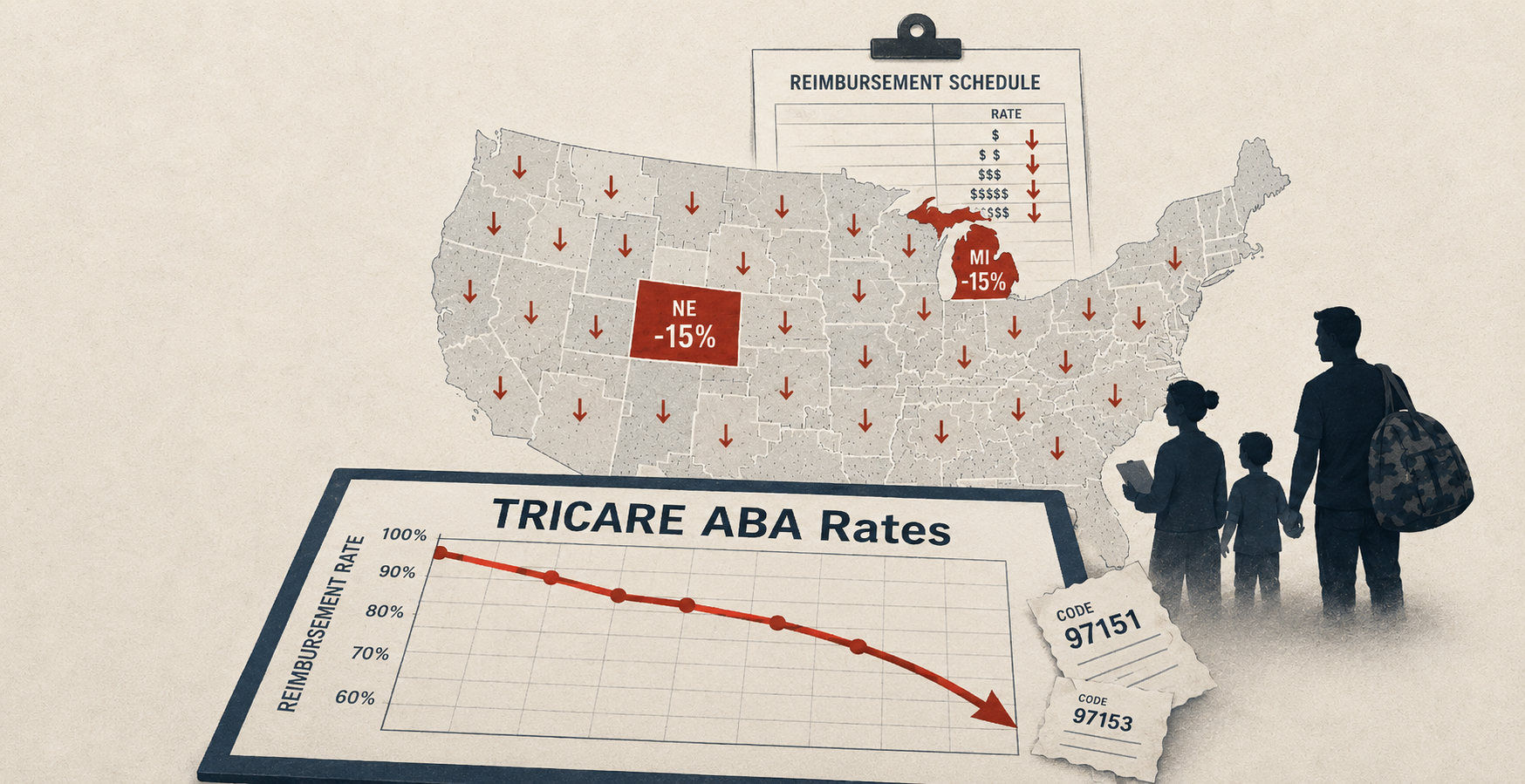
FALLS CHURCH, VIRGINIA – On May 1, the Defense Health Agency reduced TRICARE’s ABA reimbursement rates in most areas. The 2026 schedule, posted on Health.mil on April 1, lowers at least one rate in 115 out of 116 localities. Nebraska and Michigan face the largest cuts, up to 15 percent.
A BreakingNewsABA comparison of the 2026 tables against the 2025 schedule, both published by DHA, shows reductions across core billing codes. CPT 97151, the behavior identification assessment billed by BCBAs and BCBA-Ds, fell in 100 localities, held flat in 12, and rose in 4. The behavior technician rate under CPT 97153, the one-on-one treatment code, fell to 104. Most declines are small, with median changes of 0.9 percent in the assessment code and 1.4 percent in the technician rate.
The only schedule not affected is for the Philippines, which already uses the demonstration’s minimum rates.
Nebraska and Michigan Take 15 Percent Cuts
Nebraska’s rate cuts affect almost the entire table. Rates dropped in 8 out of 9 categories, including 15 percent cuts for assessments, technician-delivered treatment, and family guidance. The assessment rate went from $51.75 to $43.99 per 15-minute unit, or from $207.00 to $175.96 per hour. The technician rate for 97153 fell from $27.71 to $23.55, and the family guidance rate for CPT 97156 dropped from $43.44 to $36.92. Nebraska is facing one of the largest reductions in the country.
In Michigan, both Detroit/Ann Arbor and the rest of the state saw a 15 percent cut in the assessment code, dropping from $40.80 to $34.68 per unit. Indiana’s assistant-level treatment rate also fell 15 percent, to $21.90. South Dakota’s family guidance rate dropped 15 percent, to $32.29. The technician rate in the Rest of New York locality decreased by 8.9 percent.
In other areas, the rate decreases are smaller but consistent. Connecticut’s assessment rate fell by 1.9 percent to $35.96, and Los Angeles saw a 1.6 percent drop. Some places saw increases: Georgia’s assessment rate rose by 3.0 percent, and New Mexico saw several increases, including an 11 percent rise in technicians’ rates. Overall, most rates are still going down.
How DHA Sets the Rates
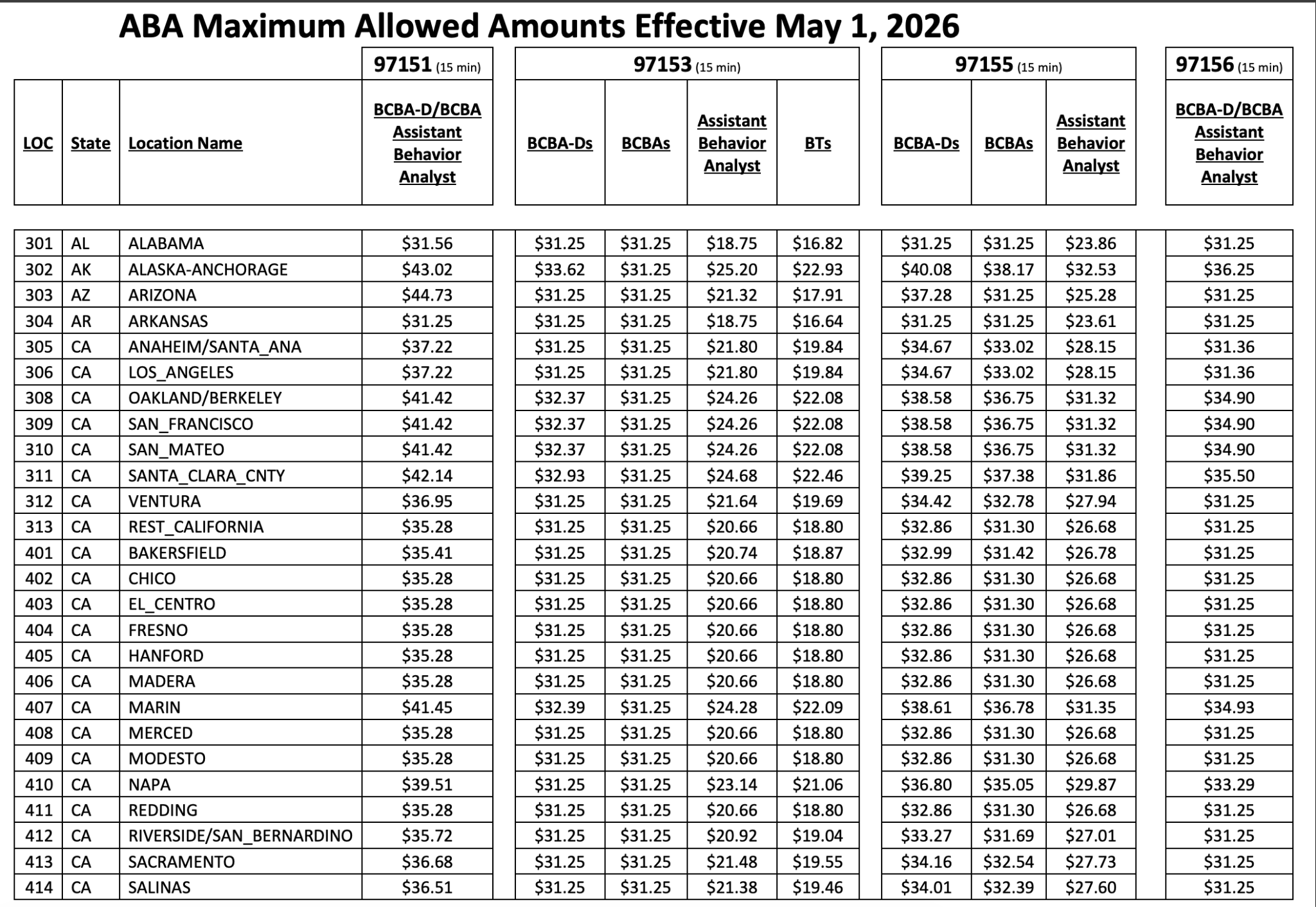
DHA created its first locality schedule in 2016 using national base rates, adjusted by Medicare’s geographic factors for TRICARE pricing, after reviewing state Medicaid rates. The 2026 table keeps this structure. The original hourly rates for the demonstration—$125 for BCBA services, $75 for assistant-level work, and $50 for technicians—still serve as minimums. When divided into 15-minute units, these rates are $31.25, $18.75, and $12.50. In the 2026 schedule, no BCBA or BCBA-D rate is below $31.25 per unit.
For the BCBA column of 97153, the minimum rate is now used in almost every locality. In 2026, 111 out of 116 localities are set at exactly $31.25 per unit, up from 103 in 2025. This means most areas have reached the minimum rate.
At the end of fiscal year 2023, the demonstration had 16,747 participants, including 12,437 active-duty family members. That year, $434.6 million was paid for ABA services, according to the Defense Department’s August 2025 annual report. The median participant age is 7 years. Humana Military manages the East region, while TriWest Healthcare Alliance oversees the West. TriWest’s provider page states that ABA certification can be completed within 10 business days after a complete application, and that families can receive up to 180 days of enrollment assistance.
The 2016 Precedent
TRICARE has considered deeper cuts in the past. In September 2014, a proposal would have lowered the hourly BCBA rate from $125 to $68. RAND, asked by the Office of the Under Secretary of Defense for Personnel and Readiness to review the figure, found that $68 was more than 25 percent below the national average of $94.72 for master’s- and doctoral-level providers, and also below the average commercial rates in 10 out of 17 states with available data.
“Providers in those ten states might be disincentivized to accept TRICARE patients compared with enrollees from other private health insurance plans.” – RAND Corporation, TRICARE ABA Benefit report (2016)
The proposed flat $68 rate was never implemented. Instead, DHA switched to locality-based schedules in 2016.
The 2026 rate reductions follow a 2025 National Academies recommendation to end the demonstration and to include ABA in TRICARE’s basic benefit, as reported by Behavioral Health Business in September. As of publication, BreakingNewsABA found no public announcement from DHA about the rate changes and no response from regional contractors or national provider groups. The demonstration is authorized through December 31, 2028. If DHA continues its current update schedule, the next rates will take effect on May 1, 2027.
AT A GLANCE
| Effective date: | May 1, 2026; schedule posted April 1, 2026 (DHA, Health.mil) |
| 97151 assessment rate: | Down in 100 of 116 localities; flat in 12; up in 4 (BNA analysis of DHA schedules) |
| 97153 technician rate: | Down in 104 of 116 localities; median change -1.4% (BNA analysis) |
| Steepest cuts: | Nebraska and Michigan, 15.0% on 97151; Nebraska fell in 8 of 9 rate columns (BNA analysis) |
| Nebraska 97151: | $51.75 to $43.99 per 15-minute unit, $207.00 to $175.96 per hour (BNA analysis) |
| Rate floor: | $31.25 per unit ($125/hour) on BCBA codes; 111 of 116 localities at the floor for BCBA-delivered 97153 (BNA analysis) |
| Program size: | 16,747 participants and $434.6M in ABA spending in FY 2023 (DoD annual report, Aug. 2025) |
| Demonstration authorization: | Through Dec. 31, 2028 (TRICARE.mil, updated Dec. 22, 2025) |
SOURCES & REFERENCES
| 1. | Defense Health Agency. ABA Maximum Allowed Rates Effective May 1, 2026. Health.mil, published April 1, 2026. https://health.mil/Reference-Center/Publications/2026/04/01/ABA-Rates-2026 |
| 2. | Defense Health Agency. ABA Maximum Allowed Rates Effective May 1, 2025. Health.mil, published April 30, 2025. https://health.mil/Reference-Center/Publications/2025/04/30/ABA-Maximum-Allowed-Rates-Effective-May-1-2025 |
| 3. | Defense Health Agency. Applied Behavior Analysis Maximum Allowed Amounts, rates page and schedule notes. Health.mil, last updated April 14, 2026. https://health.mil/Military-Health-Topics/Access-Cost-Quality-and-Safety/TRICARE-Health-Plan/Rates-and-Reimbursement/ABA-Max-Allowed-Amounts |
| 4. | Department of Defense. Annual Report on Autism Care Demonstration Program. August 2025. https://health.mil/Reference-Center/Reports/2025/08/19/ACD-Annual-Report |
| 5. | TRICARE. Autism Care Demonstration. TRICARE.mil, last updated December 22, 2025. https://tricare.mil/Plans/SpecialPrograms/ACD |
| 6. | TriWest Healthcare Alliance. Autism Care Demonstration provider page. Accessed July 8, 2026. https://tricare.triwest.com/en/provider/autism-care-demonstration/ |
| 7. | Maglione MA, Kadiyala S, Kress AM, Hastings JL, O’Hanlon CE. TRICARE Applied Behavior Analysis (ABA) Benefit: Comparison with Medicaid and Commercial Benefits. RAND Corporation, RR-1334, January 2016; RAND Health Quarterly 2016;6(2):10. https://www.rand.org/pubs/research_reports/RR1334.html |
| 8. | Behavioral Health Business. “TRICARE Report Validates Making ABA Benefits Permanent for Military Families.” September 25, 2025. https://bhbusiness.com/2025/09/25/tricare-report-validates-making-aba-benefits-permanent-for-military-families/ |

Join the discussion ▾