
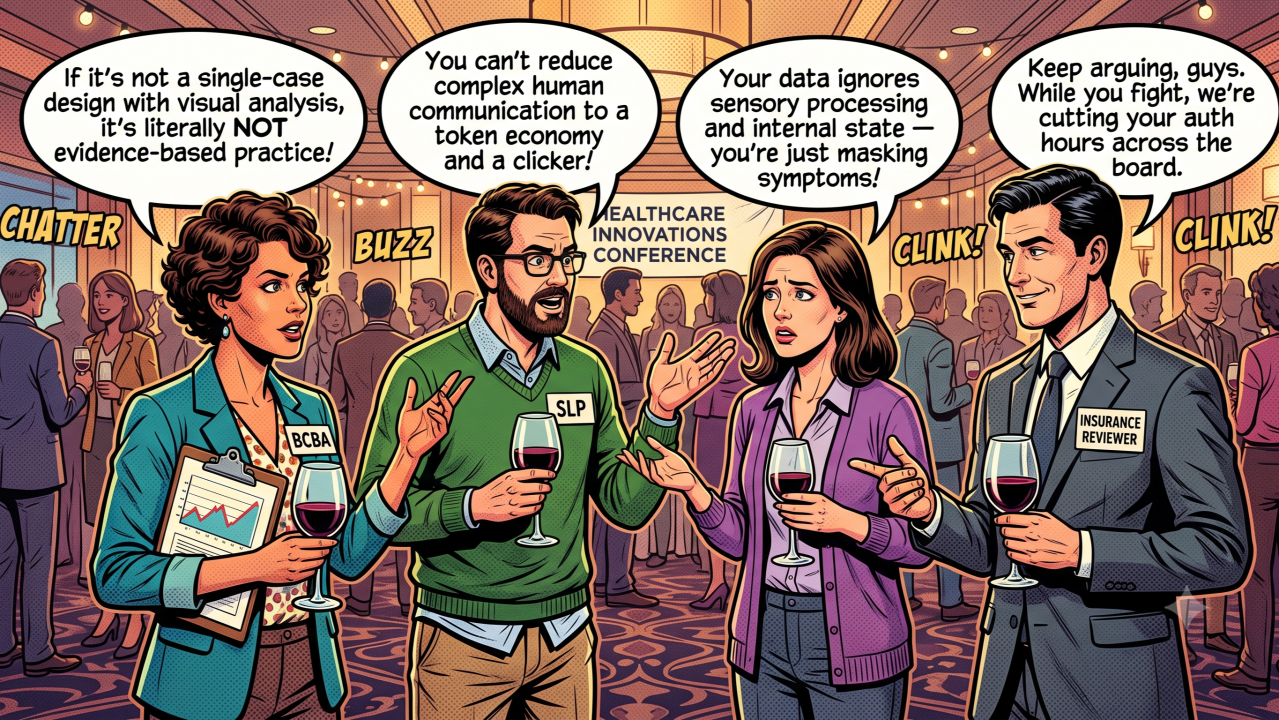
Look around autism care today. We’ve got no shortage of groups. We’ve got national associations, board certifications, state coalitions, and advocacy teams. But even with all these big titles, the whole field feels totally broken into pieces.
Behavior analysts only talk to other behavior analysts. Speech therapists only talk to speech therapists. Doctors stick with doctors, and researchers hang out with researchers.
While we sit in our comfortable little corners arguing over who has the better science, who holds the higher degree, or who gets to call themselves the “expert,” guess who is running the show?
• Insurance companies are writing the rules for clinical care.
• Politicians are passing laws without asking actual clinicians.
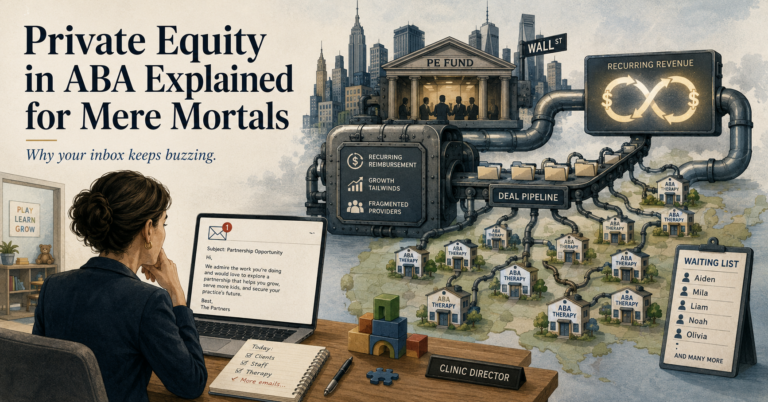
• Private equity firms are buying up clinics and running them like factory assembly lines just to bill more hours.
The real problem in autism care isn’t that we lack caring people. The problem is that we’ve never figured out how to stop protecting our little territories and actually lead together.
I’m going to say something that makes a lot of BCBAs uncomfortable: we do not own autism.
Autism care lives right in the middle of healthcare, school systems, research, government policy, and real family lives. Just because you have a billing code or a certification after your name doesn’t make you the boss of an entire person’s life from childhood to adulthood.
I’m going to say something that makes a lot of BCBAs uncomfortable: we do not own autism.
For years, different professions have handled growth by building giant walls around themselves. We guard our fancy terms, stay in our own billing lanes, and go to conferences where everyone just claps for things we already agree with.
When you treat your field like an isolated island, you miss out on great ideas from occupational therapy, speech, and psychology. Those are the exact ideas that could make our work faster, better, and actually helpful for families long-term.
In a system that pays you simply for being in the room for an hour, it is way too easy to hide bad work. A clinic can have perfect, audit-proof paperwork that makes insurance companies happy while the actual client’s life doesn’t get one bit better.
If we want to know if therapy actually works, we have to ask the hard questions:
• If the therapist leaves the room, can the client still do the skill at home?
• Is the parent getting confident and independent, or are they getting stuck relying on us forever?
• Are we so focused on tracking tiny session numbers that we forget to ask if the family’s life is actually getting easier?
If our idea of success starts and ends inside a clinic room, we aren’t building lifelong independence. We’re just running a temporary circus act.
On a recent episode of Rad N Bad, Dr. Robin McLeod, the CEO of the National Society of Autism Professionals, gave us a great visual: hover before you land.
When a clinician rushes to “land” on a rigid plan, like automatically prescribing 40 hours a week or sticking to just one method, they block out new information. But if you hover like a helicopter, you can see the whole map before you pick a path.
Hovering means taking a step back and asking:
• Other Disciplines: What do speech therapists, OTs, or doctors see that I’m missing?
• Real Science: Are we using solid, objective proof, or are we just doing what our friends do?
• The Family’s Scorecard: Does this goal actually help this family go to Target or eat dinner together without a meltdown?
Working together doesn’t mean we all hold hands and agree on everything. Real progress happens when smart people can respectfully argue, call out bad practices, and build clear standards together.
If we want a system that rewards real progress instead of just billing tons of hours, we have to step up and build those standards ourselves.
If we want a system that rewards real progress instead of just billing tons of hours, we have to step up and build those standards ourselves. Because if we don’t, insurance companies and regulators will do it for us, and we won’t like their answers.
It’s time to drop the ego, step out of our silos, and build a system that actually serves people with autism for their entire lives.